North Atlantic Drift is the experimental from Toronto-based ambient and electronic duo of Brad Deschamps and Mike Abercrombie. North Atlantic Drift were formed in the summer of 2011. The band sound uncannily reminiscent of their name, with a glacial, hynotic, pleasant drone and ambient meanderings into music. This is expansive, atmospheric ambient in the same vein as Brian Eno and Erik Satie. Following their first record Canvas in 2012, they released departures Vol. 1 through Polar Seas Recording in 2017. You can hear the full album on Bandcamp or purchase it.
A video for the evocative song Kiarash Sadigh tells the story of a blindfolded quartet playing in a forest as glimmers of light approach. The musicians continue to play passionately as the light flickers and dances around them.
Their unique sound is beyond classification and brings the listener into a quiet state of ecstacy which undulates and flows along with their attention. Mike and Brad live and work out of Toronto where they develop their varied and atmospheric catalogue of music from their studio.
Taking inspiration from the turbulent North Atlantic which is all the more dramatic from space, here is a NASA picture to get you in the mood
But why do we find things cute and what are the commonly shared criteria for cuteness all over the world?
According to psychologist Dr. Sandra Pimentel, a psychologist at the Montefiore Medical Center in New York, the answer can be found in evolutionary biology, “If we think about evolution, our goal as a species is to survive and pass on our genes,” she says.
We find babies cute and adorable so that we are compelled to take care of them and to keep them alive.
By finding living things cute we are motivated to protect these organisms and this has an evolutionary role for humans who are hard-wired to care for children and small animals.
When we see these animals or babies, our brains reward us with dopamine, a feel-good hormone that makes us feel loved up when we see animals and babies in real life, on video and in images. This explains the intense and viral following of specific YouTube channels dedicated to cute cats, tiny ponies, and even the cult of anime.
This principle is also at work when we witness cute features in cartoons but cute features can even turn up in inanimate objects like the sides of buildings and cars which are anthropomorphised and turned given human emotions or cute qualities which then give us that much needed shot of dopamine. Afterall our emotional reactions are ruled by our genes, our hormones and our neurons.
Sanrio character: Pompompurin
This boy golden retriever is unmistakable in his trademark brown beret. He has a laidback demeanor and loves the phrase ‘let’s go out!’ He loves milk, anything soft, and his mama’s cream caramel puddings. He has a talent for napping and doing ‘purin aerobics’, and can make friends with anyone. His dream is to get even bigger.
The aesthetics of cuteness is an underlying element in storytelling from time immemorial. As we know from the lessons of the internet and viral video, cuteness isn’t only for the delight of children, it’s a universal human phenomenon that taps into our deepest and most enjoyable follies and injects desirable dopamine and feel-good energy into our lives.
Product marketing capitalises on the cult of cute in many ways that we’re sometimes not even cognisant of. This is because psychological studies consistently show that people want to buy things that have elements of cuteness embedded in them.
Kindchenschema: the criteria of cute
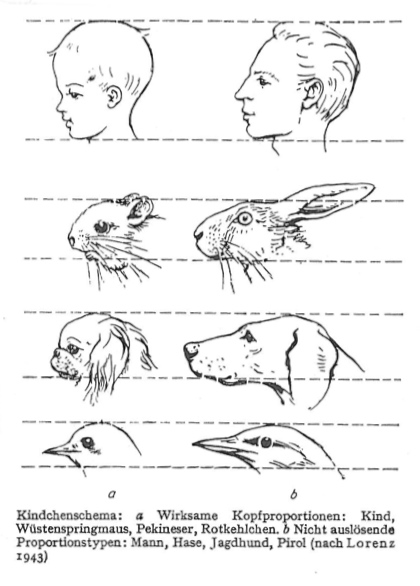
There is no English word to describe the elements of cuteness, but there is a German word. Kindchenschema was a word coined by academic Konrad Lorenz to shed light on the criteria shared by cute things, both inanimate and animate.
Round cheeks
Big head relative to body size
Larger forehead
Large eyes
Small chin
Small nose
How did Pixar endear us to the alien-like miniature world of ants? By incorporating these qualities into the creation of their cartoon characters in the film Antz. Likewise with their film Cars, which brought to the screen a series of chubby, large eyed automobiles that were full of personality and moxy, and as a consequence were endearing to the audience.
Many studies in psychology show that we give our attention to things that are attractive and cute over non-cute things.
Cuteness overload: cute aggression
Why then is there an impulse with tiny cute things to clench them, bite them or otherwise behave in an aggressive way towards cute things?
Dr. Oriana Aragon, a psychologist at Clemson University, has studied this cute aggression: the desire to bite, squeeze, or eat something because it’s so cute.
This impulse is surprisingly common among many different cultures. There is a word in Tagalog for it gigil which means gritting one’s teeth and having the urge to pinch or squeeze something that’s just too cute to handle.
According to psychologists, this impulse is called dimorphous expression. This is when you express something that’s different to how you are feeling. This happens when you laugh when you feel sad, or cry when you’re happy.
Dimorphous expression is what is at work when we look at Grumpy Cat and see his expression of grim sadness. Or when we look at Eyore and his morose, melancholy expression. These characters embody dimorphous expression and we find them unbearably cute.
Gudetama Egg: The Hello Kitty of the Millennial Generation
A case in point is Gudetama.
Gudetama is a cultural phenomenon in Japan, and now all over the world. Gudetama is a lazy egg who refuses to shape up and be a functioning piece of food. In a culture so rampantly obsessed with work, consumerism and youth – Gudetama is the foil and a rebellion against that culture. Gudetama is the perfect anti-hero for millennials in both Japan and beyond. He is a caricature of Gen-Y apathy and he is cute precisely because he is so lazy, careless and melancholy. Can you see a theme here? Cuteness can also be stemming from melancholy or anger. Cuteness can become a commentary on the society it stems from.
Cute, Quaint, Hungry and Romantic: The Aesthetics of Consumerism (2000).
This book is the definitive pop culture encyclopaedia of consumerist aesthetics. It was so kitsch and fascinating that I decided as a 19 year old when I first read it, that I would go into advertising and marketing. It really was avante-garde in that all of these internet phenomena hadn’t yet come into existence but it predicted very accurately (almost to the point of being spooky) the rise and rise of internet memes that are based around what’s quaint ( retro-cool hipsterism), romanticism (getting back to nature, coziness) and the cult of cuteness. Although this book predates all of these trends and in a way was a crystal ball into what future trends in consumerism would take. This book shows the reader the elements of the contagious appeal of different aesthetics and ideas and the neurological, psychological and cultural underpinnings of certain objects in material culture. It was big an ambitious in scope and covered off cultural icons like Leonardo Di Caprio, teddies and Mars Bars. Anybody interested in cultural trends should get this book. Although everything it predicted in terms of popular culture in 2000 has now happened.
In this unique and captivating 3D immersive storytelling tool, you can learn about the lives and habitat of birds living on the remote island of Fuglefjellet off the coast of Norway. Initially in Norwegian, the app has thankfully for us been translated into English. It’s a scroll through wet-dream of beautiful animation. I couldn’t think of a more vivid and beautiful way to tell stories about wildlife.
If Pink Floyd and Stanley Kubrik were to have a baby in 2017 – this is what it would look like.
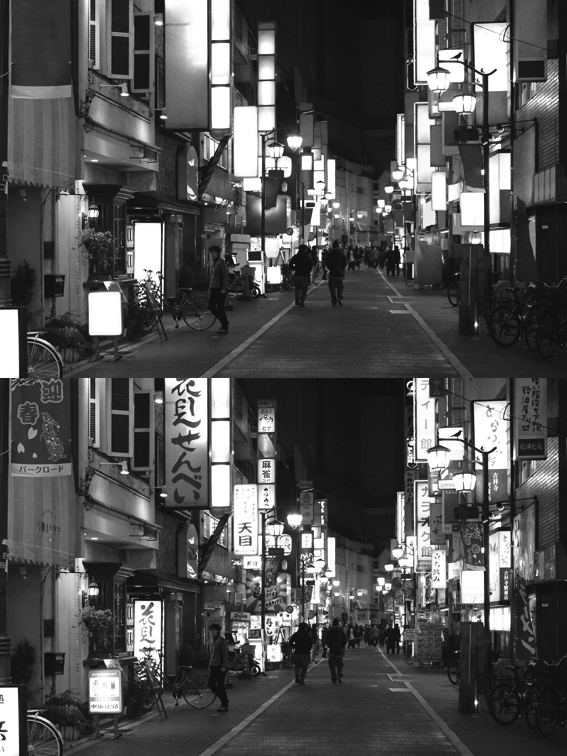
Be taken on a sublime journey of immersive 360 degree Tokyo in a most unsettling mood. The immersive short film is filled with the impersonal fluorescent tubing of remote petrol stations, the blinking lights of city buildings all cascading through 3 dimensional space like exotic and symmetrical cut crystal. We are voyeurs into this macabre world, where we can navigate through the darkness of space and see the relics of humankind. Watching this unfold in 360 degrees is unnerving and discombobulating. I hope you enjoy it.
The work was produced by theBeyond Motion Graphics company. The team have explored an extreme vision of Tokyo through dissected and bisected mechanical parts and motion graphics. Combining VR technology and innovative storytelling they have created a truly unique piece of art here.
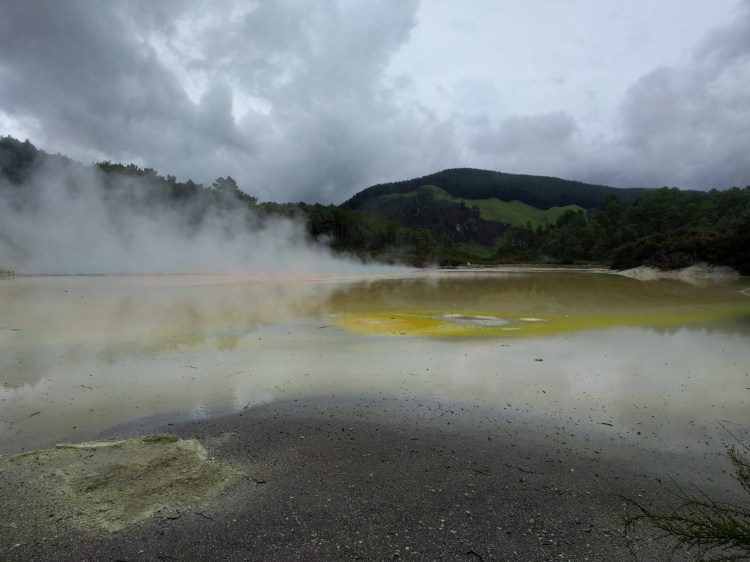
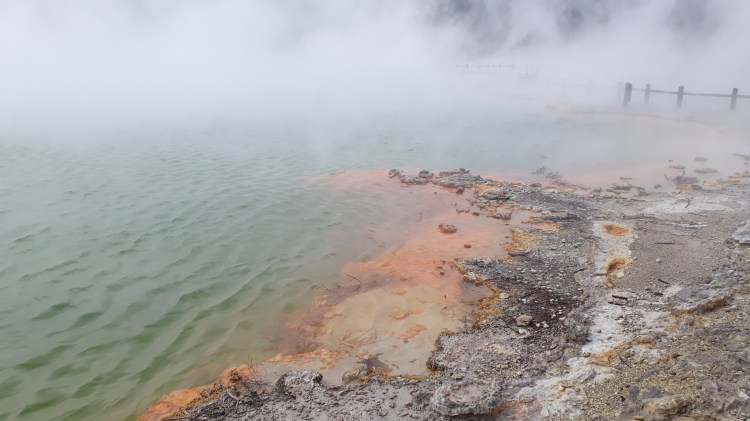
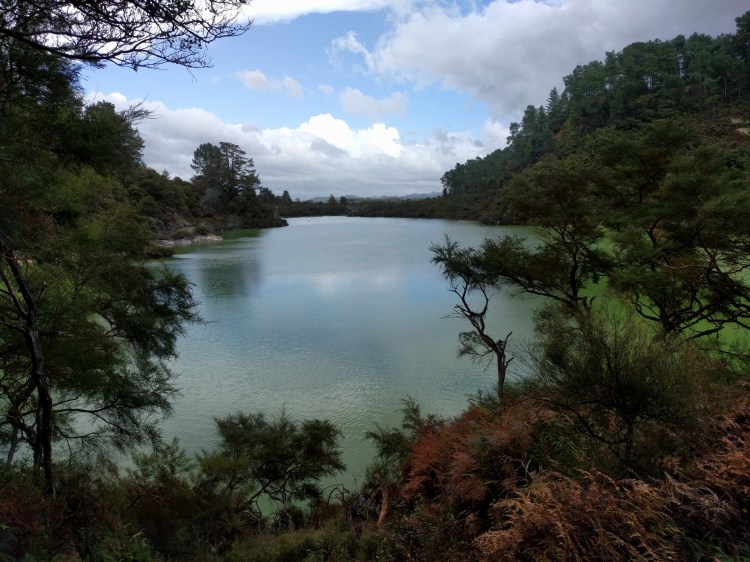
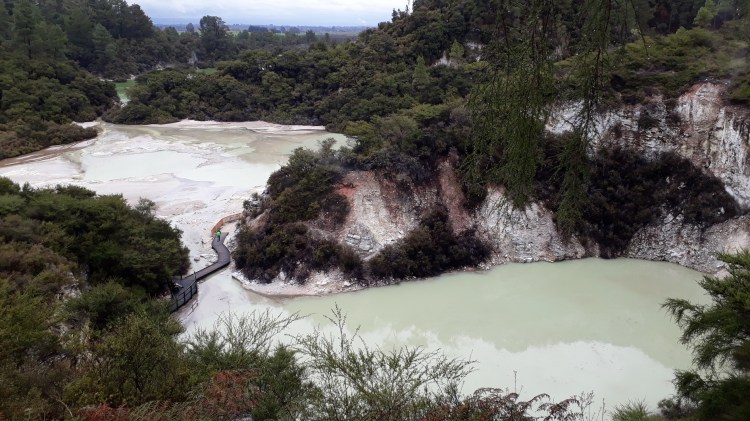
Waiotapu means sacred waters in Maori. It’s an active geothermal area at the southern end of New Zealand’s Taupo Volcanic Zone just outside of Rotorua. It’s a place of surreal colour, beauty and otherworldly wonder. It’s no exaggeration that you haven’t seen anything like this before. The alchemy of mineral deposits mixing over thousands and sometimes millions of years has caused remarkably odd combinations of colour, not found elsewhere in nature. You should go there and see for yourself the Lady Knox Geyser, Champagne Pool, Artist’s Palette, Primrose Terrace and boiling mud pools. The Park is well set out and has great amenities and guides, it’s easily accesible by foot although there is no disabled access to many parts. It’s an easy 3 hour walk that covers 18 square km. It was well worth the journey.
Welcome to the rumbling belly of the shaky isles: Waiotapu
If there was a place in the world where Smeagol could possibly live, this would be it.
Waiotapu
Wai-O-Tapu is wedged right on the edge of four volcanic calderas within the zone. A geothermal wonderland, it was discovered in 1886 and the spectacular sinter terrace, Champagne Pool, pink and white terraces. Some of these natural wonders shook and morphed during the eruption of Mt Tarawera in 1886.
Artists Palette
A spectacular feature at Wai-O-Tapu is the Artists Palette. Earthquakes over the decades have tilted the spring and causing mineral deposits to flow and then streak across the surface, which follows the direction of the wind.
A cacophony of colour can be found in the Artist’s Palette including
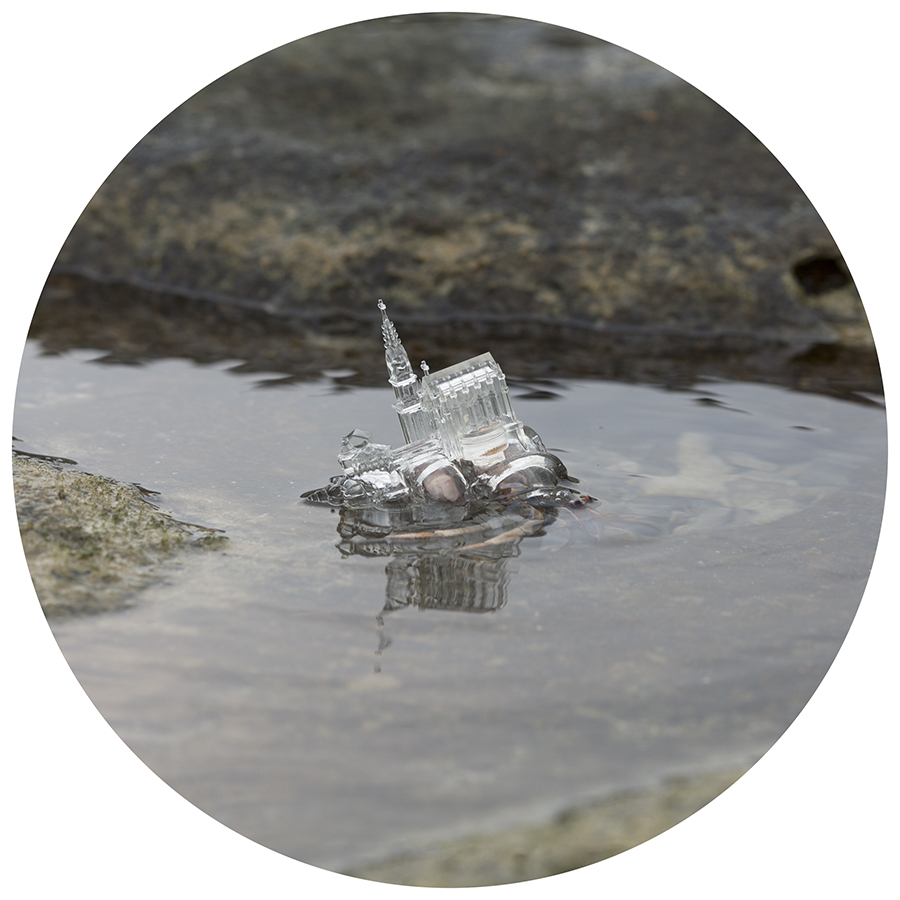
If you thought that the Auckland or NYC property market was hot right now, spare a thought for the tiny and unpredictable housing market of the hermit crab. They have a complex and sometimes cooperative and sometimes aggressive strategies for occupying shells aka homes for their fragile little bodies.
Some of these strategies involve hostile takeovers of other crabs’ shells and on other occasions hermit crabs simply outgrow their abodes and need to up sticks and find a more appealing piece of real estate. But what about all of the beta level hermit crabs who never learned jujitsu? Artist Aki Inomata hit upon a solution, the ultimate in transspecies cooperation and collaboration – the creation of custom homes for hermit crabs in crises.
Instead of sticking to the conventional conch shell shape, Inomata let her imagination run wild and generated instead tiny, translucent resin structures that were customised to fit individual hermit crabs. Each purpose-built home gave a firm nod of respect a different cityscape throughout the world.
She used 3D printing techniques to replicate tiny models of cities and then like a ‘Habitat for Humanity’ humanitarian she released the homes to the hermit crab market, with gleeful results for both species. Oh what can be achieved when animals and humans work together!
Inomata designed the 3D printed housing to last long enough to be exchanged over the generations. Hopefully with such a dowry future generations of hermit crabs stand a fighting chance of finding a mate and settling down, getting a mortgage and popping out a couple of kids.
The Maori (the indigenous people of New Zealand) which includes myself, have a very different way of defining health outcomes compared to western medicine. Te Wheke (the octopus) is often used as a symbol to define integrative and holistic health. This holistic approach to health encompasses ten elements in Maori life. Funnily enough this holistic approach tends to mirror a lot of the new ways that preventative medicine aims to help people, by taking a look at the person as a whole and what that person needs, rather than simply treating disease and sickness. Of course, a lot of these elements aren’t quantifiable by Western medicine, and so Maori health approaches and methodologies are thought by some people to be wishy-washy. The Te Wheke model relies on the individual’s self-reporting of their health and wellbeing, rather than using empirically quantifiable methods.
Also the Te Wheke model relies strongly upon the interactions of an individual in relation to the broader whanau (family), Whanaungatanga (extended family) and iwi (tribe). This is where Western medicine tends to drop the ball.
The areas of social sciences, psychology and general practice are all separate disciplines. And an individual’s social life, psychological and spiritual wellbeing are all disconnected from their physical wellbeing.
When people are ill in the Western world, they are seen by their standard Physician/GP. Yet their problem may not stem from a physical illness, but may be psychosomatic. And yet the person may have an ineffable and overwhelming sense of something wrong. Deep-seated anxieties are seen by psychologists as being symptomatic of a nervous disposition or someone with mild OCD, or Generalised Anxiety Disorder or whatever other diagnosis they give.
This diagnosis fails to recognise and assess other aspects of the person’s life like the health of their relationships, connection with other people and their local community. These aspects can be critical to someone’s health (or lack thereof).
Although don’t get me wrong, GPs, psychologists and psychiatrists aren’t the enemy. They are simply working within a diagnostic model that’s far too limited and too black and white to encompass the broad and varying ways that as person can become unbalanced or fall ill.
This is where an understanding of the ineffable and hard to pinpoint feelings one has about one’s own life become important. The Maori model of Te Wheke allows people to focus on their own lived experience of health and so it’s a very powerful method for deeper and broader self-awareness and self-reporting of health.
This makes a lot of sense to me, its framework of understanding focuses on the inner world of lived experience rather than the outer world of empirical data.
The Te Wheke Octopus model for health
The head of the octopus represents te whānau, the eyes of the octopus as waiora (total wellbeing for the individual and family) and each of the eight tentacles representing a specific dimension of health. The dimensions are interwoven and this represents the close relationship of the tentacles.
Te whānau – the family
Waiora – total wellbeing for the individual and family
Wairuatanga – spirituality
Hinengaro – the mind
Taha tinana – physical wellbeing
Whanaungatanga – extended family
Mauri – life force in people and objects
Mana ake – unique identity of individuals and family
Hā a koro ma, a kui ma – breath of life from forbearers
Whatumanawa – the open and healthy expression of emotion
I turned this model into an infographic
Infact I was so inspired by this alternative health model that I turned it into an infographic, using the principles along with a photo of a carving of an Octopus which I found in the Hawkes Bay recently. Creating this infographic was a great way for me to better understand my own culture and in turn explain this to people who would never have any exposure to Maori culture, throughout the world. See more of my infographics. You are welcome to share and reuse this image as you please.
Dolphin Voices in the Seais one for all the lovers of marine life. This lovely web based app is a bit dated but still delivers the goods with intriguing tidbits on different species of dolphins and spectograms of dolphins communicating with each other in the wild.
The website features videos and scientists talking about their research efforts and offering the latest insights into dophin behaviour and conservation.
Although targeted towards children and teens I found the application and learning tool interesting and engaging for anyone interested in marine ecology and zoology.
On a recent cycling trip to Napier, the Polish Bear and I were astonished to find the most amazing street art in the side alleys, shop fronts and carpark walls. Art Deco Napier is a place full of surprises.
Seawalls Napier: Bringing the oceans to the streets
Sea Walls: Murals for Oceans is a groundbreaking street art project created by PangeaSeed members and supporting artists to help bring the beauty and the plight of the world’s oceans into streets around the globe via art and activism.
Within the span of five days in March 2017, a group of internationally renowned artists created 29 large-scale, thought-provoking public murals, which were realized throughout the Ahuriri and Napier area. Each piece sheds light on New Zealand’s pressing marine environmental issues such as shark finning, overfishing, coastal development, climate change, and endangered marine life conservation, furthering PangeaSeed Foundation’s ARTivism (Art + Activism) initiative.
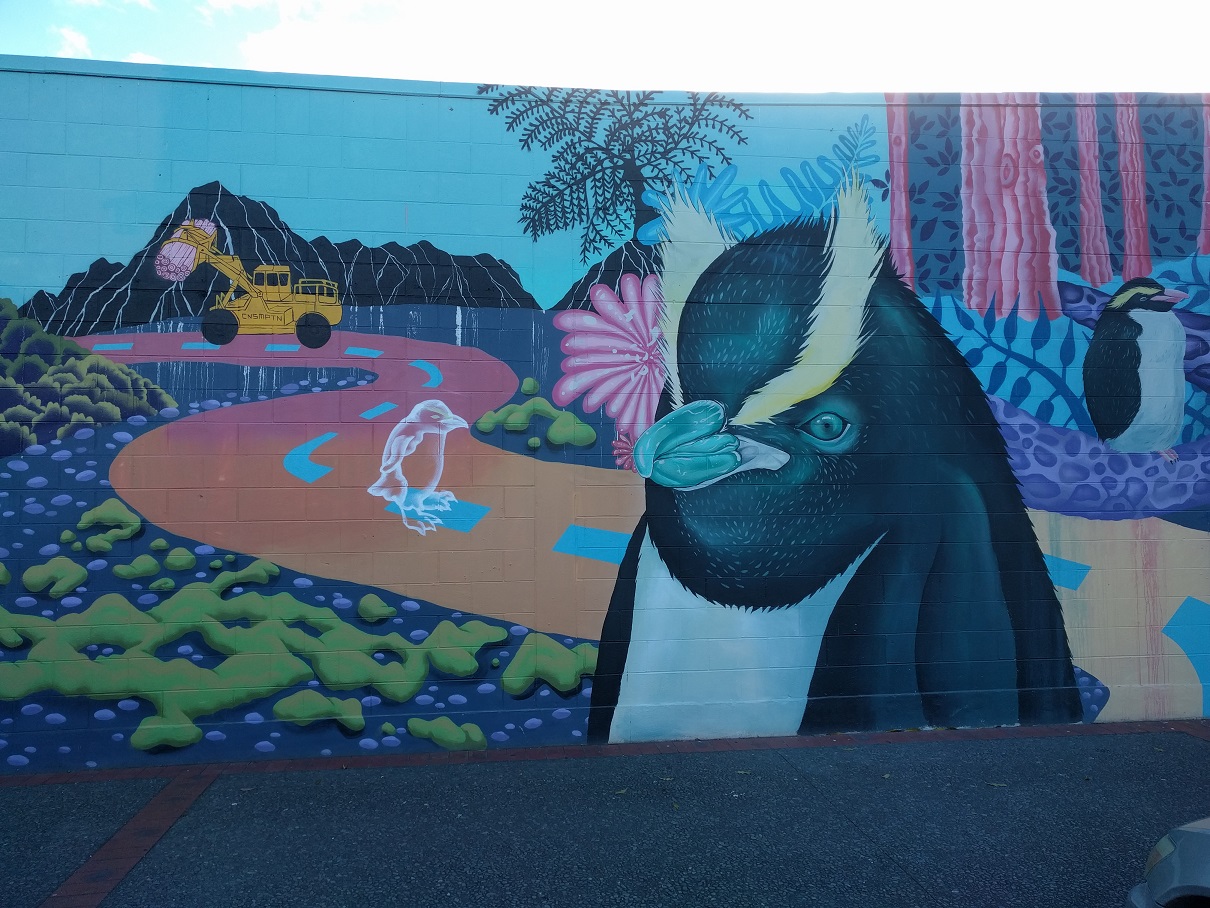
Celeste Byers’s mural addresses the endangered Fiordland Penguins, which nest in the rainforests and ocean rock caves of New Zealand’s South Island when they are not living in the sea. Their populations have decreased since human arrival and in the past 35 years, their population has gone down from 10,000 breeding pairs to 3,000. Humans have caused a loss of their habitat and oil spills, and have introduced the biggest threat to the species – predators, such as dogs, cats, stoats, and rats.
Askew One: Title: “Kaitiaki” “With my mural for Sea Walls, Napier, I was attempting to address several interrelated issues. I think the deeper I look into issues like ocean conservation I realize that nothing happens in a vacuum. Everything is connected because we live on a planet that is actually a closed system. To allow things to recycle within that system we have to be conscious of consuming more harmoniously with the system as opposed to being so disruptive. I can talk about how we are driving climate change, how it is warming the planet and subsequently causing ocean acidification which is destroying the reefs and their complex ecosystems – what’s harder is to then unpack the myriad of related consequences. Those range from the harm to all the planets creatures, the environment, economics, social and political. I cannot stress this enough – if you strip away all the talk, the political posturing and all the corporate spin, every issue we face as a species relates back to our relationship with this planet. Something that may sound as random or inconsequential to your life as a dead reef in small island nation will have an impact on everyone at some point. This mural is inspired by those thoughts and dedicated to all our neighboring Pacific Island nations, most likely the least contributors to the problem yet on the very frontline of the consequences of climate change. Big thanks to Frankie Adams for being the model for this work.”
Celeste Byers’s mural addresses the endangered Fiordland Penguins, which nest in the rainforests and ocean rock caves of New Zealand’s South Island when they are not living in the sea. Their populations have decreased since human arrival and in the past 35 years, their population has gone down from 10,000 breeding pairs to 3,000. Humans have caused a loss of their habitat and oil spills, and have introduced the biggest threat to the species – predators, such as dogs, cats, stoats, and rats.
Aaron Glasson: Pania of the Reef is a historical Maori story of love and respect for the ocean that has become one of Napier’s most well known symbols and is retold throughout New Zealand. Pania was a sea-maiden who married a local man, their shape-shifting son Moremore can be seen today in the form of sea animals that serve as an omen, and Pania’s body now makes up Napier’s most famous reef. Aaron worked closely with local Maori and the family of Pania to create his mural that depicts the story of her life, painting her decedents in the role Pania and creating a contemporary interpretation this meaningful history.
Aaron Glasson: Pania of the Reef is a historical Maori story of love and respect for the ocean that has become one of Napier’s most well known symbols and is retold throughout New Zealand. Pania was a sea-maiden who married a local man, their shape-shifting son Moremore can be seen today in the form of sea animals that serve as an omen, and Pania’s body now makes up Napier’s most famous reef. Aaron worked closely with local Maori and the family of Pania to create his mural that depicts the story of her life, painting her decedents in the role Pania and creating a contemporary interpretation this meaningful history.
Celeste Byers’s mural addresses the endangered Fiordland Penguins, which nest in the rainforests and ocean rock caves of New Zealand’s South Island when they are not living in the sea. Their populations have decreased since human arrival and in the past 35 years, their population has gone down from 10,000 breeding pairs to 3,000. Humans have caused a loss of their habitat and oil spills, and have introduced the biggest threat to the species – predators, such as dogs, cats, stoats, and rats.
Kai’ili Kaulukukui: “This mural addresses the importance of Maui’s Dolphins, which are critically endangered and the tiny remainder is dwindling rapidly. They are the smallest species of dolphin on the planet, and have unusual breeding practices that lead to a low reproduction rate. We need to speak up for them now before they quietly disappear. I tried to present them as large as possible to represent the immediate importance of this issue.”
Phibs: Every minute, a garbage truck full of plastic makes its way into the earth’s oceans and plastics are expected to outweigh fish by the year 2050. Every single piece of plastic ever made still exists on earth and now it is breaking down into tiny particles in our seas. “It is the responsibility of us all to protect, respect, and care for our Mother Earth and all her beauty.”
Cracked Ink: “I decided that I wanted my design and message to be strong and quite literal. I think whilst conveying such an important message about overfishing, with really fine details and information, it’s important that the viewer interpret it properly. Overfishing is one of the biggest threats to the health of seas and its inhabitants, and we all need to make significant changes to reverse the damage that has been done.”
Aaron Glasson: Pania of the Reef is a historical Maori story of love and respect for the ocean that has become one of Napier’s most well known symbols and is retold throughout New Zealand. Pania was a sea-maiden who married a local man, their shape-shifting son Moremore can be seen today in the form of sea animals that serve as an omen, and Pania’s body now makes up Napier’s most famous reef. Aaron worked closely with local Maori and the family of Pania to create his mural that depicts the story of her life, painting her decedents in the role Pania and creating a contemporary interpretation this meaningful history.
Aaron Glasson: Pania of the Reef is a historical Maori story of love and respect for the ocean that has become one of Napier’s most well known symbols and is retold throughout New Zealand. Pania was a sea-maiden who married a local man, their shape-shifting son Moremore can be seen today in the form of sea animals that serve as an omen, and Pania’s body now makes up Napier’s most famous reef. Aaron worked closely with local Maori and the family of Pania to create his mural that depicts the story of her life, painting her decedents in the role Pania and creating a contemporary interpretation this meaningful history.
Copyright Content Catnip 2017
Aaron Glasson: Pania of the Reef is a historical Maori story of love and respect for the ocean that has become one of Napier’s most well known symbols and is retold throughout New Zealand. Pania was a sea-maiden who married a local man, their shape-shifting son Moremore can be seen today in the form of sea animals that serve as an omen, and Pania’s body now makes up Napier’s most famous reef. Aaron worked closely with local Maori and the family of Pania to create his mural that depicts the story of her life, painting her decedents in the role Pania and creating a contemporary interpretation this meaningful history.
Askew One: Title: “Kaitiaki” “With my mural for Sea Walls, Napier, I was attempting to address several interrelated issues. I think the deeper I look into issues like ocean conservation I realize that nothing happens in a vacuum. Everything is connected because we live on a planet that is actually a closed system. To allow things to recycle within that system we have to be conscious of consuming more harmoniously with the system as opposed to being so disruptive. I can talk about how we are driving climate change, how it is warming the planet and subsequently causing ocean acidification which is destroying the reefs and their complex ecosystems – what’s harder is to then unpack the myriad of related consequences. Those range from the harm to all the planets creatures, the environment, economics, social and political. I cannot stress this enough – if you strip away all the talk, the political posturing and all the corporate spin, every issue we face as a species relates back to our relationship with this planet. Something that may sound as random or inconsequential to your life as a dead reef in small island nation will have an impact on everyone at some point. This mural is inspired by those thoughts and dedicated to all our neighboring Pacific Island nations, most likely the least contributors to the problem yet on the very frontline of the consequences of climate change.
Beautiful and quirky Napier
This remote city on the eastern outcrop of the North Island is a hub of artistic creativity, quirky ideas and environmental activism. The city abuts the Taupo Volcanic corridor, a geothermal wonder and an active and bubbling field of geothermal activity. Therefore, Napier has borne the brunt of several catalcysmic earthquakes over the centuries. The most recent earthquake in 1931 flattened the city and killed 256 people, injuring thousands. To this day it’s known as the most deadliest natural disaster in New Zealand history.
As a result of that dark event, the flattened city of Napier was rebuilt from nothing to fit with the modern art deco style of the 20’s and 30’s. Art historians, film-makers, artists and architects love the city of Napier for its unique take on Art Deco design. This includes original lead-lighting, architraves and architecture that gives a distinctively retro look to everything in the city. Parks, city buildings, cinemas, open air theatres, clocks, municipal features like toilet blocks are all created in the Art Deco style.
Over the decades, Napier has become a holiday destination for people in both Auckland and Wellington. With its sunny Mediterranean climate, beautiful Pacific ocean outlook, great food and prime location close to vineyards in the Hawkes Bay region, its a magnet for weekend visitors, retirees and younger people looking to bring up families.
More recently, Napier has become the hip and trendy (and affordable) alternative for young people to move, compared to Auckland where it’s virtually impossible to purchase a house under 1 million anywhere in the city.
The city has a great open-hearted vibe and now with the addition of exceptional street art, there is a lot of reasons to visit sunny Napier. I have to admit that this is my favourite town in New Zealand because of the above cultural reasons. I have referred to it as a city, but just a proviso it’s more of a town than a city by international standards
The message of Seawalls
Seawalls and the Pangeaseed Foundation is all about using street art to bring the urgent plight of the oceans to the fore of public discussion. Our oceans are the Earth’s life support system, providing 70% of the oxygen we breathe, a sixth of the animal protein people eat, medicines that keep us alive and healthy, and so much
more, human impact in the form of overfishing, climate change, development, plastics, and other forms of pollution are taking a toll on the health of our seas.
Unfortunately, these critical issues are often complex, multi-faceted and hard to understand for the average citizen. Through public art, Sea Walls and the Pangeaseed Foundation translate facts into visual stories that engage the public in a non-confrontational manner, and increase awareness.
All artists who contribute to Sea Walls volunteer their time and exceptional talent to our cause. Sea Walls nurtures a community of creative ambassadors for our world’s oceans.
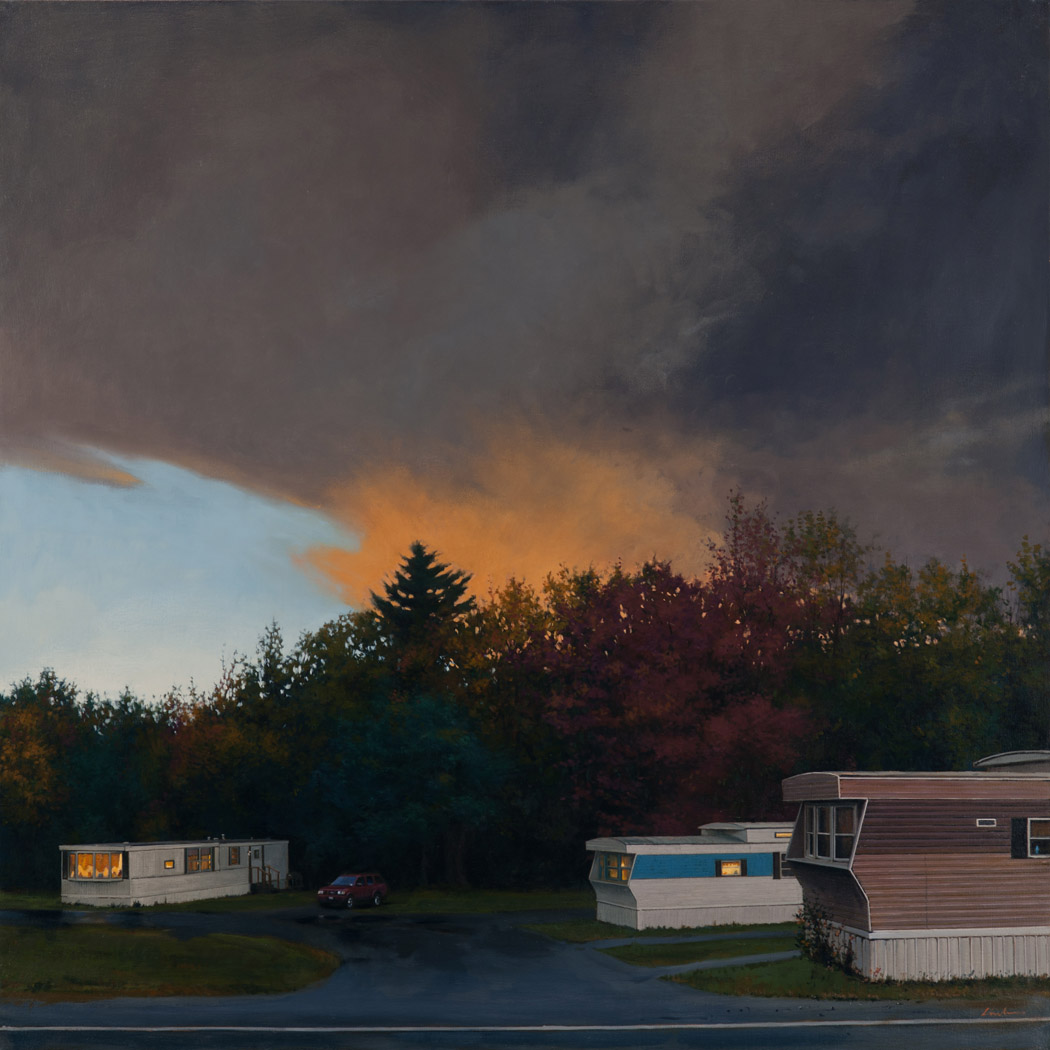
Linden Frederick paints ultra-realistic everyday scenes during the nocturnal hush of the evening. In the real world many of these buildings would be unremarkable, but in the hands of Frederick these shabby homes and plain looking commercial buildings take on a different form at dusk and night, there is a mysterious imagining of the building’s inhabitants. The people are never overtly shown and only hinted at. It’s as though we are peering into a keyhole onto a private scene with an emotional narrative.
Why the evening? Frederick described the early evening as one of melancholy and filled with apprehension, it recalls music composed in a minor key that is elegiac and moody.
The people who tidy up their yards in their hardscrabble lives, who shop at liquor stores at night or live in basement rooms are an invisible presence to those speeding through. Frederick celebrates their anonymity.” – John O’Hern, American Art Collector, June 2017
These dusk paintings recall to mind a post I did ages ago about the loneliness of neon art. And also Drew Leshko’s ultra realistic models of milk bars and liquor stores. This art evokes a similar feeling in me. It’s the feeling of sublime loneliness and of stories that are brewing just underneath of the painting, photograph or model.
Frederick paints the kinds of paintings that writers conjure up as stories. His painting style is lyrical and evocative of the inner landscapes of America and they suggest a melancholic force that remains unseen and filled with mysterious apprehension.
Just like in the famous painting Edward Hopper’s Nighthawks and in the book The Lonely City by Olivia Laing, there is a sense of loss and solitary contemplation here in among the engulfing darkness and reflected street lamps.
He is able to draw out the inner emotional landscape of the people who live in places, through the use of colour, composition, atmosphere and scale without even showing one person in these paintings, that’s quite a feat.
With his collections of motels, corner stores, highway rest stops, caravans and road side shops, Frederick creates a sense of fragile transience to the people and the places, of eerie and mysterious stories, about the dramas played out in these places, which are off the beaten track and aren’t considered remarkable in the real world.














 Content Catnip
You must be logged in to post a comment.