Māori iwi have long held beliefs and customs about the native birds of Aotearoa New Zealand.
Birds or Ngā Manu had a vital place in Maori tribal life as they provided food, beautiful feathers for adornment and their strengths and personalities were a rich source of metaphor and poetry. Their behaviour was use to predict the weather and sometimes the future.
These myths and legends come from the original migrants of Hawaiki, the original homelands in the Pacific who arrived in New Zealand in circa 1200 AD.
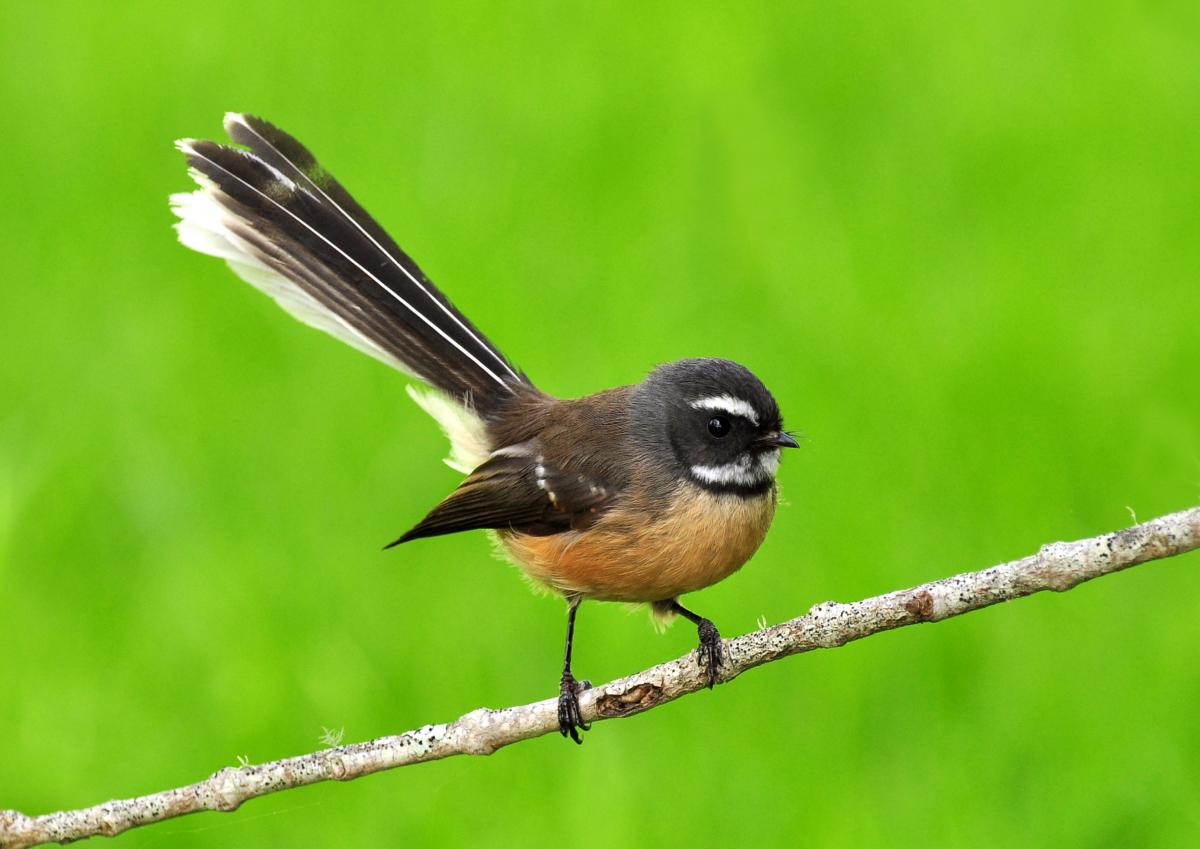
Piwakawaka aka New Zealand Fantail Birds, Mana and Maori Culture
The stories of Maui the man-god hero throughout the Pacific were adapted by early Maori settlers to a New Zealand context. These tales recall how he sought to slay the goddess of death, Hinenuitepo.
On his journey Maui took along local New Zealand birds such as the fantail, the robin and the whitehead as friendly, lyrical companions.
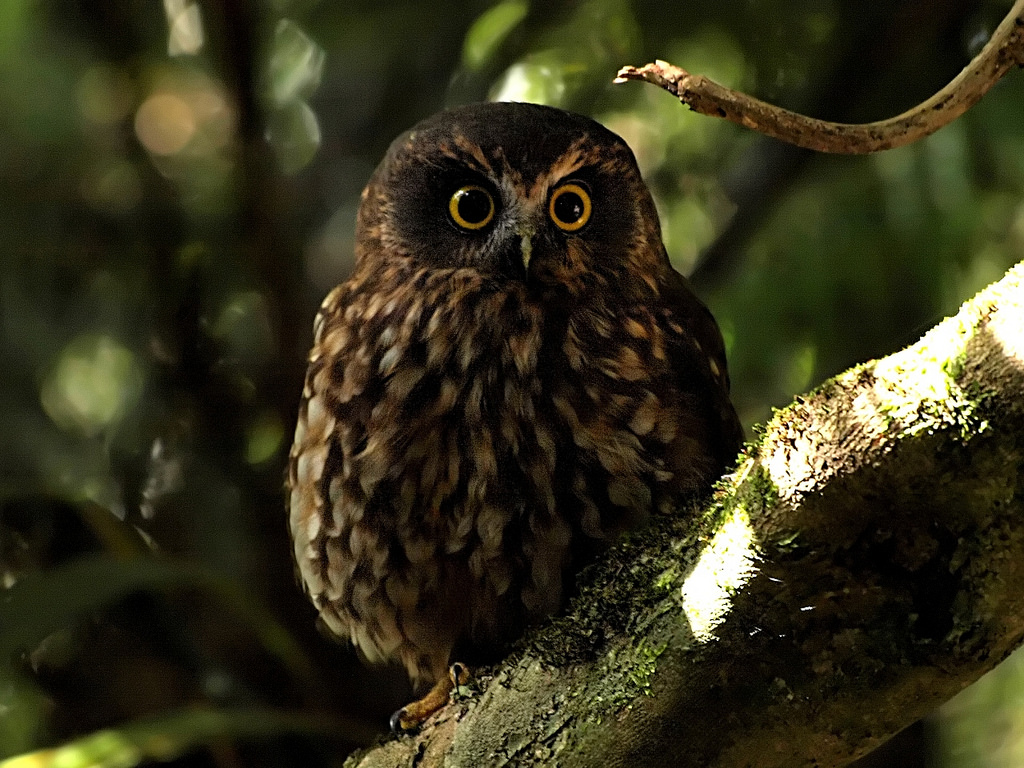
Larger birds of prey like the harrier (kahu) and morepork (ruru) had other tasks in Te Ao Māori world. These powerful birds acted as messengers to the gods in the heavens. They vaulted and soared above the clouds, along spiritual tradewinds.
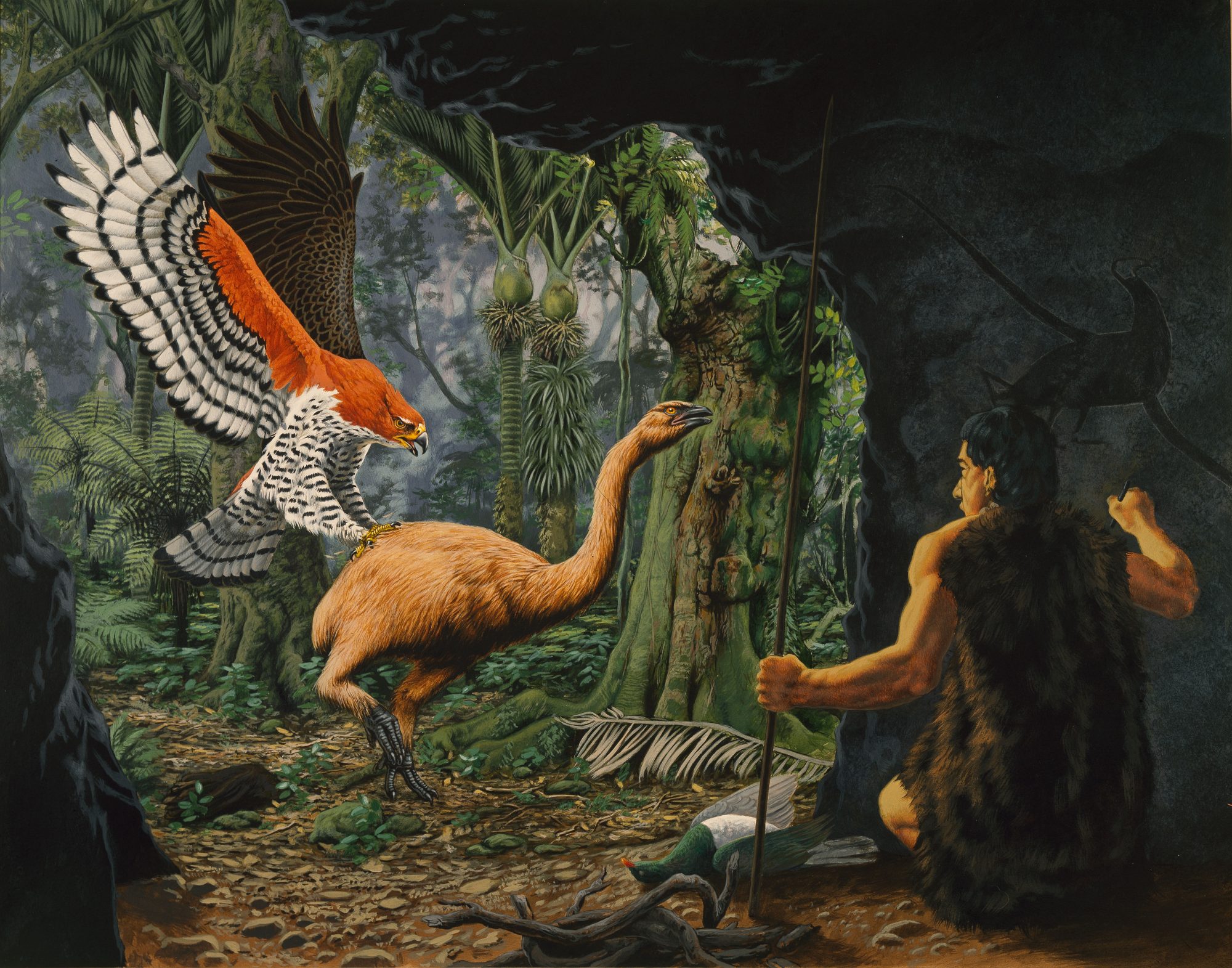
These bigger birds were the mediums used by tohunga (healers) to communicate with the gods. Tohunga not only helped to heal the sick in the tribe, they also applied their skills to practical methods of bird catching.
Brown creeper – Birds, Mana and Maori Culture
The tohunga read the signs of the sky, of the foliage, of the bird life. They oversaw the manufacture and storage of traps, lines and ladders used in hunting in the forests of Tane.
They knew that Tāne was the power and origin of all tree, bird and even human life. The tohunga and other members of the tribe would create and fly Māori kites and recite the karakia or prayers to the god Tāne, so that birds would be plentiful and the hunting successful.
This post is a tribute to the beautiful and vibrant birds of New Zealand that mean so much to the Māori people, my people. I’ve ordered them into a presentation of collective nouns and designed these slides for you. I hope you enjoy them!
“It’s paradoxical that we coevolved with so many species whose vocalizing is beneficial to our own survival. “We hear most acutely in the range of 2.5 megahertz, which is the peak of birdsong. Human speech is pitched much lower, one kilohertz or below, and so is less central to our hearing. Why is this? Acoustic ecologist Gordon Hempton surmises that our bodies evolved not for cocktail party conversation but rather to harvest sounds from wild creatures. These are the aural signals on which our species’ success depended: Birds chatting, unconcerned. Herds gathering. Corvids flocking. Sudden silence. They spoke clearly: Here is safety. Here is water. Here is food. Here is danger.”
Third Ear: Reflections on the Art and Science of Listening by Elizabeth Rosner
Extracted from: Third Ear: Reflections on the Art and Science of Listening by Elizabeth Rosner
A world of exquisite beauty and expansive awareness awaits if only we open up our ears and listen with our ‘Third Ear’ for greater connection, understanding and love of all beings. Elizabeth Rosner is a wonderfully vivid and artful weaver of liminal worlds of quietude and sound.
Rating: 🌟🌟🌟🌟🌟
Genre: Spirituality, self-love, self-awareness, psychology, history
In the Edo period of 1629, a magnificent garden took shape, destined to become a sanctuary of tranquility and reflection on mortality and power.
In the Koishikawa Korakuen Gardens in Edo (modern-day Tokyo) the Mito Tokugawa family’s founder, Yorifusa, planted the seeds of what would become Korakuen – a place where future rulers could embrace a philosophy of enjoying power only after their duties of leadership were fulfilled.
Mitsukuni, the second in command, had an eye for beauty and a soul for the lessons of the past. He drew inspiration from the landscapes and scholarly ideals of the Ming dynasty.
Now, this garden is a place of hushed quiet contemplation amidst the bombastic, rushing and striving modern world around it. It’s a tiny treasure right next to a large sporting venue and is teeth by jowl with an amusement park with a death-defying rollercoaster within 500 metres.
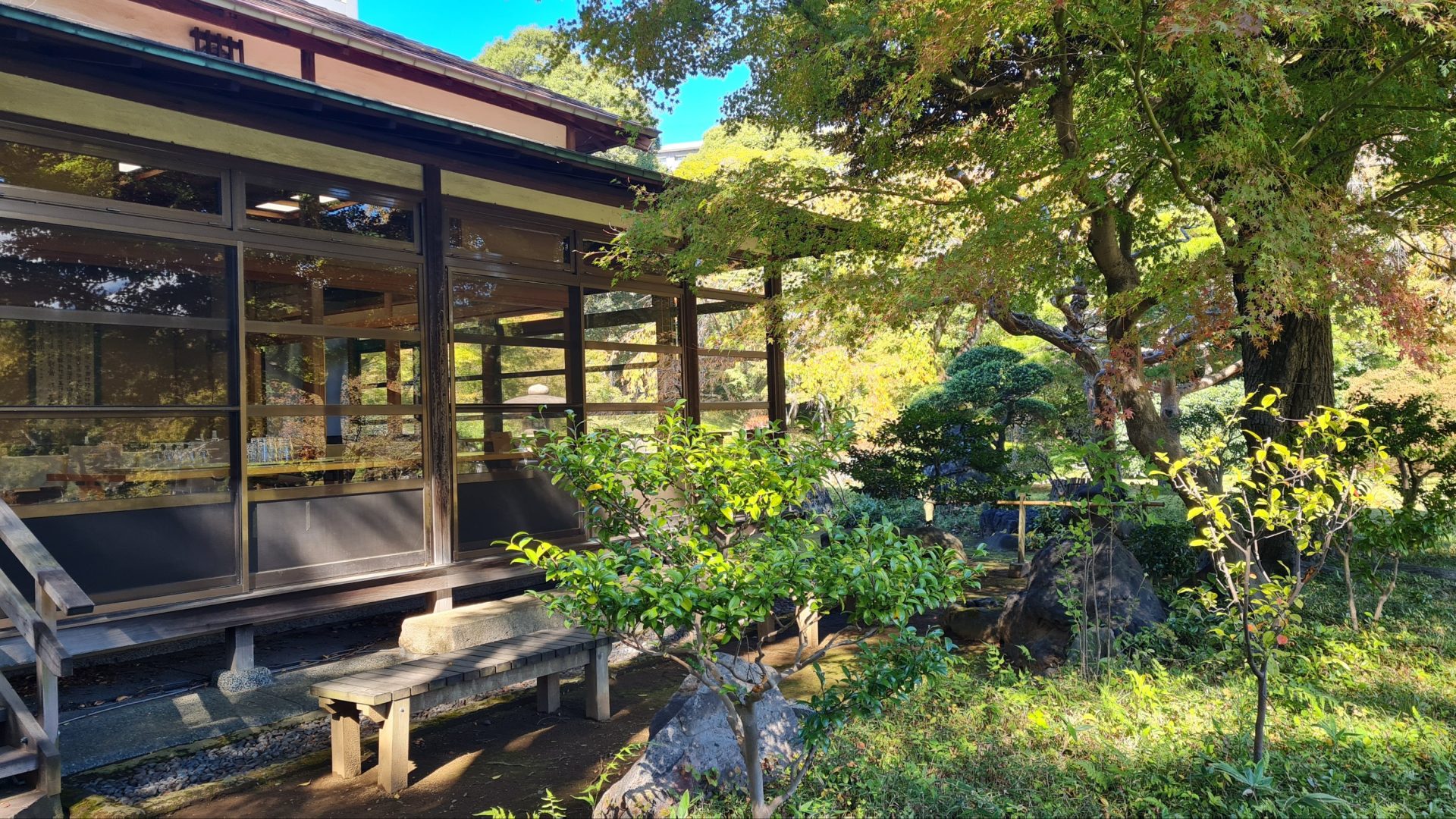
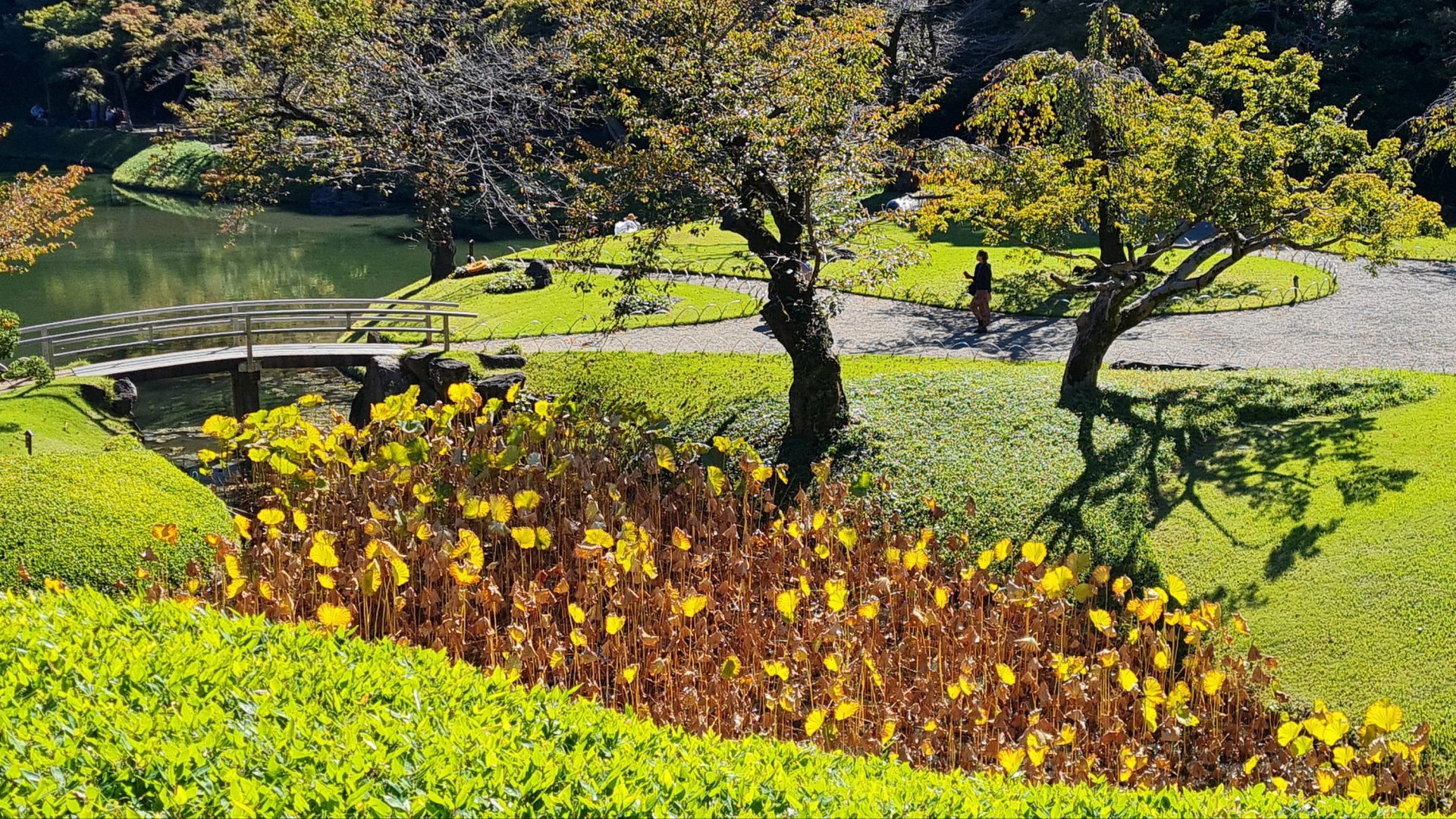
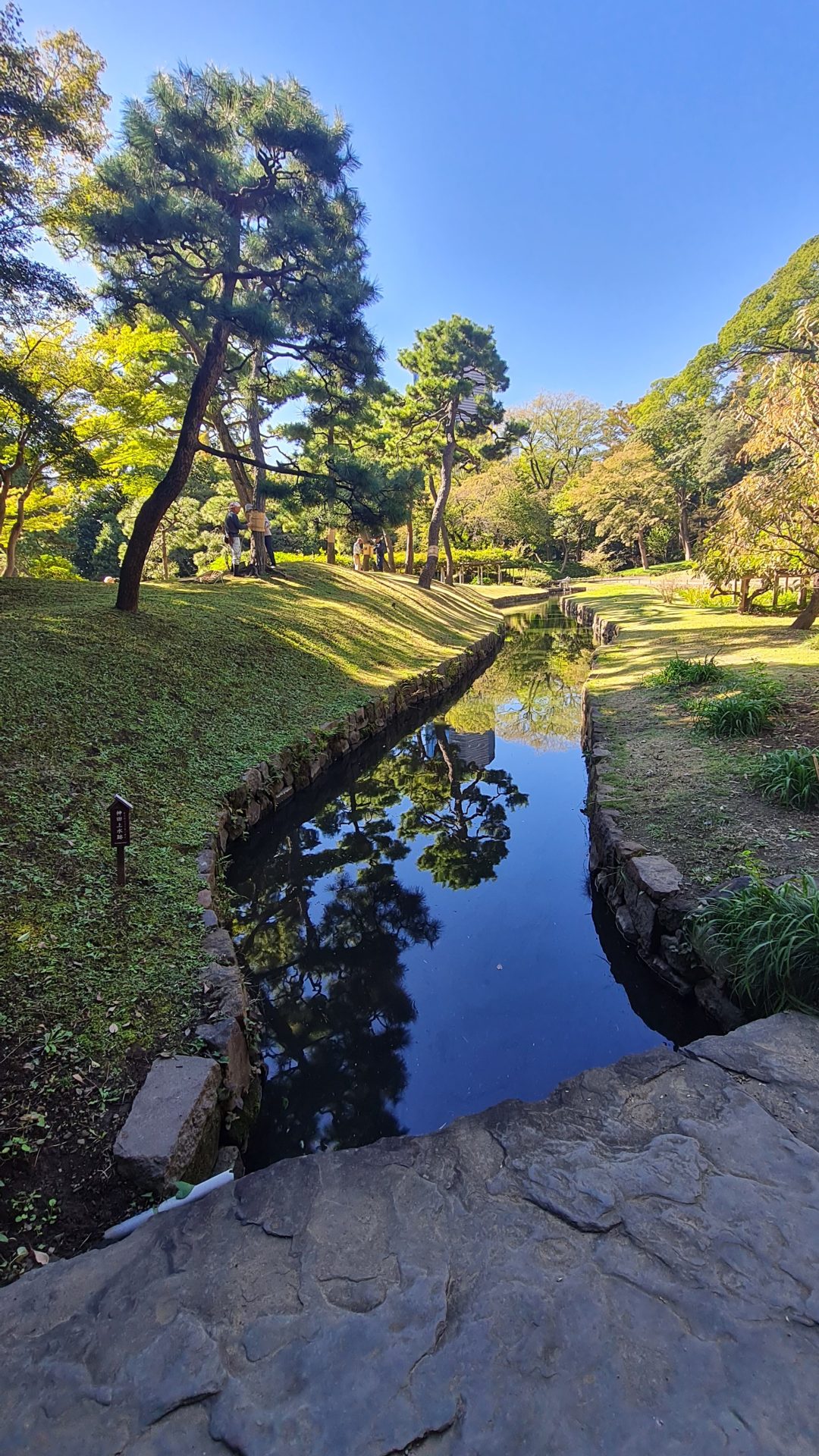
Koishikawa Korakuen Gardens is a tranquil, contemplative masterpiece, designated as a Special Historical Site and a Special Place of Scenic Beauty. Although designed originally for nobility, the place continues to whisper tales of patience, joy, embodying the gentle wisdom of the ages to every person who enjoys its undulating ponds, bridges, and hills.
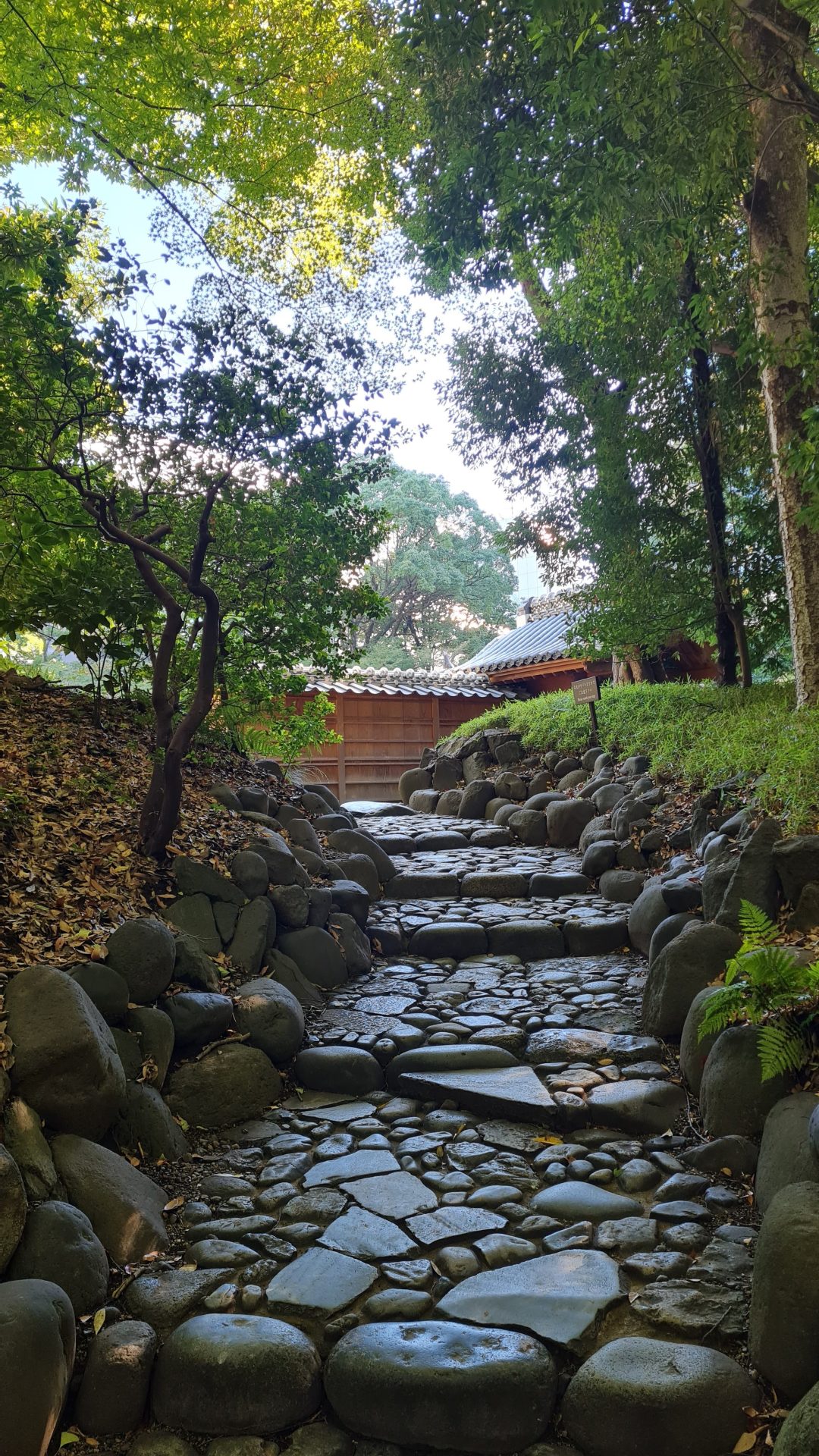
There’s a sense of exquisite discovery to the place with its winding stone pathways and small hills which open out onto unexpected and surprising vistas along the way.
How to get there
Koishikawa Korakuen is easily accessible within a 5 to 10-minute walk from Iidabashi Station, which is served by the JR Chuo Line (local trains only) and the Tozai, Yurakucho, Namboku, and Oedo subway lines. Alternatively, you can also reach it by a 5 to 10-minute walk from Suidobashi Station on the JR Chuo Line (local trains only). If you’re near Korakuen Station, it’s a straightforward 10-minute walk to the garden, accessible via the Marunouchi and Namboku subway lines.
Tenryū-ji is a temple and gardens founded by Ashikaga Takauji in 1339. It’s purpose at the time was to venerate Gautama Buddha. It’s considered as one…
I’ve just emerged from a seven day storm of crying at the drop of a hat, hating everything about being alive and blubbing incoherently while holding various plushies brought home from the four corners of the earth, each imbued with a lot of temporal and historical meaning for myself and the Polish Bear. It’s a storm of tidal, celestial and lunar magnetic pull that seems ready to consume me and set fire to everything and everyone I’ve ever loved.
What the hell is wrong with me?! you might ask. It’s the monthly curse or the monthly blessing according to who you ask and their intentions for that blood.
The storm has become a lot more spicy in recent years though, so perhaps this is something more? Maybe a cooling down of the engine, a volatile spluttering before running out of petrol. Night sweats, unusually potent moments of rage and anger at nothing in particular, vivid dreams, moments of extreme hornyness and flights of mental fancy into the past, present and future. Am I perimenopausal? I thought this only happened to other women. It’s bloody messy literally and figuratively.
What does it mean for the woman who chose a ‘hard pass’ on giving birth to another human being? To lose the ability to give birth? Does it change anything for me? To best honest it’s a bit of a mind-fuck because it stirs up a lot of primal emotion about all of my personal choices.
According to society, I should be knee-deep in shitty nappies, screaming infants, teething biscuits, school fees, braces and demands for toys and expensive tech right now. Instead in a clear-eyed and rational way I have decided to forgo the pleasure of those things, those interwoven and highly codified female experiences for most women that despite the wins of the past century still largely signify that you are “Woman” with a capital W.
I’ve chosen the lesser path travelled. Still – a path though and as it’s less travelled there is a shitload of exciting diversions one can take. Into wild woods, far into the depths of the ocean of the self, other, art, love, life and all that.
Instead, I decided to spend money on myself, buy myself stuff, anything I want really. Instead I went on adventures overseas with my beloved and still plan more, I eat fantastic food, learn new skills and follow any and all personal interests I have to their logical conclusions. Instead I chose to love children and animals out there in the world already, just not borne out of my own body.
What the hell does it all mean? I don’t know I’m all confused but other than when I have ads served to me of happy mothers feeding their kids, or getting life insurance or whatever… I feel pretty contented with my life, so long as it’s not the week before the crimson tide. Can anybody else relate to this, please tell me I’m not alone.
Stories from the City, Stories from the Sea by PJ Harvey
I’ve always felt like PJ Harvey was my spirit animal, especially her ‘girl about town’ period in the early 00’s where she wrote the incredible album Stories from the City, Stories from the Sea. There is something so defiant, adventurous, hopeful, cool and sexy about her look on the album cover here.
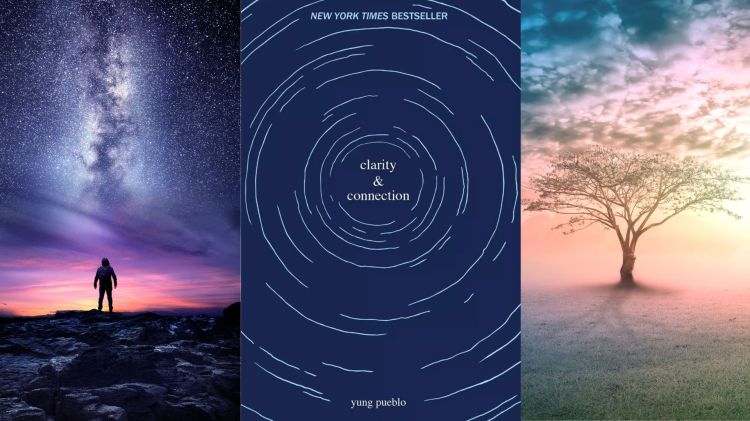
“How people perceive you is more reflective of their inner mechanics than your actions you cannot control how others think and live, but you can be intentional about the energy you put into the world some may misunderstand you, but what matters most is that you understand you”
It is difficult to describe how joyful, vivid and clear about everything in life that this book makes me feel. It’s the kind of book you can read over and over without tiring of its insights. Clarity and Connection is a revitalising treasure of wisdom that brings together timeless insights into the meaning of love, compassion (for self and other) as well as how to heal and recover from trauma and a difficult period of one’s life.
This week, #alien enigmas in ancient #Japan, Tiny Yu’s monstrous #fish #sculptures, tips to avoid bad decisions, #chickpea and potato stew recipe, #Rothko explained for those who don’t get it and much more! #ContentCatnip #InterestingThings
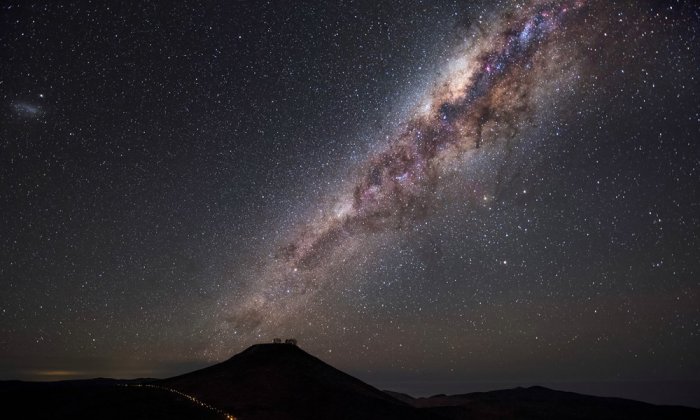
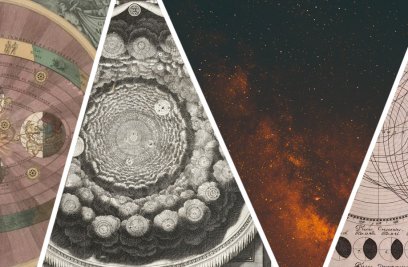
Before our cities lit the night and banished the stars, a gauzy band of faint light and shadows vividly cleaved the night sky. Our name for this band, “Milky Way,” originates in Greek mythology. Heracles, it is told, was born to Zeus following one of his many infidelities. To grant him protection and superhuman powers, Hermes snuck Heracles up to Olympus and placed him at Hera’s breast as she slept. But when Zeus’s wife woke up and realized what had happened, she flung the baby from her breast and some of her milk spilled out across the heavens. Hence the Greek term kuklos galaxías (κύκλος γαλαξίας), or “milky circle.”
This article is excerpted from Or Graur’s book “Galaxies“
The Greeks also saw in the Milky Way a road traveled by either the Sun or the gods. The Romans, who were heavily influenced by Greek culture, also thought of the Galaxy as a road traveled by the gods and called it Via Lactea — “milky way.” Roman writers also adopted the Greek word galaxías, which then made its way through medieval Latin into English.
The ancient Greeks and Romans were not the only peoples to see the Galaxy as a road. Of the different names for the Galaxy in Arabic, for example, the most common one is “The Straw Way” (درب التبانة—Darb al-Tabānah), after the sheafs of straw dropped by farmers on their way back from the fields. Spread by trade, religion, and conquest, this name is now found in many languages throughout Central Asia and northern Africa.
Neighboring countries often share similar names for the Galaxy. In Spain and Portugal, for example, the Milky Way is known as “The Road to Santiago” (Camino de Santiago), as it guided Christian pilgrims on their way to Santiago de Compostela. Meanwhile, in Finland, Estonia, and several Baltic states, birds migrating south for the winter seem to follow the arc of the Galaxy, which is called the “Birds’ Path” (e.g., Linnunrata in Finnish or Paukščių Takas in Lithuanian).
In many cultures, the Milky Way is more than just a road — it is a conduit between this world and the next. This conception of our Galaxy is found among many of the peoples of North America, from the Lakota “Spirit Road” (Wanáǧi Thacháŋku) to the Cheyenne “Hanging Road” (ekutsihimmiyo).
The ancient Egyptians may have held a similar belief. Nut, the sky goddess who swallowed the Sun at dusk and gave birth to it once more at dawn, also served as a ladder for the spirits of the pharaohs to climb up to the sky. Her arched, often star-studded body adorns sarcophagi and tomb walls, and is thought to be a depiction of the Milky Way.
Roads are not the only motifs found among the many names of the Milky Way. Rivers were the lifeblood of many cultures, so it is not surprising to find that those cultures viewed the Galaxy as a celestial river. The great rivers of India, China, and South America, for example, all have celestial counterparts.
In India, the Milky Way is known as the “Heavenly Ganges” (आकाशगंगा—ākāśagaṅgā) and stretches across the belly of a cosmic dolphin. In China, the Silver River (銀河—yínhé) separates the Cowherd (牛郎—Niúláng) from his wife, the Weaver Girl (織女—Zhīnǚ). The star-crossed lovers, symbolized in the night sky by the stars Vega and Altair, can only meet once a year, on the seventh day of the seventh lunar month, when a flock of magpies temporarily forms a bridge across the heavenly river.
The star-crossed lovers can only meet once a year, on the seventh day of the seventh lunar month, when a flock of magpies temporarily forms a bridge across the heavenly river.
Andean peoples of South America, including the Quechua and Aymara, believe that all terrestrial rivers flow into the celestial river, Mayu, which then replenishes them. The Mapuche, who live in Chile and Argentina, also think of it as a river of stories (Repeu apeu).
From rivers we turn to animals, which figure in many myths and creation stories. A Hawai’ian tale recounts how the demigod Ka-ulu flung the Chief of Sharks into the sky, where his shattered body formed the Milky Way. Variations of this story are found throughout the island nations of Oceania. To the Māori, all the way on the other side of the Pacific Ocean, it is Māui who placed the shark, Te Māngōroa, in the sky.
The Andean people of South America see “dark constellations” in the shadowy parts of the Milky Way: a snake, a toad, a tinamou bird, and a llama suckling her baby. On the other side of the world, the most famous dark constellation is the celestial emu, the counterpart of Australia’s large, flightless bird.
The sky river, Milnguya, as depicted by an unnamed Yolŋu artist, Australia, ca. 1948. Credit: Buku-Larrnggay Mulka Centre and the State Library of South Australia
These are but a handful of the many names given to the Galaxy by peoples throughout the ages and around the world. The many names and origin stories of the Milky Way are beautiful in and of themselves but also for the deeper truth they reveal about humanity. Separated by oceans, centuries, and cultural barriers, people have time and again reached for the same images. To look up at the sky and see a road for the gods, a great river, or the final resting place of your ancestors is not Chinese or Australian, Arab or Greek, African or Mayan; it is simply, deeply human.
Or Graur is Associate Professor of Astrophysics at the University of Portsmouth’s Institute of Cosmology and Gravitation, as well as Research Associate at the American Museum of Natural History. He is the author of “Supernova” and “Galaxies,” from which this article is excerpted.
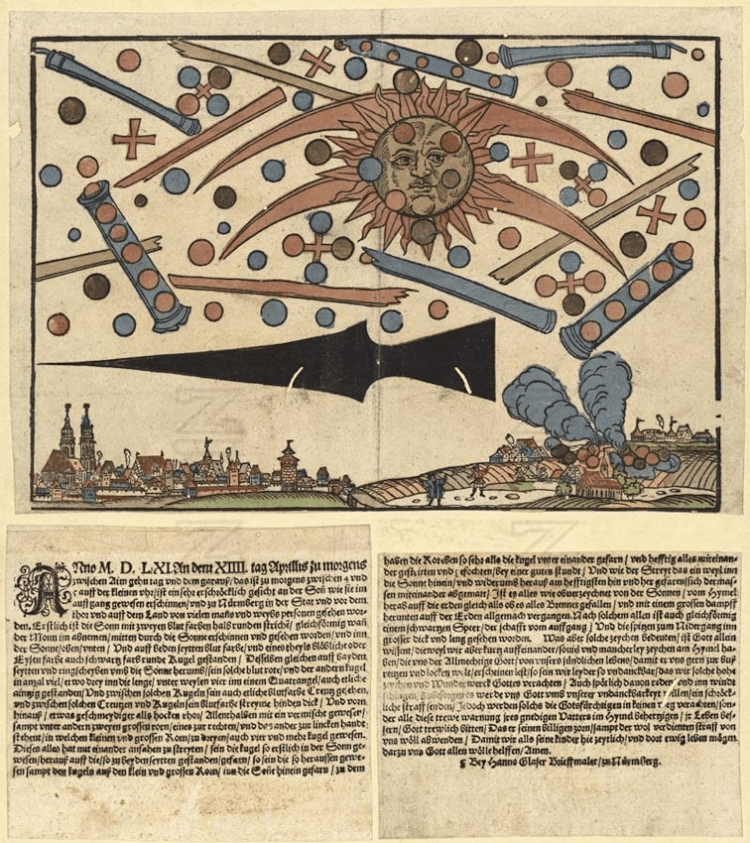
As the sun rose on April 14, 1561, over the German city of Nuremberg, the residents saw what they described as some kind of aerial battle take place in its glare — complete with the erratic dance of orbs, crosses, cylinders, and the appearance of a large and mysterious black arrow-shaped object — all followed by a crash-landing somewhere beyond the city limits. Later that month, local artist Hans Glaser produced a broadsheet (pictured above) offering a woodcut engraving of the scene, and a detailed description of what was witnessed. Via Mastodon
The medieval period was a trippy time – apparently the sun had a face back then…
The text reads:
In the morning of April 14, 1561, at daybreak, between 4 and 5 a.m., a dreadful apparition occurred on the sun, and then this was seen in Nuremberg in the city, before the gates and in the country – by many men and women. At first there appeared in the middle of the sun two blood-red semi-circular arcs, just like the moon in its last quarter. And in the sun, above and below and on both sides, the color was blood, there stood a round ball of partly dull, partly black ferrous color. Likewise there stood on both sides and as a torus about the sun such blood-red ones and other balls in large number, about three in a line and four in a square, also some alone. In between these globes there were visible a few blood-red crosses, between which there were blood-red strips, becoming thicker to the rear and in the front malleable like the rods of reed-grass, which were intermingled, among them two big rods, one on the right, the other to the left, and within the small and big rods there were three, also four and more globes. These all started to fight among themselves, so that the globes, which were first in the sun, flew out to the ones standing on both sides, thereafter, the globes standing outside the sun, in the small and large rods, flew into the sun.
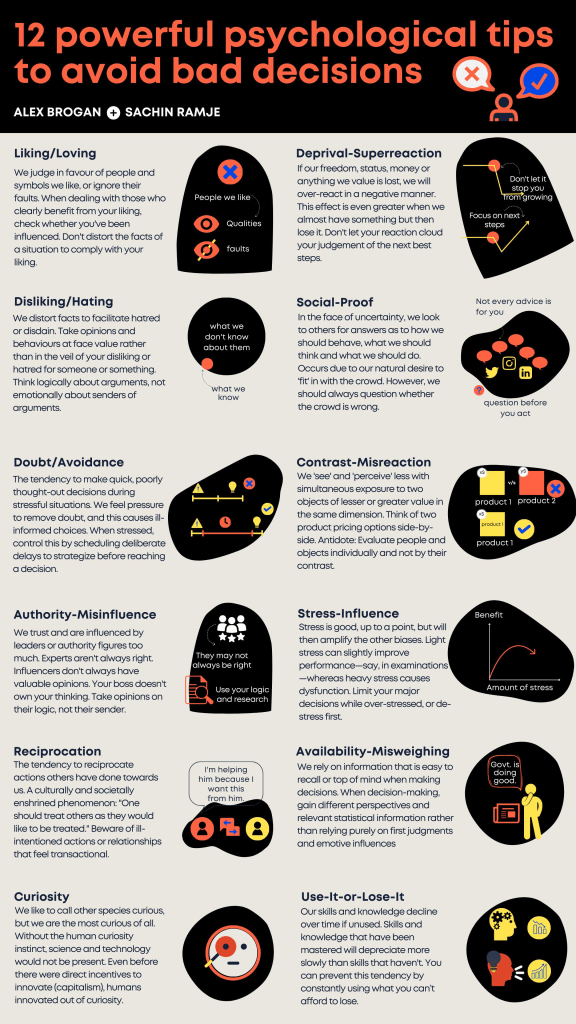
Everyone has made bad decisions before. I can recognise a few of these traps that I’ve fallen into in the past when making decisions that I’ve later regretted. Really amazing advice here! Via Reddit Cool Guides.
Infographic: 12 Powerful Psychological Tips to Avoid Bad Decisions
A beautiful passage of encouragement and like a warm cup of tea around the heart by Susana Cabaço. This is a brilliant blog on WordPress to follow!
Divine light shines in you and for you always, even though, out of free will and personal conditioning, you may block it. While complaining of the darkness, make sure you are not the one hiding from the light. Don’t keep yourself away from what’s always there for you. Find it inside and let it shine through you all around.
This is an incredible channel – Great Art Explained. Every single long-form documentary is exhilarating and exciting and gives you real insight into the deeper meaning of well-known masterpieces. The story of Mark Rothko is bittersweet and sad, however even after viewing this incredible documentary, I am still confused about the appeal of his art and why/how large blocks of colour can be considered meaningful by themselves. Can anyone explain Rothko to me? I’m turning my brain inside-out to understand.
This is a fun take on the notion of “just typing”, something we’ve played with in our own Keyboard Yoga project. With Silent Poems, you type, and interconnected glyphs appear. They’re squiggly and abstract and animated. You get to fill one screen, and that’s it. Read more and try it here
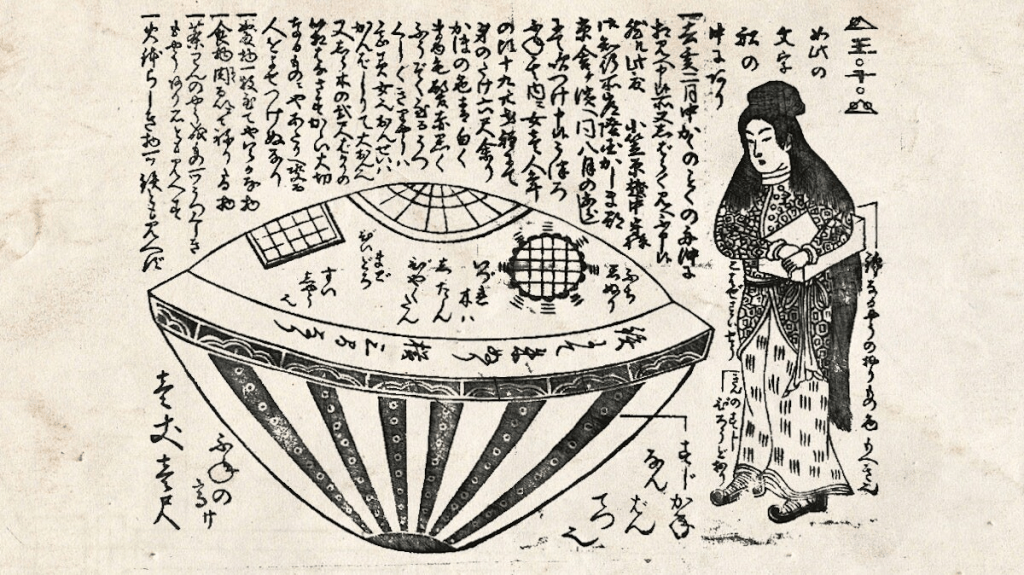
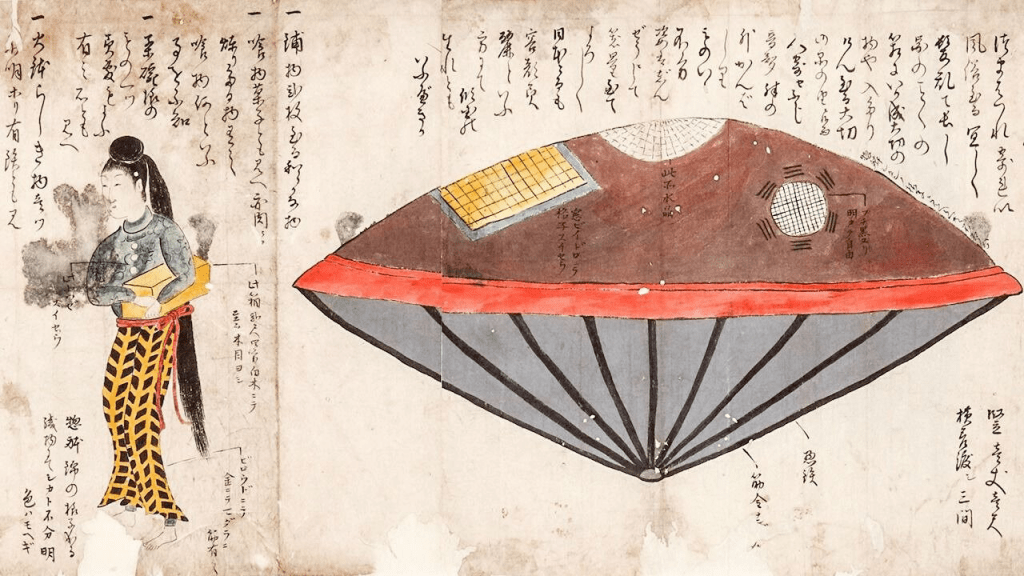
In the early months of 1803, a strange vessel washed ashore on the Japanese coast, resembling a cauldron or pod. Fishermen, thinking it familiar, rowed out to tow it in. But this was no ordinary ship; its bottom was forged from heavy metal, and the top was lacquered rosewood with latticed glass. Villagers, peering through opaque windows, saw something writhing inside. Suddenly, a panel opened, revealing a nearly human figure.
This utsuro-bune, or hollow ship, features in twelve Edo period texts. The most notable is Bakin Takizawa’s Toen shōsetsu (1825). In one tale, a five-meter vessel is found on a Hitachi beach, carrying an adolescent beauty with red and white-streaked hair, possibly fur. Dressed in a unique garment admired by local women, she clutched a wooden box and refused to let go. Her kind seemed to drink water and eat mince and cake, but she spoke no Japanese. Read more on Public Domain Review.
A hearty, filling meal that’s 100% wholesome, this Indian Chickpea Sweet Potato Stew is the best of healthy comfort food. It’s vegan, gluten-free, and made with whole foods like sweet potatoes, chickpeas, warming Indian spices, and greens, but it feels like a cozy hug in a bowl!
▢½ teaspoon Indian red chili powder or 1⁄4 teaspoon cayenne pepper**
▢A generous amount of freshly cracked black pepper
▢2 (15-ounce) cans of chickpeas, drained and rinsed (equivalent to 3 1/2 cups cooked chickpeas)
▢2 cups water or vegetable broth
▢3 cups peeled and finely diced sweet potatoes****
▢1 (14.5-ounce) can crushed tomatoes, or half of 1 (28-ounce) can crushed tomatoes
▢1 1/2 teaspoons kosher salt
▢4 ounces Swiss chard****, finely sliced into ribbons
▢1 1/2 tablespoons fresh lemon juice
▢1 cup fresh cilantro, roughly chopped
▢1/2 cup fresh mint*****, finely chopped
Garnishes (optional but recommended)
▢Thinly sliced red onions
▢Coconut yogurt
For serving
▢White rice or brown rice
▢Indian flatbread or pita bread
Instructions
Heat a large, deep nonstick frying pan or a Dutch oven over medium heat. Once hot, add the black mustard seeds and cumin seeds. Stir occasionally and toss the seeds around for 1-2 minutes, or until they start to jump in the pan and smell very aromatic but not burning.
Add the coconut oil and once it’s melted, add the diced onions. Cook, stirring occasionally, until the onions are softened and start to turn golden, 5 to 7 minutes.
Add the garlic and ginger and cook for 1-2 minutes until very aromatic, stirring frequently to prevent burning and sticking.
Add the bay leaves and ground spices, and then add the chickpeas and stir them around to coat around in the spices. Allow them to cook for 5-6 minutes, turning only once after a few minutes, to allow them to get a bit browned and crispy.
Pour in the water, stirring around to scrape up any browned bits on the bottom of the pot. Pour in the crushed tomatoes, diced sweet potatoes, crushed tomatoes, and salt. Stir well and bring to a boil. Reduce the heat to medium-low and simmer, stirring occasionally, for 30 minutes, or until the sweet potatoes are tender and the stew has thickened.
Add the chard (or kale) and cover the pan. Cook for 5 more minutes until wilted. Remove bay leaves.
Stir in cilantro and lemon juice. Serve with fresh mint, sliced red onion, and coconut yogurt.
Notes
* If you can’t find black mustard seeds, feel free to substitute brown mustard seeds – they’re a bit less spicy.
** Omit for a mild version.
*** This is equivalent to 3 medium or 2 large sweet potatoes. Make sure to finely dice the sweet potatoes – otherwise, they won’t fully cook through in the stew (or you’ll need to cook the stew longer). To see what size I dice them, be sure to watch the video starting around the 05:00 mark.
**** You can use other greens, such as kale or spinach. Spinach will cook very quickly and won’t need as much time.
***** The fresh mint adds a really nice cooling complement to the spiciness of the stew.
I think Tina Yu is one of the most talented sculpters on Youtube. I love the peaceful background music and the attention to detail and exquisite sheens and shimmers she puts on different parts of her sculpture, she shows enormous talent and imagination. I hope you enjoy this and especially the end result!
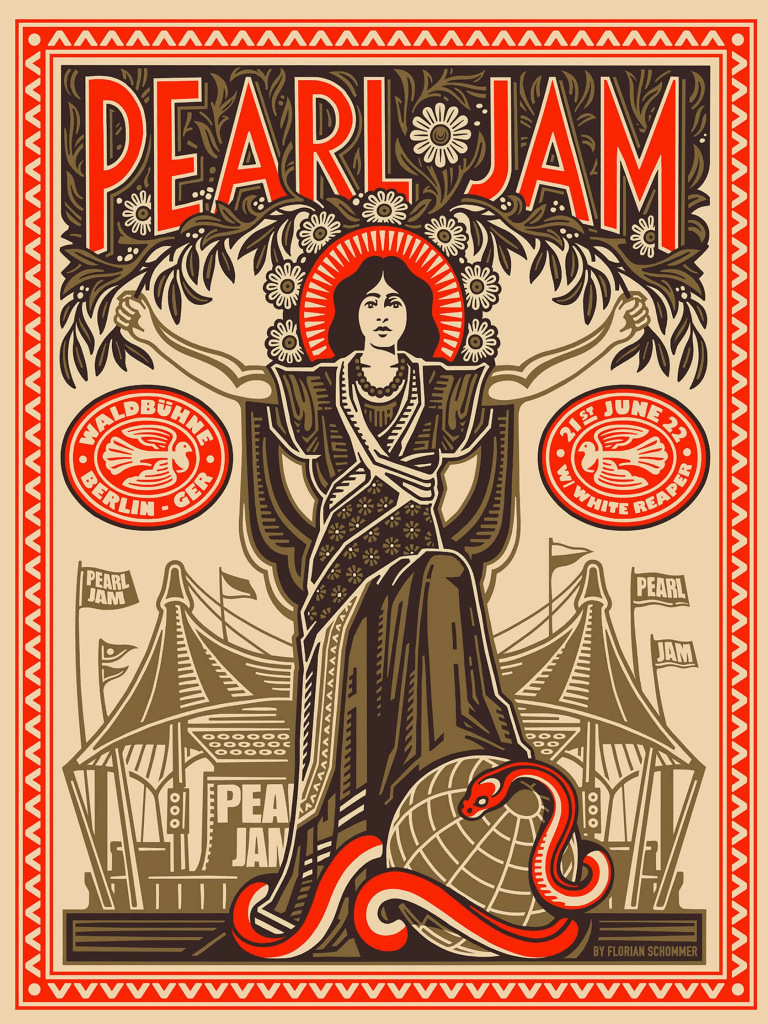
Florian Schommer, a Berlin-based art director and designer, infuses his work with psychedelic punk and rock vibes. His creative journey began in the punk and skater scenes, designing artwork for his band in the early 2000s. Today, his portfolio reflects this edgy aesthetic, featuring vibrant, bold designs and illustrations. Schommer’s diverse projects span personal works and collaborations with brands, all showcasing his unique, rebellious style. Explore more of Florian’s electrifying art via Inspiration Grid.
Did you enjoy this collection? let me know what you think of it below. Thank you for reading my dear friends!
“Artists are the perpetual defenders of living creatures, precisely because those creatures are alive. They truly advocate to love whoever is close by right now, and not those far in the future, which is what debases contemporary humanism, turning it into a catechism of the courthouse. Quite the reverse: a great work of art ends up baffling all the judges. At the same time, through such great works, artists give homage to the finest example of humankind and bow down to the worst criminals. As Oscar Wilde wrote from prison: “There is not a single man among these unfortunate people locked up with me in this miserable place who does not have a symbolic relationship with the secret of life. Yes, and that secret of life coincides with the secret of art.”
An electrifying and timeless book of ideas about how artists can resist and overcome the forces of fascism written by one of the greats of the 20th Century, Albert Camus who created a massive body of work while actively resisting Nazism during WWII.
Rating: 🌟🌟🌟🌟🌟
Genre: Essays, Non-Fiction, Politics, Art
Publisher: Vintage
Review in one word: Electrifying
“Create Dangerously” is a short book of essays written in the 1950s by Albert Camus. Despite its age, its snappy insights feel immediately applicable to the current state of our world in 2025 and beyond. Camus touches on weighty topics like the role and responsibility of the artist, resisting fascism through artistic expression and rebellion, human freedom, love, beauty and despair and much more.
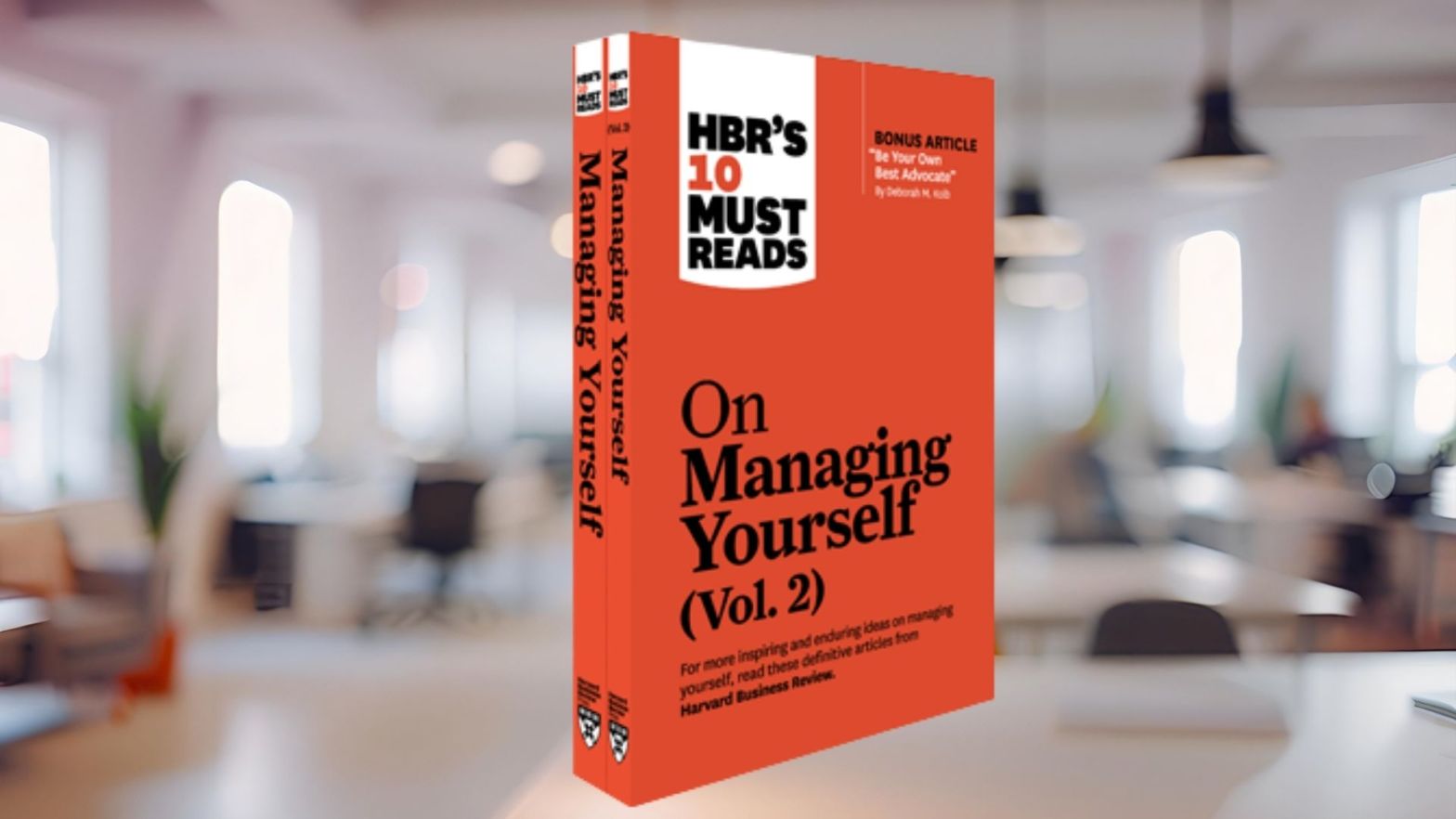
Distilling insights from decades worth of essays for Harvard Business Review. This collection shows you how to bounce back from setbacks, how to be resilient. Aside from some cringey moments it’s worth a read.
Rating: 🌟🌟
Genre: Non-Fiction, Business, Self-Help, Psychology, Career Growth
Publisher: Harvard Business Review
Review in one word: Helpful.
This curated collection from the Harvard Business Review distils decades of thought leadership insight into one toolkit for personal and career growth. There is a bit of corporate mumbo-jumbo in here. However alongside of it, there are some genuinely helpful and insightful gems that could help you to do well in your current or next job.
In the format of a series of short essays, themes include how to bounce back from setbacks and failures, how to manage your energy (not just your time), how to develop emotional resilience, and lead from your values.
If this sounds like the typical shallow fodder of LinkedIn posts, it’s not. These essays are from leaders who learned the hard way and are presenting in (mostly) no-nonsense, and deeply practical language.
Nevertheless, whenever there’s a business essay it can quickly escalate into cringe when the author delves too much into comparing organisations to people. As though the two are interchangeable. In other words an essay on resilience or creativity in people is compared directly to an example of a resilient organisation or a creative organisation. The idea that corporations and people are the same is preposterous.
One is a flesh and blood human with emotions, drives, memories and thoughts aside from profit making. A person who will die some day. And the other is a for-profit organisation that is more concerned with profit than people and is willing to expel, obliterate and forget any human people as and whenever its required. It is driven by relentless growth and the goal of immortality. As a corporate entity it is willing to do just about anything (legal, illegal, ethical or unethical) to achieve the ideal of long-term viability.
Perhaps that sounds cynical and perhaps it is. I am deeply cringed though by the comparison of corporations with people, as occurred frequently in this book.
Nevertheless, despite the corporate-cringe, there are sparkling gems of insights in this book. If you are ambitious and upwardly mobile (or merely looking to stay employed during this tumultuous time in history) then you will gain something from reading this.
Some of the more interesting insights I have highlighted are below.
Do Not Try and Change Yourself. Work on Improving Your Strengths
“The conclusion bears repeating: Do not try to change yourself—you are unlikely to succeed. But work hard to improve the way you perform. And try not to take on work you cannot perform or will only perform poorly.”
There’s No Point Being the Richest Person in the Cemetery
“A person’s strengths and the way that person performs rarely conflict; the two are complementary. But there is sometimes a conflict between a person’s values and his or her strengths. What one does well—even very well and successfully—may not fit with one’s value system. In that case, the work may not appear to be worth devoting one’s life to (or even a substantial portion thereof). If I may, allow me to interject a personal note. Many years ago, I too had to decide between my values and what I was doing successfully. I was doing very well as a young investment banker in London in the mid-1930s, and the work clearly fit my strengths. Yet I did not see myself making a contribution as an asset manager. People, I realized, were what I valued, and I saw no point in being the richest man in the cemetery. I had no money and no other job prospects. Despite the continuing Depression, I quit—and it was the right thing to do. Values, in other words, are and should be the ultimate test.”
Other People are Just as Individual As You Are
“The first is to accept the fact that other people are as much individuals as you yourself are. They perversely insist on behaving like human beings. This means that they too have their strengths; they too have their ways of getting things done; they too have their values. To be effective, therefore, you have to know the strengths, the performance modes, and the values of your coworkers. That sounds obvious, but few people pay attention to it. The same holds true for all your coworkers. Each works his or her way, not your way. And each is entitled to work in his or her way. What matters is whether they perform and what their values are. As for how they perform—each is likely to do it differently. The first secret of effectiveness is to understand the people you work with and depend on so that you can make use of their strengths, their ways of working, and their values. Working relationships are as much based on the people as they are on the work.”
Resilience: It Has Nothing Do with Having Rose-Coloured Glasses
“Today, theories abound about what makes resilience. Looking at Holocaust victims, Maurice Vanderpol, a former president of the Boston Psychoanalytic Society and Institute, found that many of the healthy survivors of concentration camps had what he calls a “plastic shield.” The shield was comprised of several factors, including a sense of humor. Often the humor was black, but nonetheless it provided a critical sense of perspective. Other core characteristics that helped included the ability to form attachments to others and the possession of an inner psychological space that protected the survivors from the intrusions of abusive others. Research about other groups uncovered different qualities associated with resilience. ”
“Resilient people, they posit, possess three characteristics: a staunch acceptance of reality; a deep belief, often buttressed by strongly held values, that life is meaningful; and an uncanny ability to improvise. You can bounce back from hardship with just one or two of these qualities, but you will only be truly resilient with all three.”
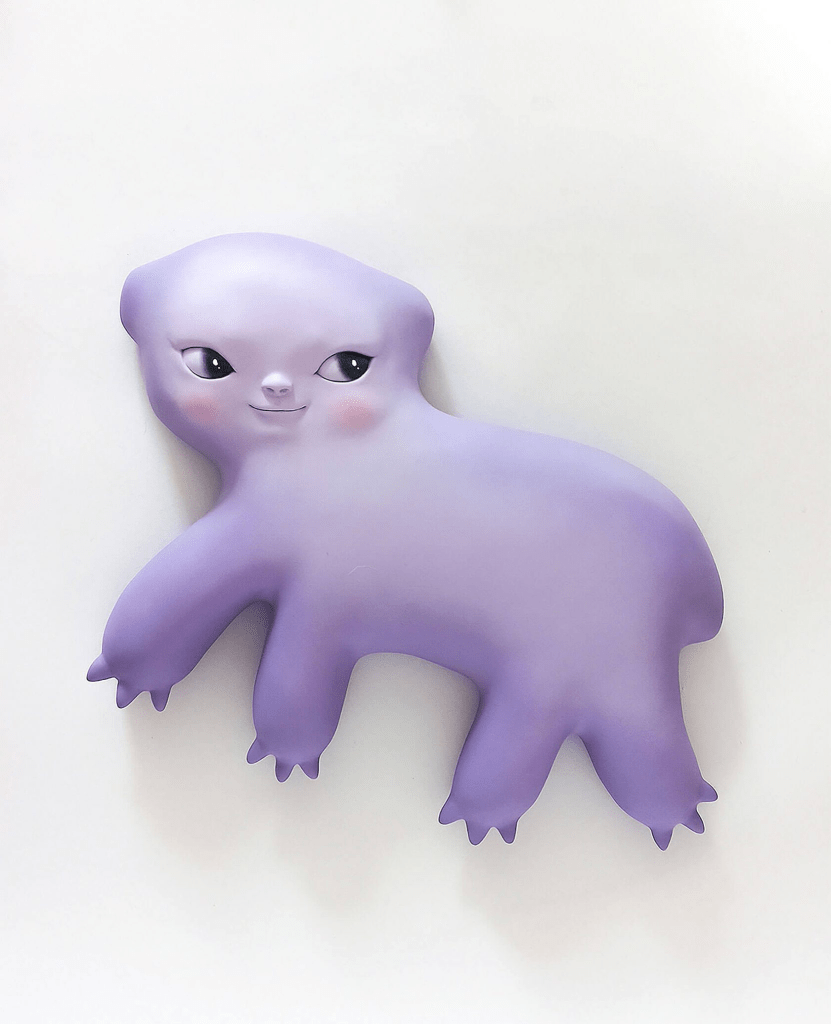
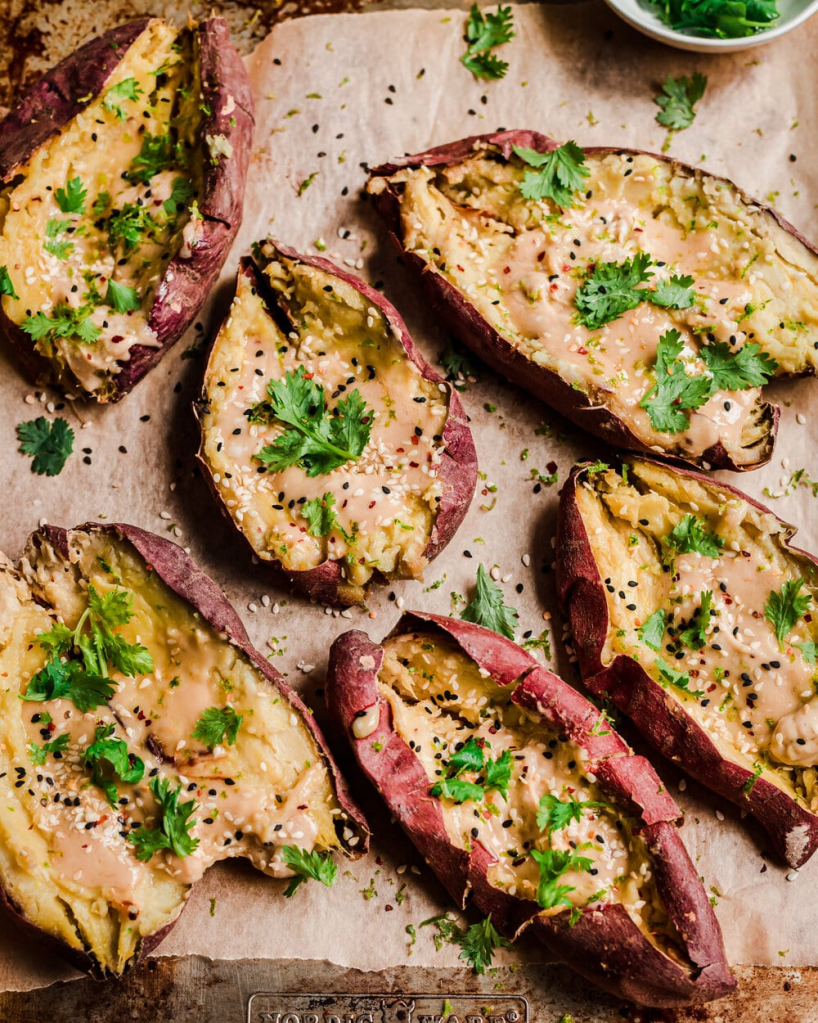
Adorable blobby #sculptures, Kagurazaka street after rain, tips to become a better #storyteller and #writer, hand building a tiny house in the woods in 3 months, baked sweet potato #recipe and much more #InterestingThings #ContentCatnip
I’ve had a gutful of hearing about the disgusting and disgraceful genocide happening real-time to Palestinian people. I refuse to be silent about it anymore to placate the feelings of those who may get offended by the words ‘Free Palestine’ or ‘From the river to the sea, Palestine will be free’. If any of that makes you uncomfortable please get out of my life. Little children are being killed while lining up to get food. They are lining up to get food because they are being deliberately starved to death by Israel. The band Kneecap is awesome for their advocacy of the Palestinian people and this connection between the historical colonisation of Ireland by the English and Palestine is an apt one.
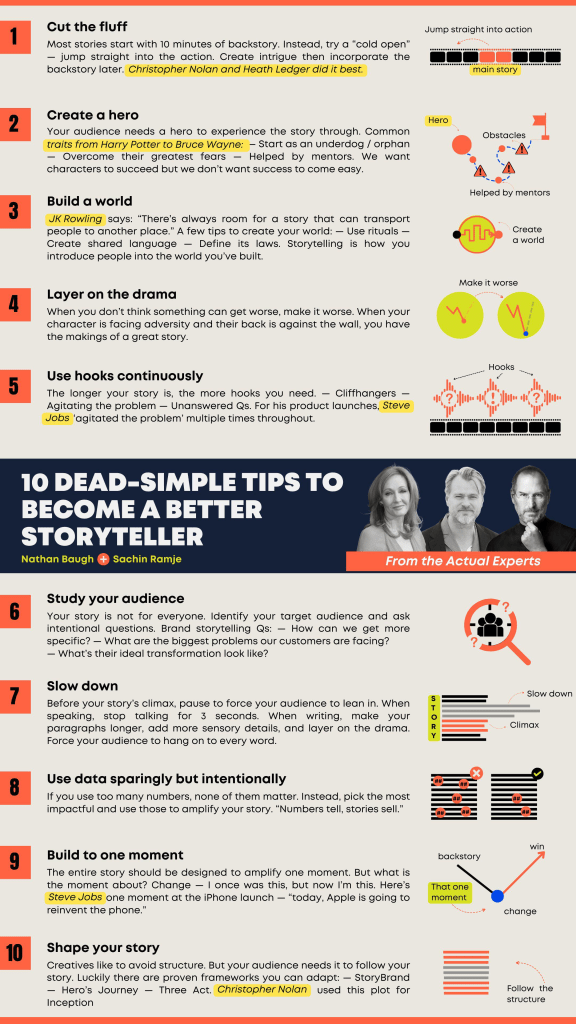
This is totally mind-blowing! As a rather timid teller of stories I always baulk at the idea people will find it all too boring. There’s a formula…I can follow it…fantastic! Via Cool Guides on Reddit
Infographic: 10 Dead Simple Tips To Becoming a Better Storyteller
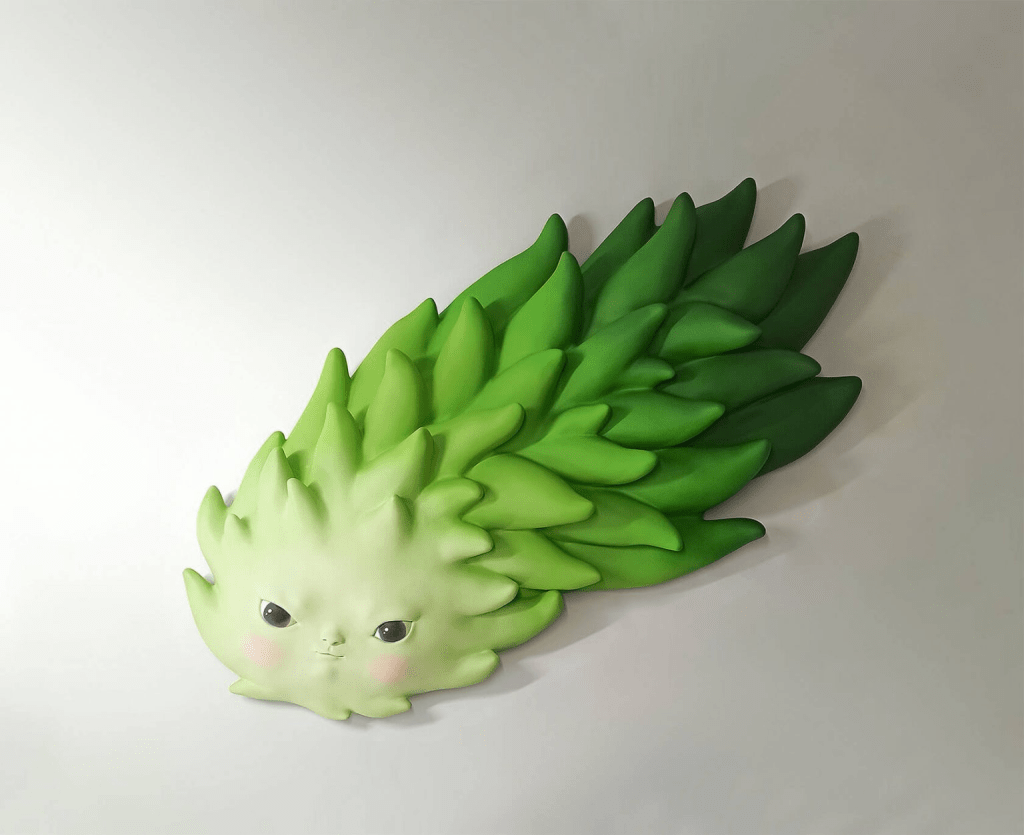
French artist Clémentine Bal creates whimsical sculptures of quirky, mythical creatures using clay, wood, and other organic materials. Her lifelike, detailed works feature endearing personalities and playful anatomical details, blending fantasy with charm. Explore more on Inspiration Grid.
I have noticed this and to be honest I find that look really boring. The pale neutral liptick, inner tube fake lips, fake massive eye lashes, the slicked back hair and beige clothes. I can’t in all honesty turn myself into a clone of these women because it just wouldn’t suit me and I would cease being me. What’s your thoughts on this generic look she’s talking about?
Baked Japanese Sweet Potatoes with Miso Tahini Butter
Ingredients
▢2 pounds Japanese sweet potatoes
Miso Tahini Butter
▢5 tablespoons vegan butter, softened at room temperature
▢1 tablespoon white miso, plus more to taste
▢2 tablespoons good-quality tahini
▢1/2 of a medium lime, zested
▢1 ½ tablespoons lime juice, plus more to taste
▢1 teaspoon toasted sesame oil, plus more to taste
▢1/2 to 1 teaspoon agave nectar
▢A few pinches of red pepper flakes
For serving
▢1 tablespoons toasted sesame seeds*
▢Flaky sea salt
▢1/2 cup fresh cilantro leaves
▢Lime zest
▢Optional: vegan furikake or gomasio
Instructions
Preheat the oven to 375°F/190°C.
Lightly slash or prick the sweet potatoes several times with a sharp knife to allow for even ventilation. Place the potatoes on a parchment paper lined baking sheet, or directly on the oven rack. Bake for 75 minutes for medium-sized potatoes (60 minutes for small Japanese sweet potatoes; 85-90 minutes for large ones). Turn off the oven and keep the potatoes in the oven, with the door closed for 45 to 60 minutes.
Meanwhile, make the Miso Tahini Butter. Add the softened vegan butter to a medium bowl, along with the tahini, miso paste, lime zest, lime juice, toasted sesame oil, agave, and red pepper flakes. Use a fork or whisk and mash until the mixture is very smooth. Taste for seasonings, and add the additional miso for more umami, lime juice for acidity, or sesame oil for toasted nutty flavor, as needed. If the butter is more on the melty side rather than creamed, pop it in the fridge for 20ish minutes until it reaches a spreadable consistency.
Once the sweet potatoes are done, slice them open and spread the miso butter tahini on top. Sprinkle with the toasted sesame seeds and a pinch or two of flaky sea salt. Top with fresh cilantro leaves. Zest a bit of lime on top before serving. If desired, sprinkle some vegan furikake or gomasio on top before serving.
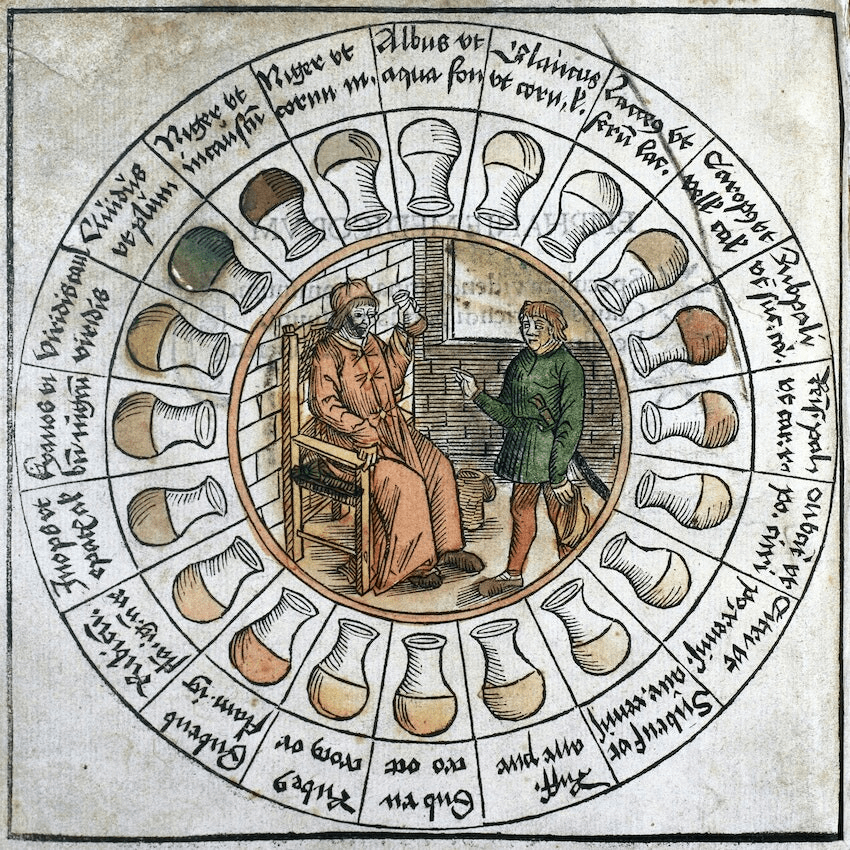
Katherine Harvey examines the complex practices of uroscopy: how medieval physicians could divine sexual history, disease, and impending death by studying the body’s liquid excretions. Via Public Domain Review
Troubled Waters: Divining Medieval Health Problems Through Urine Colours
“Trust that which gives you meaning and accept it as your guide.”
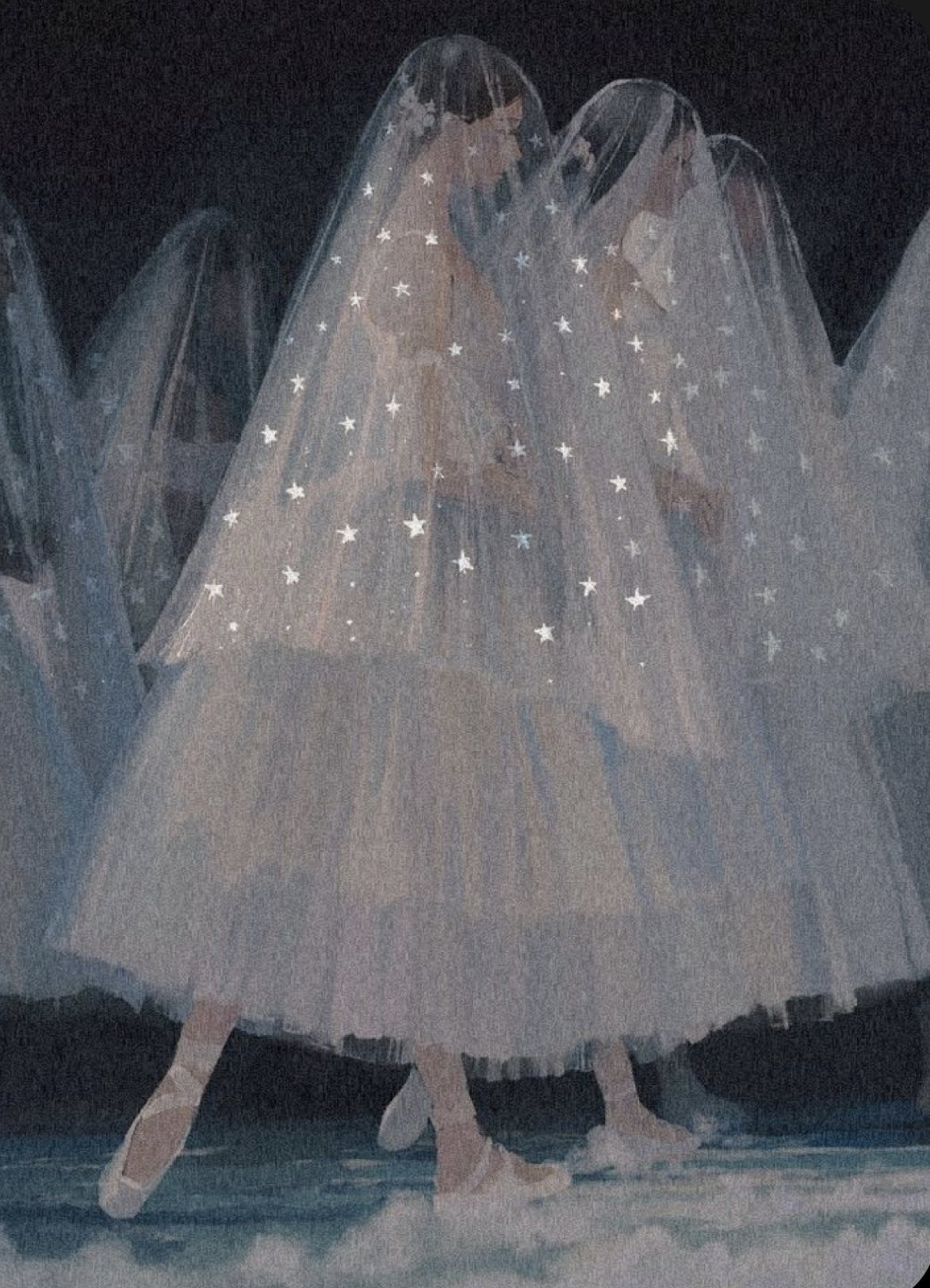
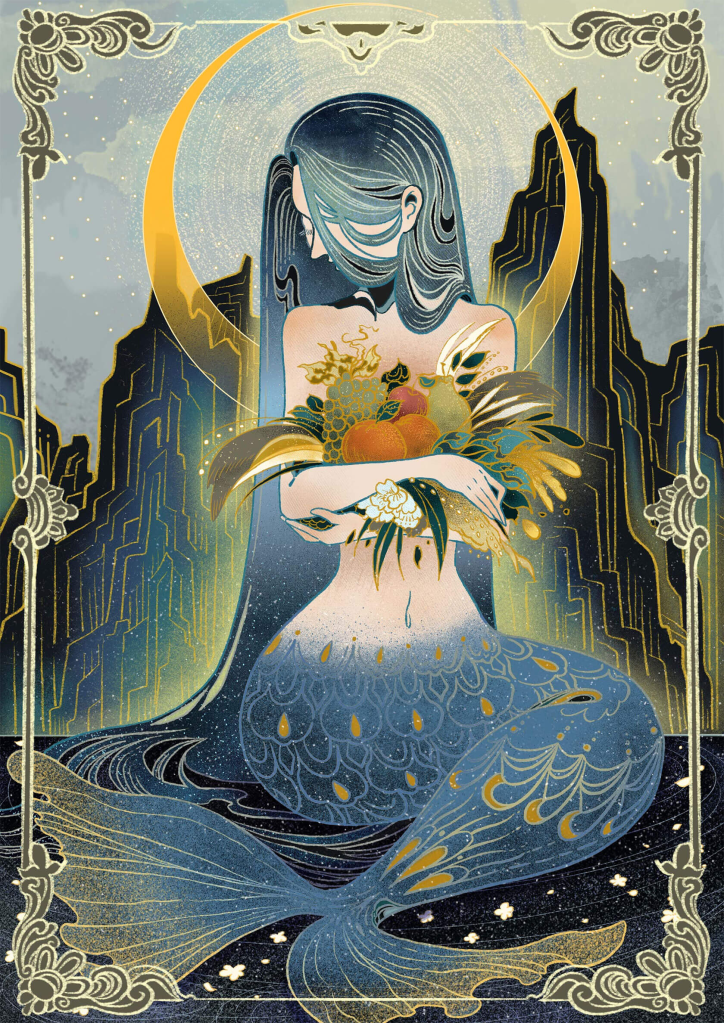
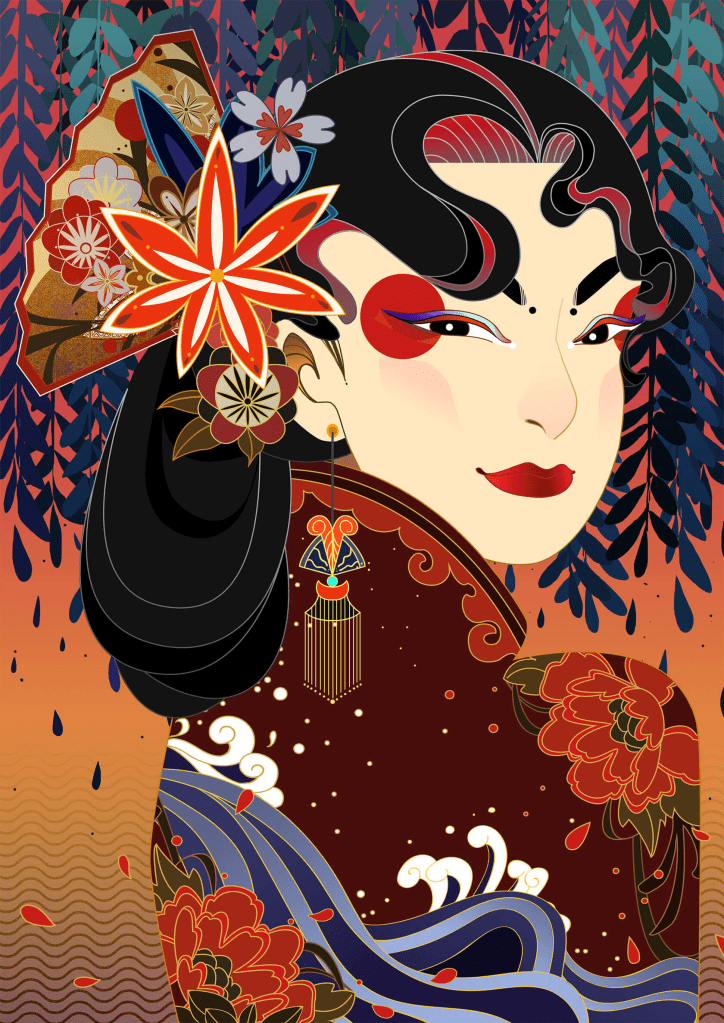
Atlanta-based artist Dannie Niu creates whimsical, hopeful illustrations inspired by classical romantic oil paintings. Her unique style, influenced by her childhood experiences, rejects somber themes for a more positive outlook. Discover her enchanting work on her website. Via
Did you enjoy this collection? let me know what you think of it below. Thank you for reading my dear friends!
I’m not sure when this would happen given the current shitshow state of the world, but would really love to travel around. I have a list of unusual destinations:
Alaska and the Canadian Yukon. I want to see some wolves, bears and moose in the wild and photograph them.
Uzbekistan: the ancient cities of the ancient silk road look really incredible.
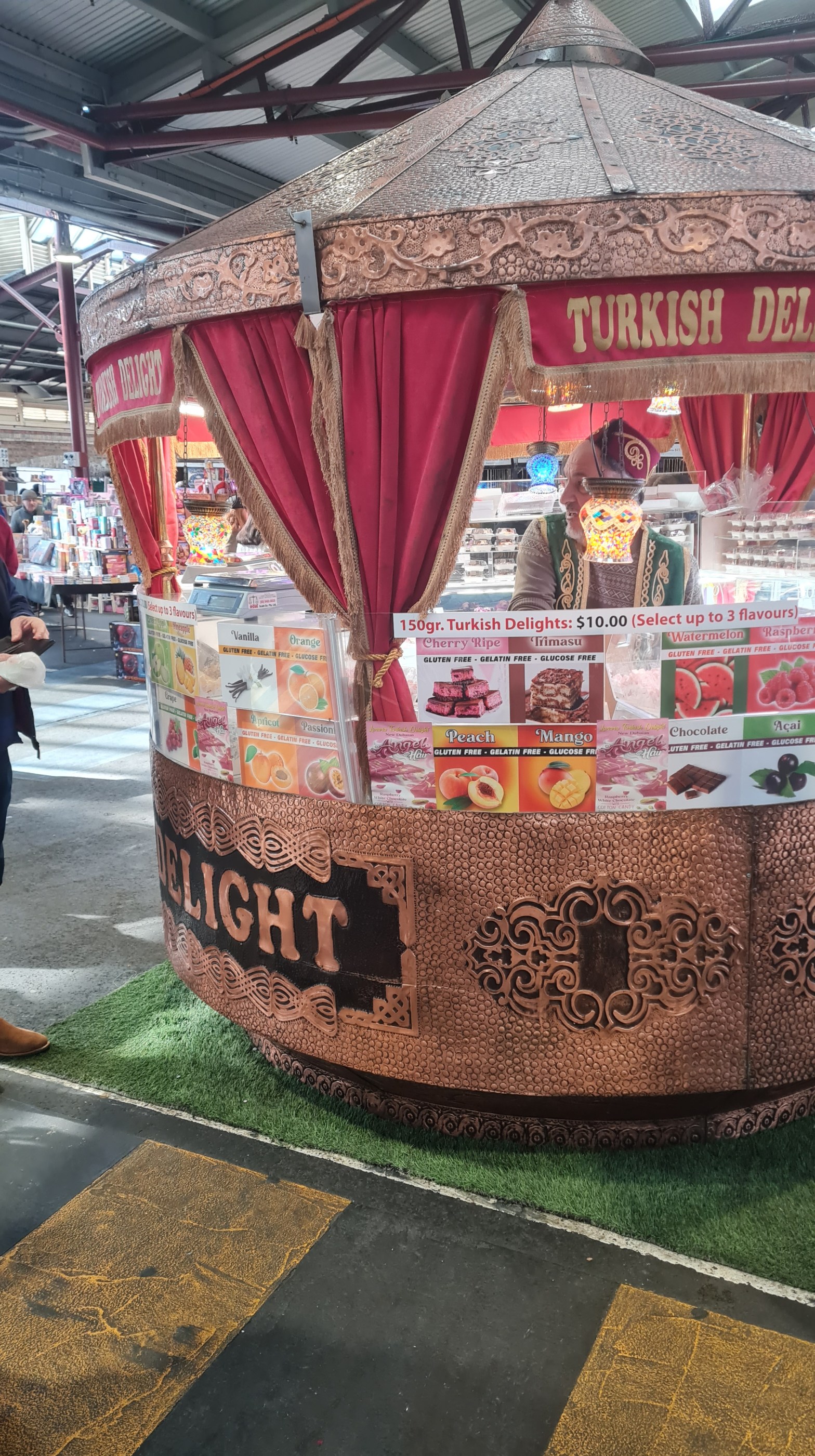
Turkey: I am massively obsessed with Turkish food, coffee, lamps, ceramics, rugs, the whole cosy aesthetic of Turkey. I would haul of whole mystical caravan full of trinkets back.
Congo: I want to see a family of gorillas happily eating and playing together led by a big silverback. At a safe distance of course to keep them safe from human diseases.


























![Gustave Caillebotte - Man on a Balcony, Boulevard Haussmann (1880) [1748x2293]](https://contentcatnip.com/wp-content/uploads/2024/07/image-1.png)
























 Content Catnip
You must be logged in to post a comment.