“There are so many things that art can’t do. It can’t bring the dead back to life, it can’t mend arguments between friends, or cure AIDS, or halt the pace of climate change.
All the same, art does have some extraordinary functions, some odd negotiating ability between people, including people who never meet and yet who infiltrate and enrich each other’s lives. It does have a capacity to create intimacy; it does have a way of healing wounds, and better yet of making it apparent that not all wounds need healing and not all scars are ugly.” ― Olivia Laing, The Lonely City: Adventures in the Art of Being Alone
“Stories have endings, that’s why we tell them, for reassurance that there is meaning our lives. But like a diagnosis, a story can become a prison, a straight road mapped out by the people who went before. Stories are not the truth. Begin with brokenness, begin again. We are not all, not only, the characters written by our ancestors. I have told my stories now, and we are still here, and the day has hardly begun. ” ~ Sarah Moss, The Tidal Zone.
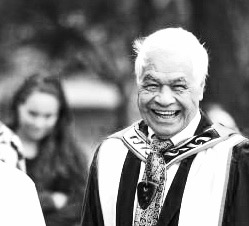
Dr Haare Williams MNZM has been Dean of Māori Education and Māori Advisor to the Chief Executive at Unitec. He was General Manager of Aotearoa Radio. He set up a joint venture with the South Seas Film and Television School to train Te Reo speakers as producers and operators in film and television. He has worked closely with iwi claimant communities and was responsible for waka construction and assembly at Waitangi for the 1990 commemorations. He has published poetry, exhibited painting and written for film and television. He was a cultural advisor for the Mayor of Auckland and is Amorangi at the Auckland War Memorial Museum.
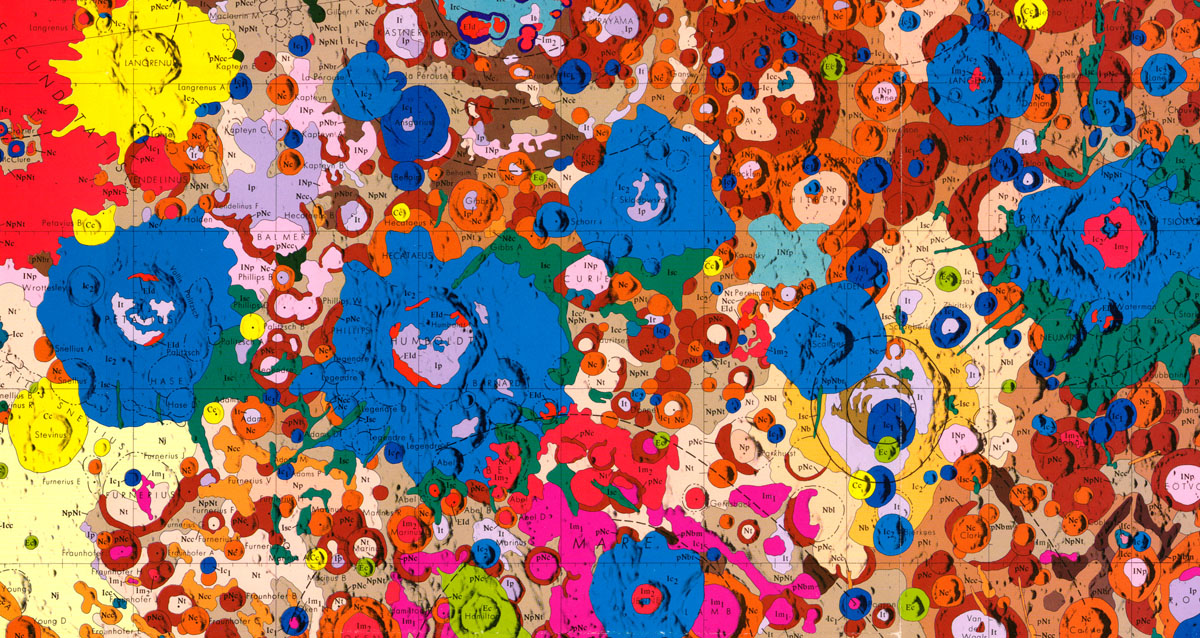
Have you ever pondered about the topography of the moon’s surface? Well I have. My brain works in weird and wacky ways. So naturally before we expose what the moon’s surface actually looks like, you need to see what the moon would look if you were on acid. courtesy of The Mighty Boosh.
As the most fascinating and brightest object in our night sky, the Moon has 11,000 craters that are visible even on a small telescope. Since it begun circling our earth 4.5 billion years ago, the Moon has become an important part of our human history and fables. It has been conquered as well firstly by the Americans, then the Russians, Chinese and Japanese. Older than all of us, it’s got a lot to teach us if we listen with our eyes to its soft glow. Click on the photo to see the larger version.
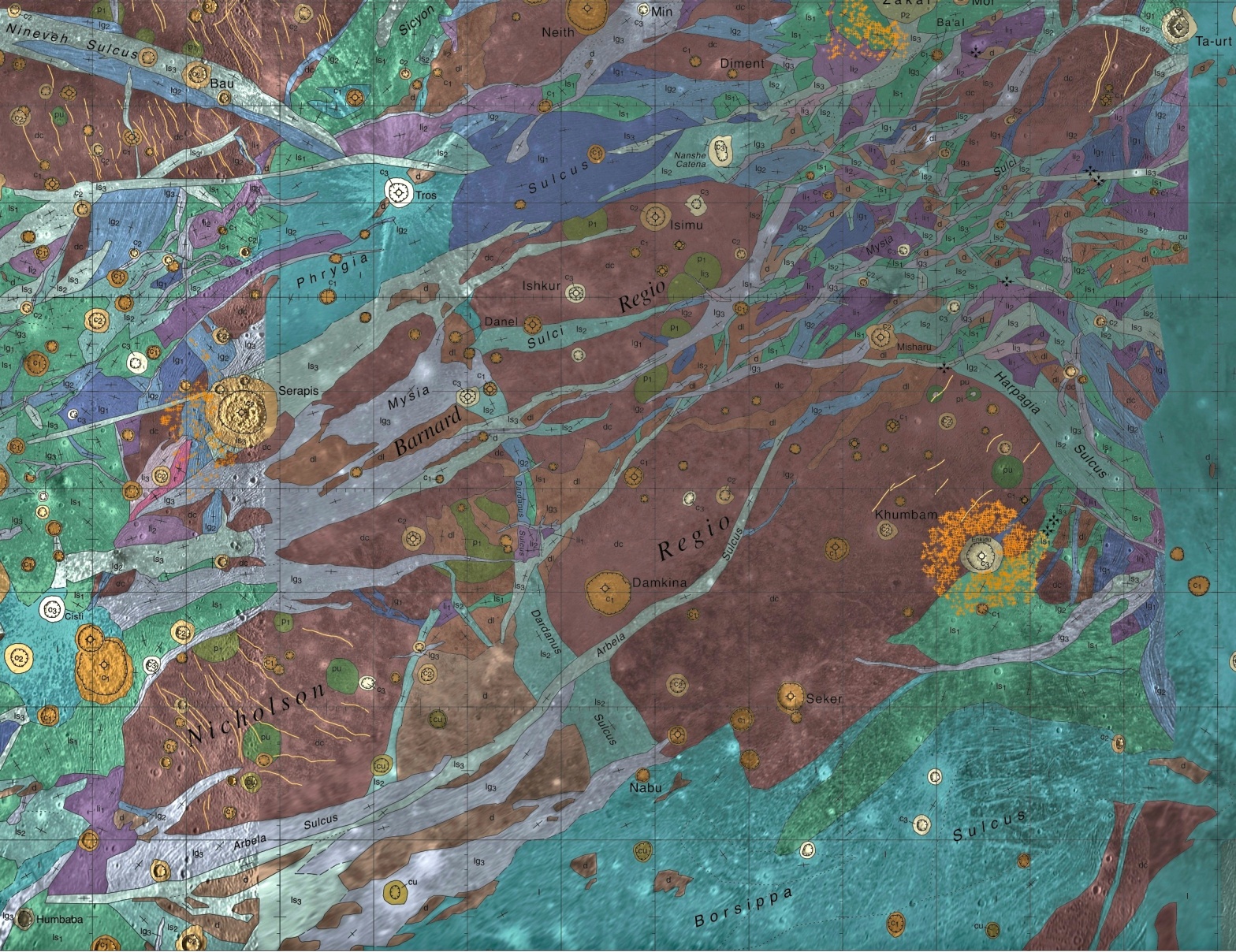
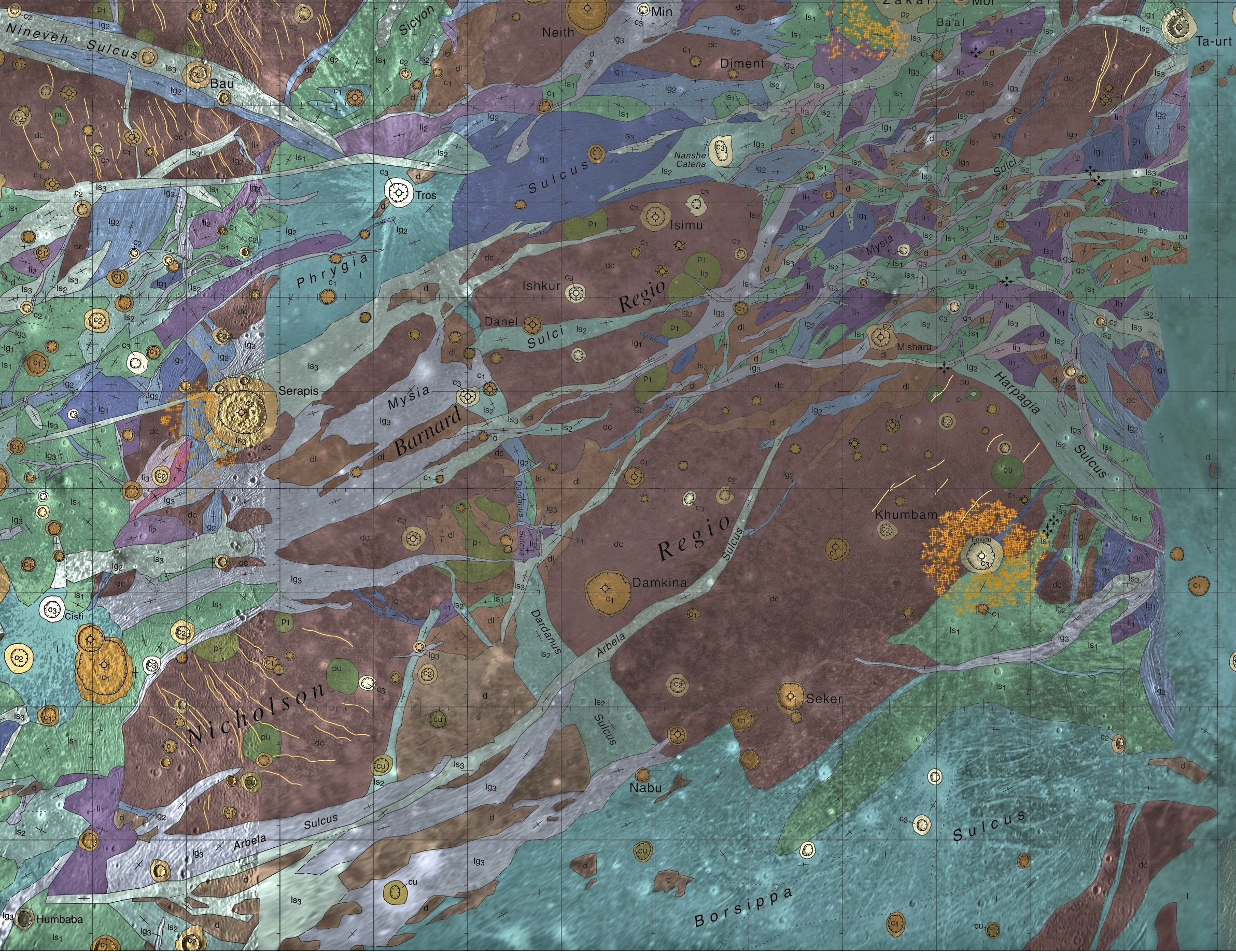
This is an animation of Jupiter’s moon Ganymede, with a geologic map superimposed over a global color mosaic. The 37-second animation begins as a global color mosaic image of the moon then quickly fades into the geologic map. Click on the photo to see the larger version.
The seventh moon out from Jupiter, Ganymede is roughly the same size as Mercury, making it the largest moon in our solar system.
The crust of Ganymede is filled with water, salt, ice and silicate rock. Other organic compounds such as sulphur dioxide and carbon dioxide are also present on this moon. The surface is made up of ancient craters and younger grooved areas. The reason for the topography is still up for debate, but the generally accepted opinion is that the grooves and craters are caused by tectonic activity at Ganymede’s core. Unlike almost all other moons, Ganymede also has a substantial magnetosphere. This means that this moon is theoretically inhabitable with life, as the magnetosphere protects life from the harmful solar rays.
We still haven’t explored the surface yet, we have only taken pictures from satellites. It’s still a mystery, perhaps there are aliens living on it! The measurement of planetary habitability and the scientific requirements required to support life is too complex to get into here, but you can read more about it on Wikipedia.
A thought-provoking and powerful story of race in modern America
Rating: 🌟🌟🌟🌟
Bloomsbury Publishing 2019
Although I am not American, I delved deeply into this book and gained a new understanding of the subtleties of race relations in this country. There is surprising layers of depth to this book, not only about race but also about how race intersects with money and class as well.
The book’s crisis point centres around its two main characters. Alix Chamberlain, an Ango-saxon ‘mommy-blogger/influencer’ who lives a swanky and rather impressive middle-class life, and Emira the African American babysitter of her toddler Briar.
One night, after an unexpected incident in her home, Alix calls up Emira to take Briar out of the house to the shops, while the police come to question her. Emira comes straight over from a party, dressed up like she’s going out clubbing. She takes the toddler Briar out of the family house to the wholefoods store to kill some time. Inside of the store, a white busy-body type speaks to a security guard and then a white security guard accuses her of kidnapping the little white toddler. This is done in a physically aggressive, condescending and horrific way.
Afterwards, this creates a catastrophic shitstorm for the young African American woman who has to tackle head-on the prejudice and skin-colour based racism of her world.
Kiley Reid, author of Such a Fun Age
Afterwards, Alix makes awkward, self-conscious and guilt-ridden attempts to right the situation. By attempting to befriend Emira, obsessing over her, idolising her and all sorts of cringe-inducing tactics to make up for what happened in the supermarket.
The uneasy tension of skin colour and racism that lays right under the surface of daily life in Such a Fun Age makes this book both compelling and heartbreaking. Racism is a problem everywhere and it’s often shrouded in a variety of guises. It can come out unbidden at the most unexpected moments. As person who is a bit brown, exotic looking, difficult to place, I can relate to this sudden and unexpected turmoil that can happen at any time.
For Emira, there is the heartbreaking financial uncertainty of being a young woman who is fast approaching her 25th birthday and who must find permanent ‘proper’ employment or else she won’t be eligible for her parents health insurance. This aspect of the book is an American problem, as this simply doesn’t happen in other parts of the developed world.
For people in Europe, the UK, Australia and New Zealand, there is a baseline level of care, such as through either the NHS (in the UK) or Medicare (in Australia). This made me feel sad for friends in America who are working class and actually deal with this drama, the need to secure permanent work in order to secure healthcare. It seems to me like an unnecessary stress.
The uneasy, awkward and stilted relationship between Emira Tucker and Alix Chamberlain is powerfully rendered, the American culture they inhabit in the book is shot through with inequalities, agitating inconsistencies. There’s a sense that life is a marathon race and that some people have a clear head-start, whereas others wait for a long time after the starting gun.
I was expecting this to be some kind of ‘woke’ book about class and race privilege, in some ways it is. Although Such a Fun Age is highly political, it is also written in a sensitive, subtle and emotionally charged way that is really haunting and stays with you for a long time after you read it.
“Just being with any animal is edifying, for each has a knowing that surpasses human understanding. A spider can taste the world with her feet. Birds can see colours we can’t begin to describe. A cricket can sing with its legs and listen with its knees.
“A dog can hear sounds above the level of human hearing and can tell if you’re upset even before you’re aware of it yourself.
“Knowing someone who belongs to another species can enlarge your soul in surprising ways.” ~ Sy Montgomery.
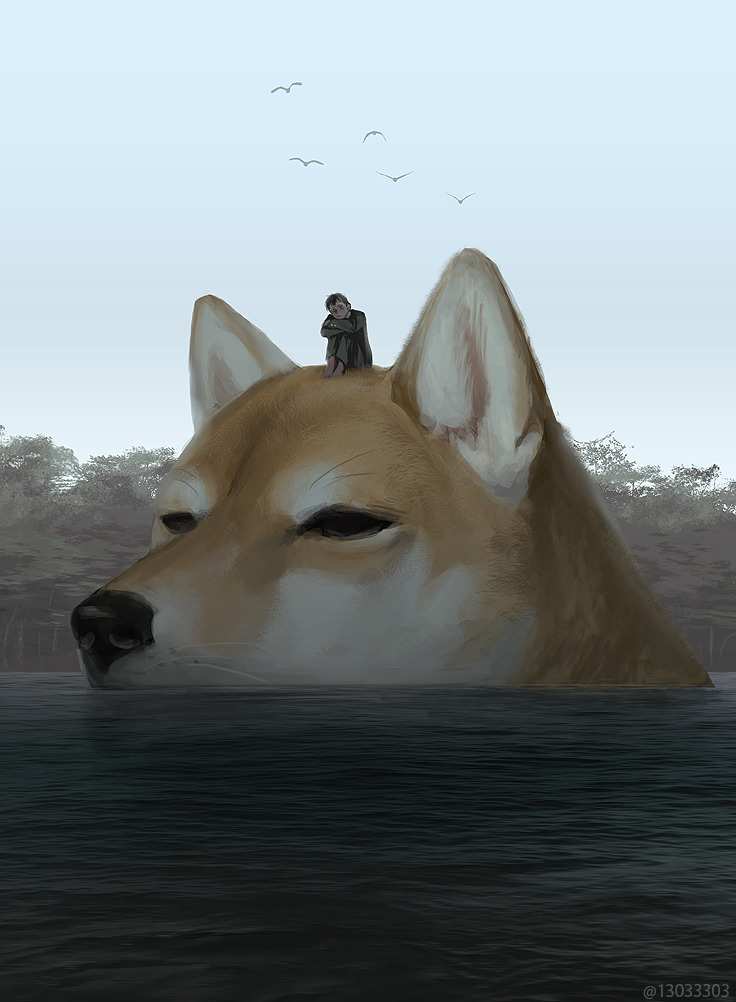
Jumbo sized animal familiars and their cuddle potential by MonoKubo
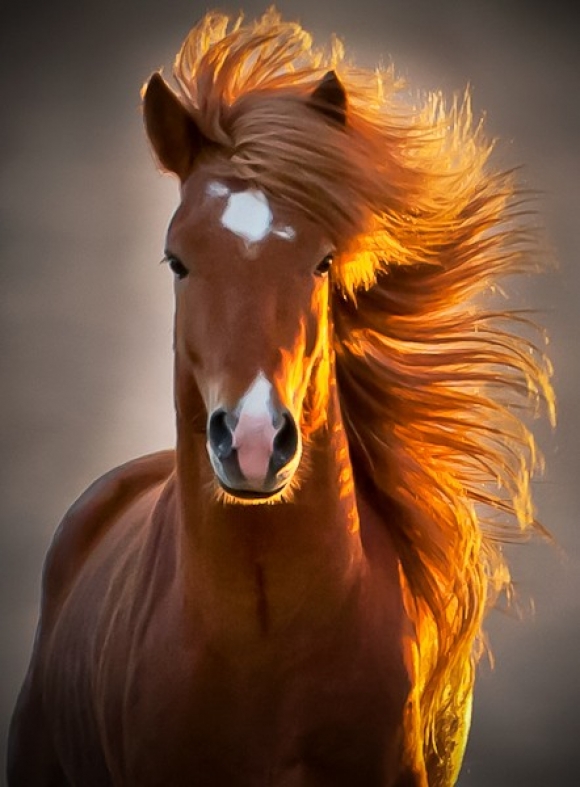
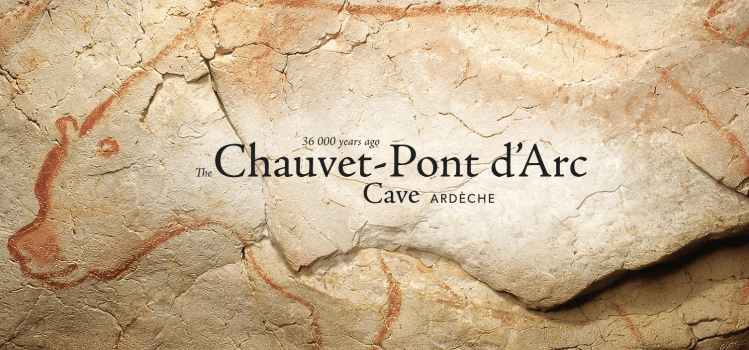
Baby, You Were Born To Run: Horses From Cave Art to Melbourne Cup
Sako, a heroic dog from Kananka Bar, BC, was inducted today into the 2015 Purina Animal Hall of Fame. (CNW Group/Purina Animal Hall of Fame)
Sy Montgomery is a naturalist, author and scriptwriter who writes for children as well as adults. She is author of more than 20 books including The Soul of an Octopus: A Surprising Exploration into the Wonder of Consciousness, and How to be A Good Creature: A Memoir in Thirteen Animals.
Yo-Ho-Ho and a bottle of Victorian cough syrup. Something weird happened to me today and a whole lot of barnacles suddenly attached to me on a walk, so here they are, the treasures from the internet.
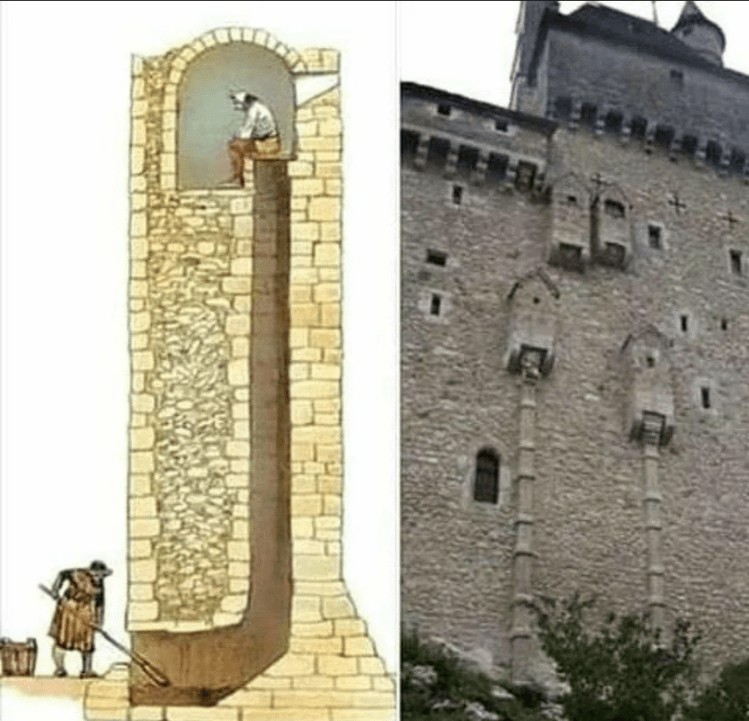
Imagine having the job of shoveling out the bottom? These epic loos were used by those who could use the gravity of their position to defecate on those below. Via Reddit
A medieval drop toilet
Slave to the Rhythm by Grace Jones
I love the funky guitar and groovy bass-lines of this song, it’s absolutely timeless, potent and optimistic. It was literally an anthem for the optimistic 80’s. The surreal visual storytelling of the video clip is like a moving Matisse or Miro painting. The 80’s really was the peak time of MTV visual storytelling and trend-setting. Grace Jones is a goddess of immense power, poise and androgynous beauty. For me, she’s like the female version of David Bowie.
Kali, a western hoolock gibbon and her de facto human family
Yeah it’s cute that she’s grooming humans, but where’s her real family? 😦
Trekking the Mardi Himal trail in Nepal with Kraig Adams
This guy makes meditative and silent vlogs without talking and just with ambient walking sounds. As a result, his videos are very immersive and has a compelling, fly-on-the-wall vibe. I just love this video I have watched it many times, a highlight is a stray white dog that adopts Kraig and follows him along the way and then just inexplicably leaves as well along the way. Great armchair travel.
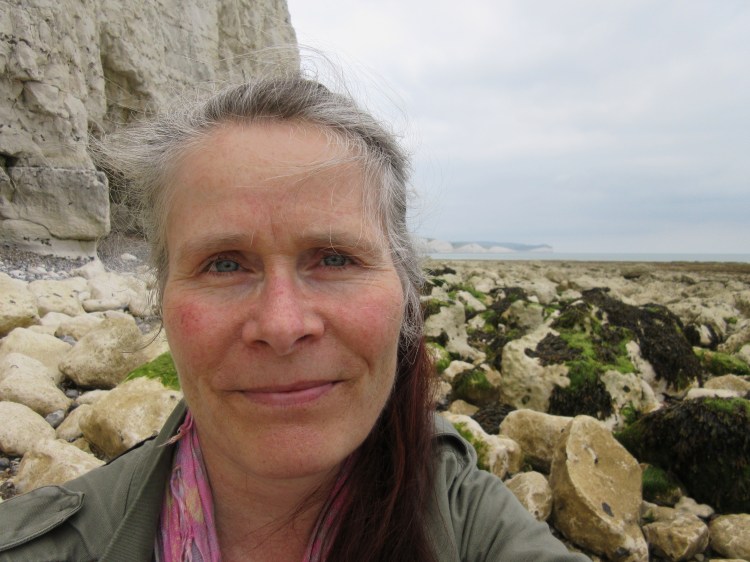
Maria Strutz is a German artist, printmaker, sculptor and translator, who lives in the UK. Her art weaves together the magical and liminal worlds of animals, nature, spirits and mythology She has delighted her fans and followers for many years with her unique linocut prints and sculptures that tap into the primeval story of humans and animals, bound together in sacred unity. She reminds us of an ancient tale known to us only in dreams. A sleepy netherworld of animals, plants, rocks and bones. Maria tells her story…
At the core of my art is a strong connection to nature
The spirits of animals and plants, landscape, stones, the sea and the elements. My art is about pattern recognition, weaving dreams, stories and images into a whole.
Beyond that I am struggling to put my art and spirituality into words.
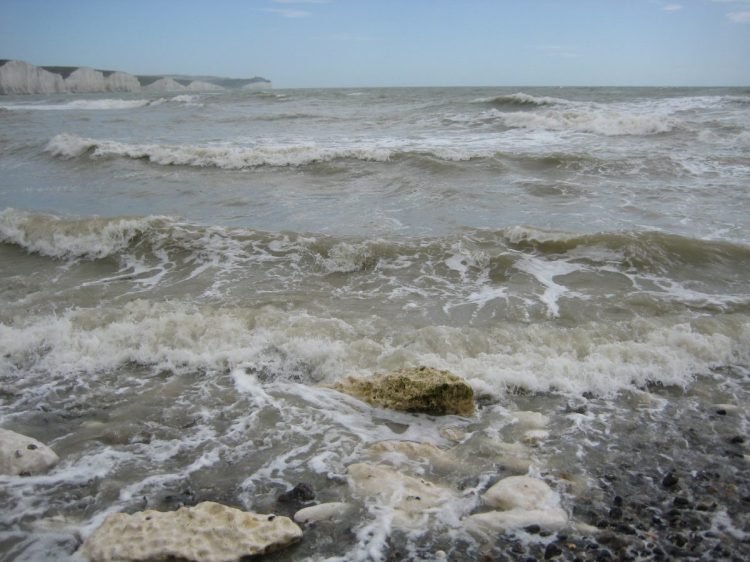
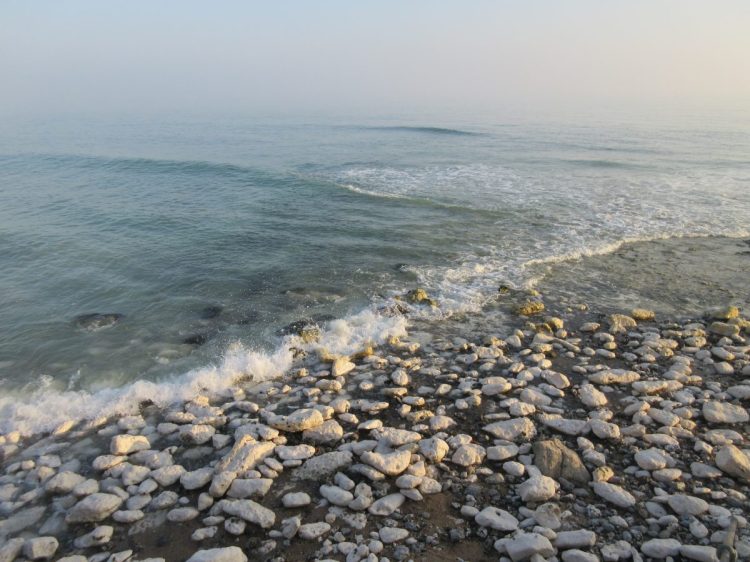
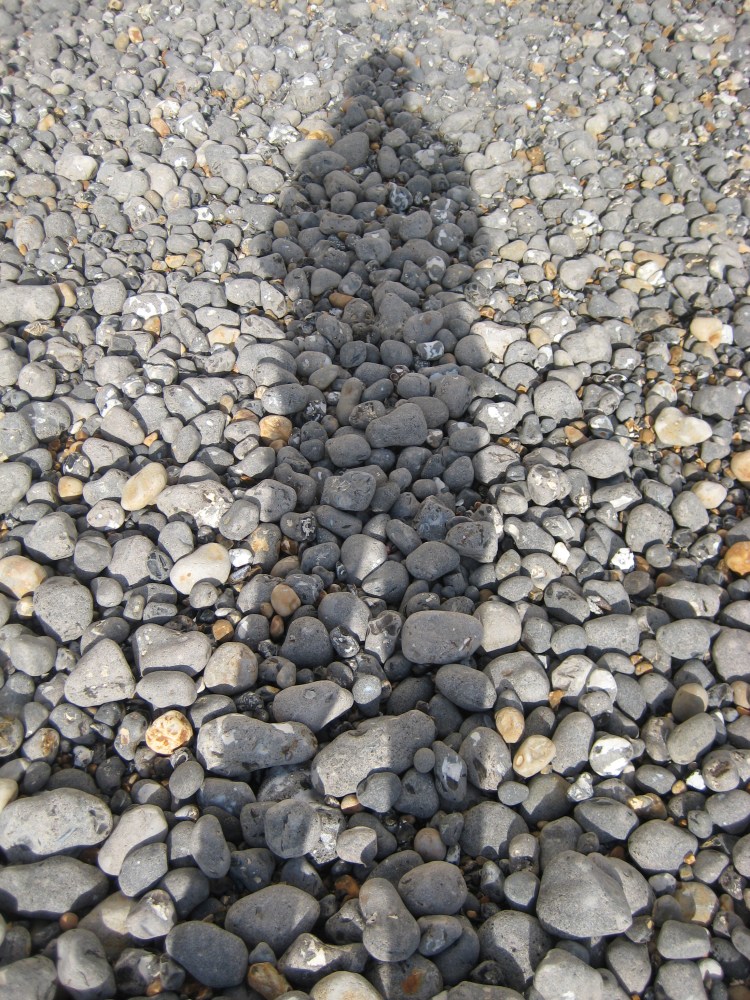
I love the sea and the sound of waves pulling back and pebbles surging and crashing
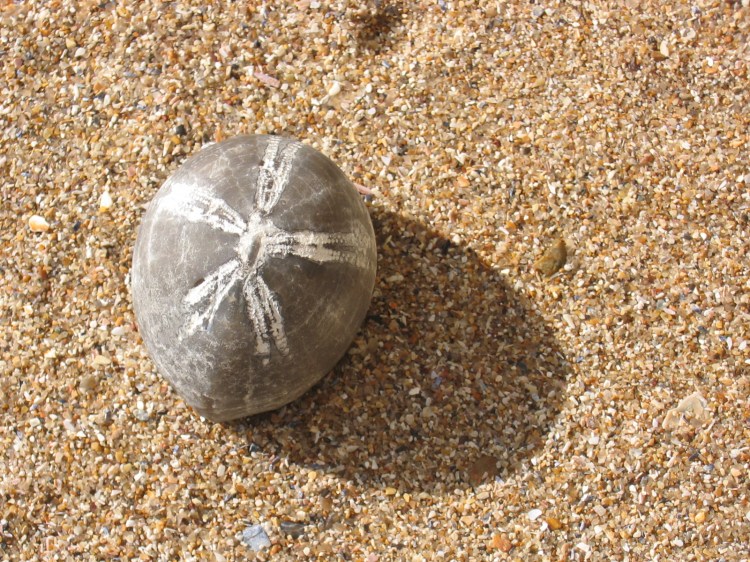
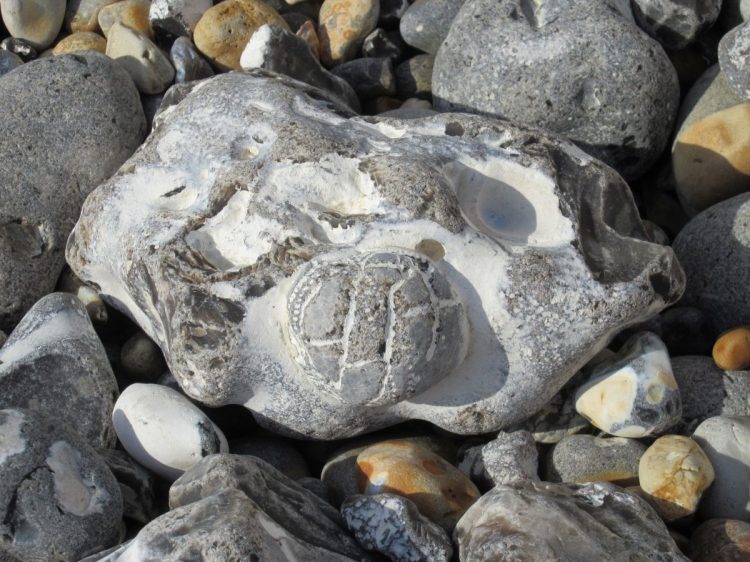
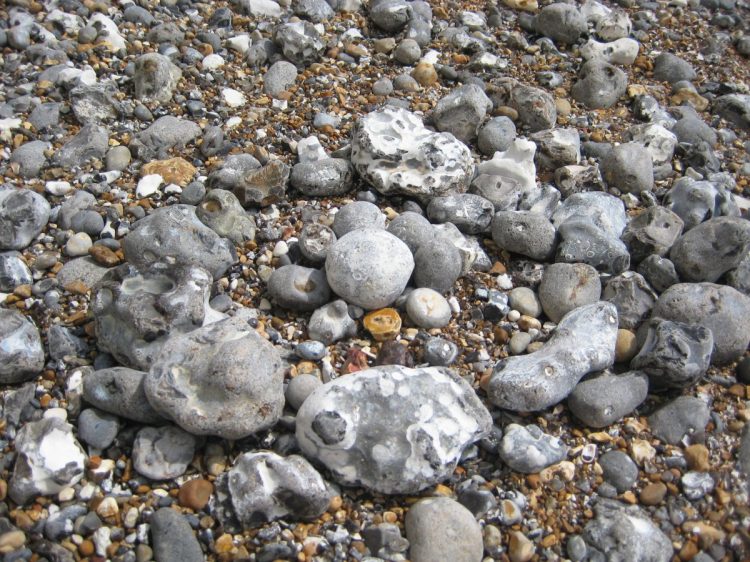
Stones, pebbles and fossils are a constant inspiration, their shapes, marks and patterns. The Thames foreshore, stones, bones, seaglass, a sense of history and wonder in everything you find.
I love it when ideas come together
Sometimes this takes a long time, an idea is there and waiting but it will not manifest. It can be frustrating, and sometimes the ideas are dormant for weeks, months, sometimes years; until somethings shifts, and the idea suddenly is clear. If a piece works, it feels fantastic.
And looking at such finished work where I feel nothing needs to be changed but it simply ‘is’, it is deeply satisfying.
My influences
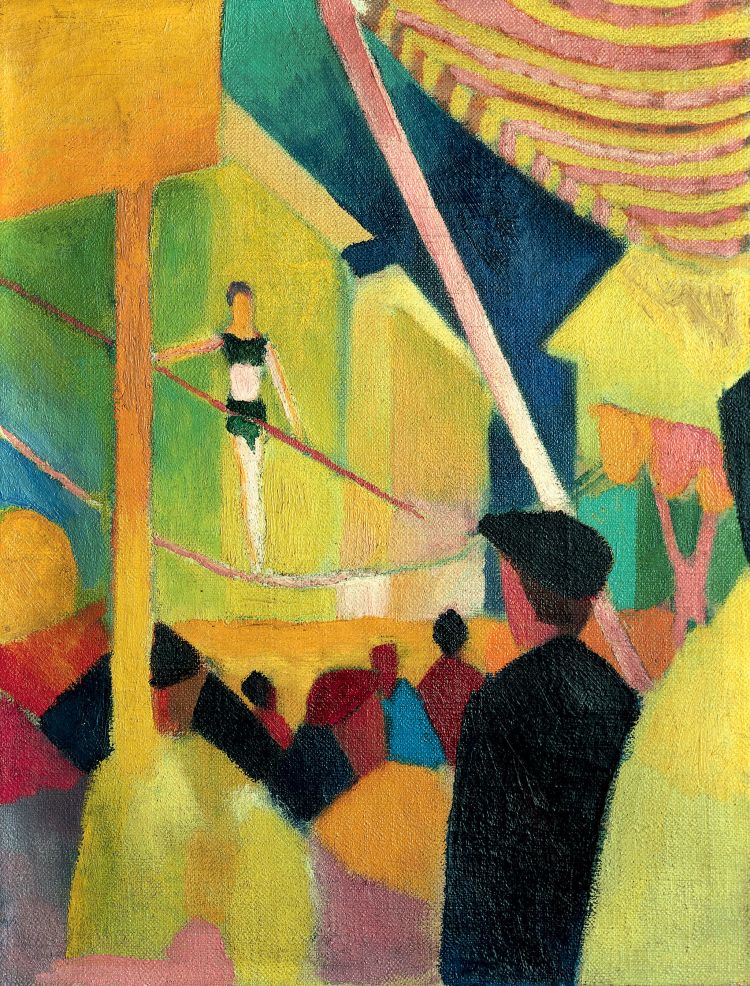
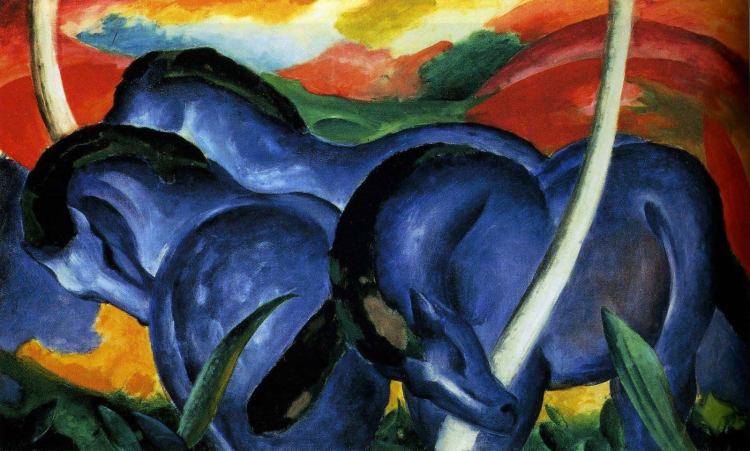
I grew up with German expressionism; August Macke, Ernst-Ludwig Kirchner, Franz Marc, Paula Modersohn-Becker.
August Macke; Seiltänzerin/ Tightrope Walker, 1913
Franz Marc; Die großen blauen Pferde/ Blue Horses, 1911
Ernst Ludwig Kirchner; Female Nude, 1908
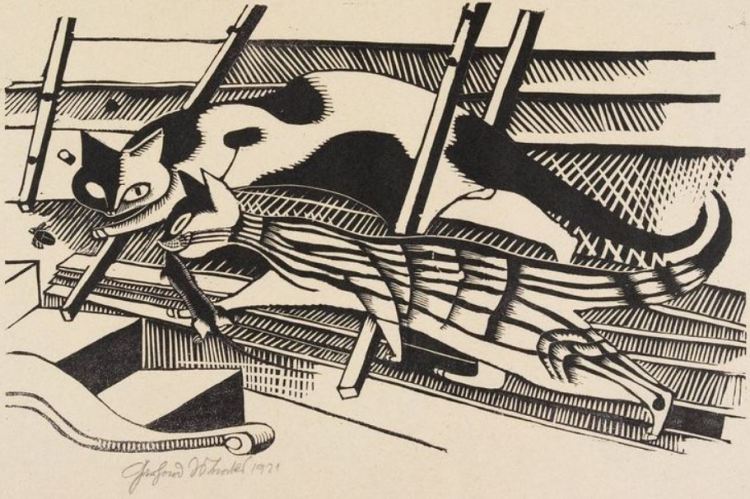
Gerhard Marcks; Die Katzen im Dachboden/Cats in the Attic, 1921
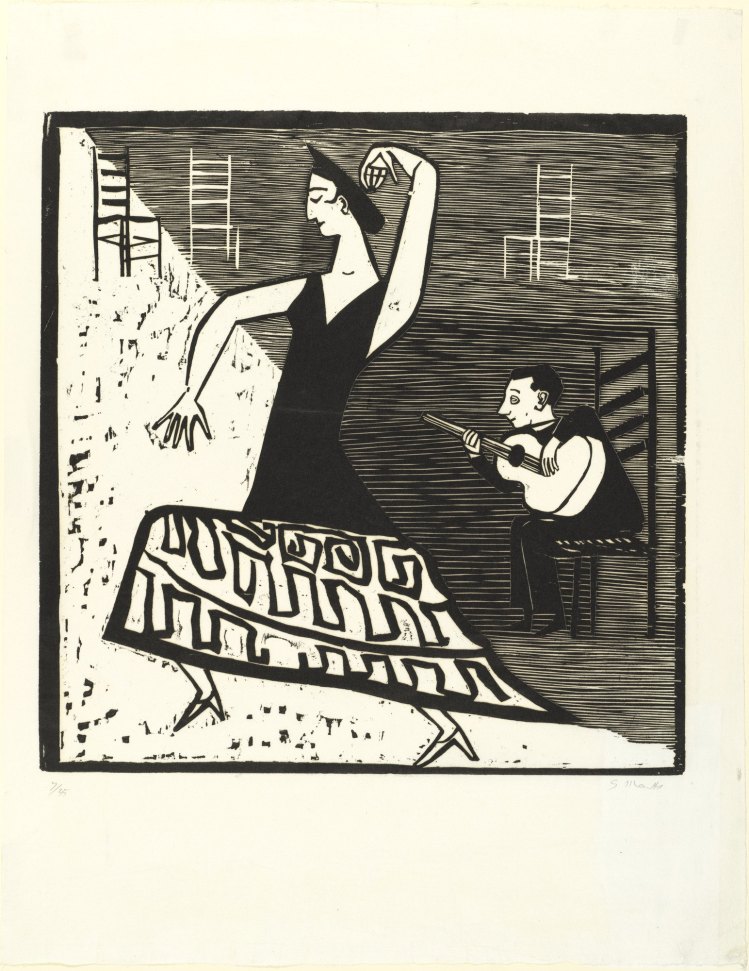
Gerhard Marcks; La Farruca, 1951
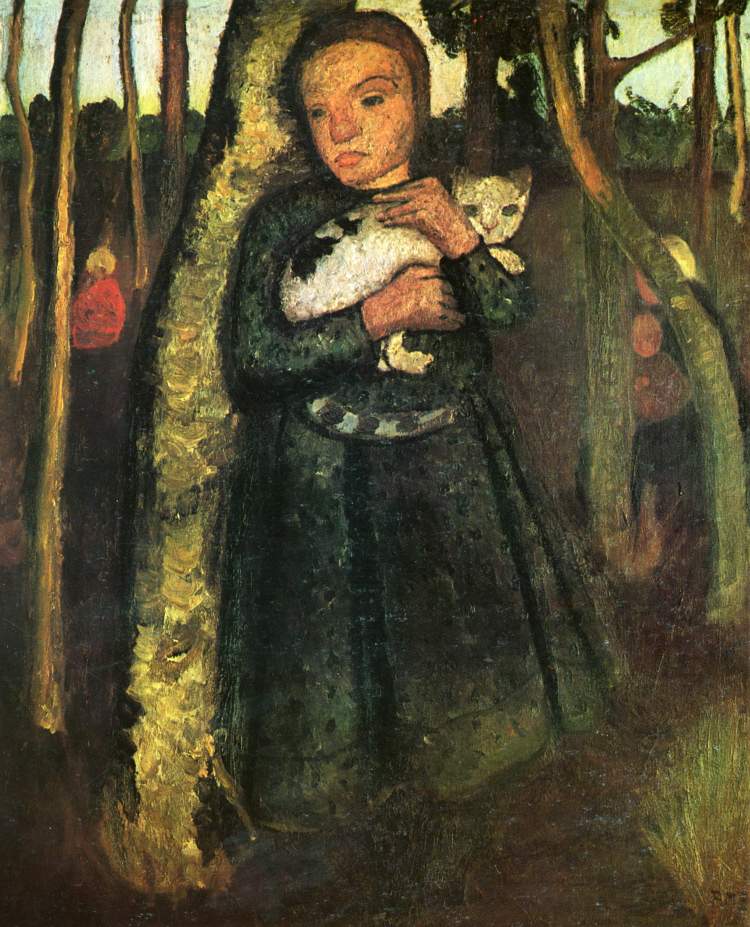
Paula Modersohn-Becker; Mädchen mit Katze im Birkenwald/ Girl in Birch Wood with Cat, 1904
I love Japanese woodcuts (Hokusai, Hiroshige, Kuniyoshi)
I find their perfection of technique astonishing, and their depiction of natural phenomena sometimes leaves an ache in me, a tinge of sadness as I know I will never come close to emulating that perfection and beauty.
Hiroshige; Naruto Whirlpool (around 1853)
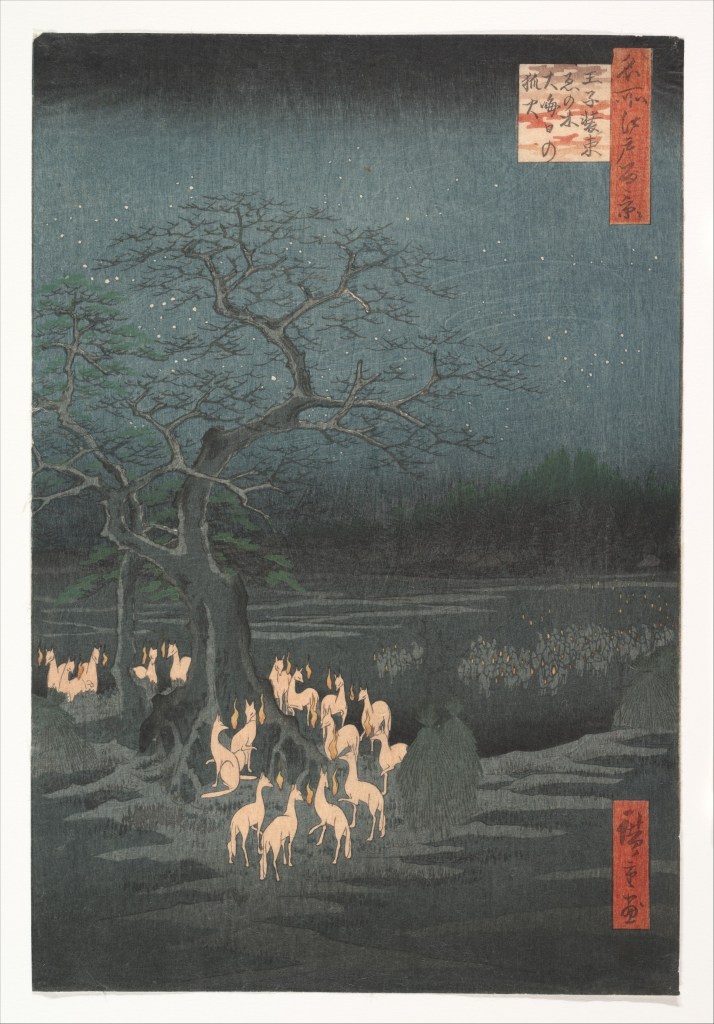
Hiroshige; New Year’s Eve Foxfires at the Changing Tree (around 1857)
Sybil Andrews has had a big influence on my linocut art. Her lines, movement and sense of landscape are something I continue to aspire to.
Sybil Andrews, Plough, linocut, 1961
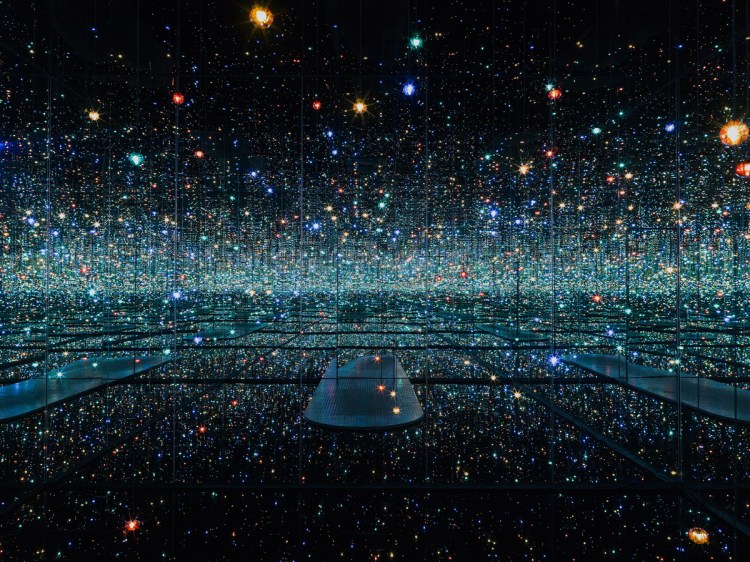
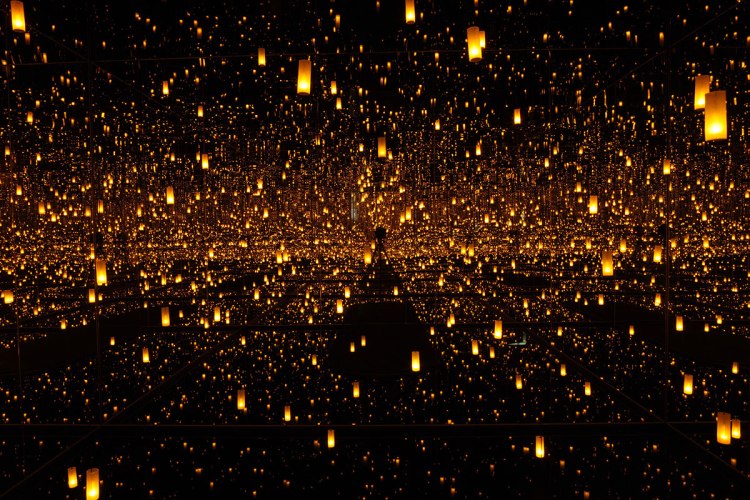
Joseph Beuys, Rebecca Horn; Yayoi Kusama – her infinity mirror rooms probably have had a big impact on my obsession with mirrored images.
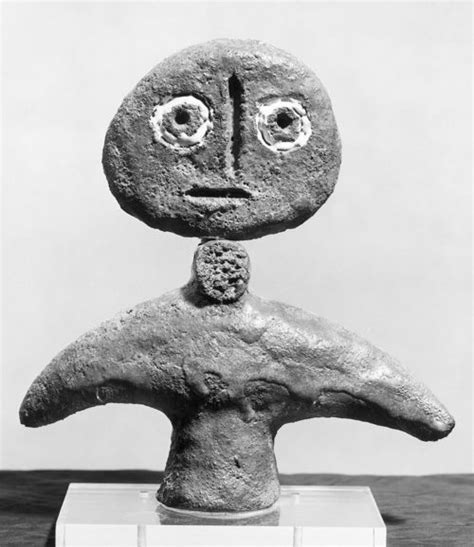
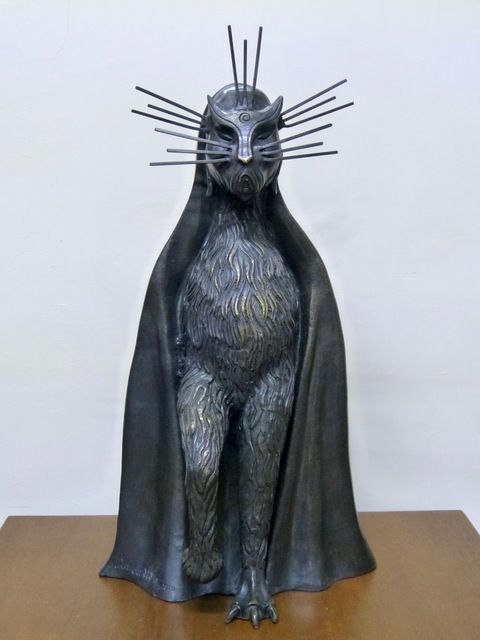
Picasso’s animal sculptures, his ability to capture the essence of animals; and his humour; the sculptures of Jean Miro, Alexander Calder, Leonora Carrington, Niki de Saint Phalle; the Nanas and her Tarot Garden. Max Ernst, Remedios Varo. The sculptures of Nicola Hicks and Paloma Varga Weisz.
Petit Hibou (Little Owl) 1956, Jean Miró
Gato de la Noche (2010) by Leonora Carrington
The need to be creative has never left me
When I was 16 I spent a year as an exchange student in the United States. I took loads of art classes in high school and loved it. After my exchange I went back to Germany and graduated from high school followed by art school. I found that formal art education did not particularly agree with me. It was not a good period in my life, a lot of painful stuff happened.
Artists & Writers in their Own Words: Maria Strutz
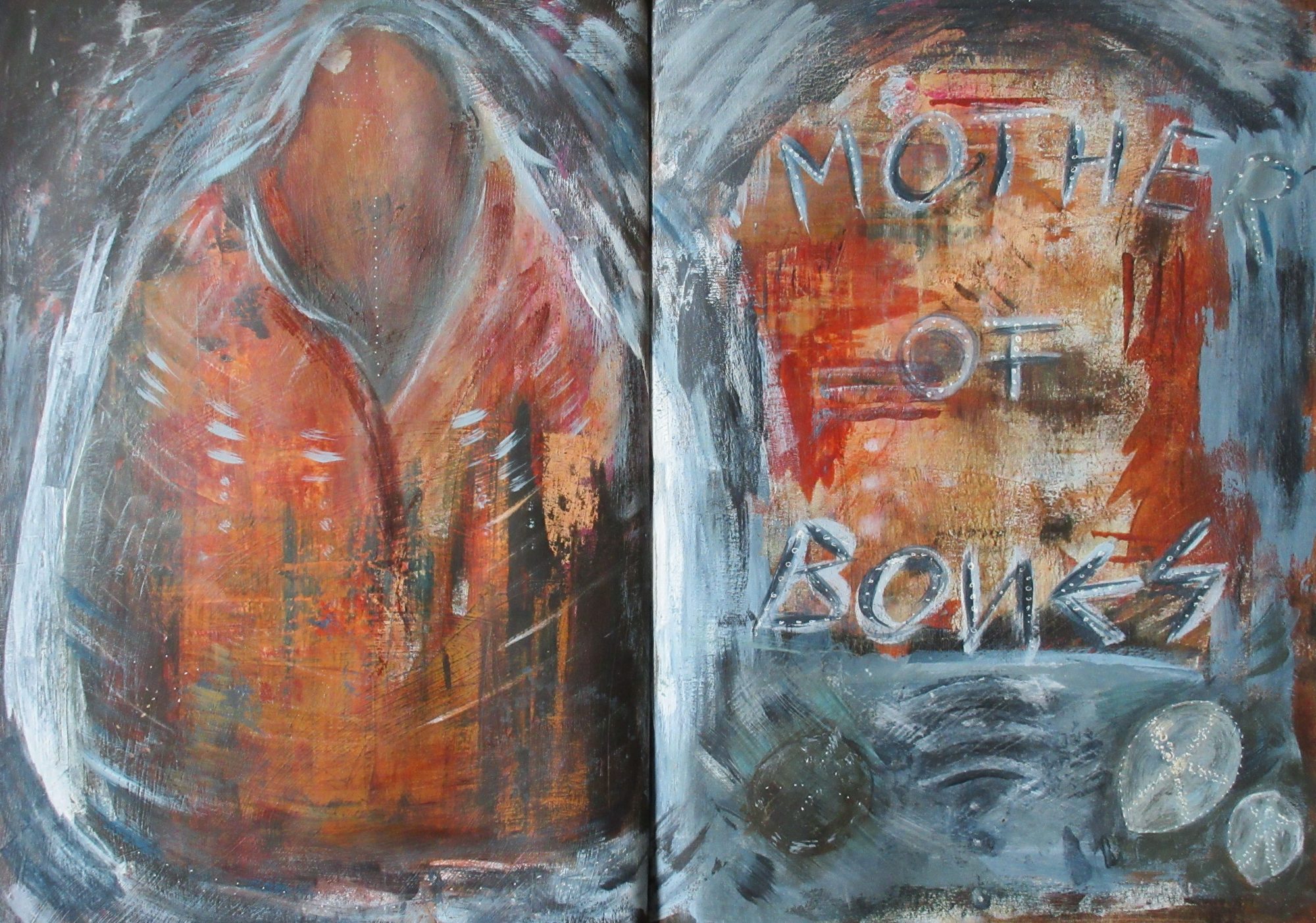
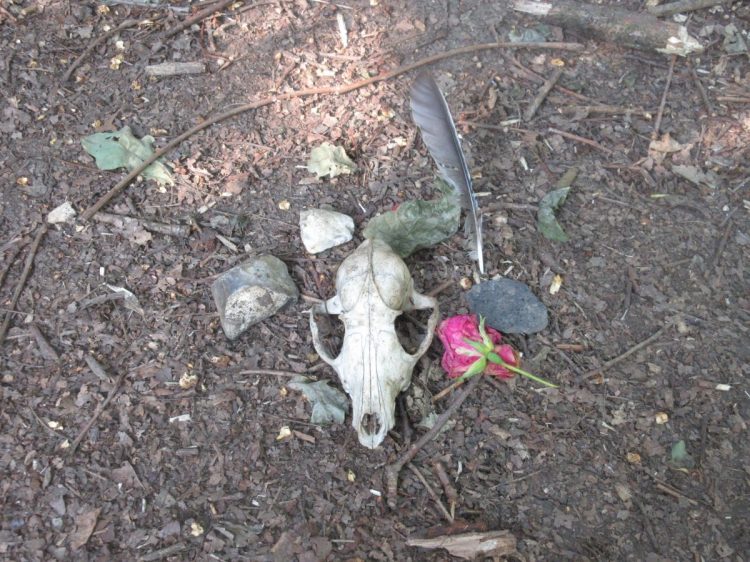
Bones are what remains of us all. Death, beyond death, beauty of death
In Art School, I became fascinated with bones. We were supposed to model a skull in clay, with a choice of horse, cow or human. Observing the beauty of skulls, seeing the shapes, angles, ins and outs, concave and convex, the fine lines, fine ridges.
Exquisite balance of marks and angles, perfect beauty. The beauty of death. Not the clinical fear of rotting and wasting, dying alone, but being encompassed by the universe, becoming one, going on, melding.
The skull of a fox
I have spent a lot of time with bones on the Thames foreshore, sifting through bones, sitting in piles of bones.
The waves tinkling and playing with pieces of ceramics. The bones jingling, hollow and resonant musical instruments. Bone mother. A comfort in bones.
Stones of Hope
Stones of hope
Labyrinth
Stones
Sea seven sisters stones
Sea seven sisters
Often I become interested in a particular animal because of dreams or journeys
Once an animal catches my attention, I immerse myself in their natural history and mythology
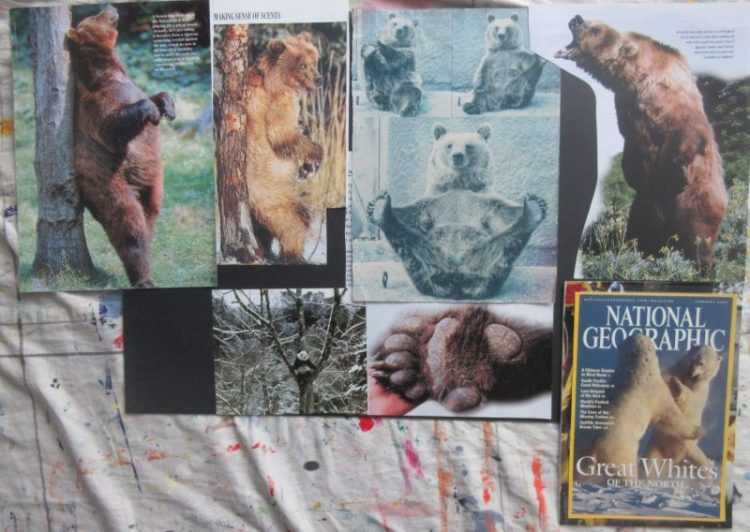
I read stories and books about them, watch videos and look at countless photographs to get an idea of their movements, their fur, skin, musculature, typical postures, and I fill notebooks with sketches.
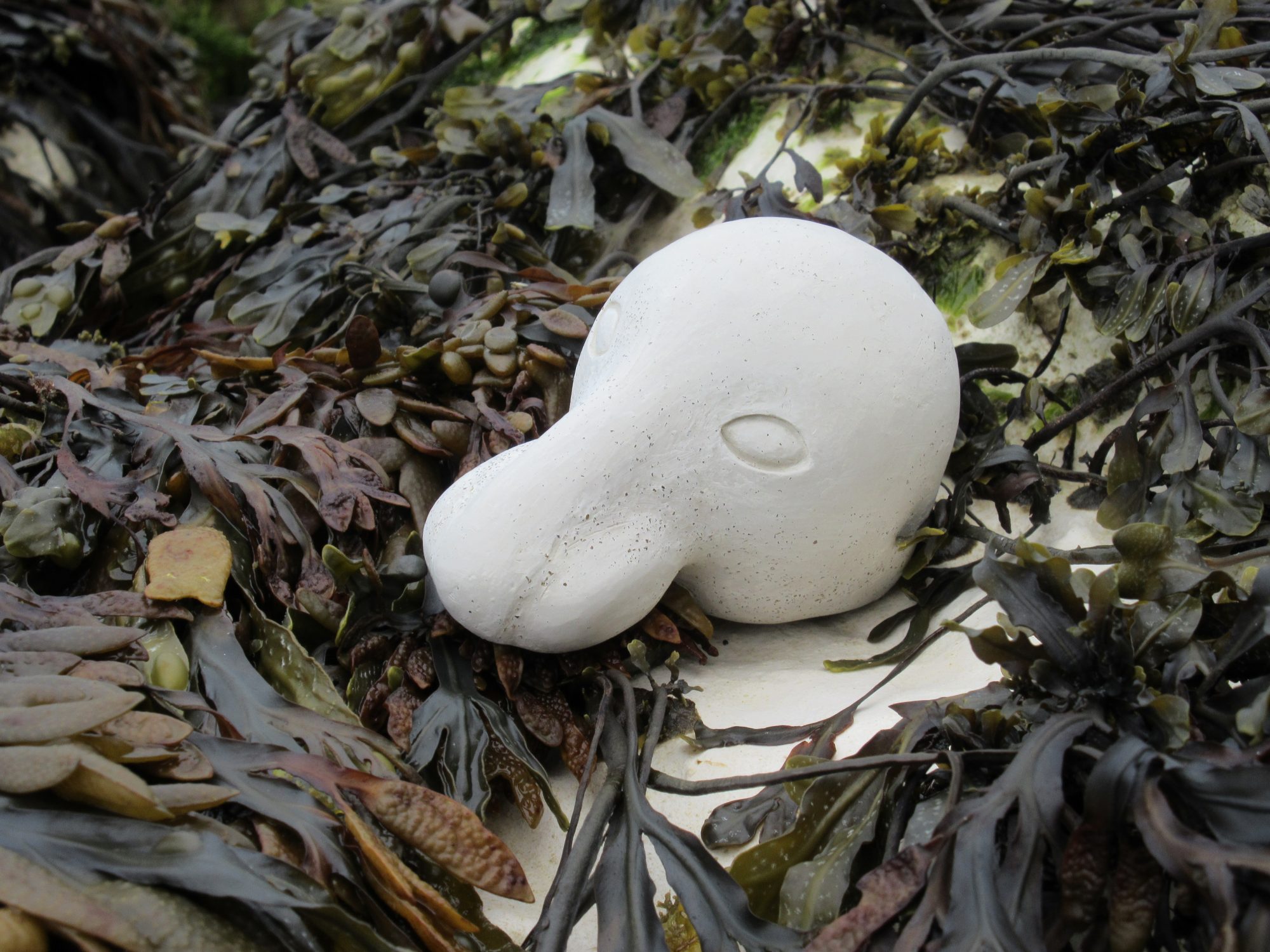
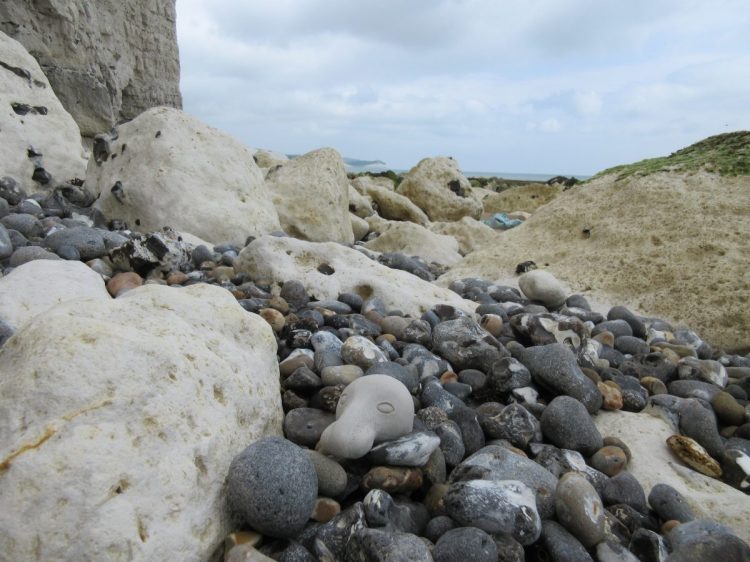
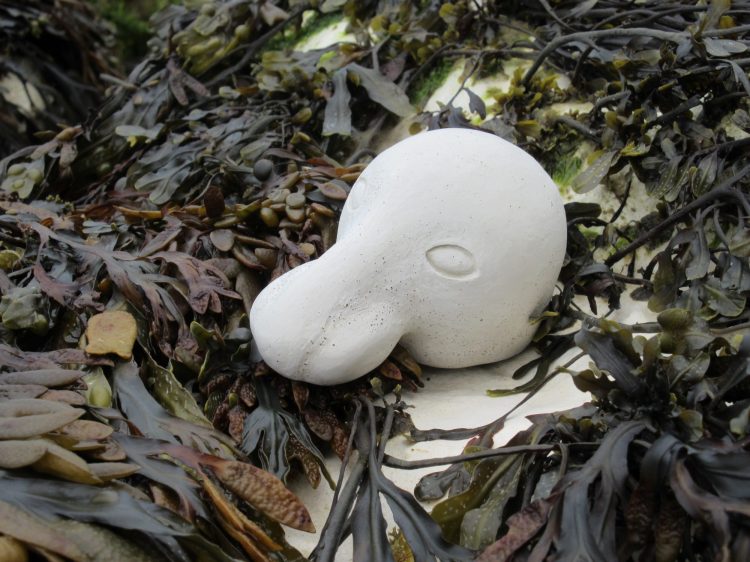
Seal head and seaweed
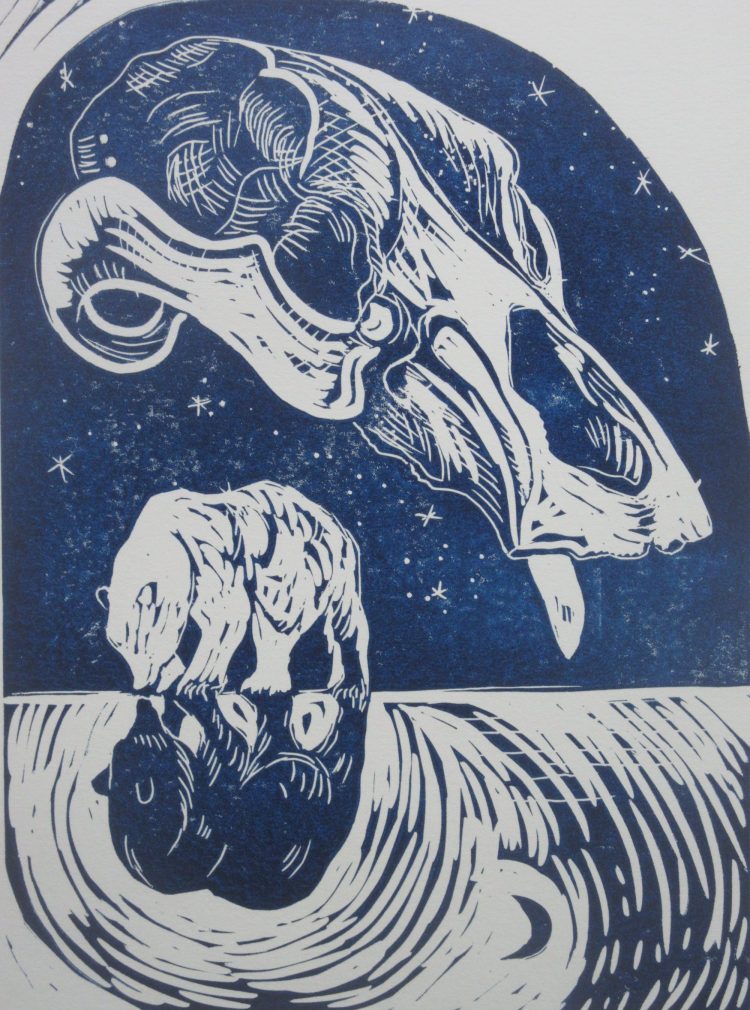
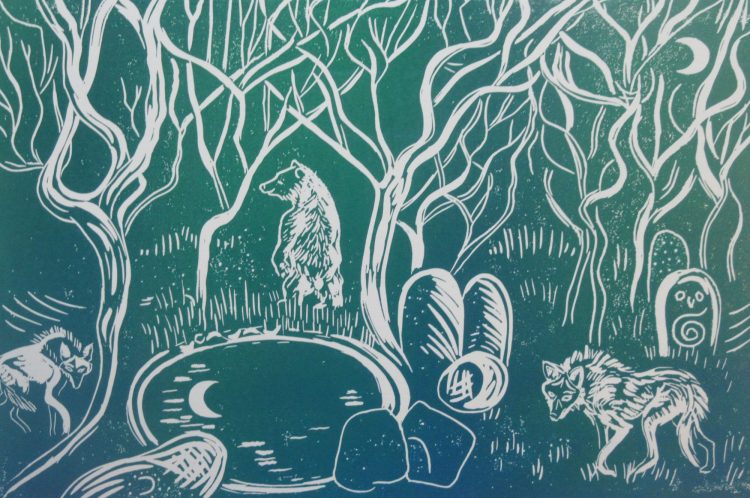
Ancestor Cave Bear watching over the Ghost Bear of Hookland
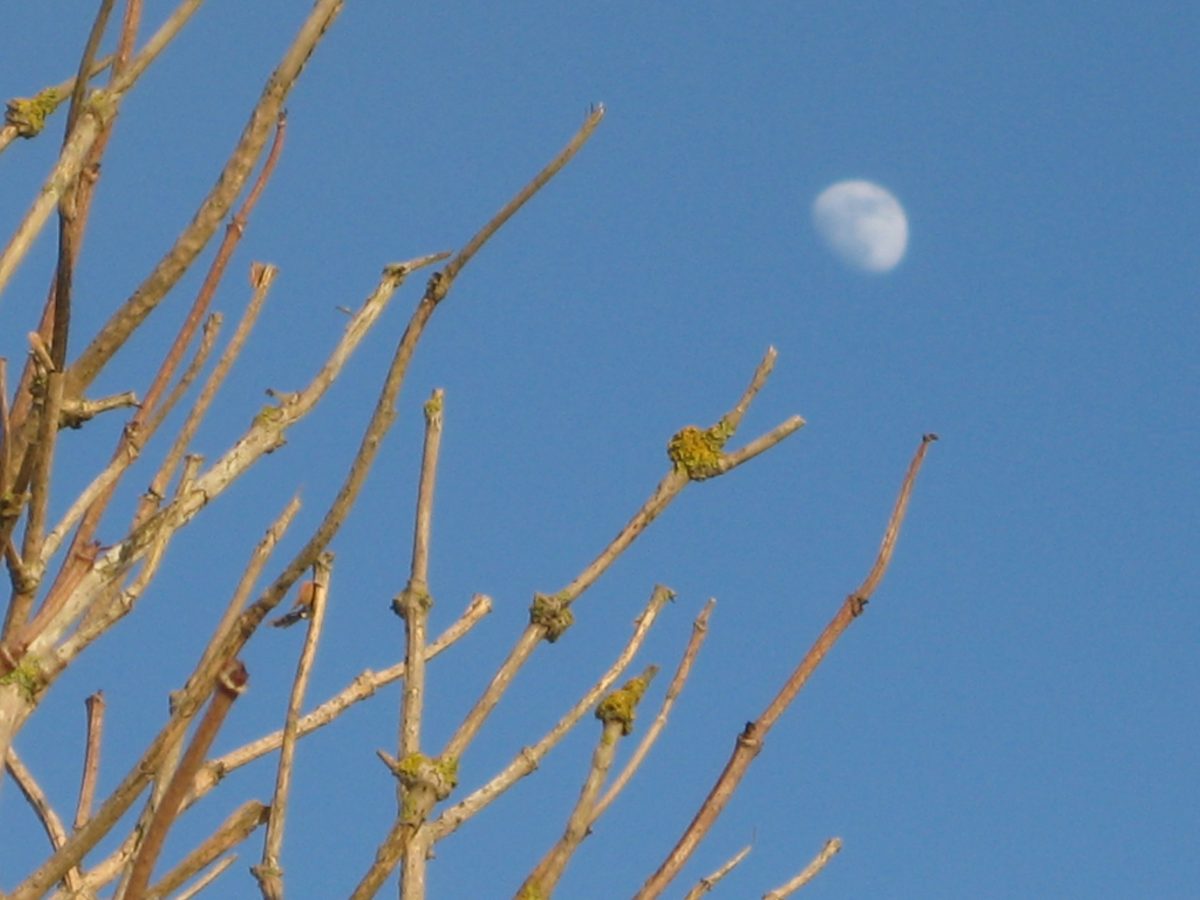
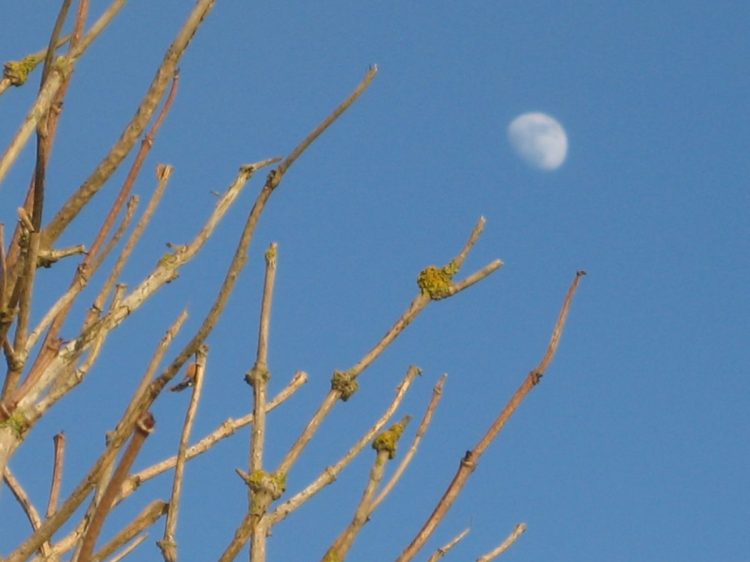
Moon during the day time
Through the hagwood
When fascinated with an animal, I become obsessed for a while; in the end some stay with me, others float away
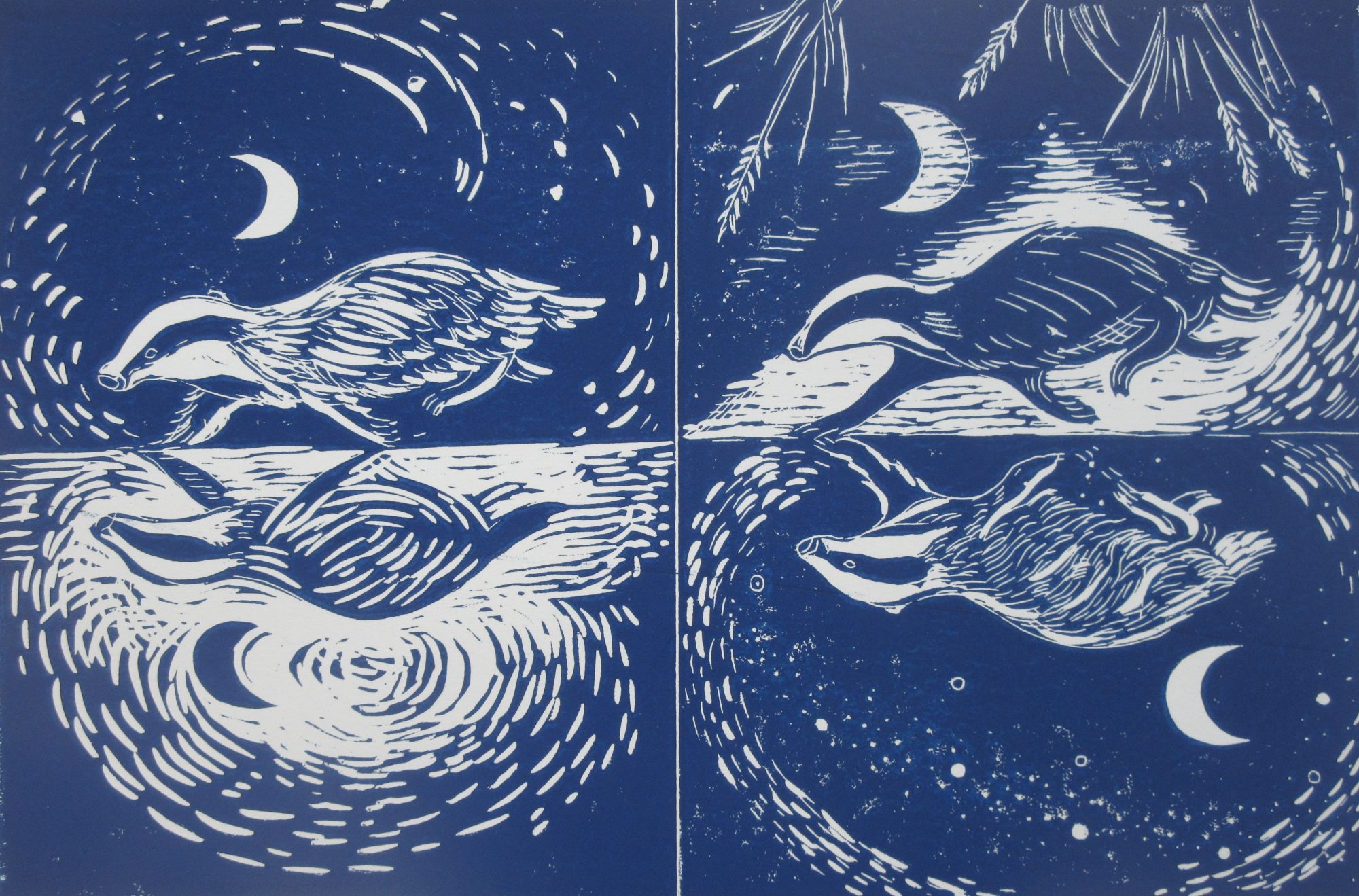
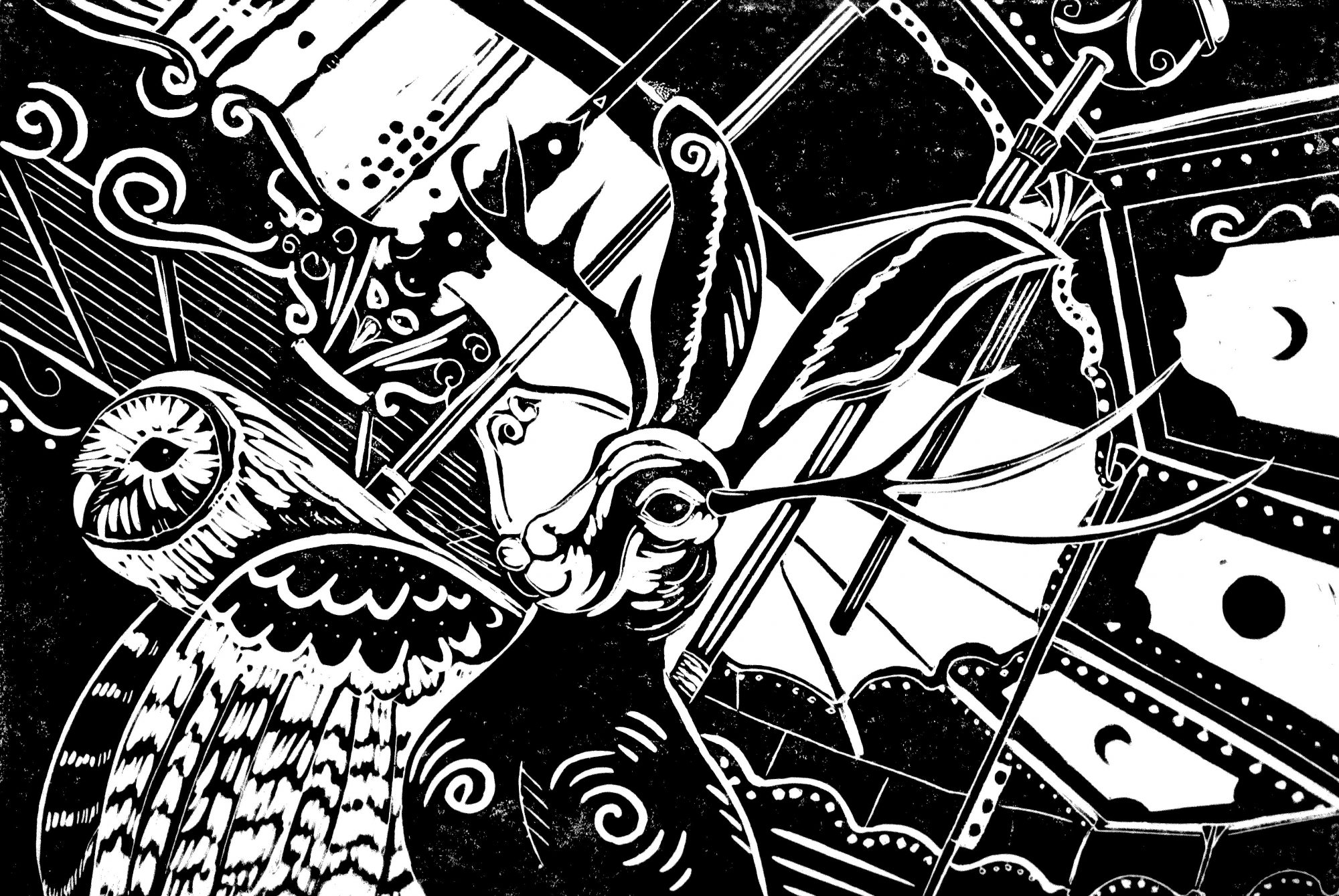
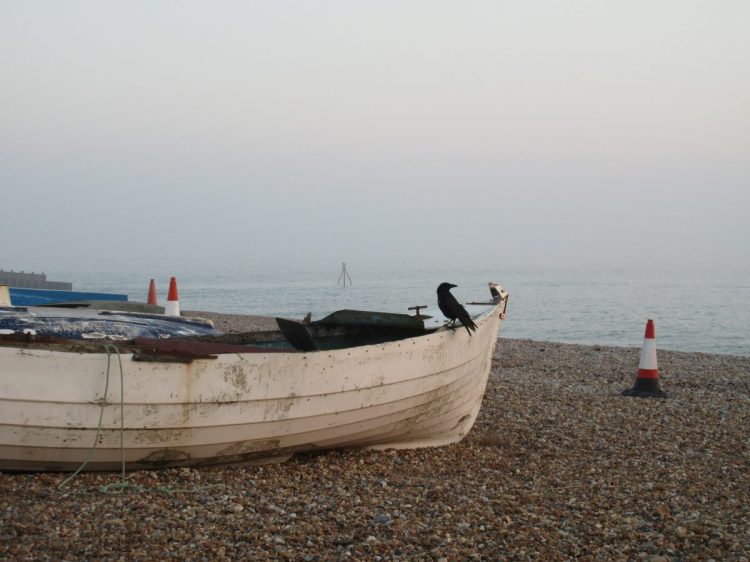
Some of the animals that I love are crows, bears, otters, seals, badgers, foxes, wolves. And owls. I always return to owls.
Once the idea is there, definitely ‘there’ and it just needs to be executed, I have to stay in the flow of it, and I might listen to something to support the feel of artwork.
Animal mood boards – Bears
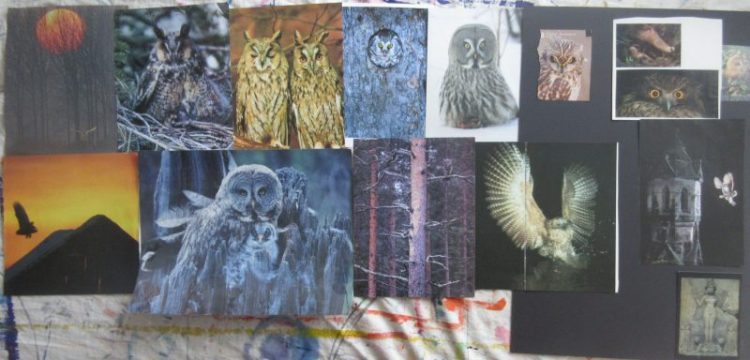
Animal mood boards – Owls
If I could give advice to myself as a young artist, I would say:
Be creative, doodle and play. Don’t wait for things to happen in order for you to be able to be creative. Carve out the time, the space, play. Also, you don’t have to study art necessarily, just create. And continue creating.
‘Ghost trees, Ghost Bear and Ruffled Fox on Pony Hills’ by Maria Strutz
If you do decide to go for an art degree, research the schools and the teachers. If you have a choice go for a teacher whose work you adore and whose opinions you respect.
I love being in flow and being creative. It’s an imperative…I can’t not do it
Art school left me feeling bruised, hurt, raw and full of self-doubt. I tried to turn away from ‘art’ after this. Very soon I started scribbling away, with a biro, nearly in a secretive way. Biro doodles weren’t ‘art’, so I was safe.
I filled notebook after notebook. A few years later I started creating linocuts, as they felt playful. They were not something I had done at college, not something that was overlayed with my professors’ critical comments.
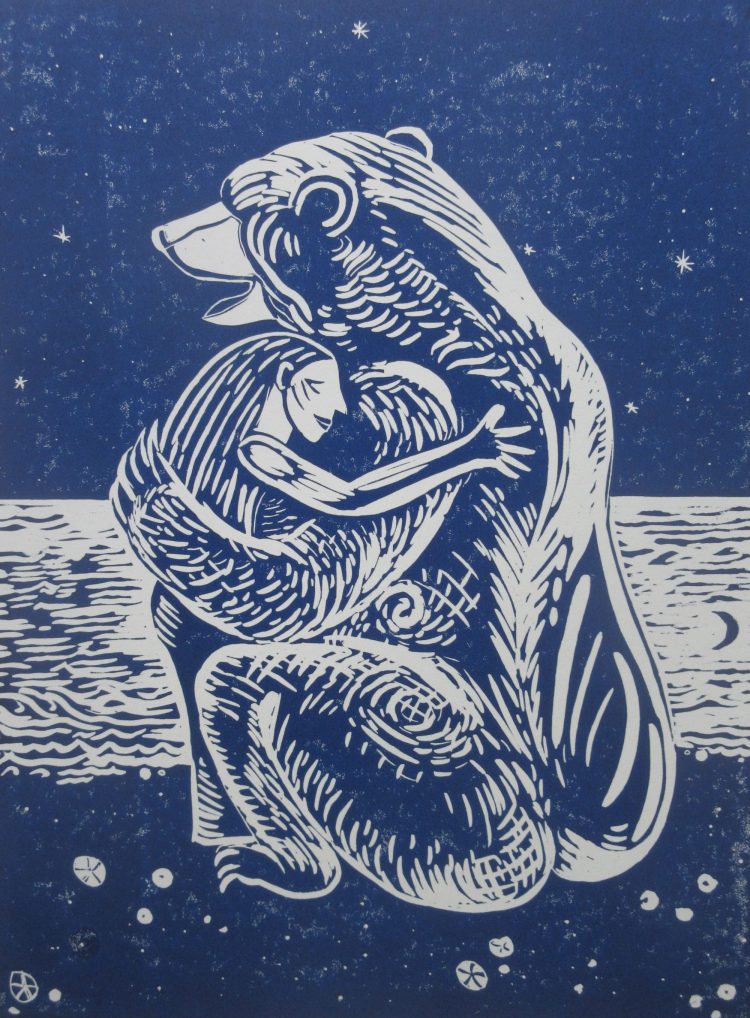
Bear hug by Maria Strutz
During lockdown, I found it important to carve out physical routines for myself
Routines of beauty. I went to our local museum gardens nearly every morning in spring and summer and had breakfast in the sunken garden. I watched the spring display blossom into full bloom until it started withering and decaying. It was gorgeous and poignant in all its stages.
I went for a few twilight owl walks and heard owls and even got to see one or two. Total win!
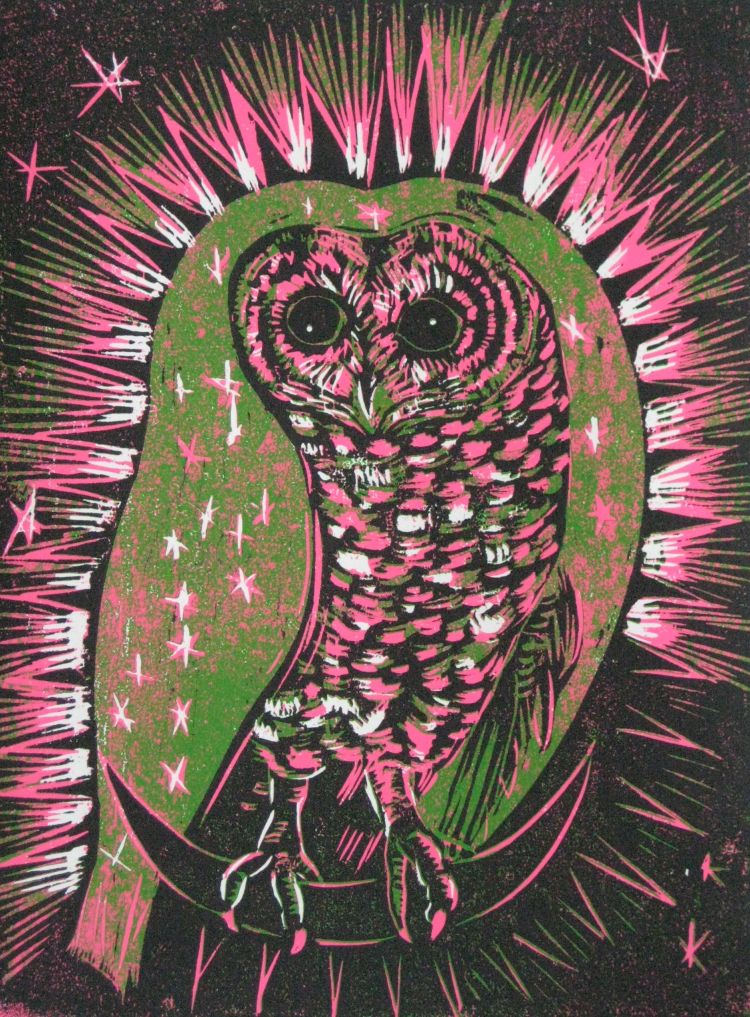
Queen of Owls of The Hum
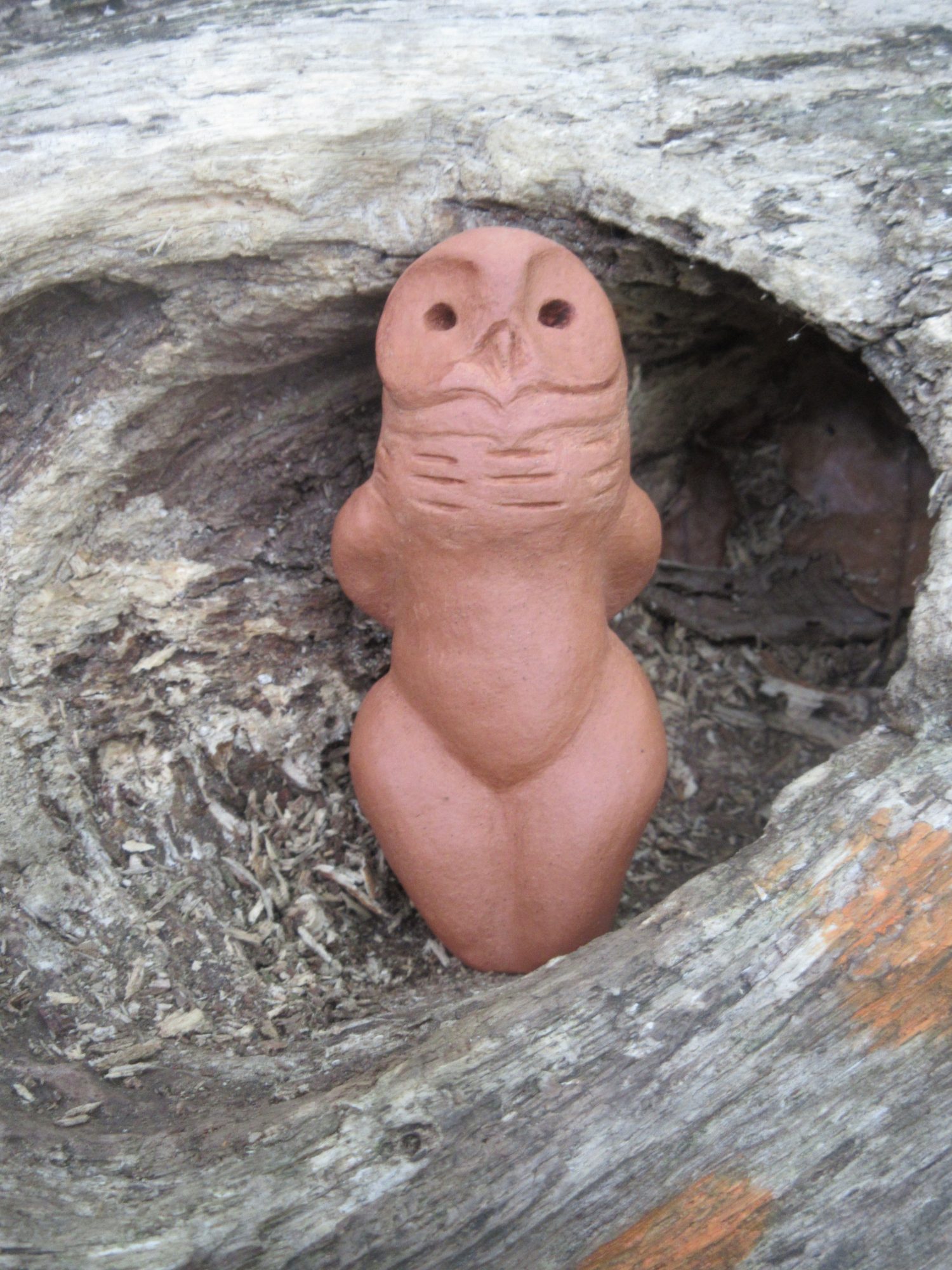
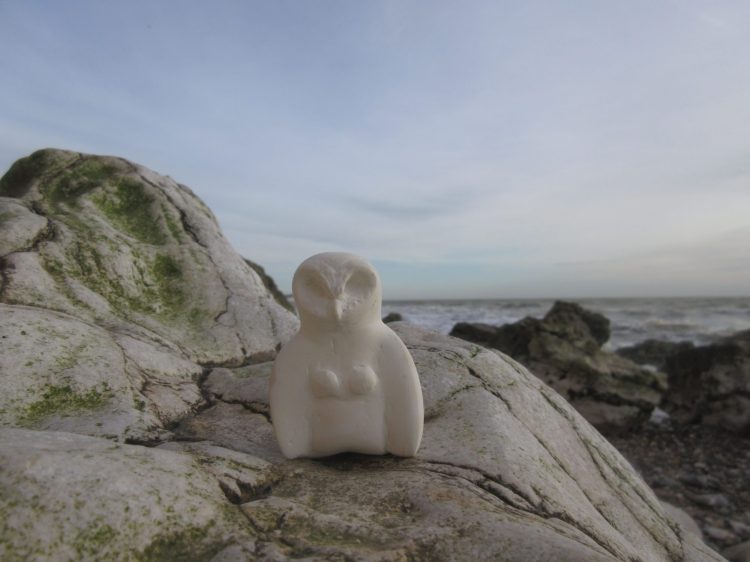
Owl Woman by Maria Strutz
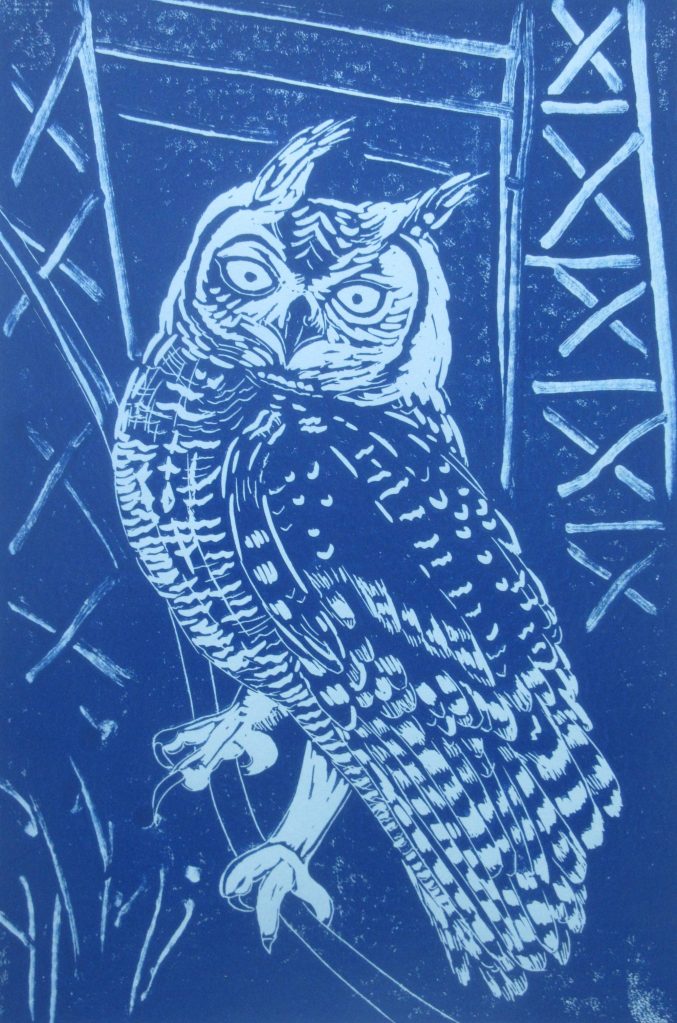
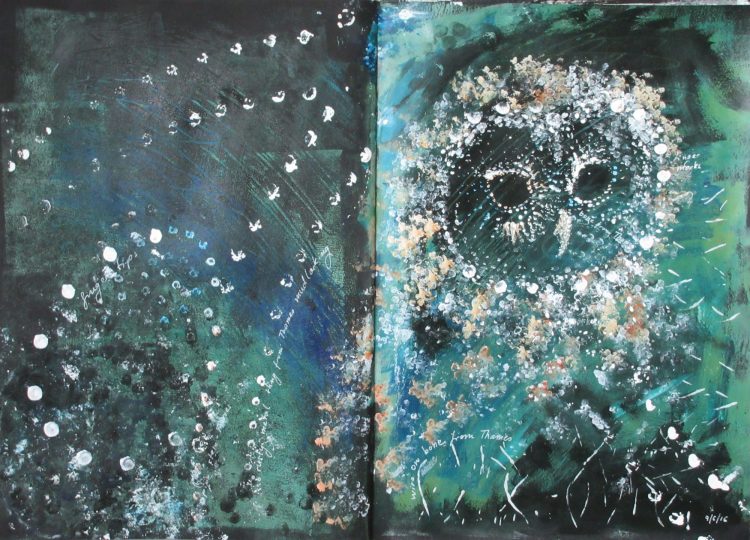
Thames Owl by Maria Strutz
I also found comfort in my artwork, entering a state of playfulness, creating non-obvious narratives. Narratives that I would like to be told.
I find creative flow is not a state that I am guaranteed to enter but when it does happen it is wonderful.
I noticed that I needed a near-constant supply of home-baked cake for most of last year. I had a period of cake-overload post-Christmas but have just made the first cake of the new year.
I enjoyed making wyrd lockdown recipes due to a lack of ordinary flour
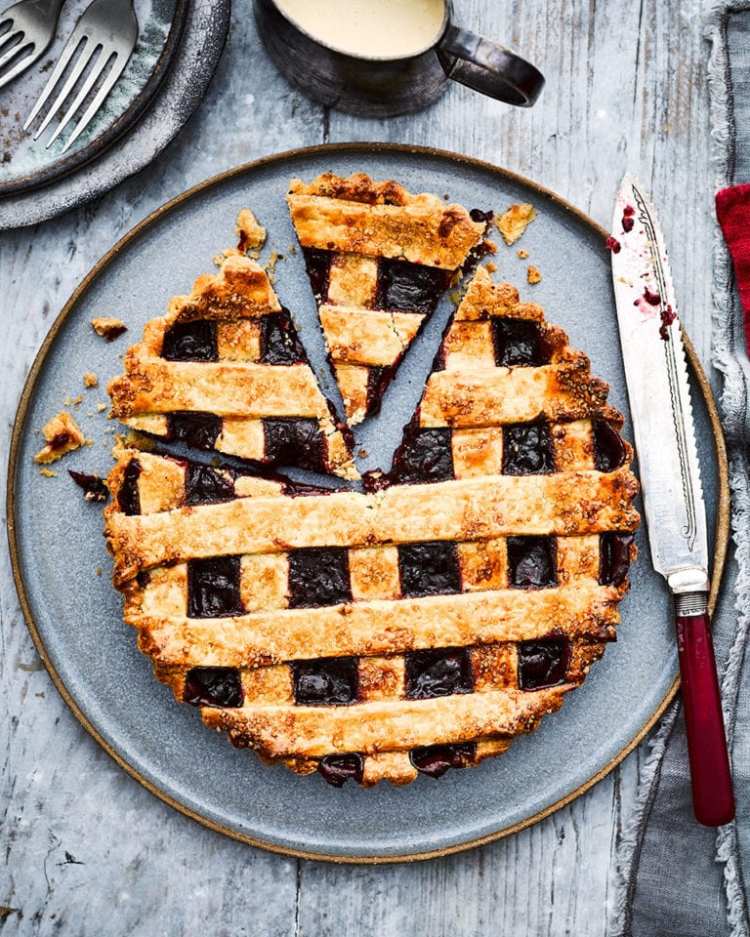
My favourite was: Linzertorte, which is an Austrian hazelnut cake with cinnamon, cloves and raspberry jam and chickpea flour, a perfect combination.
I enjoyed getting out of my head and back into my body. In the evenings I’ve been regularly practicing a Karate ‘breathing kata’. It’s soothing and good before going to sleep.
There are quotes that I feel compelled to find a visual solution for; the Carousels of Luna Park, the Empress Eel, the ghostly trees on Pony Hills, the Ruffled Fox, the Bone Bear. Utterly inspiring and at the same time not always easy to manifest.
There’s a group of hills on the eastern edge of Barrowcross they call the Pony Hills. Most reckon them haunted, but not by people, but by ghosts of vanished trees that made a forest and animals we don’t have now. Shades of bears, great worms and the ruffled fox. – Tom Rudd #VOH
If I were to speak to my younger self, I would tell her: it is okay to be vulnerable
Be kind to yourself. Trust your vision even if you cannot sell it, even if it does not manifest in money, even if you cannot voice it to others. Be gentle with yourself. Learn to let go of unhelpful crap.
When I was a child I think I saw the Queen of Owls. Well, a bit of her anyway, because one of her wings covered the whole span of the window in my bedroom. I saw the feathers, the movement of it and then she was gone. Flying up above the farm, into mystery. – Kirsten Love #VOH
Don’t believe that because others tell you that something is hard, that it will be hard for you too.
Don’t trust the judgement and opinions of people you don’t respect in turn.
Don’t measure yourself according to other people’s ideas of what being an artist means.
Don’t believe in others’ ideas of ‘success’.
One group whose music I return to again and again is Wardruna
They make music that is powerful, raw, circular, soaring, trance inducing, many-layered.
Although, I don’t think of myself as somebody who likes music. I find it easily distracting and irritating. Lyrics get in the way of my thought processes. Also, I tend to over-listen to music until it is spoiled, overfamiliar.
Thank you for reading, you can connect with me and buy my art here…
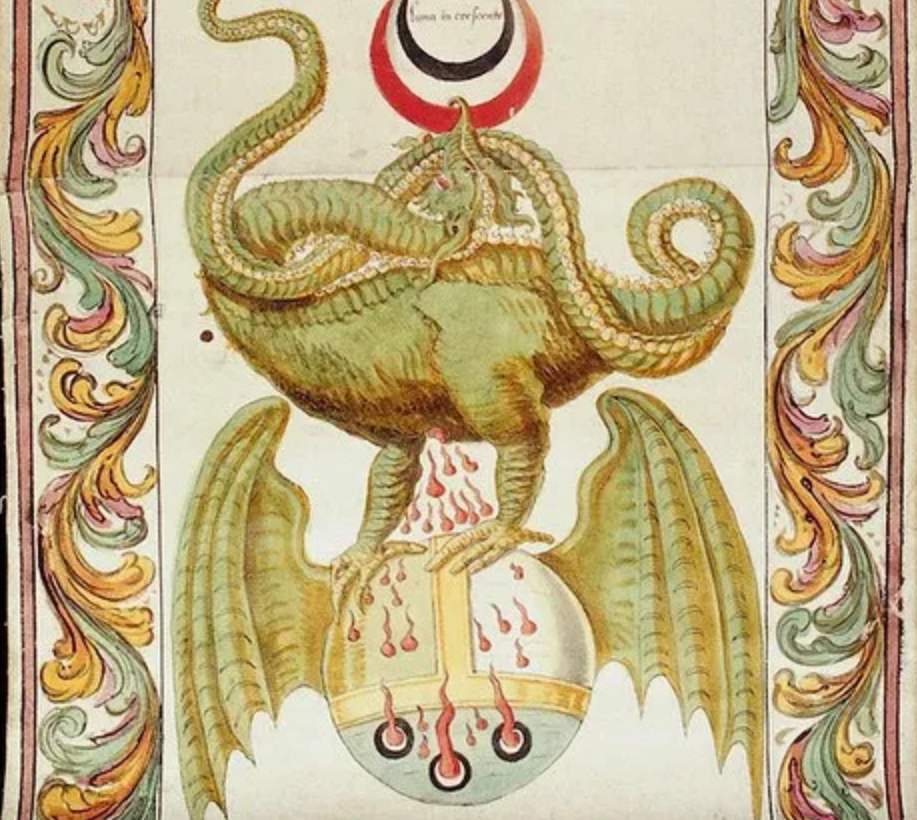
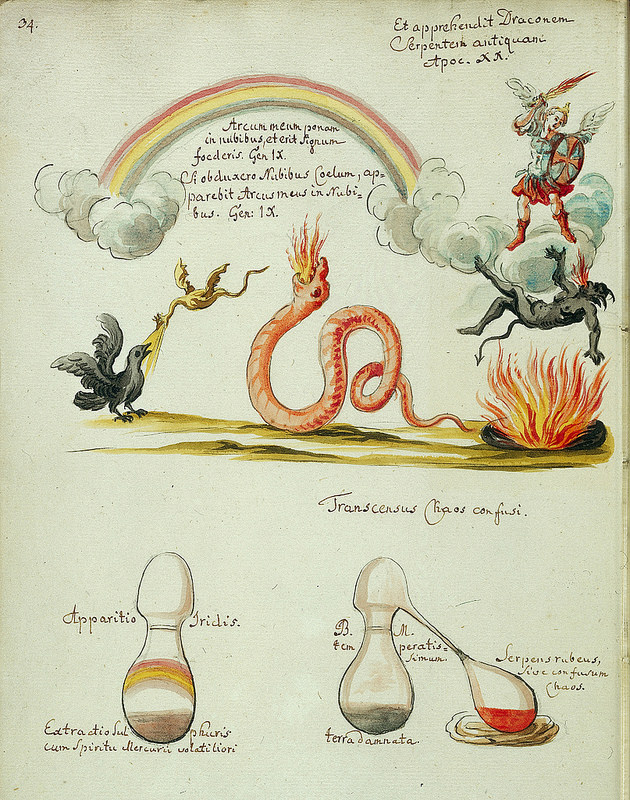
The goal of alchemists was to bring a mystical fifth element known as the ‘quintessence’ from the divine fiery heaven and down to earth. The alchemist’s journey required him to pass through the outermost circle of the underworld…and to overcome the Greek god of time Chronos. And in overcoming Chronos, one has broken transient and sequential time and reverted to a golden age of eternal youth and divine benevolence. Through drinking a rejuvenating elixir [khemeia] or drinkable gold, it is possible to cheat age and death and become immortal.
Dr Haare Williams MNZM has been Dean of Māori Education and Māori Advisor to the Chief Executive at Unitec. He was General Manager of Aotearoa Radio. He set up a joint venture with the South Seas Film and Television School to train Te Reo speakers as producers and operators in film and television. He has worked closely with iwi claimant communities and was responsible for waka construction and assembly at Waitangi for the 1990 commemorations. He has published poetry, exhibited painting and written for film and television. He was a cultural advisor for the Mayor of Auckland and is Amorangi at the Auckland War Memorial Museum.




















 Content Catnip
You must be logged in to post a comment.