Orangutan: n. Orang ‘forest’ hutan ‘person’ or forest person in Malay
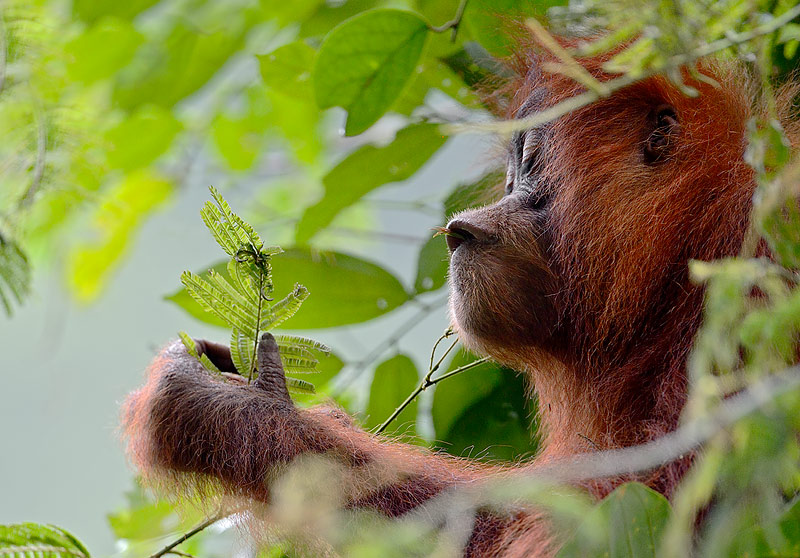
Orangutans belong to the great ape family, our closest biological relatives. This familial link is reflected in the word orangutan itself, which Malay speakers today can still recognise as deriving from the phrase orang hutan, which means “forest person”.
Beloved by children and animal lovers of all ages for their gentle soulful natures and intelligence, the word Oranghutan means Orang ‘person’ hutan ‘forest. Help protect these precious beings and #Boycott4Wildlife
This term goes back over a thousand years, contrary to the conventional belief that this word was coined by European visitors to Indonesia in the 17th century.
Surprisingly, the oldest surviving texts to use the word orangutan do not come from Sumatra or Borneo, where orangutans live today, but from the neighbouring island of Java. One of the oldest texts to mention orangutans is the 9th-century poem Rāmāyaṇa. Written in the Old Javanese language, the poem describes “the orangutans, all bearded, climbing up”.
The word orangutan came into Old Javanese from another archaic language related to modern Malay. These early appearances show the word was circulating among the archipelago’s languages well over a thousand years ago.
This origin as the phrase “forest person” shows for many centuries Southeast Asians have viewed orangutans as human-like creatures residing in the forest.
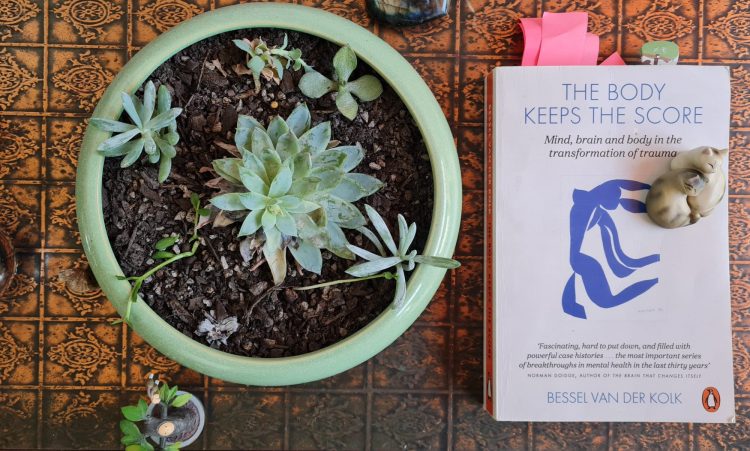
Who can find a proper grave for such damaged mosaics of the mind, where they may rest in peices. Life goes on but in two different temporal directions at once. The future unable to escape the grip of a memory laden with grief.
The essence of trauma is that it is overwhelming, unbelievable and unbearable. Each patient demands that we suspend our sense of what is normal and accept that we are dealing with a dual reality. The reality of a relatively secure and predictable present that lives side-by-side with a ruinous, ever-present past.
Comforting Thought: We are in a tight spotComforting Thought: The miracle of memoriesComforting Thought: The people we know by smell aloneComforting Thought: Anxiety is a doorway
I hope this edition of 10 things takes you into a sparkling lunar landscape of soaring birds and long-lost but loving fireflies, that’s what anybody would want or need in life…enjoy edition #84.
‘Tawai’ Dreamy, jazzy intelligent Drum N’Bass by Džiunglių Dvasios
Here is some cruisy, uplifting drum and bass by one of my favourite artists. In case you missed it I actually love this artist so much that I interviewed them here. This album is perfect background music for working on your blog, coding, making art or doing something creative.
Today, only 111,000 individual giraffes remain in Tanzania. Forming close relationships with fellow giraffes, however, could increase a female’s chances at survival, researchers found.
“Grouping with more females, called gregariousness, is correlated with better survival of female giraffes, even as group membership is frequently changing,” Bond told the University of Zurich.
Easy, yummy savoury vegan breakfast with Rachel Ama
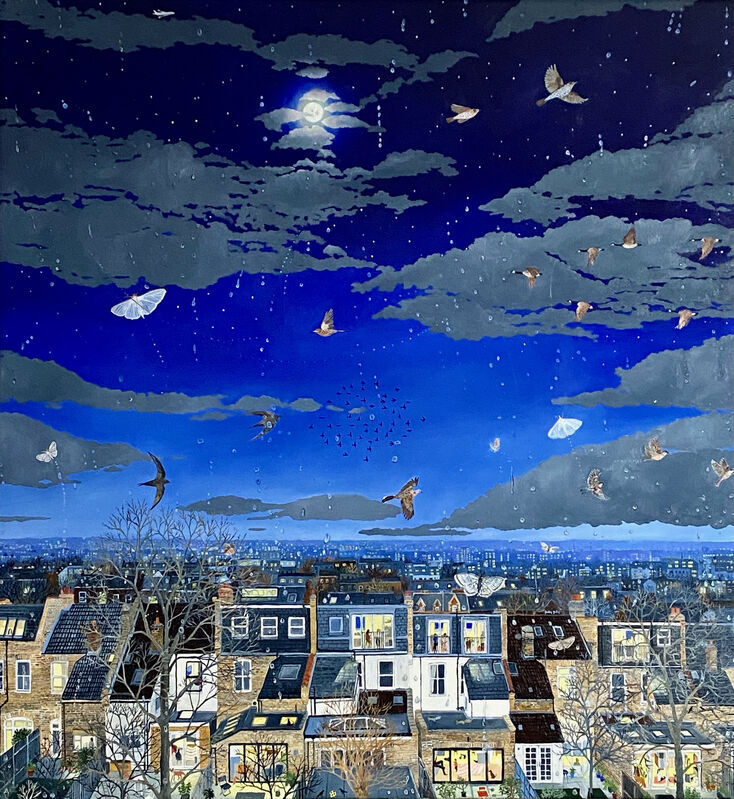
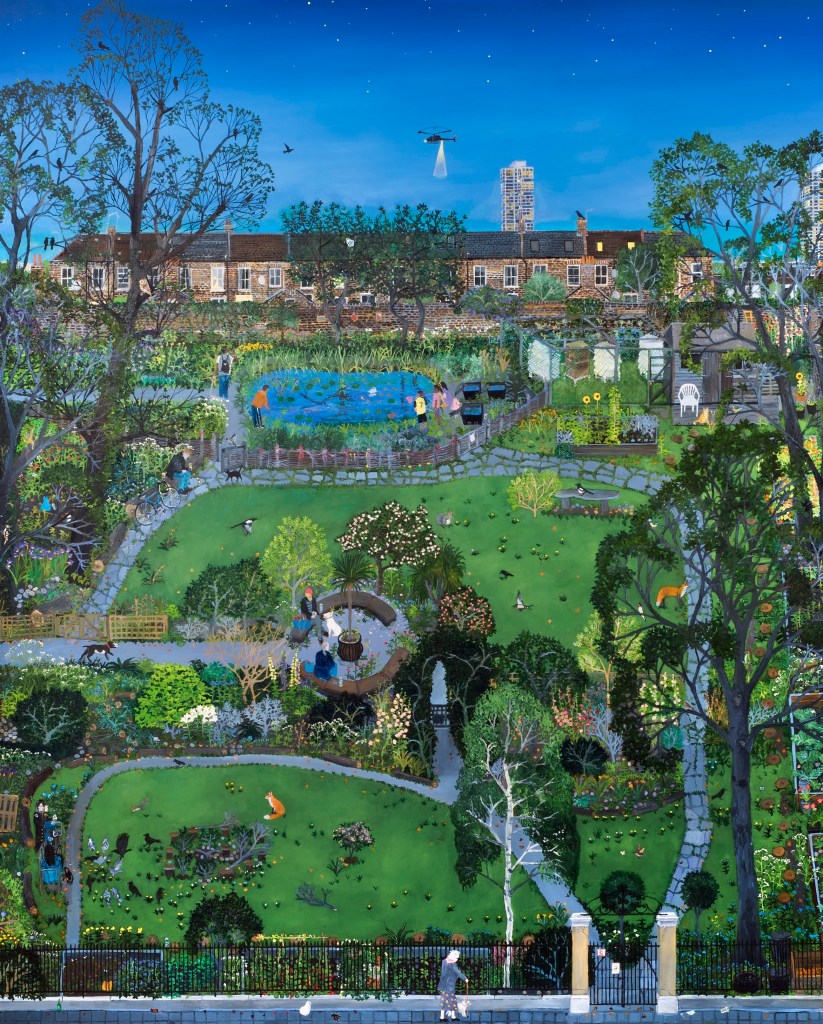
I love these paintings. There is something exhilarating and deeply joyful about seeing the birds swirl up into the twilight sky. Also (for me at least) I get vibes of medieval map drawings and scenery from old paintings.
The narrative in Haworth’s paintings may draw from poems, fairy tales, novels or biblical stories that have a relationship with our contemporary society. Although built upon observation, her paintings are fictional scenes. She visits the park at various times of the day and year observing the different types of people, wildlife and birds that use it. Noting how the atmosphere can change as day turns to night and summer turns to autumn.
Back in her studio Haworth brings together the images of the things she has seen; the people, birds, animals, plants and flowers. Then creates a more timeless imagined image with a deeper meaning. The scenes she paints are magical, full of secrets and hints of stories.
Could there be a more chill flying dog on the planet? I also love that he has such luxuriant hair and he seems to be gliding through the air effortlessly like the flying dog dragon in Neverending Story.
Big headed guys and girls smoke and have a listening party to Toro Y Moi’s new album ‘Mahal’
I don’t know what the hell is going on here but I am happy to plunge into this psychadelic galactic sonic soup. This is a unique brand of warming, funky, trippy music and some compelling and unusual people discussing the music to go along with it. I think it definitely adds to the enjoyment of something when you see other people enjoy it.
I love them although I am not sure how practical they would be for work, they certainly would get a home rotation though. Via the always amazing art curator Oksana Ivanik art.
Examine the technical details of your favourite fonts and use AI to find the best pairings for your favourite fonts. Mine is ‘Playfair Display Italics’ which you can see here in this very blog’s subheadings, read more.
This collection of prosthetic eyes in a cabinet of the Rijksmuseum is gleefully creepy
Here’s a great quote from the inspiring, wise and enriching book by Mary McEvoy ‘Ordinary Beauty’. Revel in your mediocrity at doing certain things!
There is a joy to be had at being really bad at something. I love to draw and paint. I am a terrible artist. I made one mistake however. In an effort to be good, I bought pencils and paints, enough to cover the Sistine Chapel, and in my glut I cannot find what I need. I need one pencil, soft and black and I need one blank page. That is all. I must clear the decks, find my pencil, make my mark and enjoy my incompetence.
Ordinary Beauty: Meaningful Moments in Everyday Life by Mary McEvoy
I don’t know why but I love this…awaken your inner dragon…or don’t and just chill out
Read more: Ordinary Beauty: Meaningful Moments in Everyday Life by Mary McEvoy
An enchanting book filled with rich and nourishing insights and micro stories that speaks in a universal and relatable way about how we can appreciate everyday beauty of the world. McEvoy talks about the various different small miracles that occur to give hope, light and comfort in an ever-increasingly fraught and fractured world. This book came along at the right time for me and I devoured it. This is a perfect night time reference book for when you are too tired to pick up a novel or some non-fiction that requires brain power.
A week is a cycle of seven numbered or named days most likely due to the Jewish calendar. However things get complicated as early medieval Europe inherited the idea of the week from imperial Rome, via Christianity.
Ever wondered why days of the week are all similar sounding in all European languages? The Latin names of the week are named for Roman gods and later Norse ones, the story of days of the week mirrors stories of wars, conquering tribes and European migrations.
Before Time Began: Latin Quotes on Ancient Sundials
Name days are similar across all European languages: English, German, Dutch and all Norse languages. Gods with comparable names, like Tyr, Othinn, Thor and Frigg, were certainly known to the Scandinavians and gave their names to weekdays in Scandinavian languages (compare Modern Danish tisdag, onsdag, torsdag, fredag).
The Latin names for the days of the week, and the Roman gods for which they were named, still live on in all the European Romance languages, like French, Spanish and Italian. Think of French lundi, mardi, mercredi, jeudi and vendredi, for example, and you will find the Latin Luna, Mars, Mercurius, Iovis and Venus hidden behind them.
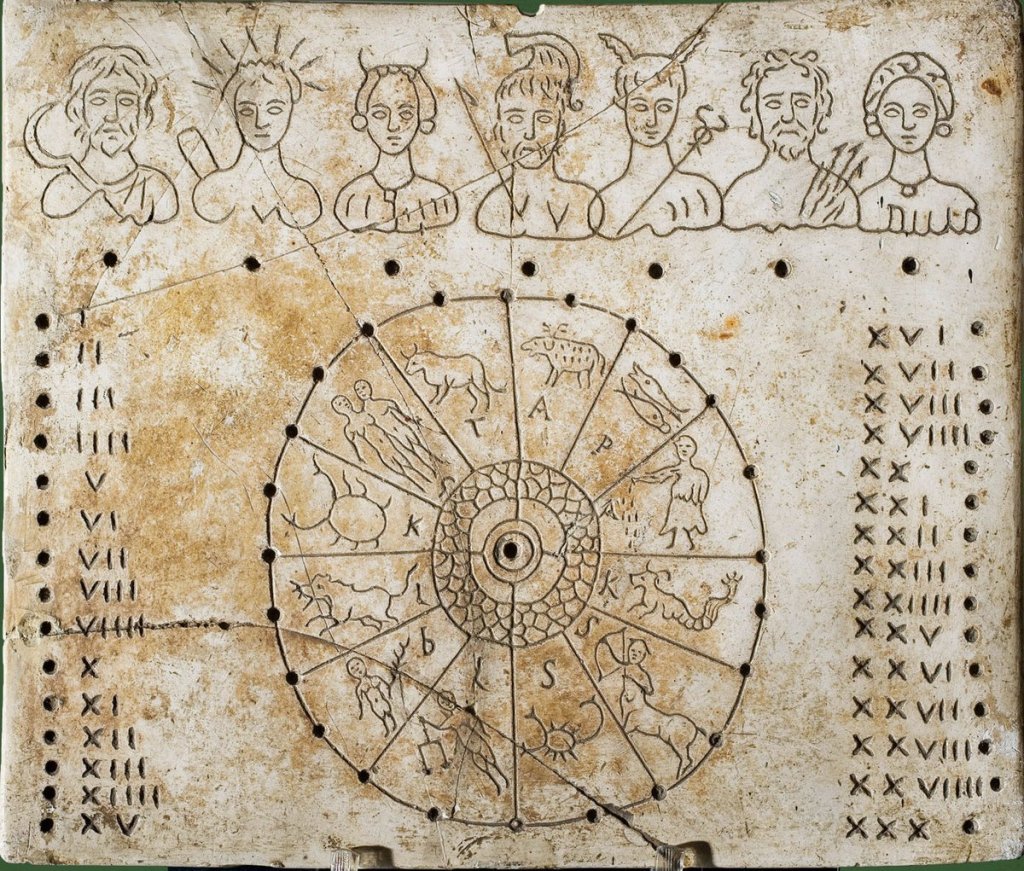
Parapegma (Calendar peg board), Roman,. The Seven gods and goddesses represent the seven days of the week. There are also thirty holes for marking the date and 24 holes for marking the current Zodiac sign. via Art & Archaeology
The Romans named their days of the week after the planets, which in turn were named after the Roman gods
Later, the Germanic-speaking peoples of western and northern Europe adopted the seven day week. In early centuries of the Christian era, they named their days after those of their own pagan gods who were closest in character to the Roman deities.
It was these peoples, the Jutes, Angles and Saxons, who brought their gods and language (what would become English) to the British Isles during the fifth and sixth centuries AD. This is how the English days of the week were formulated.
Tuesday is named for the Anglo-Saxon god Tiw about whom relatively little is known. Tiw was probably associated with warfare, just like the Roman god Mars.
Dies Mercurii: The day of Mercury
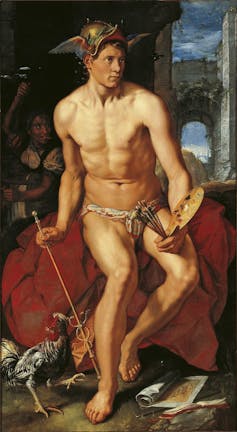
Wednesday is named for the god Woden, who is paralleled with the Roman god Mercury, probably because both gods shared attributes of eloquence, the ability to travel, and the guardianship of the dead.
Dies Iovis: the day of Jupiter
In English Thursday comes from Thunor’s day, or, to give the word its Old English form, Thunresdæg “the day of Thunder”. This sits beside the Latin dies Iovis, the day of Jove or Jupiter. Both of these gods are associated with thunder in their respective mythologies.
Vikings arrived in England in the 9th century, bringing their own very similar gods with them. Anglo-Saxons were already Christian by this time, but may have recognised the similarity between the name of their ancestors’ deity Thunor and the Norse god. We don’t know, but the word Thor does appear in written texts from the period.
Dies Veneris: The day of Venus
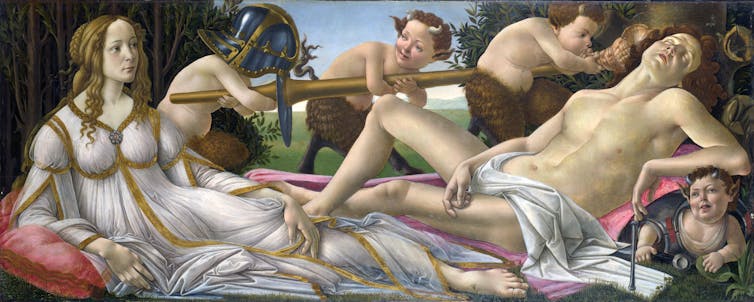
Friday is the only weekday named for a female deity, Frig, who is hardly mentioned anywhere else in early English. The name does appear, however, as a common noun meaning “love, affection” in poetry. That is why Frig was chosen to pair with the Roman deity Venus, who was likewise associated with love and sex, and was commemorated in the Latin name for Friday.
The Roman weekday ‘dies Veneris’ was named after the planet Venus, which in turn took its name from Venus, goddess of love. Detail from Venus and Mars, Botticelli, tempera on panel (c1483). Wikimedia Commons
Dies Saturni: The day of Saturn
Saturday is named for the Roman god Saturn and so follows the original Latin.
Ancient sundials of Greece, Egypt and Babylon often featured provocative and emotional expressions in Latin. They were succinct and powerful calls to action which…
The world’s mother tongues have blended and intermingled since humans first stood upright and emerged out of the primeval forests. Here’s a really awesome…
Why is it that we in the modern West seem to know so much about the Cosmos but very little about consciousness? I think the answer is simple. The material cosmos is studied as a collection of observed objects “out there.” These objects in space are measured, and their behaviour can often be controlled and predicted with mathematical models. Not so with consciousness. When we study or try and understand consciousness, what is essentially happening is that consciousness is attempting to become conscious of consciousness. The mirror is trying to mirror, become aware of itself.
Significantly, the mirror is a classical trope of comparative mystical literature in both the West and Asia.
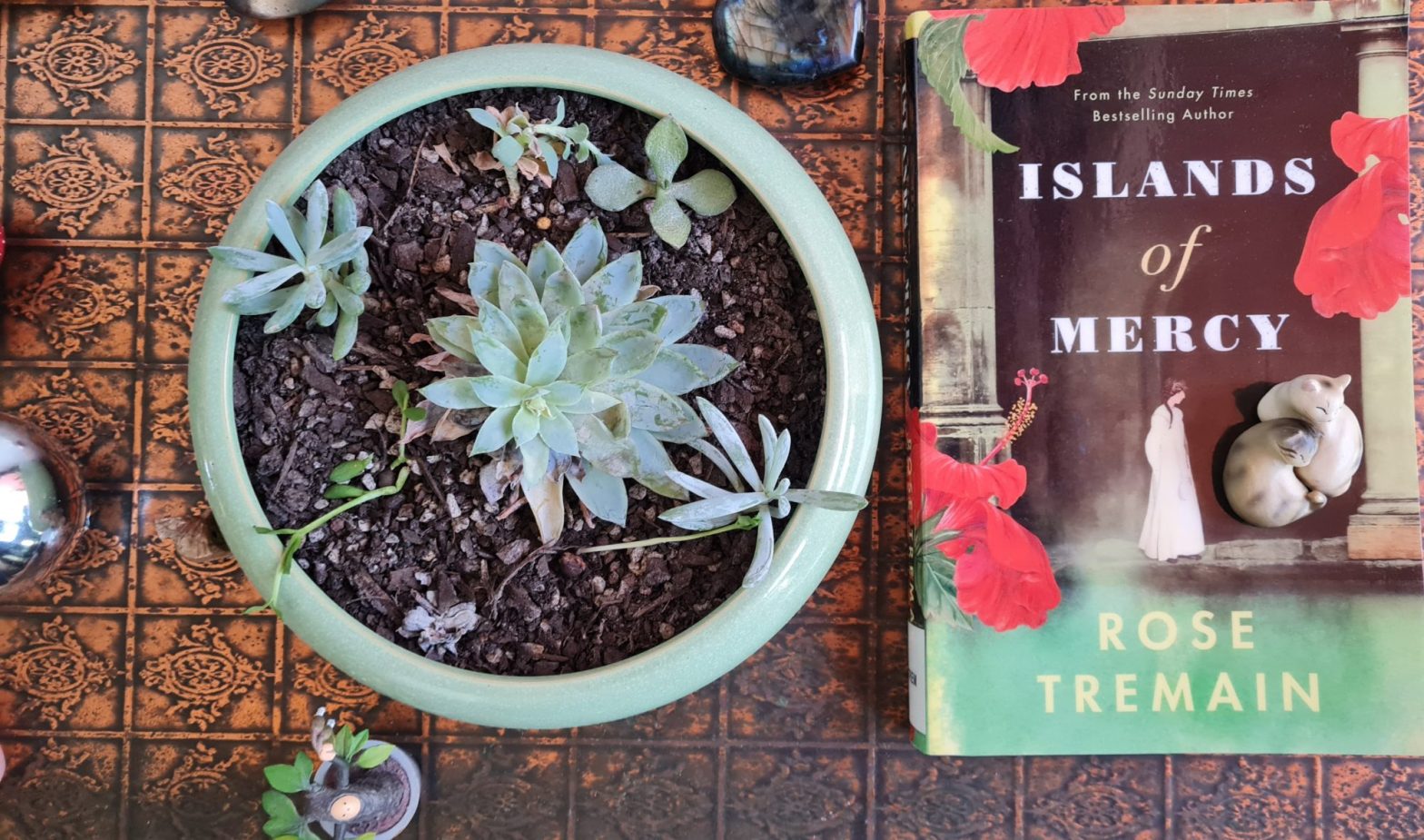
Islands of Mercy is a masterful book by the author of other historical fiction classics such as Restoration, Music and Silence and Merival. I have loved all of these books so I had a feeling (and rightfully so) that I would really enjoy this book.
Set in Victorian era Bath and across the seven seas to Borneo – this book is both intimate and epic, as well as being incredibly modern despite being set in the Victorian era. I loved the strong female lead characters and the way the male characters played second fiddle to them. The women in the book wrestle with Victorian era conundrums that are still relevant today – domesticity and child-rearing versus the free, unencumbered life. Being straight versus being a lesbian. Of course, the consequences for being unmarried lesbian in the Victorian era are incomparable to now.
Without giving too much away about the characters or their narrative trajectory in the book this is a book told across two very different but interconnected lives. Jane Adeane, a towering unconventional beauty and a nurse who lives in the comfort of 19th Century Bath in England and Sir Ralph Savage, a slightly naive, well-meaning and also hopelessly entitled British landowner in Borneo. Both main characters grapple with how to live in the conventional straight-jacket of their world while knowing that they are undeniably different to the norm. This book held me captivated in its grasp and didn’t let go. It’s vivid, emotionally raw, psychologically complex and sexually charged. As I approached the end I had a sad sinking feeling that I would miss this world and the characters within it. It was with great reluctance that I finished it. I would whole-heartedly recommend this for a weekend of gloriously indulgent reading.
Welcome to the cosy cabin of your collective fantasies, featuring Aphex Twin’s serene ambient music, snow globe creatures encased in pure sugar and a softly-spoken Japanese woman whispering compliments to you, frozen ghost apples, post-partum pomeranians, African samurais and more. It’s edition #83…indulge it’s sugar-free and palm oil free.
Richard D James AKA Aphex Twin – Early Morning Works
A genius and original of the ambient and techno genre. This mix is really uplifting, soothing, mellow and slightly melancholy. Perfect for a walk.
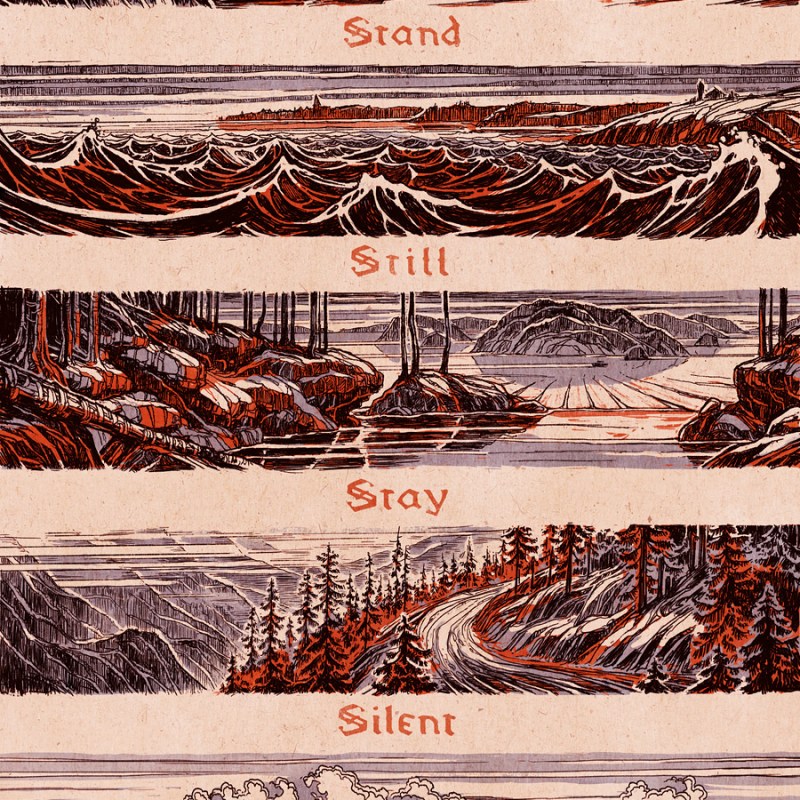
Take the risk or lose the chance
Sometimes it’s a good time to be quiet, still and to reflect. At other times it’s right to be bold and carpe diem!
The iconic painting by Francisco Goya recreated with polymer clay. Clay Disarray makes these playful and funny interpretations of classic art in a distinctive style, I would love to have one of these hanging up in my house they are so quirky and cute! Read more
Never Too Small: A Renovated Cabin in the Blue Mountains of NSW
Another simple, elegant and cosy cabin that contains everything one would need to live off-grid peacefully, nestled in the green bosom of nature. This is a very practical and well-thought out cabin in terms of its design.
Many research studies have found a link between public health and greater tree cover. With this in mind, Glasgow will plant ten trees for every citizen, it’s called the Clyde Climate Forest. Trees will be planted in abandoned coal mining sites, vacant land and urban or derelict land and connect fragmented forests together. Read more via Happy Broadcast.
Soothing tutorial: How to make cutesy edible cookie characters and snow globe
If you’ve had a bad day, I recommend soaking your brain in these wordless tutorials with cheerful music and cute characters, these journeys of artistic perfection are very soothing. Your brain will no doubt feel better afterwards. This one in particular is ingenious how the transparent slow globe is made from a simple water and sugar solution. Too cute to eat!
A beautiful and evocative poem by WordPress poet: livingtreepoetry
Whatever you might believe life is forever. You were made a leaf on a living tree in a forest to eternity.
Though a day’s length might be determined by the rounding of the sun, a season by the passage from growth to decline,
and the elements beyond your influence.
The fact that you are more than a first flush, or even a last golden hand, is something the body understands, the soul intuits.
Does the singing bird that builds its nest and nurture its young trust also in the branch, the sturdy tree?
So you might know yourself as more than leaf that takes its cue to part the stage upon a falling curtain.
We are all more than the substance of which we’re comprised at a singular point in time.
We are that too, to which we’re attached, to which we return to as living matter,
the mulch that breaks down to soil to feed the roots, this forest in which the singing birds are ever lifting their dawn chorus.
Ever migrating to, from, in a great circling formation. In this pattern of life, death, renewal.
Ana Lisa de Jong Living Tree Poetry November 2020
Softly Spoken: ASMR Personal Color Analysis by a Professional in Japan
I love this video for so many different reasons. Colour analysis in fashion and beauty is incredibly interesting as people’s skin, eye and hair colouring influences how colours will look and this will vary from person to person, which is amazing. Also the aural pleasure of listen to this softly spoken woman talk in Japanese about different colours and the tinkling zen fountain in the background is incredibly relaxing. Also the quirkiness of this video series – it is like we are sharing this woman’s personal style and fashion journey. I love having these beauty experiences, whether it be hot stone massages, facials, hair treatment, manicures and enjoying someone else’s experience is a strange new pleasure.
Ghost Apples are created when freezing weather coats an apple in ice. The apples freeze faster than the water. This encases the apple in an icy tomb. Once the weather warms again, the apple defrosts before the ice does. The rotting apple then slips out of the bottom of the apple and leaves an icy ‘ghost’ behind. Via Interesting as Fuck on Reddit.
Yasuke was a magnificent warrior. He was also a giant, particularly in Japan. At 6 foot 2, he was a full 14 inches taller than an average Japanese man at the time, who stood around five feet. For context, the average American’s height is 5 foot 9. To reach the same high differential, you’d need to stand next to Shaquille O’Neal.
During his time in Japan, Yasuke was a sensation. Nobody had seen someone like them, and people were curious. Everywhere he went, he drew crowds. Because Buddhist statues were often black, many people believed he was a divine visitor. Some historical accounts go as far as to say that buildings collapsed under the weight of a crowd who came to see Yasuke.
I hope you enjoyed the brave black samurai, ghost apples, sugar snow globes, clothing that matches your face, proud doggy mums. Also I hope that beautiful dreams await you in your slumber…until next time.
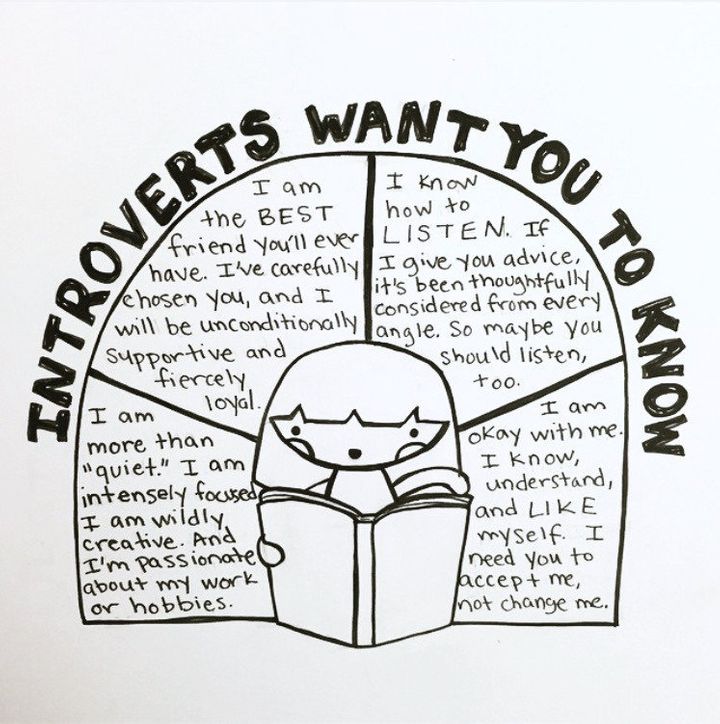
In our culture, we are not just a minority, but one that is considered to be far from the ideal. It might seem that we need to go to the other end, from feeling weak, flawed and victimised to feeling strong and superior. I consider this to be a necessary compensation. But for many HSPs, the real challenge is to achieve a middle-ground. No more ‘too shy’, ‘too sensitive’, too anything. Just OK, ordinary, normal.
For some of you, reading this book may be like holding a mirror up to yourself and really seeing yourself for the first time. This was most definitely the case for me.
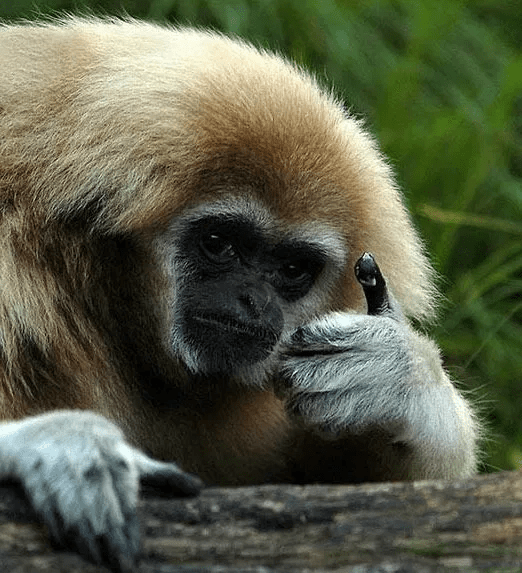
The word gibbon entered European languages through French in the 18th century. The French adopted it from the Malay word, kebon. However etymological research shows this Malay word originally came from a group of languages called Northern Aslian, spoken by indigenous communities in peninsular Malaysia. In Northern Aslian, it was probably pronounced kebong.
The word #Gibbon entered French and other European languages from the Malay word, ‘kebon’, an ancient word from indigenous languages probably pronounced kebong
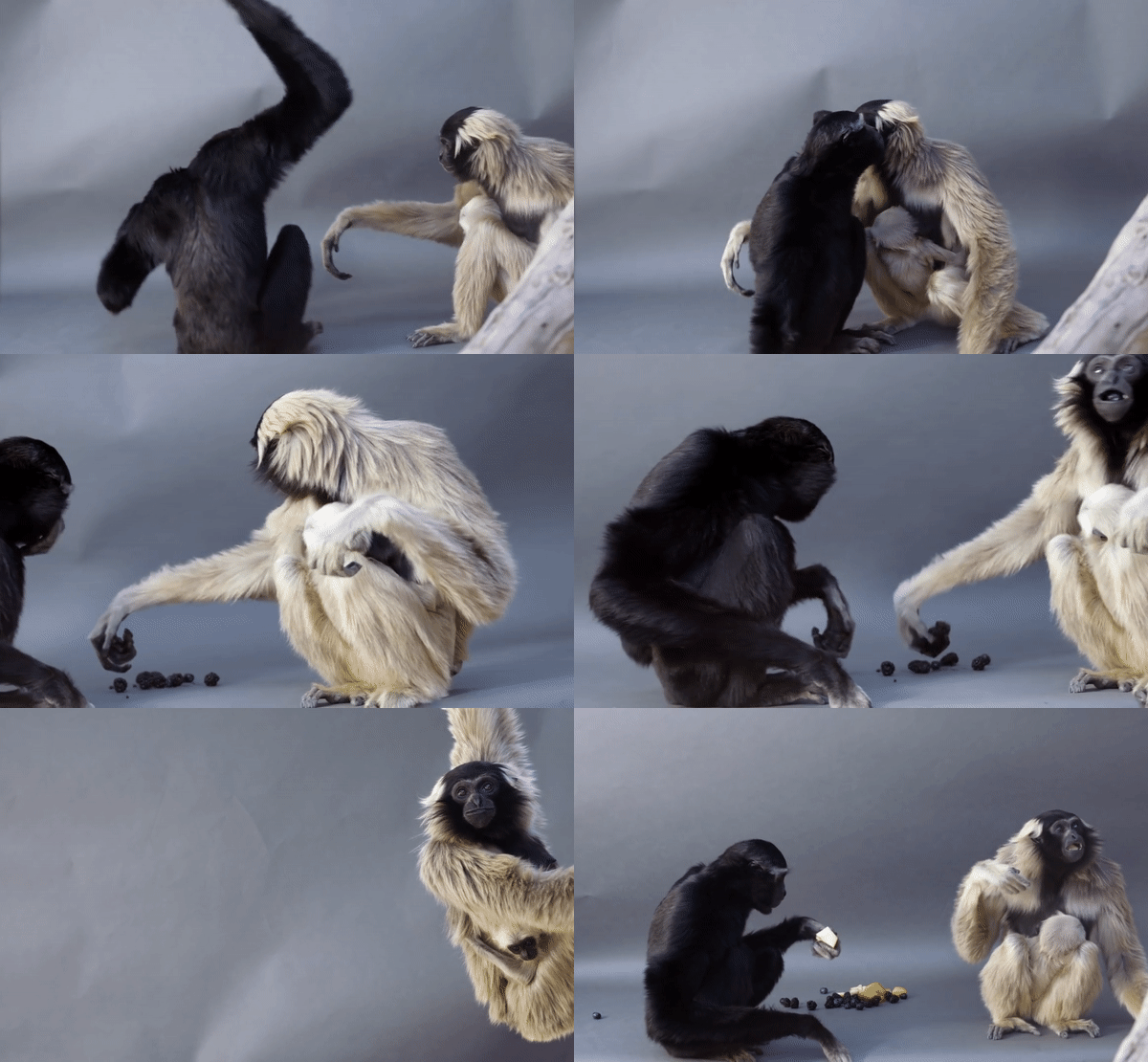
Gibbons are a type of ape with long and agile limbs suitable for gracefully swinging through the trees of Southeast Asia’s forests. Like other gibbons they form gregarious and close-knit family groups. They face a major existential threat from palm oil deforestation and illegal animal trafficking that occurs as a result of this deforestation.
Gibbon is a relatively rare term in Southeast Asia itself. It even fell out of use in Malay after the 18th century. More common in the region’s languages is the word wak-wak. Like orangutan, this word appears in the Old Javanese language as early as the 9th century and seems to derive from the crow-like sound gibbons make.
Recent fascinating research shows that the word wak-wak may originate from the ancient Middle Eastern legend of the Wakwak Tree: a fantastical tree from a far eastern land whose fruits produced human heads and bodies which cried out “wak wak”. Folk memories of the gibbon’s piercing cry may have been transmitted across the Indian Ocean many centuries before the animal was identified by European science.
All gibbon species are endangered by palm oil deforestation. Join the #Boycott4Wildlife and fight back with your wallet…
































 Content Catnip


You must be logged in to post a comment.