10 Interesting Things I Found on the Internet #173


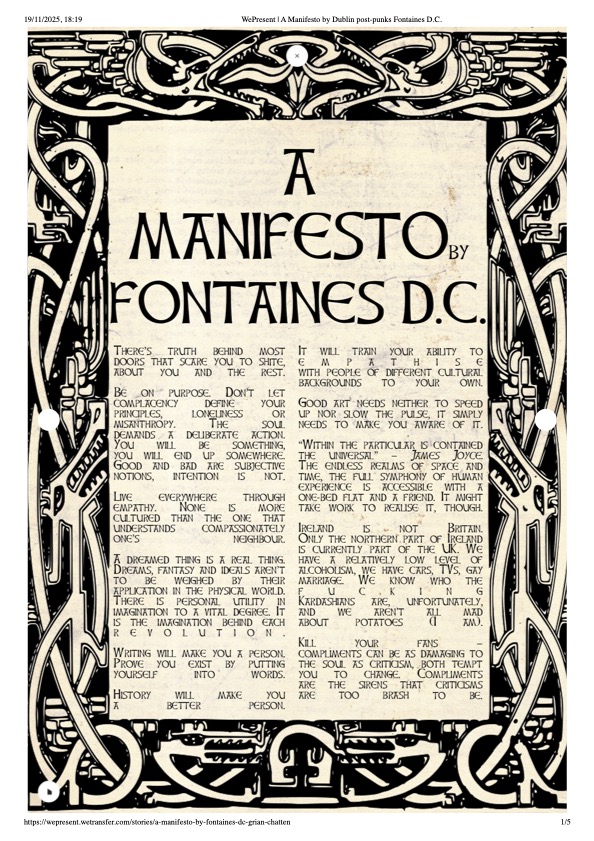
10 rules for life from Fontaines D.C.

Fontaines D.C.Β are a Dublin post-punk band made up of Grian Chatten, Carlos O’Connell, Conor Curley, Conor Deegan III and Tom Coll. In April 2019 they released their debut albumΒ Dogrel, to huge critical acclaim and have recently released their follow-up,Β A Hero’s Death. With eagerness, fervour and sincerity their politically-minded, dynamic, chant-worthy songs depict male vulnerability, detachment, death, rebirth, the depth of the human soul and the dark perils of modern living. They really know what they’re talking about, the least we can do is listen.
Via We Transfer


Ibiza 1999 atmospheric trance mix

This mix of Balearic trance from the late 90’s early 00’s takes me back to the golden years of my youth, before mobile phone mediated party pics and during the time of amazing parties.


Gemma Wheeler does it again!

Just when I thought she had hit peak perfection with these architectural makeovers she created this masterpiece in the Greek countryside transforming a crumbling and tricky villa with a lack of light and strange entrances to a modern light-filled mansion…


Mango Peanut Tempeh Tacos by Love and Lemons

Author:Β Jeanine Donofrio AKA Love and Lemons

Serves: 4 tacos

Ingredients

  • Β½-inch strips of tempeh (about 8 strips, from 1 pkg)
  • drizzle of olive oil
  • splash of tamari or soy suace
  • 1 cup thinly sliced red cabbage
  • squeeze of lime
  • 1 mango, cubed
  • ΒΌ cup scallions
  • 1 avocado, sliced
  • sriracha (optional)
  • salt and pepper
  • 4 corn or flour tortillas

coconut peanut sauce: (makes extra)

  • β…“ cup coconut milk (full fat or light, from a can or box)
  • 2 tablespoons peanut butter
  • 2 teaspoon soy sauce
  • 2 teaspoons lime juice
  • 1 teaspoon sriracha
  • optional – minced garlic and/or ginger

Instructions

  1. Drizzle tempeh strips with olive oil and tamari. Set aside to marinate while you prep everything else.
  2. Mix together the sauce ingredients. (I do this in a jar with a tight lid – shake until combined). Taste and adjust seasonings.
  3. In a small bowl, toss red cabbage with a squeeze of lime and a pinch of salt.
  4. Heat a medium skillet over medium heat. Add the tempeh strips and cook for a few minutes on each side, until golden brown.
  5. Assemble tacos with tempeh strips, red cabbage, mango, scallions, avocado slices and cilantro. Serve with coconut peanut sauce, limes and sriracha on the side.

Whore of Babylon (13th Century)

Whore of Babylon. Biblia Porta, France 13th century. Bibliothèque cantonale et universitaire de Lausanne, U 964, fol. 482r.
#medieval #MedievalArt via Medieval Illumination
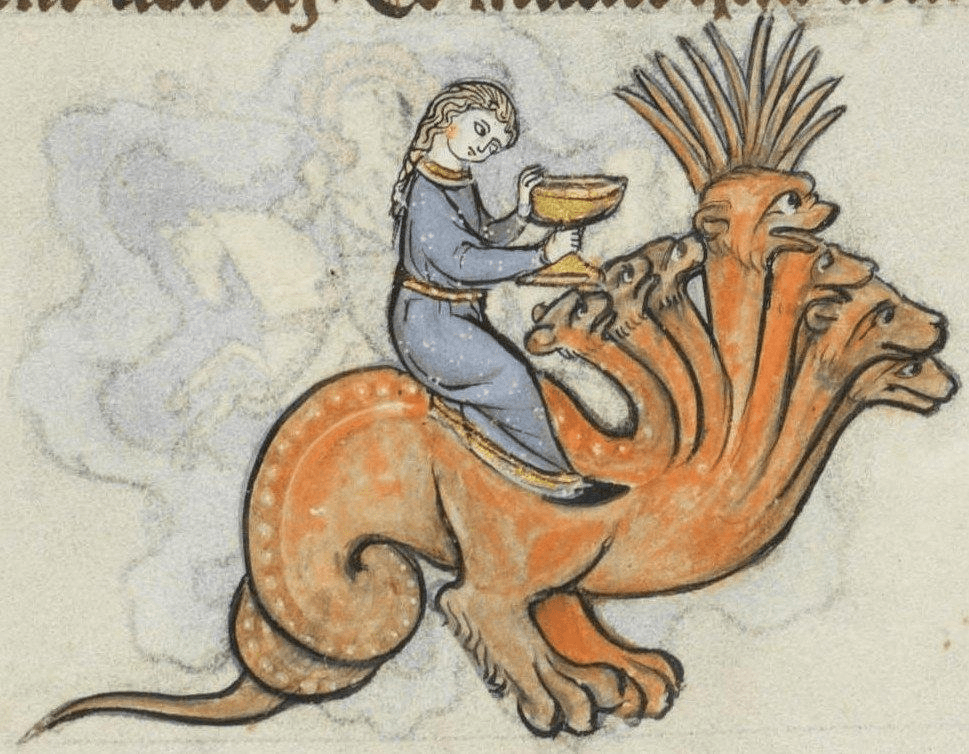
Whore of Babylon (13th Century) medieval art

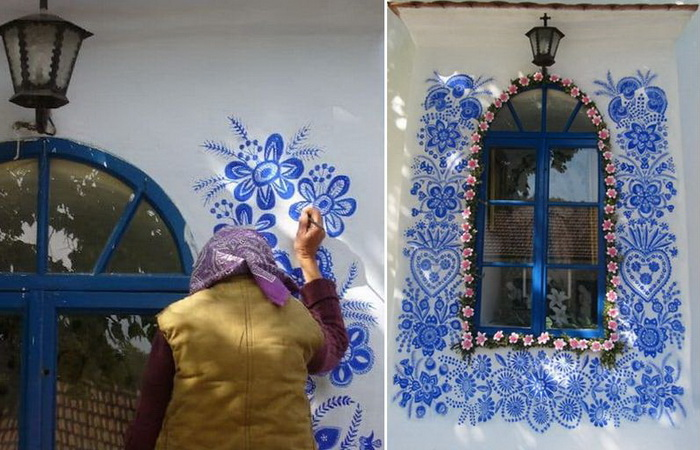
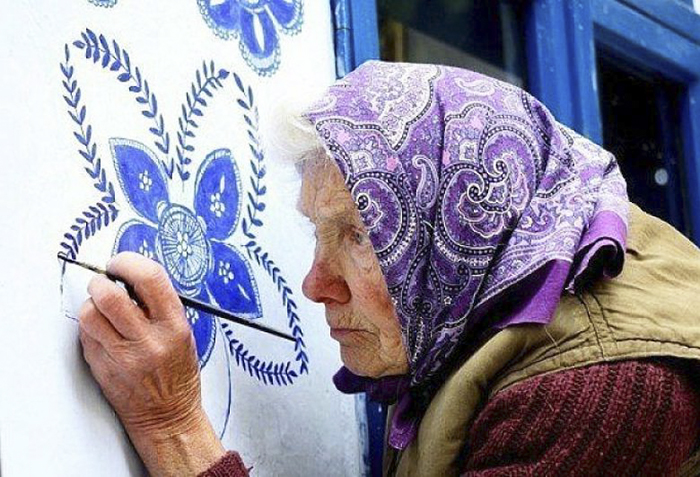
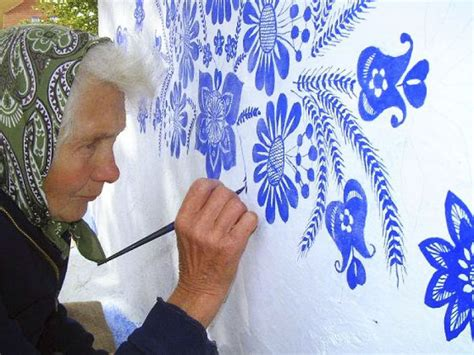
90 year old woman beautifies Louka, her village in Moravia with exquisite traditional art

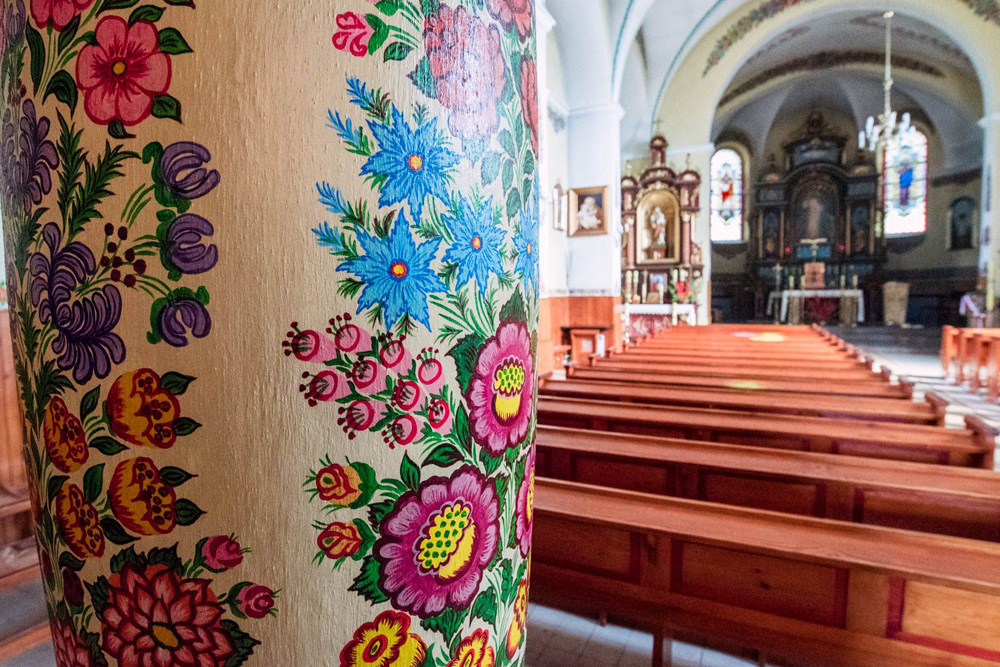
In the southern Moravian village of Louka, lives 90-year-old Agnes Kasparkova who is turning the local village into her own personal canvas of dreams. A former agricultural worker, she now spends her retirement creating traditional Moravian motifs in a brilliant ultramarine blue across the village’s white buildings.​

Kasparkova doesn’t plan her creations, instead she lets her imagination guide her brush, creating spontaneous floral designs that breathe life into the white walls. She continues an important artistic tradition passed down by previous generations of women. Via Artmag
Air fryer banana bread by Daniela

How good is having an air fryer?! I’ve made cakes, cookies, slices, roasted vegetables and made all kinds of wonderous things in my air fryer, it turns even the laziest (or busiest) person into a culinary whizz! Daniela has some wonderful recipes on her channel.


Why Sacred Values Are Dangerous

Sacred values may signify that one has a conscience, but they also have a dark side.
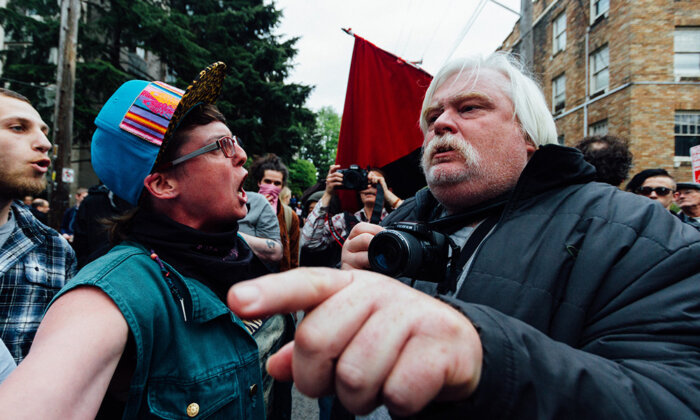
Photo credit: Adam Cohn, via Flickr

By: Steven Sloman via MIT Press Reader

Paul Jennings Hill had a sacred value: He believed that abortion was murder. Hill’s last words before being executed by lethal injection for killing physician John Britton and his bodyguard were: β€œIf you believe abortion is a lethal force, you should oppose the force and do what you have to do to stop it. May God help you to protect the unborn as you would want to be protected.”
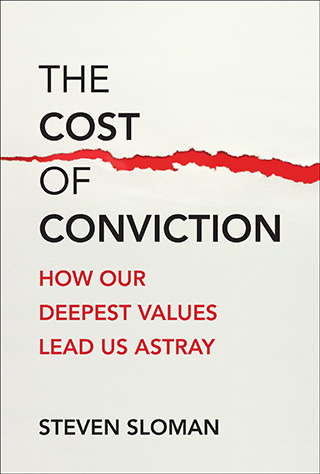
This article is adapted from Steven Sloman’s book β€œThe Cost of Conviction: How Our Deepest Values Lead Us Astray.”

Sacred values may signify that one has a conscience, but they also have a dark side. They can lead to extremism and terror. They can be the foundation for an intransigence that is a root cause of many of society’s deepest and most pressing problems.

The danger of sacred values isn’t just that they can drive individuals like Paul Hill to commit acts of violence. Individual acts of malevolent extremism like Hill’s are horrifying, but mercifully rare. That’s not the direction that sacred values normally press. More commonly, sacred values operate by binding members of a community and encouraging group action. Religious communities, for example, are replete with sacred values of various kinds, including moral proscriptions, ritual acts, and belief in deities. Adherence to such values is often necessary and sometimes sufficient to be a member in good standing of a religious community. For centuries, the vast majority of Europeans were under the sway of the pope, who could (and would) excommunicate antagonists who advocated beliefs inconsistent with church doctrine.

Not only must sacred values be upheld to remain a citizen in good standing in your community, but they shouldn’t even be contested.

But social pressure to conform to community sacred values is not limited to Christian Europe. Extreme punishment for not conforming can be observed in far-flung corners of the world. The Pakistani Taliban shot Malala Yousafzai in the head because it did not approve of her campaign in support of girls’ education. Milder forms of punishment for violating a community’s sacred values are common, if not universal. Not only must sacred values be upheld to remain a citizen in good standing in your community, but they shouldn’t even be contested.

We see it today in the polarized United States. On the right, so-called Republicans in Name Only (RINOs) are shunned for lacking loyalty; on the left, individuals who are seen as insufficiently progressive in their sacred values are similarly ostracized.

Sacred Simplicity

Sticking with your community is generally an adaptive strategy. It prevents you from being shunned and affords you the safety of numbers. But loyalty to one group can create division from others. Communities define themselves not just by who they are, but by who they are not, and that can easily turn into hostility. They may discriminate against outsiders or engage in psychological, physical, or economic conflict. History is studded with examples, from the Romans lording it over the Gauls, to the European desecration and destruction of Indigenous culture throughout the Americas, to the Nazi caricatures of Jews, Roma, and Slavs. Each of these examples involves dehumanization along with economic inequity and physical brutality, brought on not only by competing interests but also by humanity’s habit of dividing into competing groups based on clashing narratives.

In recent years, the United States has been riven by identity politics. On the right, books are banned, and academic ideas bound by the label β€œcritical race theory” are outlawed in public schools in many conservative states. Florida’s Individual Freedom Act β€” known informally as the β€œStop WOKE Act” β€” purports to protect the open exchange of ideas, but is clearly intended to prevent teaching a progressive-left perspective whose basic premise is that the U.S. is deeply racist. On the left, a movement to β€œdecolonize” knowledge calls for overhauling Western educational systems from the ground up. The imagined enemy is the hegemony of Western systems of knowledge perpetuated through the domination of white males. According to this view, Western thought owes less to its intrinsic merits than to the historical power structures (colonialism, social and political power) that elevated it above other knowledge systems.

What does this have to do with sacred values? On the one hand, not much. Some of these conflicts are about the distribution of power and resources, like money, jobs, and education. But what’s striking about the culture wars is how often people lobby against their own interests. Many white Americans suffering from extreme poverty depend on government programs to stay afloat, but support politicians who cut those programs. Meanwhile, on the β€œLeft Coast,” many white men champion diversity, equity, and inclusion, causes that could be seen as challenging their own privilege.

These individuals are not acting in their own direct material interest. Instead, they are called to action by the ideas endorsed by their communities. The Right is called to conserve or reestablish what they see as the true America, or to β€œMake America Great Again.” The Left is called to build a United States based on diversity and inclusion. Both of these calls are for action. As soon as they are seen in absolute terms, as among a citizen’s highest callings, they have become sacred values.

Sacred values have power because they erase the hardest part of any decision: the need to make trade-offs.

What is it about sacred values that gives them such power? The key, I believe, is that they eliminate the need to make trade-offs, often the hardest part of making a decision. Trade-offs force us to weigh competing priorities and decide exactly how much each one matters. When buying a house, for example, how much commute time are you willing to trade for each foot of extra floor space? There’s no formula for that; it requires reflection. But sacred values help you bypass the process. You only need to appeal to the action rule supplied by the sacred value. Those who don’t drink don’t have to ask themselves if they have had enough, and those who don’t eat meat don’t have to weigh the cost or taste of a cut of sirloin. Having a sacred value has the added benefit of simplifying decision making while providing a normative justification: I’m not avoiding the trade-off because I’m lazy, but because I’m doing the right thing!

Sacred values do more than guide behavior; they influence how people think and argue. The political scientist Morgan Marietta has described these dynamics eloquently: β€œGreater invocations of moral outrage engender a more strident form of politics.” When our reasoning and discourse are grounded in absolute notions of correct behavior, we become conjoined with our own ideas, identified with them, and therefore unable to compromise, deliberate, or reach agreement with others. This increases political intensity and engagement.

Gun rights advocacy offers a clear example. Supporters often invoke the Second Amendment as a sacred value, framing their position as a simple matter of fundamental freedom. But given what the Second Amendment actually says, the simplicity of the justification is illusory. Indeed, a straightforward reading of the amendment is that it only applies to militias, not individuals.

Gun control advocates, by contrast, rely on consequences: Over 45,000 firearm deaths occurred in 2023, leading the surgeon general to declare gun violence a public health crisis. But the causes β€” homicide, suicide, killing by law enforcement, accident β€” are varied. And the data is frustratingly complex. But against the clean moral appeal of a sacred right, even strong evidence often fails to persuade.

Sacred or Moral?

Psychologist Linda Skitka has been at the center of research demonstrating that people who experience moral conviction about an issue are more politically engaged with the issue. She measures moral conviction using five-point scales, asking questions like, β€œTo what extent is your position a reflection of your core moral beliefs and convictions?” and β€œTo what extent is your position connected to your beliefs about fundamental right and wrong?” Not surprisingly, people consider attitudes that they rate highly to be universally and objectively true. People with such attitudes also tend to be intolerant of the other side and less willing to compromise than others.

To illustrate the latter point, political scientist Timothy Ryan asked a group of subjects Skitka’s moral conviction questions about Social Security in the U.S., presenting them with a Republican and Democratic position on the issue:

As you may know, the Social Security program in the United States is projected to run out of funds in 2033 if changes are not made. One idea that has been proposed to address the problem is to raise taxes on people currently in the work force. Alternatively, some people have proposed cutting back on the benefits the government provides future retirees. How about you? Would you prefer to see taxes raised to preserve benefits at the current level, or would you prefer to cut benefits so taxes don’t have to go up?

Participants with more moralized attitudes were more resistant to compromise. In fact, they even wanted to punish politicians who were willing to compromise. These moral convictions have the trappings of sacred values. Ryan gave subjects the option of earning extra money if they allowed the researchers to donate to a political lobby group that opposed their moral conviction. Relatively few people with strong moral convictions accepted the offer. They were unwilling to make material trade-offs β€” to accept money β€” if it violated their moral values.

What is driving people’s unwillingness to compromise, along with their rigidity and absolutism? Is it their moral conviction? What would that actually mean? β€œMoral conviction” could refer to some emotion related to outrage. But if so, why are people experiencing outrage? What aspect of the situation is triggering them? Without an answer to this question, we will never know why people are outraged or how to predict when they will have moral convictions. What does it mean for an emotion to be β€œmoral”? It could mean that it relates to harm. Your feelings about seeing harm come to a small animal are moral because they are a reaction to the pain and suffering of the animal.

Yet β€œmoral” could mean something else; there are other theories of morality. According to moral foundations theory, moral senses are triggered in different people by violations of one of seven moral foundations: care, equality, proportionality, loyalty, authority, liberty, and sanctity. So different theorists map feelings to moral convictions in different ways. This makes the notion of moral conviction messy and hard to understand.

An alternative possibility is that sacred values, not morality per se, are what is actually driving the sense of outrage. We know that people experience outrage when their sacred values are violated. Obviously this can be described, most of the time, as a moral violation. We often talk about sacred values in terms of right and wrong. But the real work of determining outrage is grounded in our sacred values. Don’t violate my absolute rules of permissible action or I’ll be outraged at you! This seems like a more precise account of outrage because sacred values have a more precise definition. Moral prescriptions may serve as a rough guide for behavior, but it’s sacred values that often compel us to act.

In Morgan Marietta’s study on sacred convictions, undergraduates were exposed to either sacred or nonsacred rhetoric on hot-button political issues such as gay marriage, the death penalty, the environment, and gun ownership. The sacred rhetoric was absolutist and did not mention consequences; the nonsacred rhetoric was relativist and all about consequences. Students were then asked to describe the issue, and whether it should be decided through the normal democratic politics of discussion and negotiation or, rather, is too important or sacred to be decided by normal democratic politics.

Students exposed to sacred framing were significantly more likely to say the issue was too important for normal democratic processes. Sacred framing didn’t change opinions, but it did shift how students thought about the issue, making them less open to compromise. Marietta’s takeaway: β€œThe democratic consequences of sacred rhetoric include greater citizen participation but lesser prospects for meaningful deliberation, a contradictory influence on the health of American democracy.”

Students exposed to sacred framing were significantly more likely to say the issue was too important for normal democratic processes.

Consider your own views. Presumably you hold a position that some reasonable percentage of the population disagrees with deeply, if not violently. Are you open to having the issue decided democratically? Should we just vote and let the cards fall where they may? Or could that lead to an unacceptable result? Do you believe strongly enough in your position that you think it would be appropriate to force it on society if you could?

I hold views that I would not like to be tested democratically. For instance, I believe that at some point in the near future, only electric cars should be manufactured. I support government mandates to make this happen and do not believe the citizenry should interfere. They just do not know enough about the issue to come to an informed conclusion. My position derives from the belief that humans are responsible for limiting the extent of human-caused climate change. For me, it has become a sacred value. I now value the action of reducing the consumption of fossil fuels so much that I no longer believe in considering other material consequences. My position hardly counts as radical (even if you disagree with it), but even a sacred value reflecting a moderate position can elicit the conviction required to be willing to impose it on others. If I can hold a sacred value that leads me to bypass democracy, it’s not hard to imagine others doing the same in the name of liberty, economic freedom, or something else they hold dear. In that sense, I’m not above the culture wars.

The Ultimate Sacrifice

It does not seem controversial to claim that people, like other animals, benefit from a survival instinct. If there is anything that drives animal behavior, it is the desire to continue living. The instinct to survive explains the extreme lengths people go to when their lives are in peril. There are evolutionary theories that explain why animals will give up their lives for the sake of their kin, such as to ensure the survival of their genes. Yet evolutionary theory has a much harder time explaining the choice to die under other circumstances, like why people lay down their lives for strangers, or why some people are willing to die for an idea.

How can we understand a willingness to face death given the strength of the survival instinct? To answer this question, French anthropologist and political scientist Scott Atran has studied in detail one group that is willing to die: terrorists. He concludes that terrorists are driven by sacred values.

One of Atran’s central observations is that terrorists are not lone actors who expect to ride into town and save it all on their own. Rather, they’re made in small groups. They might have come up together. Atran reports that two of the young men involved in the suicide bomb attack that killed one and injured 40 in Dimona, Israel, in 2008 played on the same Hamas neighborhood soccer team, and so did a number of other suicide bombers. In 2004, 10 bombs exploded on four commuter trains in and around Atocha Station in the center of Madrid, killing 191 and injuring more than 1,800. Later, seven of the terrorists who plotted the bombings blew themselves up in an apartment in a Madrid suburb after being surrounded by police. Five of the terrorists came from the same primary school in TΓ©touan, Morocco. Atran concludes that β€œtaking in fellow travelers and creating a parallel universe devoted to dreams of jihad is commonplace on the road to radicalization.”

A key test of whether people are driven by sacred values is whether they are willing to let go of their position for material benefit. Sacred values are absolute and do not permit such trade-offs. In violent conflicts, Atran finds that not only are actors unwilling to trade off their goals for money, but asking them to do so makes the situation worse. Financial offers to both Palestinians and Jews to encourage collaboration with the other side made both sides even more disgusted and outraged than they already were. It increased their willingness to use violence too.

In stark contrast, a different kind of offer led to more willingness to consider the other side’s demands β€” namely, a symbolic gesture or concession that recognized the other’s sacred values. Such a symbolic gesture would include an apology for past behavior. Atran reports examples of such remediating gestures in Indonesia in the conflict between India and Pakistan over Kashmir, and in the negotiations over Iranian nuclear weapons. But Iran also illustrates a more complex dynamic: Leadership there is known to have launched a campaign to convince the Iranian population that having nuclear weapons should be a sacred value that stems directly from the country’s right to autonomy. In this case, sacred values were not merely acknowledged; they were strategically constructed.

Reframing

Whether sacred values are set in stone or can be shifted is a crucial question. Sometimes you look up and see a cloud that looks like a whale. You can see it as a cloud or a whale. You can frame it in both ways. Are sacred values like that? Atran suggests that in some cases, reframing sacred values, rather than rejecting them, can reduce conflict. One solution might be to exploit the ambiguity inherent in many such values. Consider a sacred value like β€œeveryone should have equal opportunity.” Does that mean that schools and employers shouldn’t discriminate against everyone, but instead only admit people based on merit? But doesn’t β€œequal opportunity” imply that everyone should get the same education so that they have the same subsequent opportunities? Or perhaps everyone should have the same opportunities from birth, regardless of their parents’ assets? Perhaps everyone should get the same dietary choices, same soccer clinics, or same bedtime reading? On this interpretation, who your parents are shouldn’t matter at all. The point is that the same sacred value has a range of interpretations, and those interpretations vary widely. This is true of many β€” and perhaps most β€” sacred values.

A second idea that Atran offers takes advantage of the fact that people generally have multiple sacred values that prescribe action at different timescales. I might value peace and tranquility today and justice in the long term. Different frames will make each value more or less relevant. If I focus on the short term, then my frame will favor promoting peace. If I focus on the long term, then my frame will favor promoting justice. If the two sacred values are at odds, as they are whenever injustice prevails, then my framing can make a difference. More generally, different frames can temporarily prioritize different values. Atran observes that fulfilling one value may require delaying others.

Sometimes, diplomatic gestures or apologies that acknowledge an opposing group’s sacred values can also open space for compromise. Even small symbolic acts, like Nixon’s β€œping-pong diplomacy” initiative in 1971 β€” in which the U.S. and China exchanged table tennis players as a first step toward reopening diplomatic relations β€” can shift perception.

Finally, one of the great diplomatic skills is the art of apology, expressing regret for a harm or violation you take responsibility for (whether or not you actually consider yourself guilty). An effective apology requires that the recipient feel understood, and that whoever is apologizing acknowledges and appreciates the harm or injustice that the victim is experiencing. It is not good enough to say, β€œI’m sorry for whatever you think I did.” A bankable apology spells out in some detail why the victim feels they were wronged and how they feel about it, such as, β€œI’m sorry that my action violated this particular sacred value that you hold so deeply, and that you were left with a sense of outrage and despair.” You don’t need to admit guilt as long as you recognize and acknowledge the other’s values.

To be sure, having at least some sacred values is an essential property of a good citizen because morality requires us to hold certain values sacred (like β€œavoid harming others”). But being good does not always require putting one’s sacred values on display. Most issues can be framed in terms of the consequences they produce. Rather than asking whether it is right or wrong to, say, allow people to carry concealed weapons, we can ask what the consequences of such a policy would be. And asserting a consequentialist frame makes conversation possible. It turns out that people on both sides desire many of the same consequences (lower murder and suicide rates, and fewer mass shootings). By framing issues in terms of how to achieve consequences, we can avoid violating people’s sacred values and find common ground.


Steven Sloman is a Fellow of the Cognitive Science Society, the Society of Experimental Psychologists, the American Psychological Society, the Eastern Psychological Association, and the Psychonomic Society. He is a professor at Brown University and the author or co-author of several books, including β€œCausal Models,” β€œThe Knowledge Illusion” (with Phil Fernbach), and β€œThe Cost of Conviction,” from which this article is adapted.


Good vibes only progressive house mix by Zeu5

He is an exceptionally talented DJ and producer, great music for doing work or just to dance to!


The Hacker – Fadin away (Dima aka Vitalic Remix)


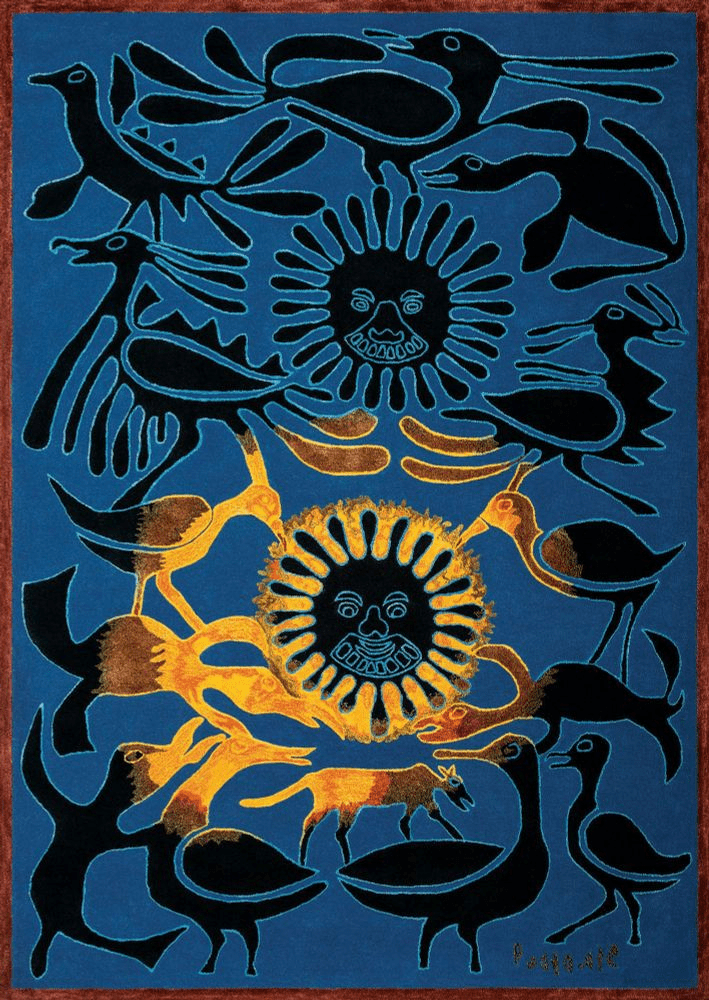
Art by Kenojuak Ashevak (1960)

Ashevak was a pioneering figure in modern Inuit art, and this piece showcases her distinctive style and thematic focus on the natural and spiritual worlds of the Arctic.​

Ashevak was known for her imaginative and often mystical depictions of Arctic wildlife, particularly birds. Ashevak explained that her creative process was intuitive: “I just take these things out of my thoughts and out of my imagination… I am just concentrating on placing it down on paper in a way that is pleasing to my own eye”.​​

Her work was instrumental in bringing Inuit art to a global audience. She began her artistic career in the late 1950s in Cape Dorset, where a newly established printmaking studio provided a new medium for her creative expression. Her prints quickly gained international acclaim, and she became one of Canada’s most celebrated artists.

​


Did you enjoy this collection? let me know what you think of it below. Thank you for reading my dear friends!
The medieval artisans of Poland

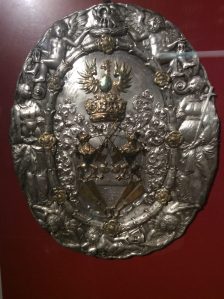
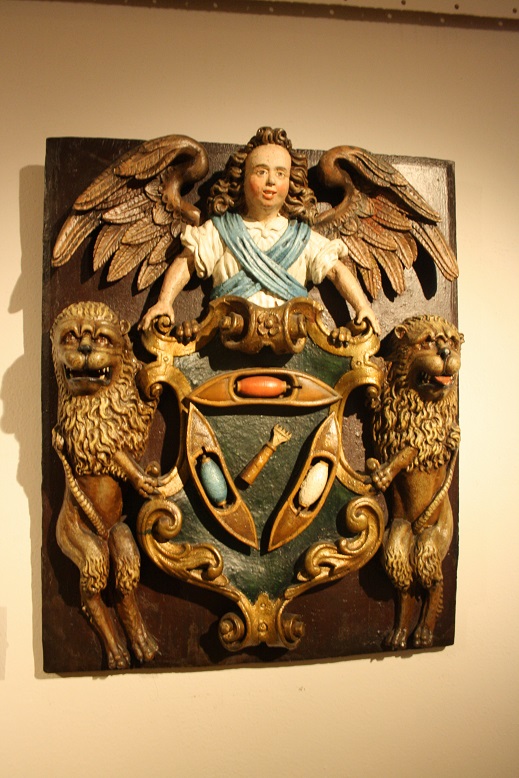
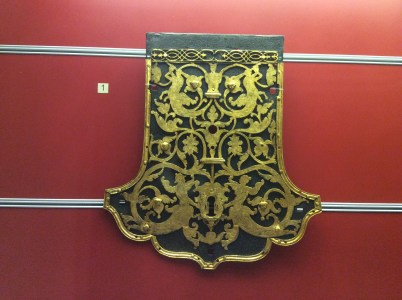
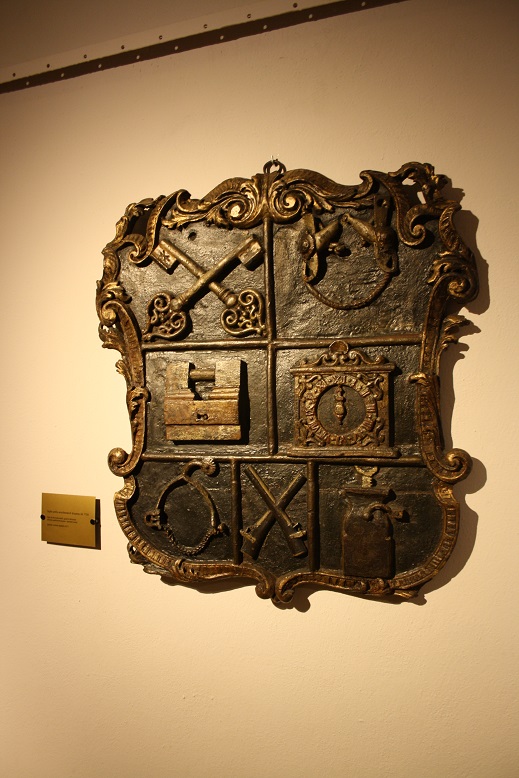
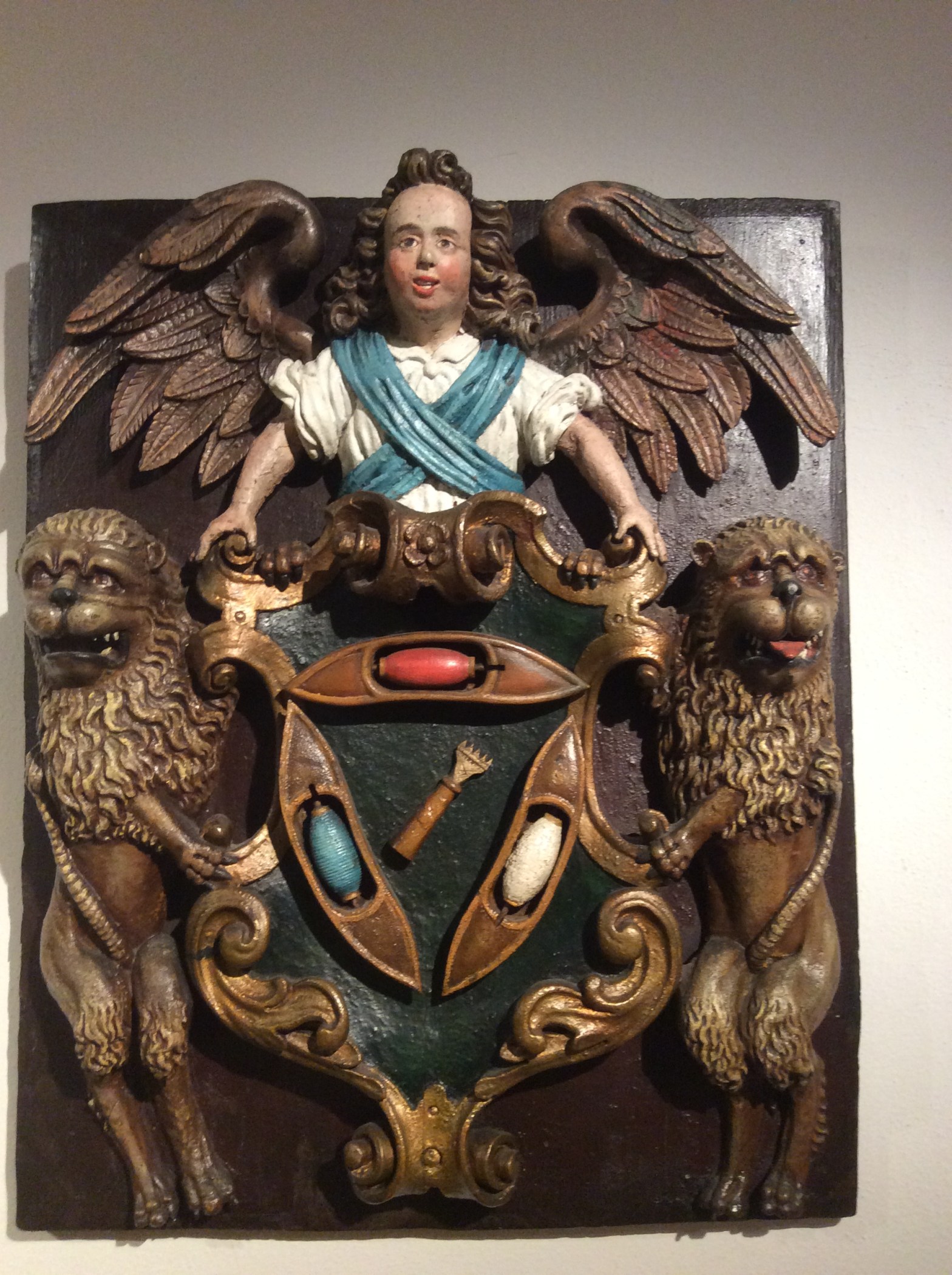
On a visit to theΒ Muzeum Narodowe we WrocΕ‚awiu in the Polish city ofΒ WrocΕ‚aw I discovered fascinating medieval shop signs and merchant guild coats of arms that illustrated the professions of artisans, traders and merchants of medieval times.

The medieval artisans of Poland
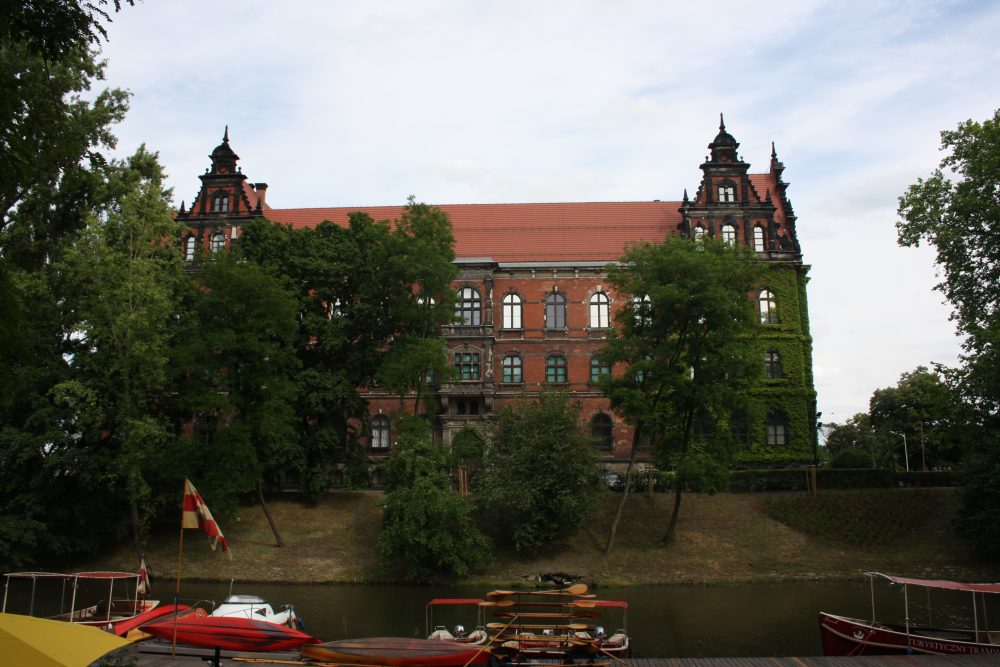
A pretty view from the Odra river onto the Muzeum Narodowe we WrocΕ‚awiu

Here are some images I took without the flash on in theΒ WrocΕ‚aw museum.

The medieval artisans of Poland

The remarkable artistry of these guild coat of arms shows how proud medieval people were, plugging their chosen trade and gaining respect and recognition for their talents in burgeoning medieval cities.

The medieval artisans of Poland

The establishment of medieval merchant guilds in Poland was closely connected to the growth of urban centres and based on German law during the 13th and 14th centuries. At the time gminas (Polish territorial districts) governed by their own law and a municipal government.

The local municipal governments (a town council, a tribunal) consisted of the representatives of trade. Some of the richest merchants (wholesalers) were allowed to sit in town councils.

This higher level of merchant power was restricted to a certain class of rich merchant men (excluding women, Jews or foreigners). Retailers and traders also created associations comprising of rich stall-keepers, salt traders, herring traders, iron traders, and so on.

The medieval artisans of Poland
Sign of a draper’s guild in Wroclaw, 1600-1650

The medieval artisans of Poland
Sign of a locksmith’s guild in Wroclaw, 1750

The oldest mention of a guild of merchants in Krakow dates from a 1410 council book. No doubt Council documents were riveting reading then, as they are now…

“It’s all happening on Tuesday, a day after St. Michael’s day, on the third week of the Lent 1410. The senior merchants were chosen by councillors MikoΕ‚aj Gemelich sworn, Wenyng Marcin, Joge Schiler sworn, Piotr Kaldherberg sworn, Jerzy Morsztyn sworn PaweΕ‚ Homan sworn”. Here is the oath taken by the senior merchants: “We swear to God that here we stand to defend and obey the merchant law, to faithfully act and to secure the profits; we swear we shall not be guided by love or bias; we shall not allow any offence and shall not come into any agreement without the council’s knowledge or permission”.

Over time stall-keepers created their own merchant guilds and older established merchants were given some political, social and economical power because of their guild memberships. IN medieval times, journey-men, peasants, Jews, women, children those given work on a casual basis weren’t awarded entry to the guilds, which were by nature – elitist.

The medieval artisans of Poland

Other known medieval guilds in Poland were inn-keepers, fish traders (especially herring traders) and salt traders and those dealing with wool cloth, cooper and lead.

Father of Nicolas Copernicus, Jan was a rich merchant living in Krakow between 1422 – 1447. He was a member of the Krakow Guild of Merchants.

The medieval artisans of Poland

Guilds were formed to secure the interest of the merchants and to also fulfill religious, moral, economical, political and social functions. Although a lot of detail about how they actually threw their weight around is a bit of a mystery.

The thriving culture of trading and artisanal goods continues on today in most cities and towns in Poland, it’s especially visible in Krakow and WrocΕ‚aw where merchants peddle woodwork, glassware, pottery and lace every day of the week during summer.

Read more about the extensive history of one guild in Krakow on this English page and a history of Jewish merchants in Poland.

10 Interesting Things I Found on the Internet #172


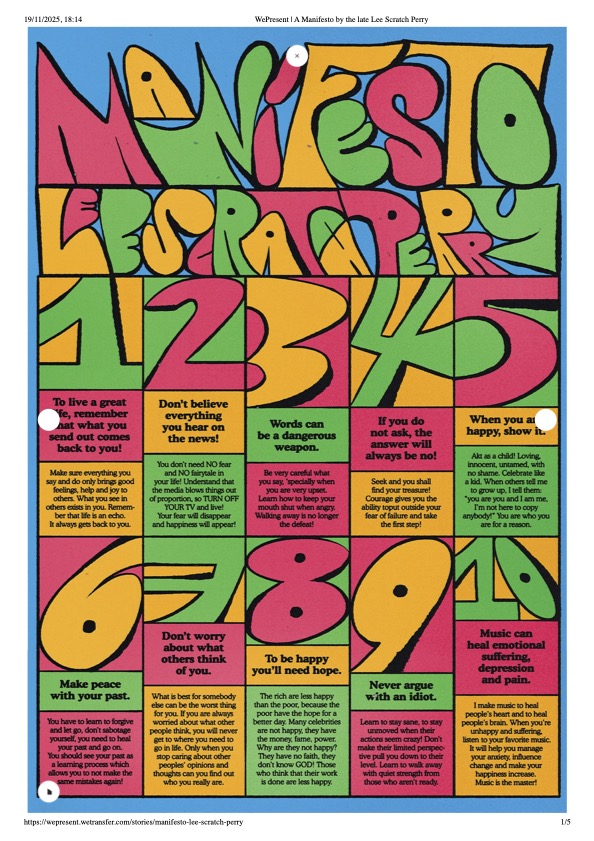
Lee Scratch Perry’s rules for life

Here are 10 life rules from a man who lives in a truly extraordinary way. Jamaican artistΒ Lee Scratch PerryΒ is a wildly creative musician and producer who has sprinkled his inimitable magic on to projects in collaboration with the likes of Bob Marley and the Wailers, The Clash, The Beastie Boys and many more. He’s a true legend, and his sage rules for living reflect that.

Via We Transfer


Jungian art therapy – discover your inner symbol


Why I’m writing about the sublime, by Robert Greene

One of my favourite non-fiction authors who writes about the human experience and philosophy Robert Greene is going to be putting out a book soon about experiencing the sublime, here he talks about why the sublime is important to everyone.


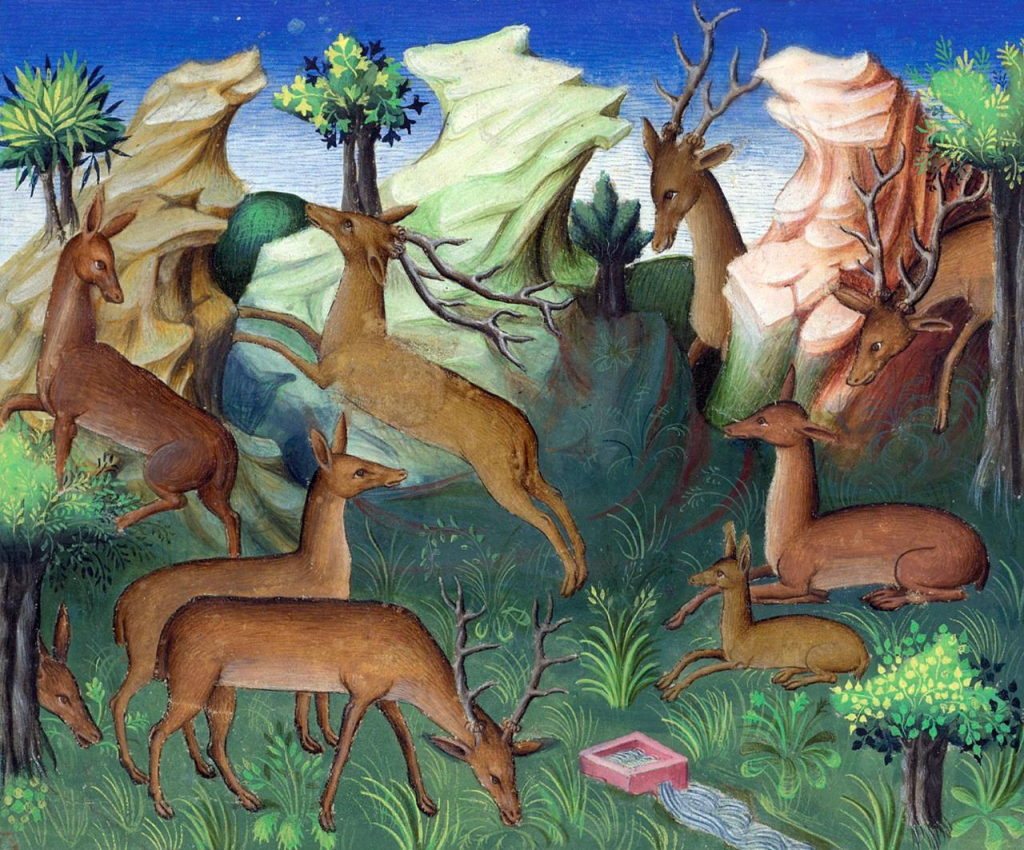
Deer by Gaston Phoebus (1470)

Deer. Gaston Phoebus, Le Livre de la chasse, Paris ca. 1407. NY, Morgan, MS M. 1044, fol. 7r.
#medieval #MedievalArt via Medieval Illumination

Deer by Gaston Phoebus (1470) medieval art

The Neon Judgement – The Fashion Party


β€˜Eliminate the nonessential’ and Other Advice for Artists

Artist and teacher Kit White offers a toolkit of ideas and a set of guiding principles for creative thinking via MIT Press Reader.

β€œArt is an idea that belongs to everyone,” writes artist and teacher Kit White in the opening pages of his book β€œ101 Things to Learn in Art School.” β€œWhatever physical form it might take, whatever emotional, aesthetic, or psychological challenge it may offer, it is vital to every culture’s sense of itself.” As such, art is not separate from life, says White, but the very description of the lives we lead.

This article is excerpted from Kit White’s book β€œ101 Things to Learn in Art School.”

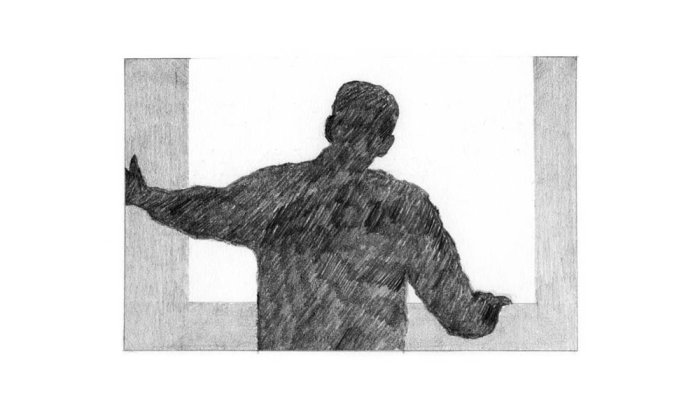
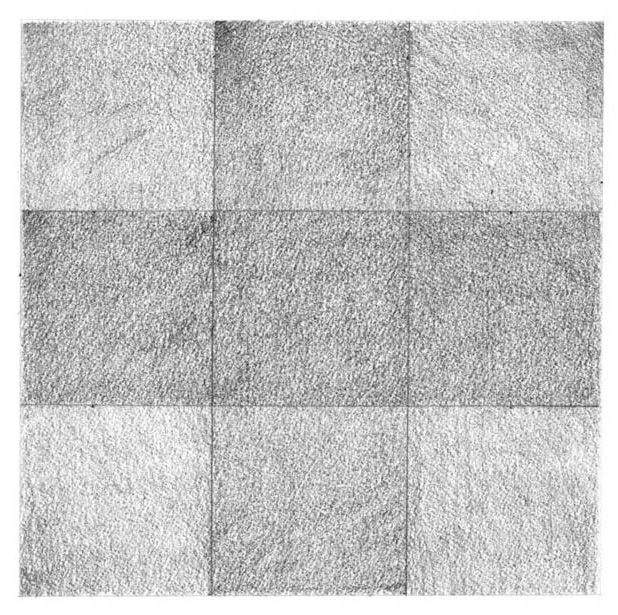
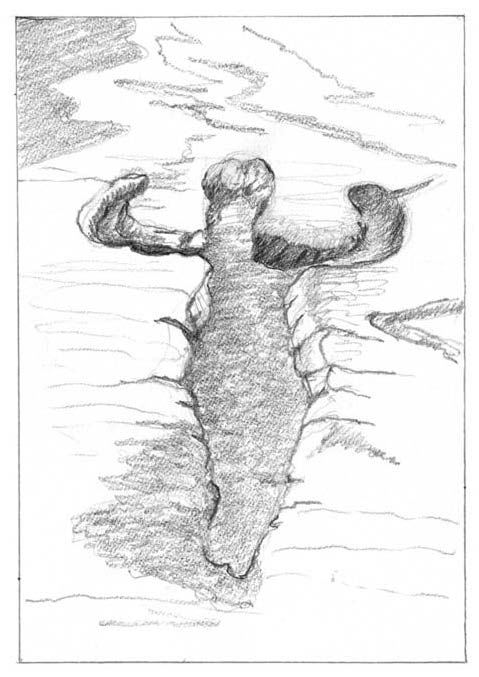
The 101 maxims, meditations, and demonstrations contained in White’s book offer both a toolkit of ideas and a set of guiding principles for the artist. Complementing each of the 101 succinct texts is an expressive drawing by the author, often based on a historical or contemporary work of art, offering a visual correlative to the written thought. β€œArt can be anything” is illustrated by a drawing of Duchamp’s famous urinal; a description of chiaroscuro art is illuminated by an image β€œafter Caravaggio”; a lesson on time and media is accompanied by a view of a Jenny Holzer projection; advice about surviving a critique gains resonance from Piero della Francesca’s arrow-pierced Saint Sebastian. β€œ101 Things to Learn in Art School” is a guide to understanding art as a description of the world we live in, and using art as a medium for thought. We’re pleased to offer a selection of lessons from the book below.
β€”The Editors


For every hour of making, spend an hour of looking and thinking.

Good work reveals itself slowly. You cannot judge a work’s full impact without hours of observation. It is also a good idea to step away from what you are doing at regular intervals. The immediate impression a work makes when it is reencountered is critical. A good work is satisfying both upon immediate encounter and after long periods of concentrated viewing. If any work fails on either approach, keep trying until you feel satisfied that you have succeeded on both counts.

After Ad Reinhardt
After Ad Reinhardt

Making art is an act of discovery.

If you are dealing only with what you know, you may not be doing your job. When you discover something new, or surprise yourself, you are engaging in the process of discovery.

After Ana Mendieta

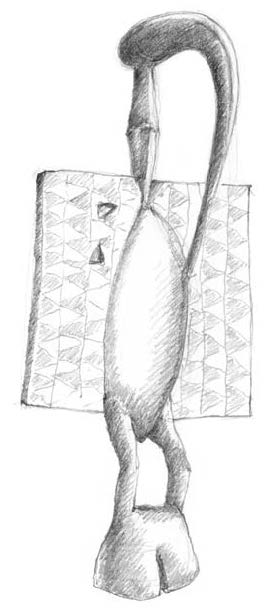
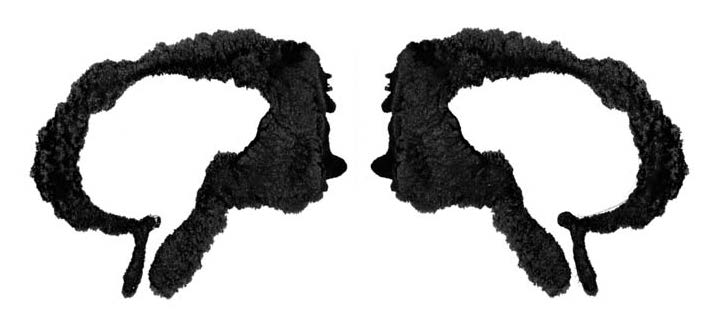
The human brain is hardwired for pattern recognition.

It has the capacity to distinguish tens of thousands of variations of the human face, which is composed of slight differences in a small set of features. The brain looks for what it knows. This has an upside and a downside. It makes it possible to create a recognizable image with very crude means. But it also makes it more difficult to render the world new or unfamiliar. To make an image different enough to bypass the brain’s pattern recognition and force it to reassess the meaning of an image is a challenge for every artist. To make the familiar unfamiliar is a large part of making new visual language.

After 19th-century Senufo bird

Art is a form of experimentation.

But most experiments fail. Do not be afraid of those failures. Embrace them. Without courting the possibility of something miscarrying, you may not take the risks necessary to expand beyond habitual ways of thinking and working. Most great advances are the product of discovery, not premeditation. Failed experiments lead to unexpected revelations.

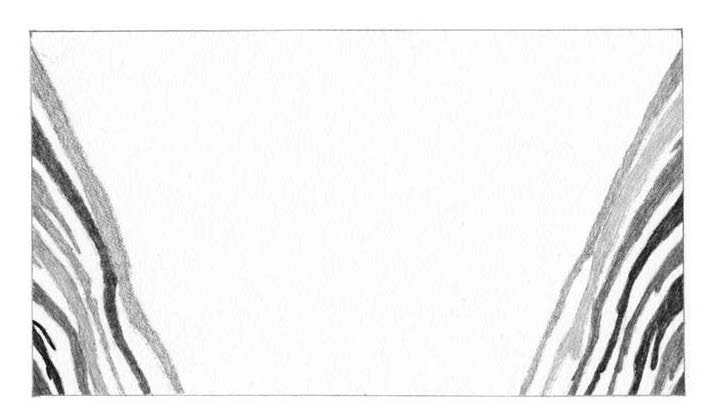
Color is not neutral.

It has an emotional component. Certain colors have specific associations and induce certain responses. Learn what they are. When you use color, try to determine and understand the accompanying emotional response and how to use it effectively. Color has a visceral impact.

After Morris Louis

Meaning does not exist in the singular.

It is a transaction between two or more conscious minds. Your work is an attempt to bridge understanding between you and others. For this reason, there is no such thing as private symbolism. Meaning derives from communication.

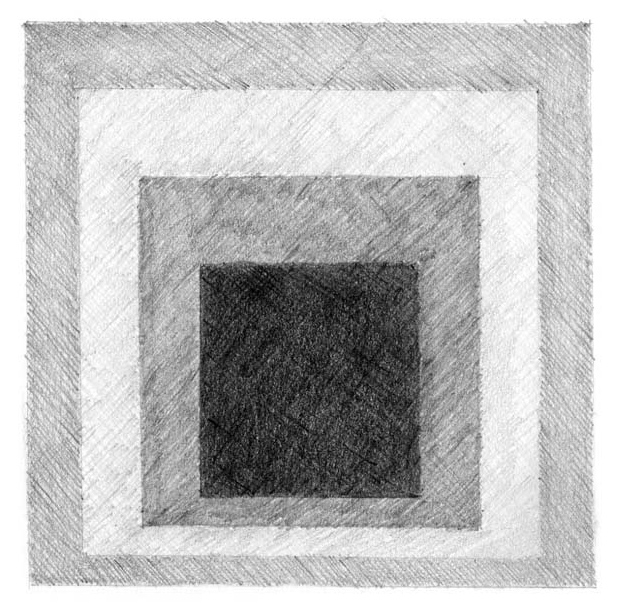
Eliminate the nonessential.

Every work of art should contain whatever it needs to fulfill its descriptive objective but nothing more. Look at the β€œleftover” parts of every composition. Successful images have no dead spaces or inactive parts. Look at your compositions holistically and make sure that every element advances the purposes of the whole.

After Josef Albers

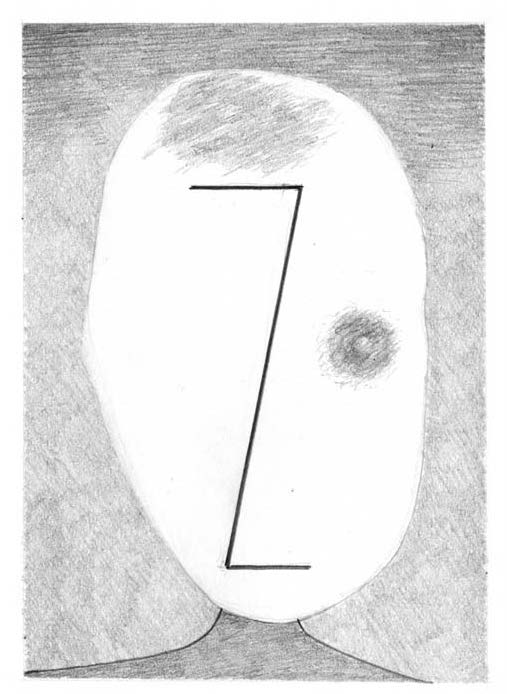
An idea is only as good as its execution.

It is important that you master your medium. Poorly made work will either ruin a good idea or make the lamentable execution itself the subject. Overly finessed technique can mask a lack of content or can smother an image. At the same time, roughness and imprecision has its place in rendering. One can only gauge the need to throw technique away if one has first achieved the mastery of it.

After Paul Klee

Kit White is an artist and former professor of painting at Pratt Institute, Brooklyn. His work is in the permanent collections of many museums, including the Guggenheim Museum. He is the author of β€œ101 Things to Learn in Art School,” from which this article is excerpted.


Scott Marsh is a legend of political art!

Scott Marsh is a prominent Australian street artist, recognised for his large-scale, provocative, and politically charged murals. His street art is characterised by sharp satire and social critique, often created in rapid response to current events. ​

One of his most famous pieces was created in 2017 during Australia’s same-sex marriage referendum. This art in Sydney’s Redfern depicted then Australian Prime Minister Tony Abbott in a wedding dress marrying himself an allusion to his deep narcissism.

In another notable work, Marsh painted then-Prime Minister Scott Morrison who was holidaying in Hawaii while devastating wildfires ravaged Australia, a pointed critique that helped raise over $60,000 for bushfire relief.​

More recently, he created a mural in Melbourne depicting Benjamin Netanyahu, Prime Minister of the genocidal Zionist regime of Israel. The artwork shows Netanyahu in a military uniform with an Israeli flag armband, set against a backdrop of a burning, bombed-out Gaza, clearly showing his central role in the destruction in Palestine. The portrait’s composition, including the uniform and posture, intentionally evokes propaganda imagery from Nazi Germany and the Third Reich. This creates a disturbing visual parallel between historical fascist regimes and the current actions of the Zionist leadership, calling out the genocide in Gaza for what it is – Hateful and Fascist.

Via Artmag


Energetic comfy UK garage mix by Opi


Sweet Potato Soup by Nagi

  • Leeks and onions β€“ These add a flavour boost without having to resort to loads of cream or tons of spices to make this soup really tasty. If leeks are a bit pricey (as they can be during some months of the year) just use an extra onion instead. Just one onion to replace two leeks. Why? Because leeks have a more subtle, mild taste than onion. Two extra onions would make this soup too oniony, I think.Bonus – Leeks don’t make your eyes water when you cut them! πŸ‘πŸ»
  • Sweet potato β€“ 2 medium ones totalling 1 kg / 2 lb (unpeeled weight), or one gigantic one.
  • Cumin powder β€“ A spice that really compliments the sweet flavour of sweet potato. Gives this a flavour reminiscent of Moroccan food which you know is a good thing!
  • Garlic β€“ This soup was never going to happen without garlic!
  • Butter and oil β€“ Because of the sheer volume of onion and leek that is sautΓ©ed, we need 4 tablespoons of fat to cook them. I felt like using just butter makes the soup a little too buttery, but using just oil isn’t as fun. So I took the best of both worlds by using equal amounts of each.😎 You can double up on either of them, if you prefer.
  • Chicken stock (or vegetable stock) β€“ I know it’s counterintuitive to use chicken stock for an otherwise vegetarian soup. But it really does give the soup deeper flavour than vegetable stock. However, I freely substitute vegetable stock.
  • Cream β€“ Any dairy cream will work here. Thickened or heavy cream, pure cream, single cream, double cream etc.Alternatives – I haven’t tried coconut milk or cream but I think they’d work nicely here. Sour cream and yogurt can also be used but they won’t add that touch of creamy mouthfeel that cream gives this soup. I’d rather use an extra knob of butter, personally.
  1. SautΓ© leek, onion and garlic for 5 minutes until sweet and softened.
  2. Stir sweet potato and cumin for 3 minutes so it’s nicely coated in the flavoured oil and the cumin gets toasted, which brings out the flavour.
  3. Simmer 20 minutes β€“ Add the stock and simmer for 20 minutes with the lid off.
  4. Blitz with a stick blender until smooth.
  5. Stir in cream.
  6. Serve – Ladle into bowls and shower with something crispy!


How to Forgive Yourself for a Painful Past

This excerpt is from the thoroughly wonderful subscription I have to IFS expert and psychotherapist Dan Roberts. Definitely well worth getting this regularly to your inbox!

Looking back over your life, how do you feel about it? I hope mostly good, but I suspect that there are aspects of your life you regret, feel embarrassed or even ashamed about. Even though that might be painful, in some ways it’s a good thing – the concept of β€˜healthy shame’ means that we are conscious when we have hurt someone, behaved badly or done something regrettable. This is like a message from your conscience that helps you learn from your mistakes, so you never do it again.
This is quite different from what psychologists call β€˜toxic shame’, which is when we feel, deep down, that we are bad or wrong because of something we have done. This kind of shame is horrible, has no possible benefit and is the core work of most psychotherapy, helping you process and eventually let go of this corrosive emotion, like you would throw out some long-forgotten, mouldy food from the darkest corner of your fridge. Viewed through a parts lens, of course we wouldn’t throw out the part feeling that shame, just the shame itself, which hurts that poor part as much as it does the rest of you.
It’s also helpful to distinguish between guilt and shame. We feel guilt when we make a mistake, like sending an insensitive message or forgetting a friend’s birthday. We would then think, β€˜Oh crap, I did something bad.’ But shame is when we make the same mistake and then think, β€˜I am bad.’ This is far more destructive and almost always untrue, because we usually think we are bad when we made an all-too-human mistake. Or, especially for folks with a trauma history, someone did something horrible to us and we blame ourselves for it in some way, thinking we deserved this horrible treatment and so should suffer for it. This is patently untrue and, again, is often the core work of psychotherapy, especially if it’s trauma therapy.

Try making amends

The key to letting go of all this inner turmoil is to forgive yourself, whatever you might have done. But forgiveness is tricky, especially if you have actually hurt someone or done something that jars with your values, like being mean to your kids or having an affair. In that case, I think the ninth step in 12-step recovery programmes is very helpful: make amends to the person you hurt. This can be on a spectrum, from minor trangressions like being snappy with your daughter to major ones like betraying your partner, but the fundamental principles remain the same.
Either way, it’s helpful to own what you have done – let’s take the first example, which would look like sitting your daughter down and apologising for being snappy. In therapy, we call this a β€˜non-defensive apology’ and it’s really powerful (unlike one of those politicians’ non-apology apologies which seems fake and just makes things worse). You might say, β€˜Darling, I’m so sorry for getting cross with you earlier. I was tired and stressed out, but that doesn’t make it OK. I totally messed up and I am truly sorry.’
You can then make amends by adding, β€˜How can I make this right? What would help you feel better?’ She might want a bowl of ice cream, or a hug. Perhaps she would want something more, like asking for you to work on your anger, or promise to be more patient with her. At this stage, unless she’s asking for a new puppy or an infinite supply of chocolate, you have to say yes, because this is the second step to repairing the β€˜rupture’ you caused earlier.
Dr John Gottman, eminent couples therapist and co-founder of the Gottman Institute, says the secret to a good relationship is not to never have ruptures, because that’s impossible. Whether that relationship is with your partner or kids, you will sometimes rub each other up the wrong way, bicker or hurt the one you love, however hard you try not to. Instead, the key is how you heal those ruptures: how skilled you both are at repair. And the non-defensive apology and making amends are key stages in repair after a rupture.

Now forgive yourself

When you have healed the rupture, given your daughter a big hug, promised to work on your stress and anger in future, it’s time to forgive yourself. This is a key step, because what many of us do is now turn β€˜I did something bad’ (hurt my beloved child) into β€˜I am bad’ (only a terrible person would hurt their kid) and carry the toxic shame this triggers in our heart and mind for years. Why? What possible good could that do? None. In fact, the more shame you feel, the more likely you are to feel thin-skinned and defensive and get snappy again the next time your daughter is challenging. Say sorry, make amends, let it go.
This is, of course, easier said than done. But it’s still a useful ambition to hold – that instead of carrying shame for all the things you did wrong, or wish you could undo, try making amends to that person and then letting it go. After all, carrying the radioactive gloop of shame inside will only cause you suffering. And life is hard enough already, without punishing yourself for mistakes you made in the distant past, which everyone else involved has probably long forgotten. Via Dan Roberts


The Young Family by Australian artist Patricia Piccinini

Β Since the 1990s Patricia Piccinini has challenged conventional views of the duality of nature and culture through compelling material experiments that manifest in human/technology hybrids. Her sculptural objects question Western philosophical traditions privileging mind over body and the placement of the human subject and human intelligence at the apex of life on Earth.

How do we build our lives together with other, more-than-human animals? And how can it be a nurturing relationship? How can we have an understanding and experience of nature, which is not just about this very traditional idea of pristine nature, untouched by humans? Because that doesn’t exist, and the idea is not workable anymore.

Artist Patricia Piccinini
Patricia Piccinini, The Young Family, 2003, silicone, acrylic, human hair, leather, timber, 89 x 164 x 142 cm, Bendigo Art Gallery, Victoria,

Did you enjoy this collection? let me know what you think of it below. Thank you for reading my dear friends!
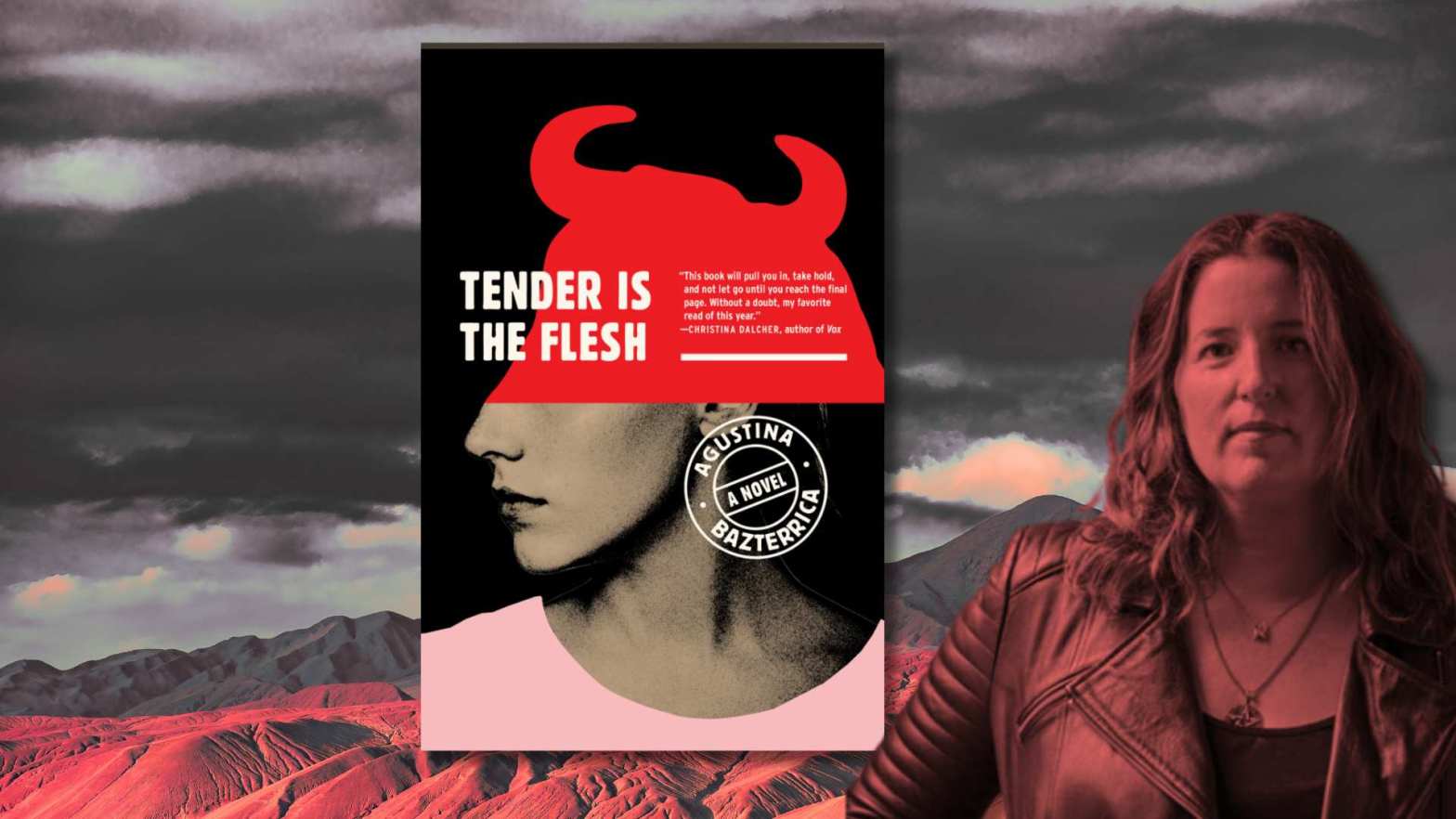
Book Review: Tender is the Flesh by Agustina Bazterrica

An emotionally and physically eviscerating exploration of what it means to be a human and what it means to be an animal. And the morbid and savage extent that humans will go to dehumanise the living beings they eat.

Rating: 🌟🌟🌟🌟🌟

Genre:Β Horror, animal rights, human rights, speculative fiction

Publisher:Β Scribner

Review in one word:Β Provocative

* Contains no plot spoilers.

Tender is the Flesh is dark fictional work of enormous savagery, beauty and genius. This is one of the best books I’ve ever read in my life and I’m not even a fan of horror. Normally I shy away from gory, horror-filled and post apocalyptic books because I don’t like any kind of gratuitous violence. This book was hugely different because there’s a powerful philosophical meaning to the violence.

From the moment of reading the first sentences I was utterly captivated. In a world not too different from our own, a virus wipes out all animals on the planet. This means in order for human life to continue, a protein must be found that contains all of the amino acids humans need. The world is overpopulated and so this protein becomes other human beings – cannibalism is rebranded as ‘special meat’.

Instead of just β€œmeat,” now there’s β€œspecial tenderloin,” β€œspecial cutlets,” β€œspecial kidneys.” He doesn’t call it special meat. He uses technical words to refer to what is a human but will never be a person, to what is always a product. To the number of head to be processed, to the lot waiting in the unloading yard, to the slaughter line that must run in a constant and orderly manner, to the excrement that needs to be sold for manure, to the offal sector.

No one can call them humans because that would mean giving them an identity. They call them product, or meat, or food. Except for him; he would prefer not to have to call them by any name.”

Tender is the Flesh

Protagonist Marcos works at the local slaughterhouse AKA processing plant, where they slaughter humans, although these creatures are intentionally dehumanised – not given a name, have their vocal chords cut out at birth so that they can’t scream, are branded and corralled into small pens where they are artificially inseminated, sold into labs for unspeakably cruel experiments and treated like – well…like how people treat animals every day!

This was where the book became infinitely interesting for me and powerful. By supplanting animals we use for meat – cows, pigs, sheep and chickens for human beings, for the first time people who are desensitised to what happens to animals are shockingly able to see, the immense cruelty, slavery and pain that animals have to endure before they are killed, simply because we want to eat, wear or use them.

β€œThere’s a sharp, penetrating smell to the resting cage sector. He thinks it’s the smell of fear. They climb a set of stairs to a suspended balcony from where it’s possible to observe the shipment. He asks them not to talk loudly because the head need to be kept calm. Sudden sounds disturb them, and when they’re edgy they’re more difficult to handle. The cages are below them. The head are still agitated after the journey, despite the fact that unloading took place in the early hours of the morning. They move about in a frightened way.

He explains that when the head arrive, they’re given a spray wash and then examined. They need to fast, he adds, and are given a liquid diet to reduce intestinal content and lower the risk of contamination when they’re handled after slaughter. He tries to count the number of times he’s repeated this sentence in his life.”

Tender is the Flesh

In this scene in a butcher specialising in ‘special meat’ there’s a softening of the language and a rebranding that goes on, exactly like how a deli or butcher would refer to animal meat:

β€œFirst it was the packaged hands that Spanel placed off to the side where they were hidden among the milanesas Γ  la provenΓ§ale, the cuts of tri-tip, and the kidneys. The label read β€œSpecial Meat,” but on another part of the package, Spanel clarified that it was β€œUpper Extremity,” strategically avoiding the word hand. Then she added packaged feet, which were displayed on a bed of lettuce with the label β€œLower Extremity,” and later on, a platter with tongues, penises, noses, testicles, and a sign that said β€œSpanel’s Delicacies.”

Tender is the Flesh

This is a masterwork of subversive fiction and as a person who has wrestled with eating meat for all of my life and being plant-based, this is how I chose to see the book’s meaning.

It’s about the immense brutality of people against other people, and people against other animals. It’s about power and status and how those with lower status (humans or animals) are subjected to untold and unimaginable cruelty for sport, food, experimentation, fashion and everything else.

β€œUrlet is sitting against the tall back of an armchair made of dark wood. Behind him hang half a dozen human heads. His hunting trophies. He always clarifies, to whomever will listen, that over the years these were the toughest head to hunt, those that posed β€œmonstrous and invigorating challenges.” Next to the heads hang framed photographs. They’re antique photographs of black people being hunted in Africa before the Transition. The largest and sharpest image shows a white hunter down on his knees holding a rifle, and behind him, on stakes, the heads of four black men. The hunter is smiling.”

Tender is the Flesh

The language used in the ‘processing centre’ is deliberately softened and dehumanised in much the same way as a person working in a slaughterhouse learns to use different words to describe what they are really doing, brutally murdering conscious living beings over and over again.

This book is a warning and an allegory about how we treat animals but also how, if given the chance, we will treat other human beings. I don’t believe it’s a coincidence that in this book the processing plant’s directors were either German or Japanese – this alludes to the brutal ‘processing’ of people in camps that occurred during WWII. There is a lot of dark collective emotional baggage that is aired in this book! It is explosive and yet so very necessary!

Originally written in Spanish by Argentinian writer Agustina Bazterrica, one of the only things I know about Argentina aside from Tango is that they love and export A LOT of meat. This book really gets to the heart of their meaty culture.

How living, thinking and feeling human beings and living, thinking and feeling animals are reduced to “resources” that can be used to one’s advantage for profit or comfort.

Marcos the book’s narrator has a life that’s crumbling to pieces with his dad disappearing due to dementia and a wife who has recently left him due to them both losing a child.

Everything seems to be going to pieces for Marcos until he gets a live female specimen of Pure Grade Meat who he ties up in his garage. Little by little he begins to treat her like a human being and it seems that through this connection he might yet salvage some of his compassion and humanity.

If this book sounds like it’s too much for you, I actually felt the same way and for a long time held onto it, looking at it like some kind of dark talisman.

By eventually reading it, I was rewarded with some of the most mind-blowing fiction I’ve ever read. I heartily recommend this one. Yes it’s not for the fainthearted but it will forever change how you view humans and animals and the casual, socially acceptable ways that we deny consciousness and basic rights to other living beings – human and animal…and after all aren’t we all really just animals?

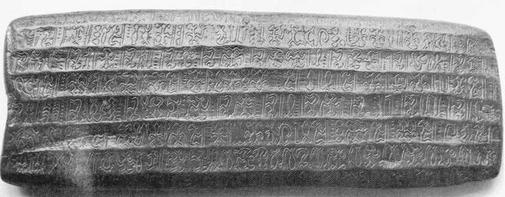
Mysterious Rongorongo Glyphs from Easter Island

A collection of 24 sacred wooden objects from Easter Island bear Rongorongo inscriptions, a system of glyphs that was discovered in the 19th Century and is still a mystery to historians. Numerous attempts at decyphering the proto-writing have been unsuccessful.

These pieces of wood (a lot of it driftwood) are weathered, burned and damaged and of an irregular shape. Some form a chieftain’s staff, a bird-man statuette, and two reimiro ornaments. Oral history however suggests that only a small elite was ever literate and that the tablets were sacred.

The Santiago tablet (G)
Mysterious Rongorongo Glyphs from Easter Island's Rapa Nui Tribe

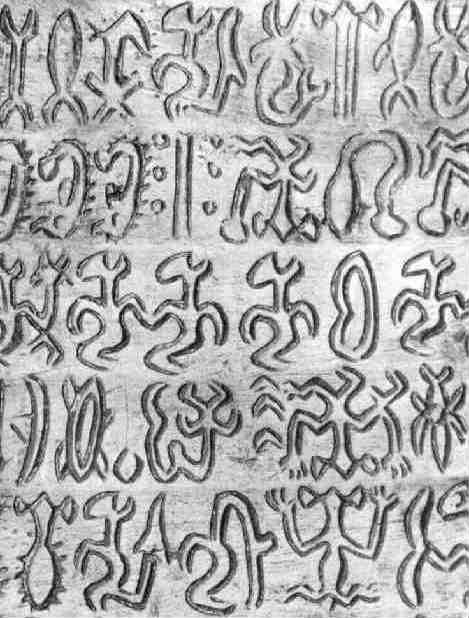
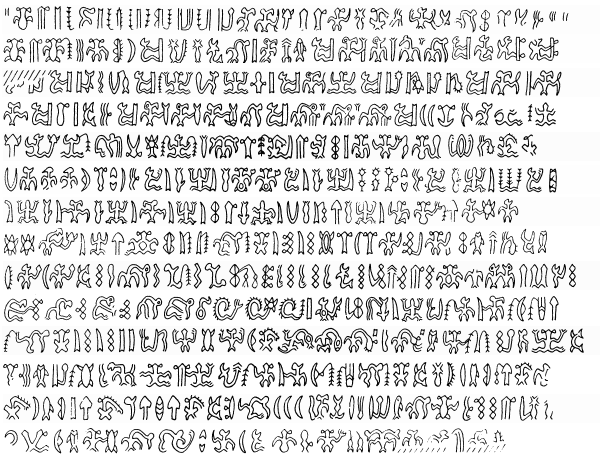
The glyphs themselves are outlines of human, animal, plant, artifact and geometric forms. Many of the human and animal figures, such as glyphs 200 Glyph 200 and 280 Glyph 280, have characteristic protuberances on each side of the head, possibly representing eyes.

Authentic rongorongo texts are written in alternating directions, a system called reverse boustrophedon.  From left to right and bottom of top. The reader begins at the bottom left-hand corner of a tablet, reads a line from left to right, then rotates the tablet 180 degrees to continue on the next line.

Oral tradition indicates that the wood was carved with small shark’s teeth and flakes of obsidian. This method is still used throughout Polynesia.

Other tablets appear to have been cut with a steel blade, often rather crudely. Although steel knives were available after the arrival of the Spanish, this does cast suspicion on the authenticity of these tablets.

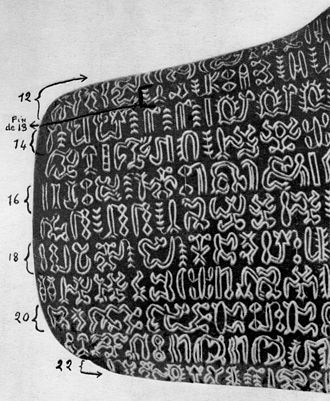
Possible meanings of the tablet’s symbols
A photographic negative of one end of the tablet

The glyphs are stylized human, animal, vegetable and geometric shapes, and often form compounds. Heads often have characteristic projections on the sides which may be eyes (as on the sea turtle glyph but which often resemble ears. Birds are common; many resemble the frigatebird which was associated with the supreme god Makemake. Other glyphs look like fish or arthropods. A few, but only a few, are similar to petroglyphs found throughout the island.

Oral tradition holds that either Hotu Matuβ€˜a or Tuβ€˜u ko Iho, the legendary founder(s) of Rapa Nui, brought 67 tablets from their homeland. The same founder is also credited with bringing indigenous plants such as the toromiro. However, there is no homeland likely to have had a tradition of writing in Polynesia or even in South America. Thus rongorongo appears to have been an internal development. Given that few if any of the Rapanui people remaining on the island in the 1870s could read the glyphs, it is likely that only a small minority were ever literate. Indeed, early visitors were told that literacy was a privilege of the ruling families and priests who were all kidnapped in the Peruvian slaving raids or died soon afterwards in the resulting epidemics.

Mysterious Rongorongo Glyphs from Easter Island's Rapa Nui Tribe

Little direct dating has been done. The start of forest-clearing for agriculture, and thus presumably colonisation, has been dated to circa 1200, implying a date for the invention of rongorongo no earlier than the 13th century.

Read more

Comforting Thought: Your Mind Is Part of the Ecosystem

Our mental and ecological health are linked writes Timothy Morton for the MIT Press Reader. Recognising this interdependence can change how we relate to the world and to ourselves.

There is a really deep reason why, when you examine things from an unusual (to humans) point of view, they become strange in such a way that you need to include your own perspective in your description, as if you were like Neo in β€œThe Matrix,” touching the mirror only to find that it is sticking to your finger and pulling away from the wall as you try to withdraw your hand.

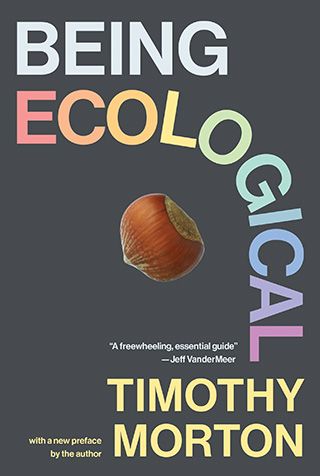
This article is excerpted from Timothy Morton’s book β€œBeing Ecological.”

It’s like what happens in a dream. When you dream of nasty creepy-crawlies falling on you from the ceiling, you also have a certain feeling or attitude (or whatever you want to call it) toward the insects, perhaps horror or disgust, perhaps mixed with a strange detachment. This is the same as how in a story there is what’s happening (the narrative) and how it’s being told (the narrator, whether it be singular, plural, human or not, and so on). These two aspects form a manifold. When we look at a β€œthing,” we are forgetting that β€œthing” is just part of a manifold. It’s not true that there’s β€œme” and then there’s a β€œthing” I reach out to with my perception, like reaching my hand out to a can of beans in the supermarket. But perhaps we have tried to design our world to look like a supermarket, full of things we can reach out and grab.

When you analyze a nightmare, you discover that the insects and the feelings you are having about them are both aspects of your very own mind.

The result of living as though you believe in subject–object dualism, which is our usual mode of thinking about the world (even if we are doing it unconsciously), is that it becomes hard to accept what is in fact more logical and easier on the mind in the end. When you analyze a nightmare, you discover that the insects and the feelings you are having about them are both aspects of your very own mind. Perhaps the insects are unacceptable thoughts of which you’re just becoming aware. What is so powerful about psychoanalysis and some spiritual traditions such as Buddhism is that they enable you to entertain the idea that thoughts and so on are not β€œyours” all the way down, which can be very liberating: What matters isn’t exactly what you think, it’s how you think. You know that facts are never just β€œover there” like cans of soup waiting to be picked up in some neutral way.

You know ideas code for attitudes, insofar as ideas always imply a way of thinking them, an attitude, and that this explains how propaganda works. Take a very simple example: the term welfare evokes contempt for its recipients in a way that the word benefits doesn’t. Since 2010 the British Conservative Party succeeded in getting almost everyone in the media to say β€œwelfare” and not β€œbenefits,” with the obvious repercussions of making cuts more acceptable. Reading a poem is a wonderful exercise in learning how not to be conned by propaganda, for this very reason. That’s because a poem makes it very uncertain exactly what sort of way you are supposed to hold the idea it presents. If I say β€œCome here!,” it’s fairly obvious what I mean, but if I say β€œIt is an Ancient Mariner,” you might be a bit flummoxed. Reading a poem introduces some wiggle room between ideas and ways of having them. Propaganda closes this space down.

Something fascinating occurs if you start to think how the biosphere, as a total system of interactions between lifeforms and their habitats (which are mostly just other lifeforms), is also like the inside of a dreaming head. Everything in that biosphere is a symptom of the biosphere. There is no β€œaway” that isn’t merely relative to a certain position within it. I can’t suppress my thoughts without them popping up like nasty insects in my nightmare. I can’t get rid of nuclear waste just by hiding it in some mountain. If I widen my spatiotemporal scale enough to include the moment at which the mountain has collapsed, I didn’t really hide the waste anywhere once and for all. You can’t sweep things under the carpet in the world of ecological awareness.

And this biosphere includes all the thoughts (and nightmares) we are having too. It includes wishes and hopes and ideas about biospheres. It’s not exactly physically located precisely on Earth. It’s phenomenologically located in our projects, tasks, things we’re up to. Say, for example, we decide to move to Mars to avoid global warming. We will have to create a biosphere suitable for us from scratch β€” in a way we will have exactly the same problem as we have on Earth, possibly much worse, because now we have to start from the beginning. Experientially, which is a sloppy and biased way of saying the philosophical word phenomenologically, we are still on Earth. Sloppy and biased, because it implies all kinds of things that need to be proved in turn, such as the idea that there is a certain kind of β€œobjective world” and that β€œsubjectivity” is different from it. The phenomenology of something is the logic of how it appears, how it arises or happens. If we move to Mars, the move will appear in an Earthlike way, no matter what the coordinates on our space chart tell us.

So it’s not correct to say that the biosphere is β€œin” a preexisting space. The biosphere is a network of relations between beings such as waves, coral, ideas about coral, and oil-spewing tankers, a network that is an entity in its very own right.

As the systems theorist Gregory Bateson implied when he wrote about β€œthe ecology of mind,” mental issues are somehow ecological in this sense. How your thoughts are related equals what is called β€œmind,” and mind is like the biosphere. Even though it’s made up of thoughts, mind is independent of those thoughts, it affects them causally. If you are scared, you will think scary things. It’s what some people call β€œdownward causality.” Something like climate can affect something like weather. It’s not true that climate is just a graph of how weather events are related. There is something real there. You can’t reduce the biosphere to its component parts, just as you can’t reduce your mind to its component thoughts. And you can’t reduce your thoughts to what the thought is about, or to the way you are thinking about that thought: you need both, because a thought is a manifold. And this leads to a very interesting insight: maybe everything is a manifold. Or to use Bateson’s language, a β€œsystem.” The system is different from the things out of which it is made. Being mentally healthy might mean knowing that what you are thinking and how you are thinking are intertwined.

Something fascinating occurs if you start to think how the biosphere, as a total system of interactions between lifeforms and their habitats, is also like the inside of a dreaming head.

It’s not exactly what you believe but how you believe that could be causing trouble. In other words, there are beliefs about belief. Maybe if we change how we think about things such as coral and white rhinos, we might be more ecologically healthy. And maybe mental health and ecological β€œhealth” are interlinked. I believe that humans are traumatized by having severed their connections with nonhuman beings, connections that exist deep inside their bodies (in our DNA, for instance; fingers aren’t exclusively human, nor are lungs or cell metabolism). We sever these connections in social and philosophical space but they still exist, like thoughts we think of as unacceptable and that pop up in nightmares.

Part of our growing ecological awareness is a feeling of disgust that we are literally covered in and penetrated by nonhuman beings, not just by accident but in an irreducible way, a way that is crucial to our very existence. If you didn’t have a bacterial microbiome in your digestive system, you couldn’t eat. Maybe this feeling of disgust will diminish if we become used to our immersion in the biosphere, just like our neurotic feelings diminish as we become friendlier with our thoughts β€” perhaps through psychotherapy or meditation. There have indeed arisen forms of ecological psychotherapy, and a branch of psychological studies some call ecopsychology. And many Buddhist meditation teachers also write about ecology, as a glance at some of the readily available magazines such as Shambhala Sun will show you.


Timothy Morton is Rita Shea Guffey Chair in English at Rice University and the author of numerous books, including β€œDark Ecology” (Columbia University Press), β€œEcology Without Nature” (Harvard University Press), and β€œBeing Ecological,” from which this article is excerpted.

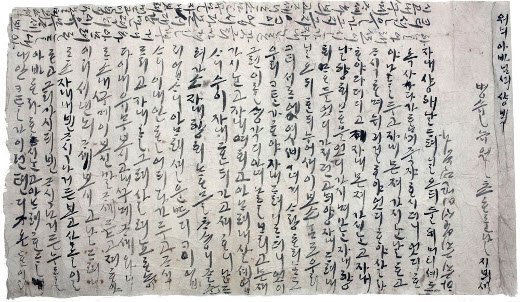
To Won’s Father: An Ancient Love Letter Rediscovered

In 1998, archaeologists in Andong City, South Korea to their amazement discovered the tomb of Eung-tae a man who lived in the 16th century. The mummified remains were a rare find for the time.

Eung-tae was unusually tall, even by today’s standards. He was 5”9 and well built with skin and beard still intact.

“The dark moustache made me feel that he must have had a charming appearance,” said Se-kwon Yim, former director of the Andong National University Museum. She was one of the first people to see him.

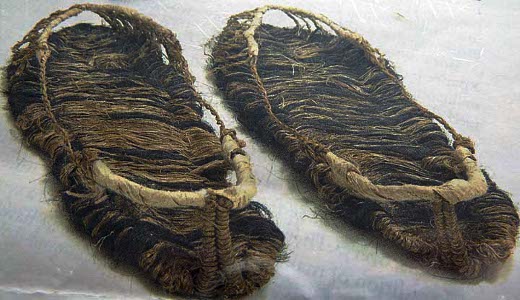
Even more astonishingly, the tomb contained a bittersweet letter from his wife, written after his death, and a pair of shoes woven from hemp bark and his wife’s hair.

In the ensuing 16 years after the discovery, the public’s fascination with this find shows no signs of abating. With an opera, two novels and a feature film inspired by the discovery.

To Won's Father: An Ancient Love Letter Rediscovered

To Won’s Father [Transcript]

To Won’s Father

June 1, 1586

You always said, “Dear, let’s live together until our hair turns gray and die on the same day.” How could you pass away without me? Who should I and our little boy listen to and how should we live? How could you go ahead of me?

How did you bring your heart to me and how did I bring my heart to you? Whenever we lay down together you always told me, “Dear, do other people cherish and love each other like we do? Are they really like us?” How could you leave all that behind and go ahead of me?

I just cannot live without you. I just want to go to you. Please take me to where you are. My feelings toward you I cannot forget in this world and my sorrow knows no limit. Where would I put my heart in now and how can I live with the child missing you?

Please look at this letter and tell me in detail in my dreams. Because I want to listen to your saying in detail in my dreams I write this letter and put it in. Look closely and talk to me.

When I give birth to the child in me, who should it call father? Can anyone fathom how I feel? There is no tragedy like this under the sky.

You are just in another place, and not in such a deep grief as I am. There is no limit and end to my sorrows that I write roughly. Please look closely at this letter and come to me in my dreams and show yourself in detail and tell me. I believe I can see you in my dreams. Come to me secretly and show yourself. There is no limit to what I want to say and I stop here.

Discover More…

Letters of Note

Archaeology.org: Korean Love Affair

To Won's Father: An Ancient Love Letter Rediscovered

10 Interesting Things I Found on the Internet #171


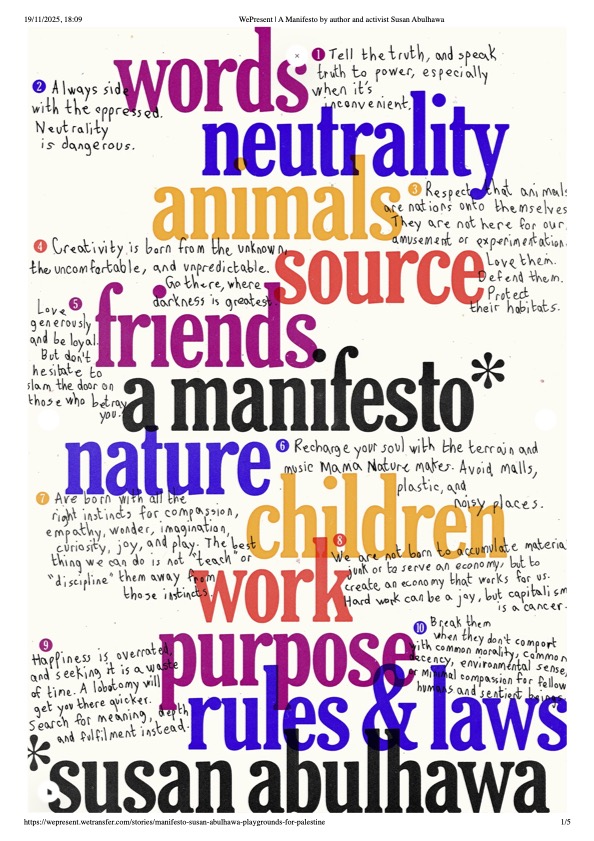
Ten rules for living by writer and founder of Playgrounds for Palestine Susan Abulhawa

Via We Transfer


Stewart Keller – Coloring Book


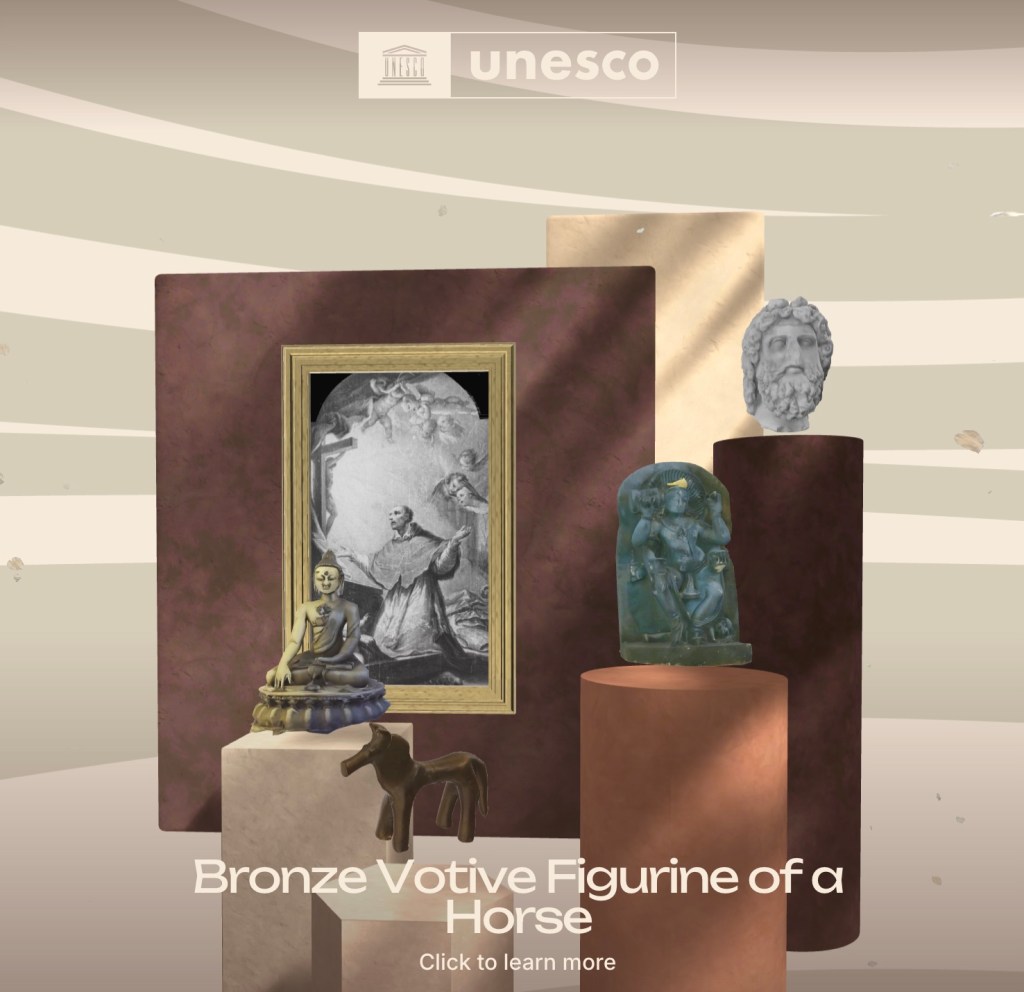
UNESCO has launched a virtual museum of stolen objects to draw attention to illicit trade in indigenous artefacts

UNESCO has launched the Virtual Museum of Stolen Cultural Objects, the first of its kind worldwide. 🌍

Screenshot

An immersive digital space that brings together over 240 stolen and missing cultural objects in 2D and 3D from 50+ countries β€” and the voices of the communities they were taken from. More than a museum, it’s a tool to:

  • Raise awareness about illicit trafficking
  • Support stronger protection policies
  • Promote provenance research
  • Foster cooperation for restitution

Created by Francis KΓ©rΓ©, Pritzker Prize-winning architect, with the generous support of Saudi Arabia and in partnership with INTERPOL. A milestone in the global fight against illicit trafficking of cultural property. On the International Day against Illicit Trafficking in Cultural Property, we’re reminded that protecting heritage means protecting our shared identity.


Ecofeminism in Contemporary Art: an Australian Perspective

Some of the most powerful contemporary art engaging with the ecological crisis is that which draws on ecofeminism’s non-dualistic thinking and the deep customary insights of First Nations knowledges. In this article I consider work by three contemporary Australian artists whose aesthetics help facilitate the sensory recognition of the interrelatedness of the human and more than human, including the inextricable histories of colonial violence and environmental degradation, and position art as an inclusive platform for ecological communication and activism.

Ecofeminist philosophy explores the connections between the instrumentalisation of nature, the control of women, and the acquisition of scientific knowledge, all of which underpin modernity and the ideology of β€œprogress”. As early ecofeminist Carolyn Merchant argues, β€œNature cast in the female gender, when stripped of activity and rendered passive, could be dominated by science, technology, and capitalist production”.1 Ecofeminism critiques male-biased Western canonical views about women and nature and seeks alternatives and solutions.2

In Feminism and the Mastery of Nature, philosopher Val Plumwood proposes that Western culture has been systematically unable to acknowledge dependency on nature, the sphere of those it has defined as β€œinferior” others. As a result, the master discourse of reason has distorted the knowledge of the world and developed β€œblind spots” that threaten our survival. It is only through creating β€œa truly democratic and ecological culture beyond dualism”3 that we can transition to a sustainable future. In Environmental Culture: The Ecological Crisis of Reason, she reaffirms that β€œdeveloping environmental culture involves a systematic resolution of the nature/culture and reason/nature dualisms that split mind from body, reason from emotion, across their many domains of cultural influence”.4 While sharing with deep ecology the belief that human life is just one of many equal components of a global ecosystem, ecofeminism asserts that one cannot disentangle anthropocentrism and androcentrism, nor critique the culture/nature dualism without providing a gendered analysis of how this dualism has functioned historically to legitimise the dominations of women and nature.5 By defamiliarising our conventional exchanges with nature, ecofeminism attempts to shift perceptions of other life forms – the more than human – as well as question received ideas about what it means to be human.

In recent decades environmentally conscious artists have embraced nature through humbling gestures of reconciliation, challenging the modernist belief in the dominance of β€œman” as rational being, along with its correlate, the environmental and social degradations of industrial capital. Ecofeminism informed many of these actions and highlighted the gendered dualistic thinking underpinning Western understandings of nature through inter-species and intersectional ecological actions.6 Ecofeminism has also informed recent scholarship and art practices associated with the β€œnew materialism” that similarly realigns our understandings of life and agency. The ecofeminist imagination operating in such work materially confronts us with the different modalities of objects, setting us up for interactions that heighten our sense of the thingness of the world, including ourselves. As philosopher Jane Bennett suggests, such an approach allows passage to a more complex and more ethical view of what it means to occupy this planet, where human/object, human/environment and material/spirit are understood not as separate, but as integrated.7 With this understanding could come an enhanced political agency that is at home with mystery and uncertainty, and that operates holistically rather than privileging the place of the human subject, and in particular, reason.

Such an integrative conception of the human and more than human world is at the heart of many First Nations’ ways of being. In Australian Aboriginal belief systems, Country embodies the relatedness of land and culture: it is β€œa place that gives and receives life. Not just imagined or represented, it is lived in and lived with […] Country is a living entity with a yesterday, today, and tomorrow, with a consciousness, and a will toward life.”8 Country is the bedrock of culture, as the Earth is vested with the power and knowledge of ancestorial creator beings. This understanding of the intimate landscape necessarily recognises First Nations ownership and stewardship, an acknowledgment embedded in many First Nations’ artworks that link ecology and art to identity and cultural survival, and assert that loss of identity goes hand in hand with environmental degradation.

Julie Gough (b. 1965) is a Trawlwoolway artist, writer and curator whose practice addresses the historical and ongoing trauma of the First Peoples of Lutruwita (Tasmania), including the experiences of her own family. Working with archives and stories, she makes films and installations that reinterpret particular places whose significance has been covered over or forgotten. In her works Country, as identity and as ecological phenomenon, are inextricable. In the most recent Biennale of Sydney (rΔ«vus, 2022), which centred on the political agency of rivers and wetlands, J. Gough presented p/re-occupied (2022), a video projection with mixed media, including sound, kayak and rocks.9 The video follows the artist as she kayaks along several interconnecting rivers and tributaries in the Midlands of Lutruwita: her journey is a ritual of repatriation, to return facsimiles of cultural belongings, namely ancient stone tools long ago removed to museum collections, to ancestral waterways. At the same time the journey serves to return the First Nations names to these rivers, words β€œthat respect their past and purpose and alliterate their flow since invasion, since colonisation. Survivors. Kin” – paranaple (Mersey River), panatana creek, tinamirakunaβ€―(Macquarie River) and lokenermenanyaβ€―(Clyde River). According to the artist,

To be home, truly, on Country, is to become it. Particles. Substance of place. Belonging. Inhale. Exhale. Everything seems to swirl around, to gather, reform, then set out again […] When I kneel by a river on my island home, I don’t need to see my reflection to be grounded. Our Old People are in the wind, my imprint in that mud is the same repeated, over millennia, by family.10

Leanne Tobin (b. 1961) is a multidisciplinary artist of English, Irish and Aboriginal heritage, descended from the Buruberong and Wumali clans of the Dharug, the ancestral peoples of Greater Sydney. In her practice, which is often community based and collaborative, the desire to nurture Country brings together concerns around recovering stories of the Old People and caring for the more than human world. L. Tobin also featured in rΔ«vus, with Ngalawan – We Live, We Remain: The Call of Ngura (Country) (2021), a sculptural installation, video and participatory weaving work that brought to life the Dharug story of Gurrangatty, the ancestral eel that long ago created the rivers and mountains. The work was spread across two locations to allow visitors to walk part of the path of the eel’s lifecycle; this is a phenomenal journey that sees the eels climb dams and creep over land as they follow their Songline to the Coral Sea, thousands of kilometres north, to spawn, adopting the colours of the river as they move between fresh and saltwater. The sculptural installation comprised of longfineels sinuously crafted in hand-blown glass, made in collaboration with glass artists Ben Edols (b. 1967) and Kathy Elliott (b. 1964), transparent and speckled to evoke the epic adaptive transformations the animals undergo. L. Tobin accompanied these with an animated video and a public workshop that allowed for more extended conversations about this creation story.

The eel’s adaptive transformations and survival in the wake of environmental degradation resulting from overdevelopment and pollution endemic to extractive capitalism, echo those of the Dharug people in the face of ongoing colonial violence. The Dharug are the custodians of Sydney’s Parramatta/Burramatta River, the traditional name translating to β€œwhere the eels lie down”. In this work L. Tobin recovers the name to affirm the relation between culture and the more than human:

Today, us Dharug move like eels between two worlds. We have morphed and adapted to new ways imposed on us. First to be colonised and first to lose colour, over time we’ve learned to adapt and become the river. Like eels we have never left. Where once we were hidden, our collective voice now rises to speak the truth.1

V. Plumwood’s idea that the West’s master form of rationality has been unable to acknowledge its dependency on nature, relegating nature to the sphere of β€œinferior” others and distorting our knowledge of the world in a way that threatens our very survival,12 has been a key source of inspiration for Melbourne/Naarm-based artist Patricia Piccinini (b. 1965). Since the 1990s she has challenged conventional views of the duality of nature and culture through compelling material experiments that manifest in human/technology hybrids. Her sculptural objects question Western philosophical traditions privileging mind over body and the placement of the human subject and cognition at the apex of life on Earth. She imagines a world where such hierarchies no longer rule; a world in which machines and matter get amorous and feel family-bound (The Lovers, 2011; The Pollinator, 2018), where marvellous creatures evolved from the unpredictable interaction of disparate genetic material provide human comfort (Kindred, 2018), and where objects call out to us, reminding us of the limits of our power and the rich possibilities of listening to intelligences other than our own (The Naturalist, 2017). Her work brings to mind J. Bennett’s description of β€œvital materialists” whose β€œsense of a strange and incomplete commonality with the outside may induce (us) to treat non-humans – animals, plants, earth, even artefacts and commodities – more carefully, more strategically, more ecologically”.13

P. Piccinini’s exhibition, A Miracle Constantly Repeated (2021-2022) in the magisterial reclaimed ballroom above Flinders Street Station in Melbourne, was centred around the proposition that the distinctions we have made between nature and culture, human and animal, structure and wildness, are failing us and the planet. She observes, β€œWe’ve inherited this idea that we are here and nature’s over there. That distinction? That boundary? It actually doesn’t work anymore.” Through her artwork, P. Piccinini asks:

How do we build our lives together with other, more-than-human animals? And how can it be a nurturing relationship? How can we have an understanding and experience of nature, which is not just about this very traditional idea of pristine nature, untouched by humans? Because that doesn’t exist, and the idea is not workable anymore.14

The practices discussed here evoke the ecofeminist desire to capture the irrepressible productive drive of the world, where organic and inorganic matter interact in complex ways that belie the assertion of human will, where the very notion of β€œan environment” comes into question, given it assumes a distinction between humans as agents and their context as passive. The work of First Nations artists Julie Gough and Leanne Tobin foreground the significant intersections between ecofeminist rethinking and deep ancestral knowledge of Country. As L. Tobin says,

Rivers teem with life. All living things in and along the river depend on the river. Water is fundamental in Mother Earth’s cycle of growth and regeneration. Rivers distribute that life force. The Old People understood our interconnection and reliance and their lives evolved around ensuring the health and continuation of that life force. We are all interconnected: what affects one affects us all.15

Dr Jacqueline Millner is Professor of Visual Arts at La Trobe University. Her books include Conceptual Beauty: Perspectives on Australian Contemporary Art (Artspace, 2010), Australian Artists in the Contemporary Museum (Ashgate, with Jennifer Barrett, 2014), Fashionable Art (Bloomsbury, with Adam Geczy, 2015), Feminist Perspectives on Art: Contemporary Outtakes (Routledge, co-edited with Catriona Moore, 2018), Contemporary Art and Feminism (Routledge, 2021 with Catriona Moore) and Care Ethics and Art (Routledge, 2022, co-edited with Gretchen Coombs). She has curated major exhibitions and received prestigious research grants from the Australian Research Council, Australia Council and Create NSW.


Interior design for the anonymous men of Reddit


Who’s Looking Out For Young People And Future Generations?


Crispy pea fritters by Nagi

Sub-out the dairy and replace with vegan options…it still will taste amazing!

Here’s how to make it. I love that the only thing you need to pull out the cutting board for is to slice up some green onion!

How to make Crispy pea fritters
  1. Batter first β€“ Put the flour, cornflour, egg, milk, garlic powder, salt and pepper into a bowl and mix to combine.
  2. Frozen peas β€“ Add the peas, still frozen, plus the cheese and green onion. Then mix so the peas are coated in the batter. It will look like there is not enough batter. Have faith – the little there is sets when cooked and glues the peas together (the cheese helps too). Too much batter = pancake situation = crispiness compromised = disappointing!
How to make Crispy pea fritters
  1. Pack to measure β€“ Scoop up the batter using 3 tablespoon cookie scoop (# 20) or a 1/4 cup measure. Pack it in tightly.
  2. Flatten β€“ Place / flick the batter into the pan.
How to make Crispy pea fritters
  1. Flatten the mound to about 1.25cm / 0.5β€³ thick.
  2. Flattened! Then repeat with remaining batter to make 4 or 5 at a time.
How to make Crispy pea fritters
  1. Cook for about 1 1/2 minutes on each side until it is deep golden and crispy. Adjust the heat as needed if it’s browning too quickly or slowly. And be brave – make sure you cook until very golden, because golden = crispy!πŸ’‘TIP: Don’t skimp on oil for fritters. Heat enough oil into your pan so the base is covered completely. Remember, oil thins out as it heats up so it will spread more. If you don’t use enough oil, your fritters will end up burnt rather than golden and crispy which is so disappointing.
  2. Drain the excess oil on paper towels then repeat with remaining batter. You should get 9 or 10, depending on how tightly you pack the cup. Then serve with the Lemon Yogurt Dipping Sauce! (Which is just a mix together situation so I skipped the step photos for that.)

Harnessing the warm and nourishing resource of self-energy by Dan Roberts

Dan Roberts writer and psychotherapist creates these regular, incredibly helpful, supportive and caring emails. I loved them so much I had to share this one, you will not regret subscribing to him. Find them all on his website.

Omnia tempus habent: a delightful medieval rhyming calendar | Marche ~ Here I sette my thinge to springe,

As regular readers will know, I am a big fan of internal family systems (IFS) therapy, having taken a deep dive into this warm, compassionate, transformative model. There is something about IFS that resonates deeply with me and my clients, who seem to love it too. It’s also hugely popular globally –in fact, to train in IFS you have to enter a lottery, as trainings are so oversubscribed – so it clearly resonates with millions of people around the world too.

If you have encountered IFS in these posts or elsewhere, you will know that the idea of Self is key – this is the inner resource we all possess, famously described by Dr Richard Schwartz, founder of IFS, as having eight qualities (that all happen to begin with C – Dr Schwartz is a big fan of alliteration): Calm, Compassion, Clarity, Confidence, Curiosity, Courage, Connectedness and Creativity.

The expression of these qualities, both inside your mind and body and with other people, is called Self-energy. This may sound a little mysterious, or even New Age-y, but there are many brain-based ways of understanding it. One idea I often share with my clients is that the body has innate healing processes, which is easy to understand if you imagine breaking your wrist in a skiing accident. It would hurt, of course, but hopefully you would find a nice, friendly doctor in your ski resort who would X-ray your arm, find the break and then protect it with a plaster cast.


Gary’s Gang – Let’s Lovedance Tonight


Snake Eater (1072)

Snake eater. Beatus of LiΓ©bana, Commentaria in Apocalypsin (the β€˜Beatus of Saint-Sever’), Saint-Sever before 1072. BnF, Latin 8878, fol. 13r.
#medieval #MedievalArt via Medieval Illumination

Snake Eater (1072) medieval art

Dreaming in Summer by Emma Haworth (2025)

Emma Haworth’s practice is built upon meticulous observation of the ebb and flow of modern metropolitan life: in the streets, the parks, the squares of London, New York, Paris, or some other great urban center. Haworth distills both telling, individual detailβ€”the plastic bag caught in the branches of a winter tree, the Hyde Park sunbather’s slim-line briefcaseβ€”and a vital sense of the whole panoramaβ€”the quality of light falling through London plane trees or bouncing off New York skyscrapers, the sense of movement in a crowd, the sense of pleasure on a bank holiday. Haworth was awarded the Woodhay Picture Gallery Prize by the New English Art Club in 2001, and was nominated for the Hunting Art Prize at the Royal College of Art in both 1999 and 2000. In 2010, she won joint First Prize in the National Art Open Competition, as well as First Prize in the Sunday Times Watercolour Competition. On Sale via Artsy

Screenshot

Did you enjoy this collection? let me know what you think of it below. Thank you for reading my dear friends!

Sunrise

Sunrise, as you enter the houses of everyone here, find us.
We’ve been crashing for days, or has it been years.
Find us, beneath the shadow of this yearning mountain, crying here.
We have been sick with sour longings, and the jangling of fears.
Our spirits rise up in the dark, because they hear,
Doves in cottonwoods calling forth the sun.
We struggled with a monster and lost.
Our bodies were tossed in the pile of kill. We rotted there.
We were ashamed and we told ourselves for a thousand years,
We didn’t deserve anything but thisβ€”
And one day, in relentless eternity, our spirits discerned movement of prayers
Carried toward the sun.
And this morning we are able to stand with all the rest
And welcome you here.
We move with the lightness of being, and we will go
Where there’s a place for us.

From ‘Conflict Resolution for Holy Beings’ by Native American Poet Laureate Joy Harjo

Comforting Thought: Seek Respite Wherever it Exists, Even the Heart of the Battle

β€œWe may hope, of course, as I do, for smaller flames, a moment of respite, a pause that will allow us to dream again. But perhaps there is no peace for an artist other than the peace found in the heat of combat. β€œEvery wall is a door,” Emerson rightly said. Do not seek the door, or the way out anywhere but in the wall that surrounds us. On the contrary, let us seek respite wherever it exists, that is, in the very heart of the battle. For in my opinion, and this is where I will conclude, that is where respite can be found. It is said that great ideas come to the world on the wings of a dove. And so, perhaps, if we listen closely, amid the din of empires and nations, we might hear the faint sound of beating wings, the sweet stirrings of life and hope. Some will say that such hope is carried by a nation, others by a person. But I believe quite the reverse: hope is awakened, given life, sustained, by the millions of individuals whose deeds and actions, every day, break down borders and refute the worst moments in history[…]”

‘Create Dangerously: The Power and Responsibility of the Artist’ by Albert Camus.
Book Review: Create Dangerously: The Power and Responsibility of the Artist by Albert Camus

An electrifying and timeless book of ideas about how artists can resist and overcome the forces of fascism written by one of the greats of the 20th Century, Albert Camus who created a massive body of work while actively resisting Nazism during WWII.

Rating: πŸŒŸπŸŒŸπŸŒŸπŸŒŸπŸŒŸ

Genre: Essays, Non-Fiction, Politics, Art

Publisher: Vintage

Review in one word: Electrifying

“Create Dangerously” is a short book of essays written in the 1950s by Albert Camus. Despite its age, its snappy insights feel immediately applicable to the current state of our world in 2025 and beyond. Camus touches on weighty topics like the role and responsibility of the artist, resisting fascism through artistic expression and rebellion, human freedom, love, beauty and despair and much more.