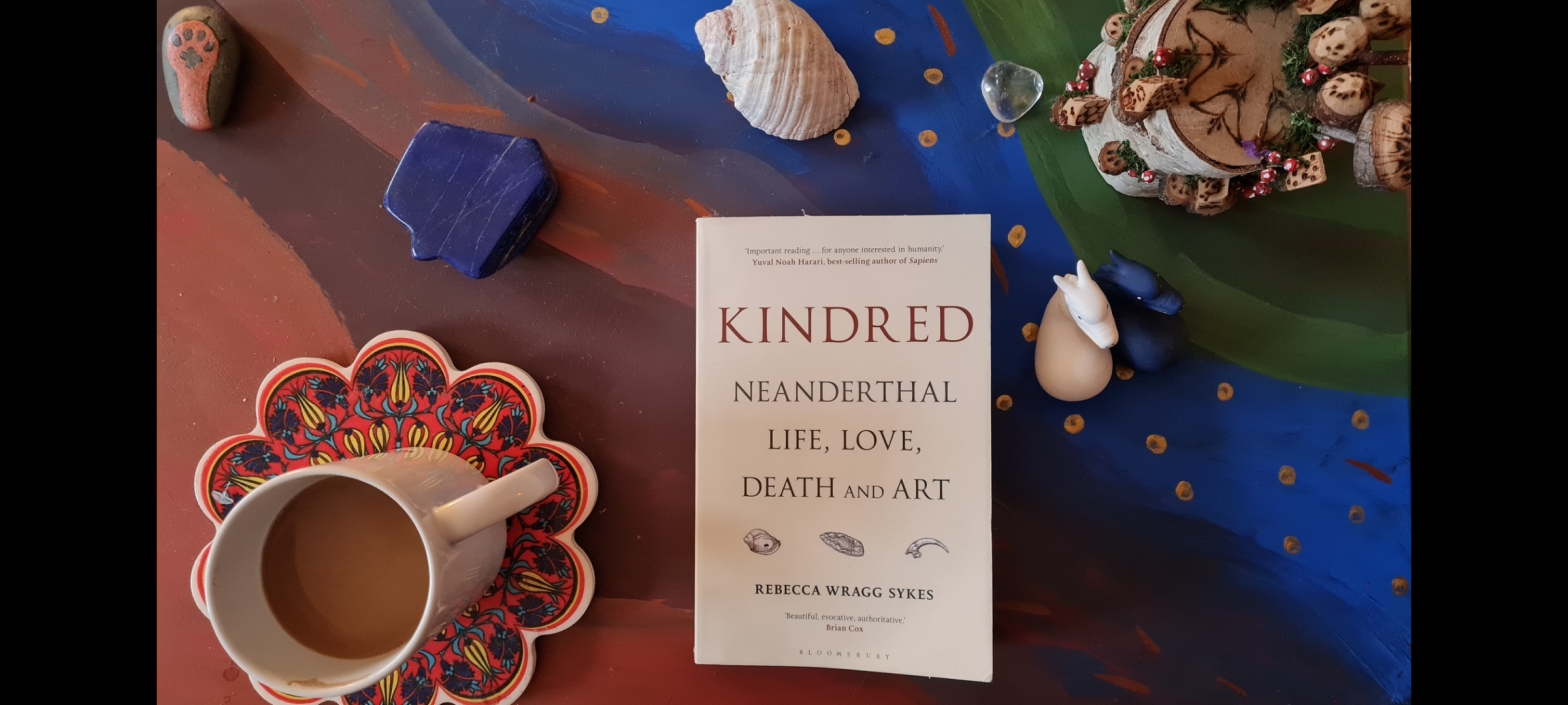
Book Review: Kindred Neanderthal Life Love, Death and Art by Rebecca Wragg Sykes

If you are anything like me and are fascinated by pre-history when oversized marsupials ruled Australia and there were multiple species of humans wandering around, then you absolutely must read this book. It’s a magnum opus of the Neanderthal world. It’s like opening up a present of everything hidden in our human world.

Genre: Archaeology, Natural History, Literary Non-Fiction.

Rating: 🌟🌟🌟🌟🌟

These ‘other humans’ whose lineage suddenly and mysteriously stopped have been labelled by many archaeologists in order to suit the prevailing cultural mores and political beliefs of different times. Yet what are we still to discover? it turns out a hell of a lot!

Illustration of a Neanderthals as people not specimens © Tom Björklund / CC BY-SA (https://creativecommons.org/licenses/by-sa/4.0)

More than simply a history book, this is a luminous and electrifying book written by Wragg-Sykes who is an exceptionally skilled storyteller. She brings these maligned and misunderstood ‘other humans’ roaring to life through her creative and magical ways with words. As a writer and lover of literary fiction I was gobsmacked by her way of describing the emotional and visceral lives of being a neanderthal along with reflections on the nature of deep time itself, which had me hooked right from the start.

The answer is to begin at the heart and spiral outwards
A black carbon molecule
An incandescent ember
An ashy aureole
A lattice of branches
A circle of eyes glowing in the dark
Hearths are archaeological touchstones
They lie at the centre
Where the warp of time and the weft of space connect
Like beacons shining through the fog of millennia and a confusing haze of data, they offer anchor points precisely because they were also the cores of Neanderthal life.

Kindred, pp. 181
It wasn’t only meat on the Neanderthal menu – they also ate plenty of fruits, veg and seeds ©Getty Images/Alamy

The flowing and fluid style of narrative building draws you into an ancient, foreign prehistoric world of novel-like proportions. From the reviews by archaeology magazines and many well known media outlets at the start, there is a strong sense that the book is academically rigorous as well.

What follows is quite possibly one of my favourite series of words I’ve ever read in my life. Visceral, earthy, ancient, mysterious and tapping into the soul essence of what it means to be a living curious animal, and to be human.

I have other favourite poems by other poets and writers, but this is right up there with them:

Inside the body, the bone
Under the skin, the blood
Across the fur, the hand
From the hand, the fire
Before the fire, the wood
Out of the wood, the tar
Held by the tar, the stone
Scraped by the stone, the red
Beneath the red, the shell
Inside the shell, the secret

Kindred
Cave art in La Pasiega, Spain, was daubed on the walls by Neanderthals some 64,000 years ago ©P Saura

At the start of each chapter Sykes opens with a deeply evocative, colourful and dreamy description of the daily lives of neanderthals and those other-than-human beings they hunted. This sets the scene in the most profound way. I can’t say I’ve read a history book like this, full of poetic and evocative departures from the norm but this 100% works.

Time is devious. It flees frighteningly fast or oozes so slowly, we feel it as a burden, measured in heartbeats. Each human life is marbled with memories and infused by imaginings, even as we exist in a continuous flowing stream of ‘now’. We are beings being swept along in time, but to emerge and view the whole coursing river defeats us.

kindred, pp.22

Look through the shadows, listen beyond the echoes, they have much to tell. Not only of other ways to be human, but new eyes to see ourselves. The most glorious thing about neanderthals is that they belong to all of us, and they’re no dead-end, past tense phenomenon. They are right here, in my hands typing and in your brain understanding my words. Read on and meet your kindred.

Kindred, pp.19

I cannot recommend this book enough, it is absolutely mind-blowing. If you love ancient history and archaeology then you really cannot miss this book, please read it. I have a bit of a nerdy girl-crush on Rebecca Wragg Sykes now.

About the Author: Dr Rebecca Wragg-Skyes is a well-known and respected archaeologist and author who has an Honourary Fellowship at the University of Liverpool. She is an exceptional science communicator and her work is published in the New York Times, The Times, The Guardian and BBC.

10 Interesting Things I Found on the Internet #127

Enjoy a gigantic fluffy cat getting groomed, Leonor Fini’s wisdom and deeply comforting art, some funky Italodisco, intricate Japanese artistry, genre-shifting music recommendations and much more, it’s edition #127 of #InterestingThings by #ContentCatnip!


“Brian trying to groom himself is like watching a pumpkin do a sit-up”

Oh lawd…he comin…


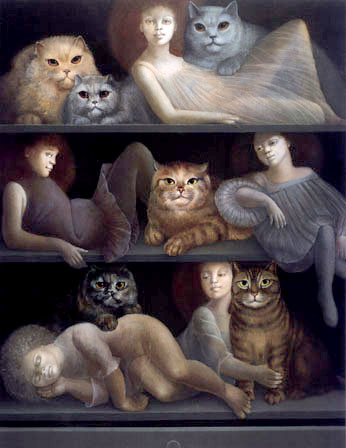
“I paint pictures which do not exist and which I would like to see” ~ Leonor Fini

“I always imagined I would have a life very different from the one that was imagined for me, but I understood from a very early time that I would have to revolt in order to make that life. Now I am convinced that in any creativity there exists this element of revolt.”

Leonor fini

From Italy with Disco

Delicious and uplifting classic funk that you have never heard before from Italy


Ask Reddit: What one song changed your taste in music forever

Whole lotta love – Led Zeppelin

  • Portishead – Glory Box
  • Kraftwerk – Autobahn
  • Depeche Mode – Enjoy the silence
  • Massive Attack – Angel
  • Debussy – Clare de Lune
  • Metallica – One
  • Tool – Sober
  • Eminem – Lose Yourself
  • The Prodigy – Out of Space
  • Metallica – Enter Sandman
  • Warren G – Regulate
  • Queen – Bohemian Rhapsody
  • Motorhead – Ace of Spades
  • Faith No More – Midlife Crisis
  • The Doors – Riders of the Storm
  • Dave Brubeck – Take Five
  • Prince – When Dove’s Cry


European countries and their slang terms for booklovers

Fascinating that endearing terms for those who love books, read and have poor eye-sight have a lot in common with animals that are kind of directionless and random – worm, moth, rat…hehe.

Found via Brian D. Butler’s blog on WordPress

European countries and their slang terms for booklovers

Yamamoto Akane is the only artist in the world to embed gold leaves into glass


Really nice three hour long intelligent drum & bass mix

Perfect background music for creative work, coding or just being productive.


The Dark Night of the Soul

Life is sometimes intricate and difficult, and we may encounter a profound and occasionally perplexing phenomenon known as the Dark Night of the Soul, a time when the soul traverses the shadowy realms of inner turmoil, questioning, and existential crisis. While this may sound like an ominous journey, it is, in fact, a transformative process that holds the potential for profound personal growth and self-discovery.

Via the amazing blog Wise and Shine

Prague at Sunset

Any time is a good time to take a photograph of this bridge in Prague, but particularly during the crepuscular hour nearing dusk when the lanterns are ablaze against the rapidly changing sky. Artist unknown.


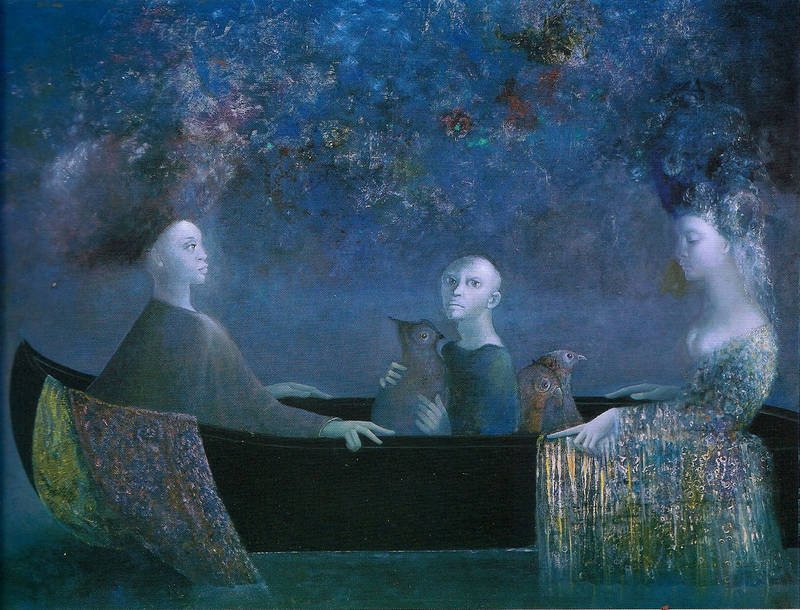
Voyage sans amarres by Leonor Fini (1985)

One of the most captivating and compelling of Fini’s works in my humble opinion. Just look at all of those soothing blues and purples and the blanket of stars and ocean. Certainly full of divine mysticism.


Creamy vegetable soup

This looks incredible with the pesto sparsely poured over the top of the charred vegetables, making my mouth water…


It turns out we are born to groove

In 2009, my research group found that newborns possess the ability to discern a regular pulse – the beat – in music. It’s a skill that might seem trivial to most of us but that’s fundamental to the creation and appreciation of music. The discovery sparked a profound curiosity in me, leading to an exploration of the biological underpinnings of our innate capacity for music, commonly referred to as “musicality.”

Via MIT Press Reader
It turns out we are born to groove! Babies in an experiment on rhythm

“The business of the poet and the novelist is to show the sorriness underlying the grandest things and the grandeur underlying the sorriest things.”

~ Thomas Hardy

Did you enjoy this collection? let me know what you think of it below. Thank you for reading my dear friends!

Unplug from the world, plug in to yourself

How do you know when it’s time to unplug? What do you do to make it happen?

The world, work and the demands of people can be confusing, demotivating and exhausting at times. I wonder if you can relate to that? How to unplug from that?

Tsundoku

A collection of Tsundoku: books 📚 not yet read but tantalizingly, teasingly there right in front of me. Just looking at the pile calms me down.

Observing the skyline

A place from where one can see the changing sky and its moving forms of clouds, lights and time shifting imperceptibly. It could be a vast and hopeful blue sky, or a slate-coloured forboding storm on the horizon. It could be an apricot sunset 🌇 😍 ✨️ 

Observing animals

Your own pets and their intricate, complex, weird and big personalities can be a great source of enjoyment and can make you laugh. Some people for whatever reason don’t have pets. I don’t, not because I don’t love animals but because we don’t know where we will be moving to next.

In this case you could watch a nature documentary or look at birds in your neighborhood. They’re always up to something cheeky, if you watch them closely. You are just as much of an object of fascination to them as they are for you.

Listen to relaxing music

I have some playlists going that are full of new age, ambient and uplifting classical music. I find this takes me onto a different way of relating to the world and time.

Walking and shinrinyoku

I’ve talked about shinrinyoku before. It’s the ancient Japanese art of forest bathing for mental and physical revitalisation and renewal. Sounds a bit weird or cliched but don’t doubt it..it works and is quite miraculous and alters your own quiet corner of the world.

Travel: Koishikawa Korakuen Gardens

A cuddle, an embrace, a silent moment:

If you are lucky enough to have on hand a person who can administer a ‘cuddle on demand’ COD service, then by all means you should avail yourself regularly. It is mutually beneficial and helps you both to feel connected, feel good and unplug together. Likewise a good laugh together about something will work.

Baking

Baking or any other process of cooking involves transformation of ingredients with heat or pressure from your own hands or a blender or what have you. It sounds simple but it’s deeply symbolic and means you are literally reshaping something and creating something anew that rearranges all of your physical senses. When done right it looks, smells, sounds and tastes incredible, it’s so good it’s sexy. Perhaps this is why some chefs are considered sexy?

The Bear is coming back on soon. I am slightly fascinated by the lead character Carmi for his arms but mostly, for how he cooks.

Anyway I hope you liked these ideas for how to unplug and I would love to hear how you do it below. 😊 Happy Friday friends

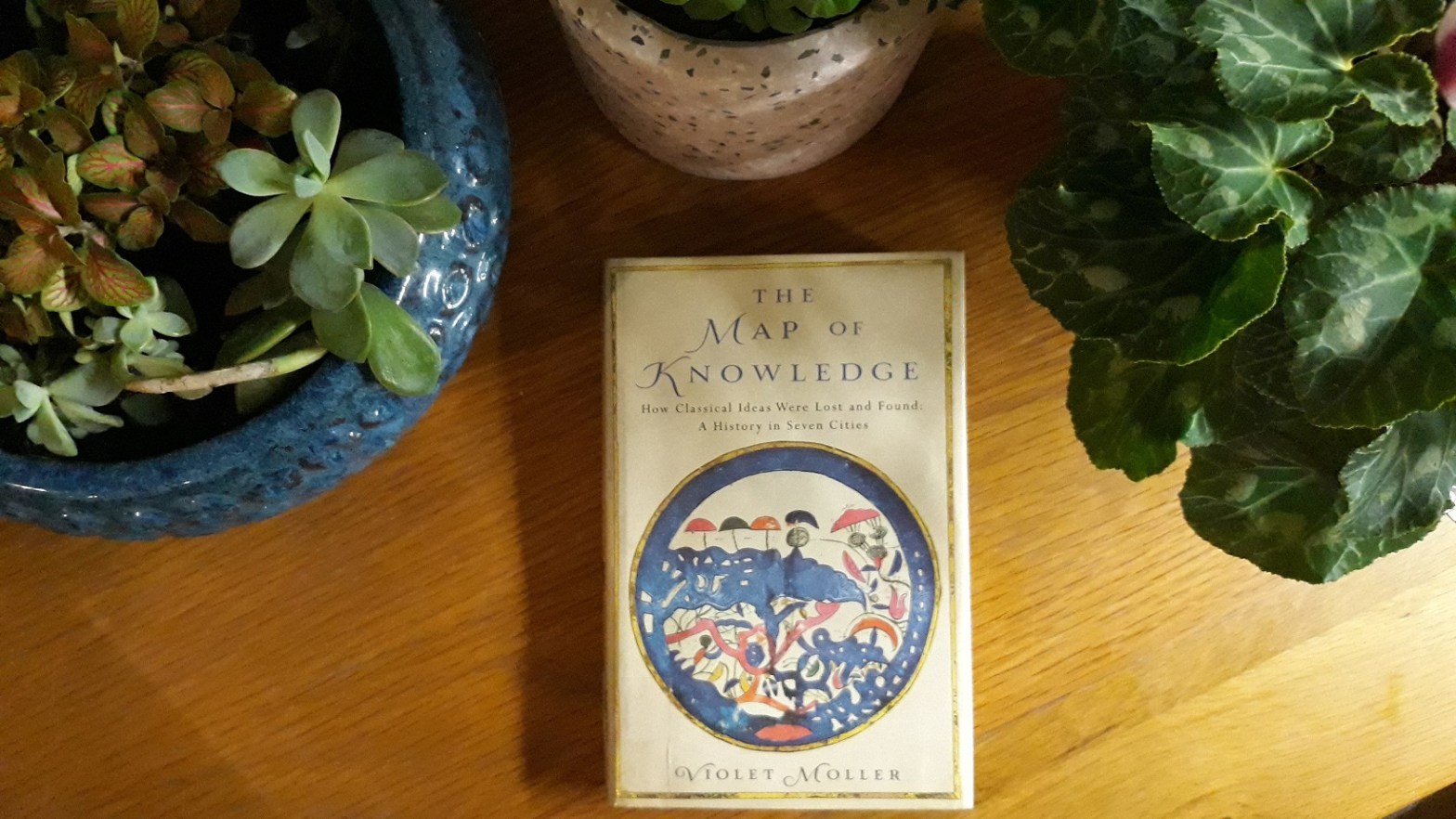
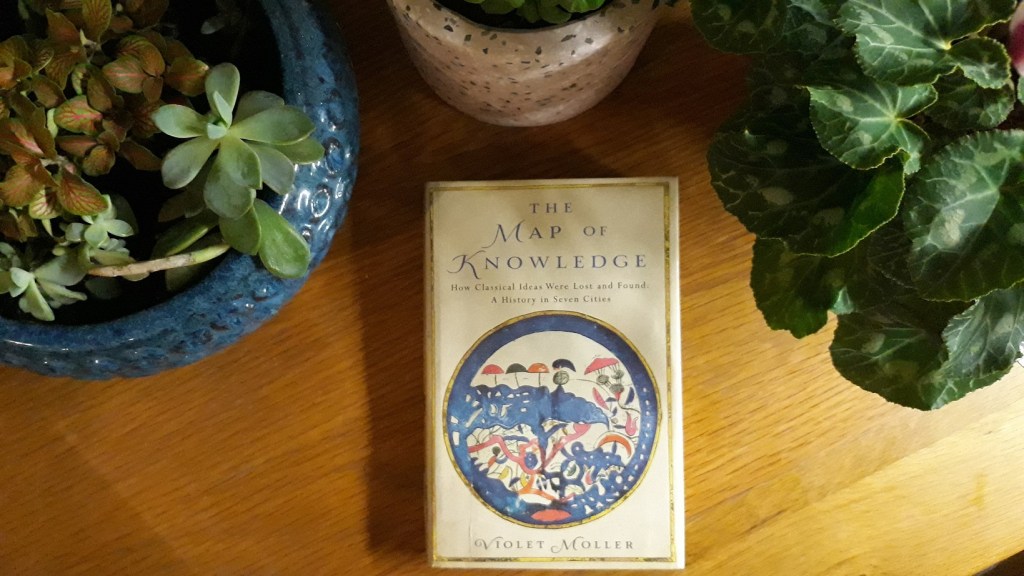
Book Review: The Map of Knowledge by Violet Moller

Have you ever wondered where the original ideas in mathematics, astronomy, science, medicine, philosophy ever came from? The answers to these questions are in this remarkable history book that takes us on a tiki-tour through the highways and back alleys of some of the most vibrant and buzzing cities of the ancient world, where knowledge of various different disciplines was nurtured and grown and then germinated like magnificent seeds from exotic flowers in many directions.

The Map of Knowledge: How Classical Ideas were Lost and Found A History in Seven Cities is a really great book for curious minds, history lovers and anybody who simply enjoys romping through ancient cities.

Writer and historian Violet Moller brings to life the vibrant and bustling stories of ancient cities of Alexandria, Baghdad, Cordoba, Toledo, Salerno, Palermo, Venice and beyond. Along the way we learn how iconic texts and manuscripts including Euclid’s Elements, Ptolemy’s The Almagest and Galen’s works on medicine and psychotherapy were passed down through generations and via the steady, determined hands of various key people (many who are obscure in the history books)

Book Review: The Map of Knowledge by Violet Moller

The idea of this book on the History of Knowledge seems vast at first, almost too vast to accurately tell a story about it. So Moller divides the book into a clear structure to make it easier. She tells the stories of cities in all of their flushing and celebrated glory. I have to admit I found these parts the most enjoyable.

Geological Marvel, Art or Book? You Be The Judge!
Ancient word of the day: Tsundoku

The nitty gritty about the texts themselves and the various discrepancies between versions of texts and differences in translations over the centuries got a bit dull to me. However, overall if you want to learn more about ancient manuscripts that underlie all of modern ideas we hold today, and also the cities that were once magnificent – many of them still beautiful cities today and begging for a visit, then this is the book for you!

4.2*/5   

More books in the Tsundoku

Book Review: How Not to Die by Dr Michael Greger MD

I originally wrote this post in 2015. Over the past decade I’ve tried to stick to a healthy diet, but as typically happens it’s easy to get lost in tasty yet unhealthy food. I’ve reposted it in the hope to remind myself to get on track.

With its rather dramatic title ‘How Not To Die‘ is a timeless guide to a lifetime of good health. Although there’s a lot of these dietary and nutrition books around, none are as stuffed full of scientific references and scientific evidence as this one.

In fact a whole third of the book is dedicated to scientific referencing which highlights and backs up the validity of Greger’s assertions.

Dr Greger is the founder of the world’s biggest not-for-profit nutrition organisation NutritionFacts.org. He is an American doctor and nutrition specialist who has lectured and taught all over the world.

If you only buy one book about health in your lifetime, let this be the one. How Not to Die’s scope is vast and covers all aspects of human health, disease and preventative medicine and provides an overwhelming amount of evidence about the simplest intervention possible – a plant-based diet.

Greger opens up his book by talking about his grandmother. She was a woman who went through several heart bypasses and was told she would soon die by doctors. Then she switched to a plant based diet and daily exercise, and as a result she lived another 30 years.

The proof for Greger was (not) in the pudding but rather in the leafy greens. It set him on a career path in medicine and a fascination for nutrition.

Greger focuses his chapters on how not to die from some of the most common preventable, non-communicable diseases such as cancer, heart disease, obesity, diabetes. He talks about the scientific evidence that backs up the idea that adopting plant-based diet improves your health and dramatically reduces the likelihood of every disease under the sun.

In the second half of the book Greger talks about practical ways to improve your diet by increasing whole and organic foods and avoiding all processed foods and animal products.

Although it may seem throughout the book that he’s firmly advocating vegetarianism and veganism, Greger clarifies that:

“I advocate for an evidence-based diet, and the best available balance of science suggests that the more whole plant foods we eat, the better”

Greger talks at length about Cardiovascular disease, diabetes and also delves into other less obvious diseases that are impacted by diet – Parkinson’s, Alzheimer’s and depression.

I read this book (in 2015) while walking and listening to it on audio. My partner and I loved it so much we bought the acompanying How Not to Die Cookbook which is a great way to add plenty of flavour and nutrients to your meals.

My partner and I decided to go plant-based as a result of reading this book in 2015. As a result of this, we both have lost weight felt lighter and more energised and more alert than ever before. After reading Greger’s book, we also realised we weren’t missing out on anything by eating plants, instead we were gaining our health and prolonging our lives. This book is highly recommended, get it here

Ok Doomer: Are Millennials ‘Generation Exhausted’?

Covid and endless inflation, AI and global conflicts, misinformation and political instability. Climate change and extinction. The world is full of unknowns and bin fires at the moment.

All of the above unknowns are getting onto my head like a low-key buzzing static sound just below perceptible  human hearing. Animals hear it. Plants hear it. It’s the sound of the natural world being throttled. It’s the sound of the natural world screaming.

With so much uncertainty, is it any wonder millennials and younger are feeling tired. I feel fucken exhausted. There I’ll say it…..I wonder if you can relate?

Sorry if this comes as a departure from my usual nourishing and optimistic stuff.

The burn-out and the feeling of exhausting one’s personal resources to cope in this rapidly changing world is a shared experience. At least from articles I’ve been seeing lately.

When you love your work and consider it a calling, or if you’re exceptionally purpose-driven and committed, your job will demand a lot of you. You can often find yourself overextended, because you’re so passionate about your cause and care so deeply about improving others’ lives, or you’re overcommitted to your organization’s mission or goals. But without sufficient periods to rest and recharge, the risk is high for exhaustion, depersonalization, and, down the line, a lack of efficacy, as you become increasingly overwhelmed and depleted.

When work becomes the central focus of our lives (for any reason)—or when our identity gets excessively wrapped up in what we do for a living—we run the risk of making too many personal sacrifices and losing sight of our own self-care, leaving us ripe for burnout.

When Meaningful Work Backfires, Time Magazine

There was the great resignation, when people left their jobs en masse circa 2021. “Quiet quitting” described people refusing to work outside their paid hours amid pressure to work overtime or be constantly on-call.

Now a new term has emerged: The Great Exhaustion, which starts with stress directly related to work and piles on wider anxieties about the state of the world — such as climate change, war, political instability and the rising cost of living.

“The Great Exhaustion is a reflection of this collective experience of being burned out, tired, emotionally fatigued, by work and all things in our world, as well, that go beyond work,” said Jennifer Dimoff, an organizational psychologist who teaches at the Telfer School of Management at the University of Ottawa.

Stressed at work? Anxious about the wider world? You might be part of ‘The Great Exhaustion, CBC

Feel the burn(out): Millennials are aging from bright-eyed ‘hustle culture’ workers into exhausted middle managers, Fortune

Just searching on the topic of burnout and modern malaise brings back many results but about 90% of them are about work and ‘optimising people to ensure they perform’. What about if you don’t want to be optimised? What about if you do not believe in the sanitised corporate lie you are being fed? You can just stop…for a while at least. If you have the means to get off the train do so.

I think part of the exhaustion for me is realising I posesss a fragile, mortal and organic body made from the same stuff as ancient people had. Yet they didn’t have the internet or late stage capitalism or the 24 hour news cycle, or debt peonage or the underclass of the gig economy any of that shit. Instead they were looking to the sky, the soil and the animals for clues and portents.

We are wired that way, in the deepest parts of us if we search far enough we can remember our impermanence and interconnectedness with nature. Being plugged in to the ‘in silico cyberpunk’ modern world is taxing on our stone age brains and bodies and this is why we’re exhausted. I know I can’t speak for anyone here except myself.

Maybe you are older than me or younger, maybe you feel really great and highly motivated right now. If so I humbly ask what keeps you feeling that way and if I can cultivate some of the same I will try. But don’t do it for the corporate overlords or the greedy gods of productivity – they will never be satisfied. Endless growth is their motto and the natural world with us as individuals inside are not made to healthily grow in this way.

The only things that endlessly grow in this world are cancers and corporate profits.

Comforting Thought A frog in a well never knows the vast ocean

A frog in a well never knows the vast ocean

There is an ancient Taoist expression that ‘A frog in a well never knows the vast ocean’. This is a reminder to be humble and to accept the world as being vast, with our own knowledge of it limited. We must never assume to have the answers to everything, but instead be humble students.

10 Interesting Things I Found on the Internet #126

A mesmeric trance session to put your feet up to or dance the night away, an interesting infographic about types of intelligence, cities with rude names, dog reflections, news caption fails, vegetable bahn mi tacos and much more, it’s edition #162.


Trance session #5

Mesmerising and kicking trance mix for creative work, coding or anything else you need to concentrate on. A great channel to follow!


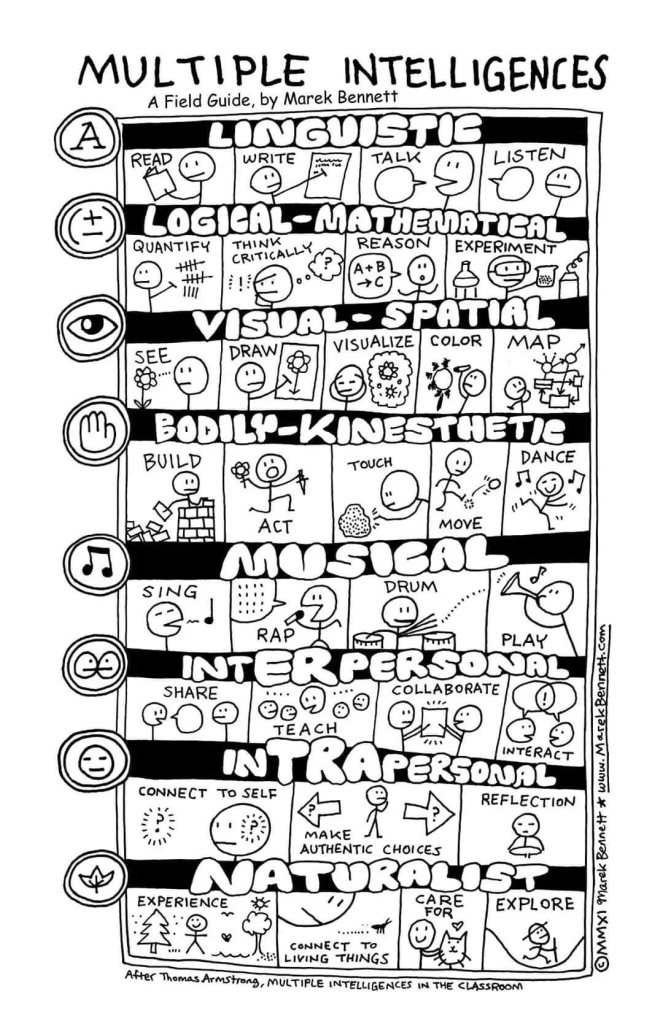
Types of intelligences: An infographic

I think I have a leaning towards linguistic, interpersonal, intrapersonal, visual-spatial and bodily-kinesthetic intelligences, what about you?

Via Cool Guides on Reddit

Millennials: what’s a phrase you used to hear but would never hear today

  • Be kind and rewind.
  • Get off the internet, I need to make a phone call.
  • Eject disc one and insert disc two to continue installation.
  • Surfing the information super highway.
  • A/S/L
  • AS IF!
  • Take a chill pill
  • Stop, Hammertime!
  • Gettin jiggy with it
  • Eat my shorts
  • Not the mama!
  • You’ve Got Mail!
  • Talk to the hand, because the face don’t wanna hear about it
  • Kowabunga dude
  • Run Forest Run!
  • Let’s look it up on the internet when we get home.

Via Reddit


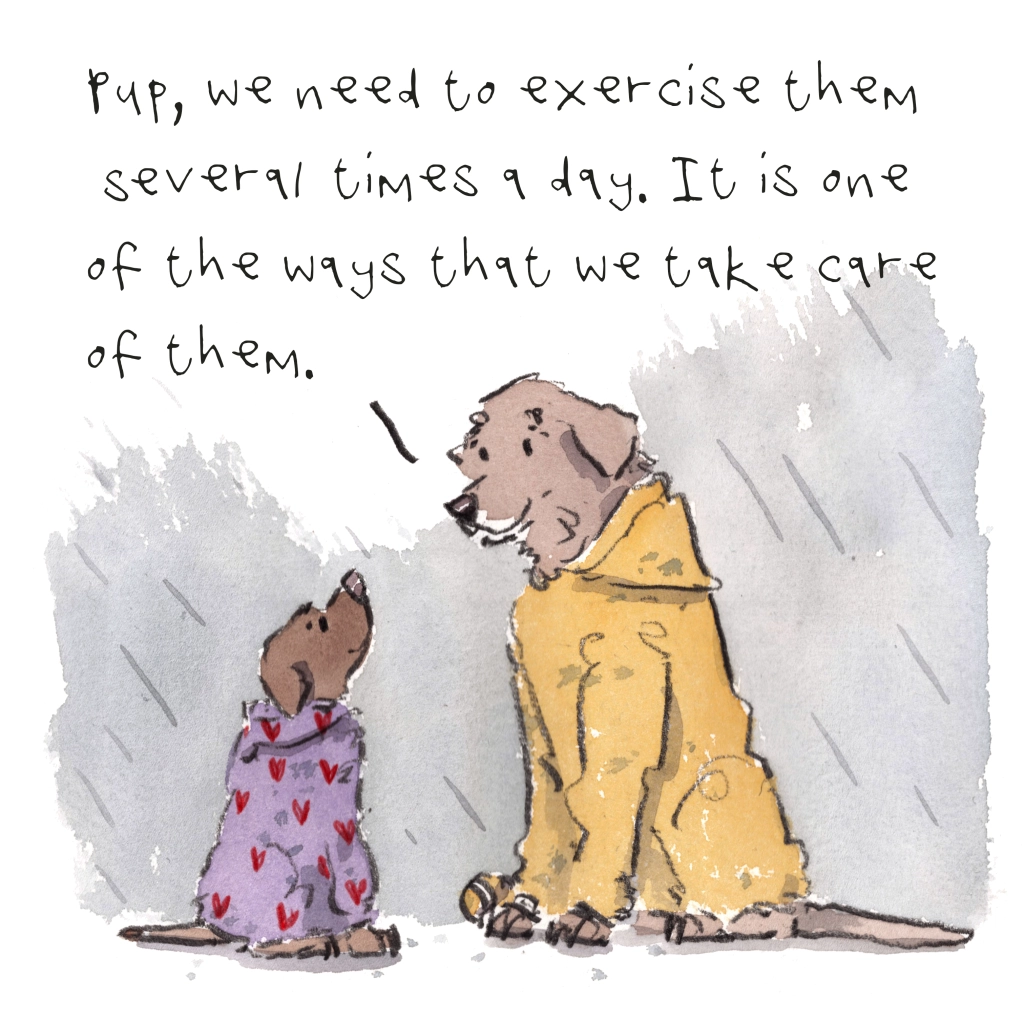
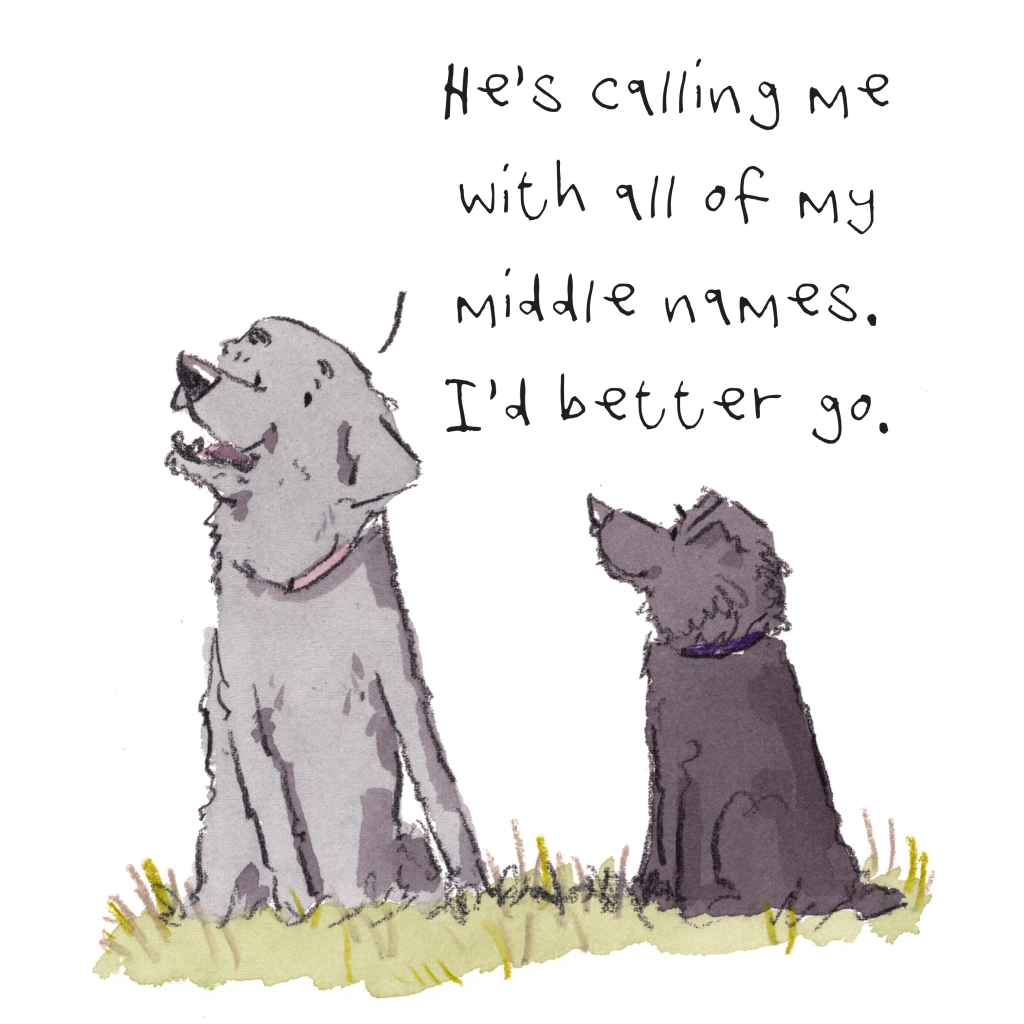
Iain Welch’s sweet, whimsical and heartfelt reflections between dogs

Ever wondered what passes between pups in canine conversations…the genius illustrator/artist Iain Welch demystifies it for you here…

Via Iain Welch


Spelling mistakes matter, especially on TV

Who knows if this typo was on purpose or accidental. It certainly adds some magic and hillarity to an otherwise serious news program. From ABC News Australia.


“There is no better deliverance from the world than through Art; and no surer method of linking oneself to the world than by it.”

Johann Wolfgang von Goethe

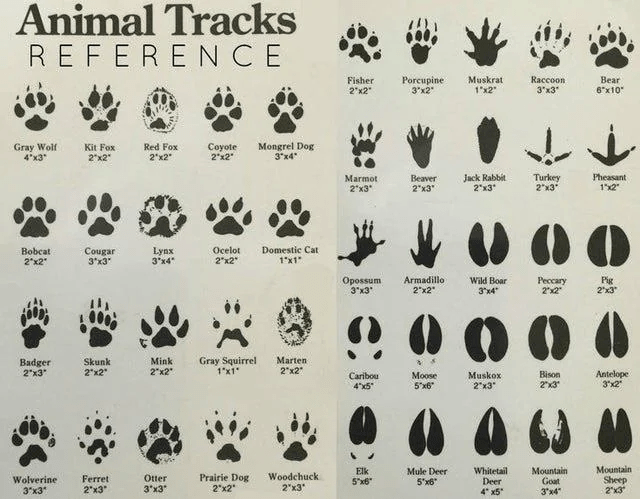
Animal tracks

Via Reddit


This octopus shows her supreme intelligence

They may look different to us but they are incredibly intelligent as this video proves. Please don’t eat them.


It is never too late to turn on the light. Your ability to break an unhealthy habit or turn off an old tape doesn’t depend on how long it has been running; a shift in perspective doesn’t depend on how long you’ve held on to the old view. When you flip the switch in that attic, it doesn’t matter whether its been dark for ten minutes, ten years or ten decades. The light still illuminates the room and banishes the murkiness, letting you see the things you couldn’t see before. Its never too late to take a moment to look.

Sharon Salzberg


Sabbatical goes to China’s fake European towns

Imagine if you will a sort of anti-vlogger. That is – a person who visits a foreign country and is respectful of customs to the point of learning to speak the local language in order to communicate with locals. This is the sort of extreme commitment that Sabbatical goes to each time he goes to a country. His vlogs are not ultra-edited with annoying fast cuts, stupid music special effects either, it’s just him talking and being friendly, respectful and polite in variety of countries. This time he visits China’s fake Paris and fake English countryside towns. I’ve always been fascinated with fake places like this. In other episodes he goes to Morocco. People he meets in China and Morocco were impressed by his language abilities – he is very humble about it all. A great one to subscribe to.

Vegetable bahn mi tacos

Looks incredible! I’m going to give them a go


The hidden power of rituals in our lives

‘So much of our lives is dictated by forces — economic, political, physiological, ecological — over which we have little control. Ritual, on the other hand, gives us all a powerful tool for helping to shape and reshape our lives, says Bradd Shore, a psychological anthropologist who has spent a career studying the phenomenon.

“My surprising conclusion is that ritual is perhaps the most powerful tool in the human toolkit that is largely under local control,” Shore says.”‘

MIT Press Reader

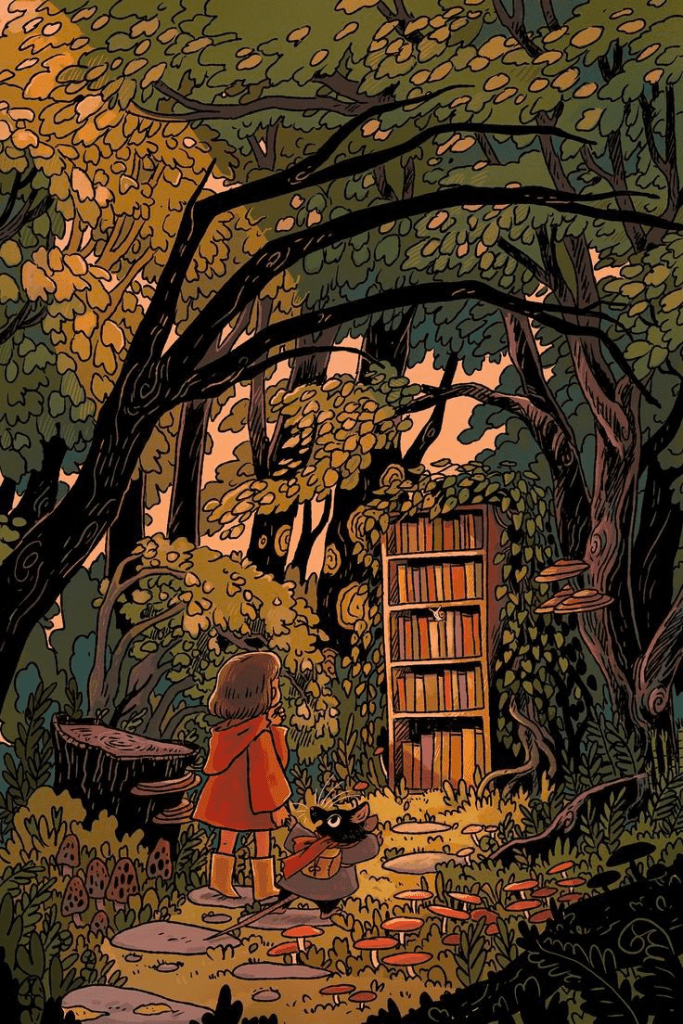
A sweet forest library by Robin Kaplan AKA the Gorgonist

The Gorgonist is Robin Kaplan, who has haunted comic conventions up and down the west coast of the USA for over ten years. Robin has worked for IDW, BOOM!, and Action Lab, as well as Penguin Random House and Macmillan. Robin wanted to be friends with all the ghosts and monsters as a kid, and now tries to make work that shows kids how to do just that! Read more on their website


Did you enjoy this collection? let me know what you think of it below. Thank you for reading my dear friends!

Travel: Oeshiki Festival of Light, Ikegami Tokyo

Oeskiki is an annual buddhist festival held on the 13th of October that commemorates the death of Nichiren in 1282. He was a revered buddhist teacher who lived during the Kamakura period, about 700 years ago. Although celebrated throughout Japan, the main Oeshiki festival is held at Ikegami Honmonji Temple located in the Ota ward in suburban Tokyo – the location where Nichiren died.

Mando

The festival lasts all week and reaches its zenith of noise and excitement on the night of 12th October with a long illuminated parade of Mando along a two-kilometer route from Ikegami Station to the celebrated temple. Mando, which literally means “10,000 lanterns”, is a rite where some 3,000 worshippers carrying sacred lanterns decorated with beautiful cherry blossoms.

We just happened to find a hotel in Ikegami during this event by pure coincidence and it was the best part of the trip. So vibrant, passionate, full of joy and deep cultural roots.

Watch my video of the Oeshiki Festival of Light

What a vibration celebration!!!

Matoi

Another highlight of the ceremony is Matoi. Matoi is referring to the Edo period’s firemen. In the ceremony, Matoi will play flutes and drums to accompany the Mando. The mando are something like a parade float, which are about 5 meters (16.4’) in height. In its structure built in the form of a five-story pagoda with the Odaimoku (Namu Myoho Renge Kyo) or pictures of Nichiren Shōnin’s life depicted on the sides. The whole structure is lit from the inside and rows of artificial cherry blossoms are hung from the top on an umbrella to from a cherry tree, because it is said that when Nichiren Shōnin passed away the cherry trees came into bloom out of season. Nichiren Shōnin’s studies of the various Buddhist teachings convinced him that the true and only doctrine, the quintessence of Buddhism, was the Lotus Sutra (Hokke Sutra, the Sutra of the Lotus Flower of the Wonderful Dharma, or Saddharma Pundarika Sutra). He resolved that henceforth all Buddhist scripture should be judged in its light. His devotion was so deep that he changed his name to Nichiren.

Nichiren

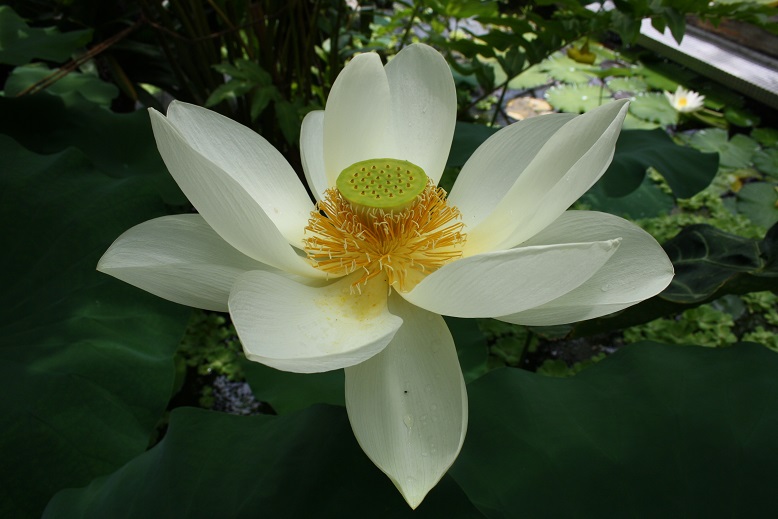
Nichiren means “Sun Lotus.” He described his name as follows:

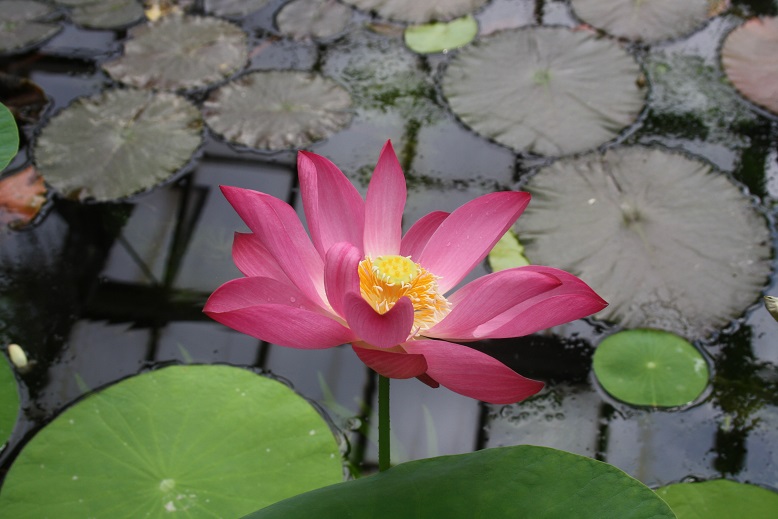
“There is nothing so clear and serene as the sun and the moon, and nothing purer than the lotus flower. The Lotus of the Perfect Truth is like the sun and the moon and the lotus flower.”

Travel: The Enchanting Ogród Botaniczny of Kraków

The Botanic Garden of the Jagiellonian University (or as they are known in Polish: Ogród Botaniczny Uniwersytetu Jagiellońskiego) is a stunningly beautiful botanical garden that I visited back in 2014 just outside of Kraków in Poland. This was one of the main highlights for me on a busy trip to see the Polish Bear’s family.

The Enchanted Ogrod of Kraków

A place of immense beauty and escapism

The Ogród Botaniczny of Kraków has a long scientific heritage that dates back to 1783. They are the oldest scientific gardens in Poland and were established by Professor Józef Bogumił Rogaliński.

Throughout this time many inquisitive and curious minds have peered into the depths of floral wonders and the garden was pivotal during the Enlightenment period in Poland, as a centre for botanical research and the dissemination of botanical knowledge across Europe.

The Enchanting Ogród Botaniczny of Kraków

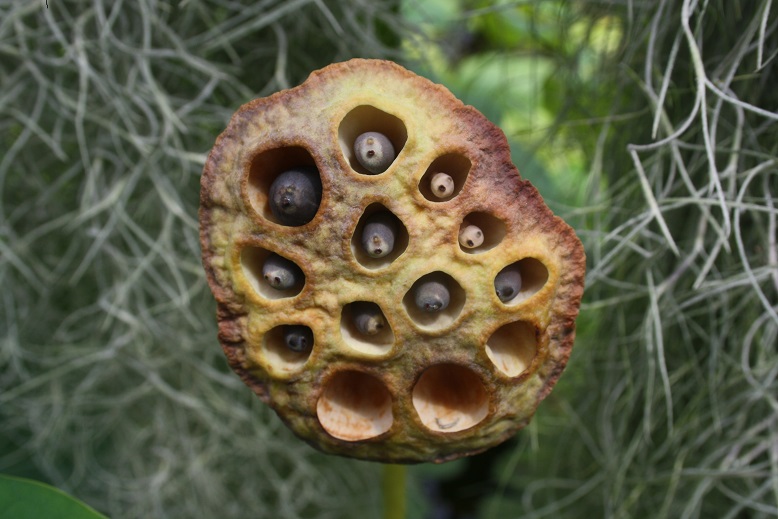
The ogród covers a lush expanse of 9.6 hectares, featuring lush landscaped gardens, several glasshouses and conservatories and exotic plant collections like orchids and even different types of Australian wattle and New Zealand flax plants. There are plentiful ponds where gigantic carp swim around and gaggles of geese glide past. It’s designed as a French baroque style and is perfect for meandering the time away on a sunny day.

The Enchanted Ogrod of Kraków

I love the hushed quiet and peacefulness of these places, the world is stilled to a hush and the natural gurgle of a creek, the probing antennae of a snail and the impatient rustle of trees, and when the sun peaks through that it’s as though the world is shining and dreaming just for you.

The Enchanted Ogrod of Kraków

Part of the Jagiellonian University, the garden has existed in one form or another for specimen growth and analysis since the 16th century. This heritage is evident there in their beautifully landscaped surrounds, the entire place is vibrant and buzzing with life.

The Enchanting Ogród Botaniczny of Kraków

The Enchanting Ogród Botaniczny of Kraków

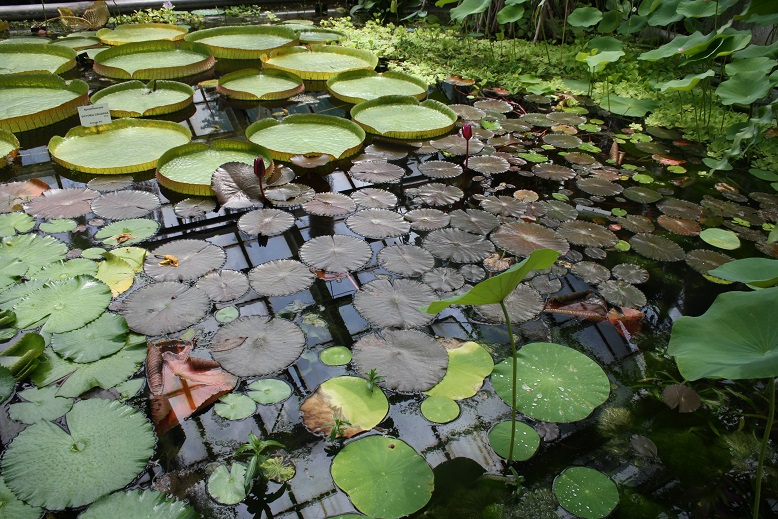
This greenhouse complex known as “Victoria” was refurbished in 1882 and then rebuilt in the 20th century and again reconstructed in 1993–1998.

The Enchanted Ogrod of Kraków

The “Jubilee” palm house was opened in 1966 alongside a group of tropical greenhouses. In 1954 came “Dutch” – low emissions, which covers collections of orchids.

The Enchanted Ogrod of Kraków

The Enchanted Ogrod of Kraków

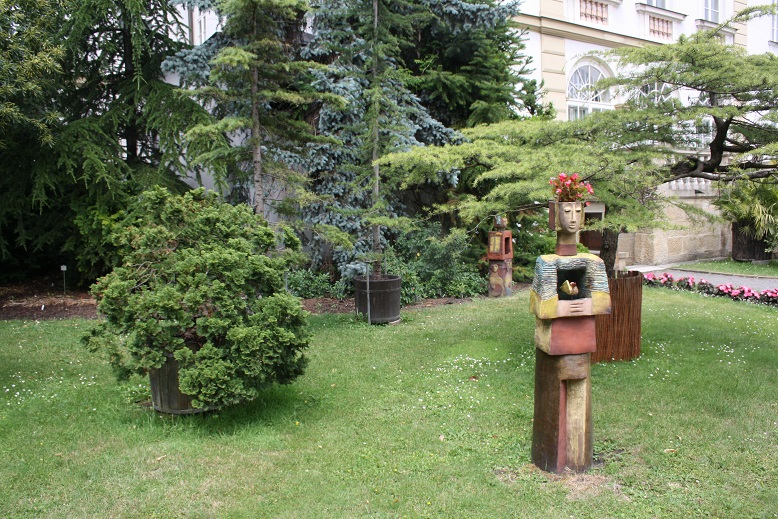
On the day that we went there, a collection of beautiful clay artworks lined the pathways which seemed to portray mother earth-style figures in mutual embrace and union with the spirits of the earth and celebrating verdant growth.

The Enchanted Ogrod of Kraków

The Enchanted Ogrod of Kraków

The Enchanted Ogrod of Kraków