
Emotional First Aid Kit #1

Sometimes the world just wants to break you with all of its chaos. Right now my family is in the eye of the storm, with one of our own absolutely determined to destroy himself with alcohol. Nobody knows what to do and so we are just paddling water at the moment, trying to stay afloat. So for my own wellbeing, and for others who may be secretly struggling, here are a few things to bring you back to wellness, I like to call this an emotional first aid kit, but it’s also a protective amulet and a series lighthouses that will guide you through the storm back to shore, always comforting when you need it. This is going to be an ongoing series, I hope you enjoy it.

Kintsugi/Kintsukuroi

There is a Japanese practice called Kintusukoroi or kintsugi which means ‘golden repair’. Kintsukuroi is the art of repairing broken pottery with powdered gold or platinum mixed with lacquer, so that the repair reflects the history of the breakage.

The repaired object mirrors the fragility and imperfection of life – and also its beauty and strength. The object returns to wholeness, to integrity.

Comforting Thought: Kintsukuroi

Two widowed penguins comfort each other with the sparkling city lights of Melbourne to warm their little hearts

True story!

Scottish musician Jenny Sturgeon takes inspiration from Nan Shepherd’s book ‘The Living Mountain’ for her peaceful album

Be a Soul: Ram Dass

Souls love. That’s what souls do. Egos don’t, but souls do. Become a soul, look around, and you’ll be amazed-all the beings around you are souls. Be one, see one. When many people have this heart connection, then we will know that we are all one, we human beings all over the planet. We will be one. One love. And don’t leave out the animals, and trees, and clouds, and galaxies-it’s all one. It’s one energy.

Ram Dass

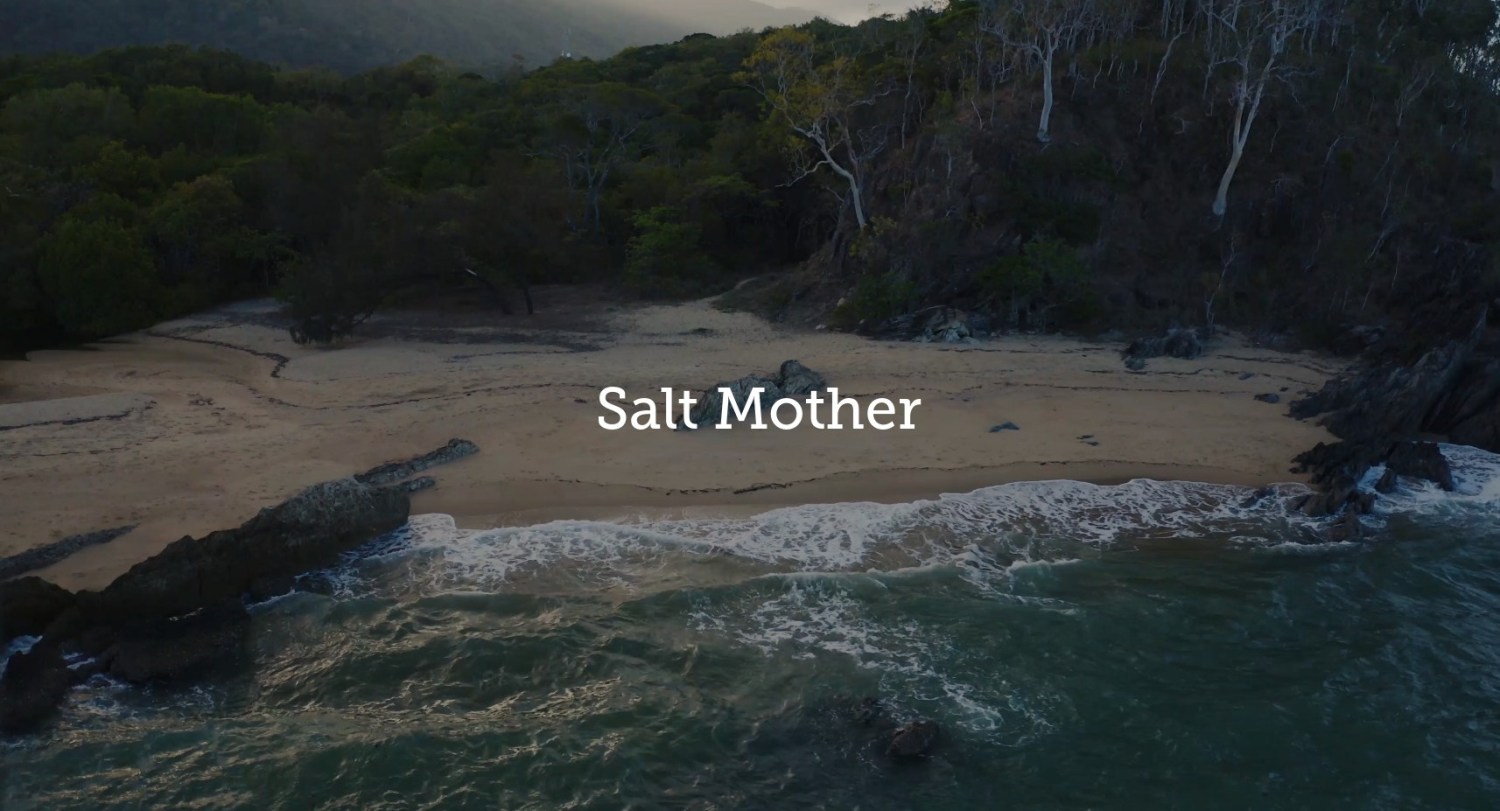
Salt Mother

A moving poem by Indigenous Australian author Bruce Pascoe
Paul Barton plays Bach for a blind Asian Elephant in Thailand

Wild woman quote: Strength

“To be strong does not mean to sprout muscles and flex. It means meeting one’s own luminosity without fleeing, actively living with the wild nature in one’s own way. It means to be able to learn, to be able to stand what we know. It means to stand and live.” Clarissa Pinkola Estes, Women Who Run With the Wolves

Self-Love Meditation

Violence Always Rebounds on Itself: Lao Tzu

Whoever relies upon the Tao for governing men
doesn’t try to force issues
or defeat enemies by force of arms.
For every force, there is a counter force.
Violence, even well intentioned,
Always rebounds upon oneself.

The master does his job
and then stops.
He understands that the universe
is forever out of control
and that trying to dominate events
goes against the currents of the Tao
Because he believes in himself,
he does not try to convince others,
Because he is content with himself,
he does not need others approval.
Because he accepts himself,
the whole universe accepts him.

Lao Tzu (Tao Te Ching) 5th Century BCE.

Hang Drum Meditation Music

Comforting Thought: Ep’humin et ouk ep’humin

Ep’humin et ouk ep’humin (from Greek) Things that are under our control and things that are not under our control.

Of things that exist, some are in our power and some are not in our power. Those that are in our power are conception, choice, desire, aversion, and in a word, those things that are our own doing. Those that are not under our control are the body, property or possessions, reputation, positions of authority, and in a word, such things that are not our own doing. ~ Epictetus, Discourses.

Sacred Spirit

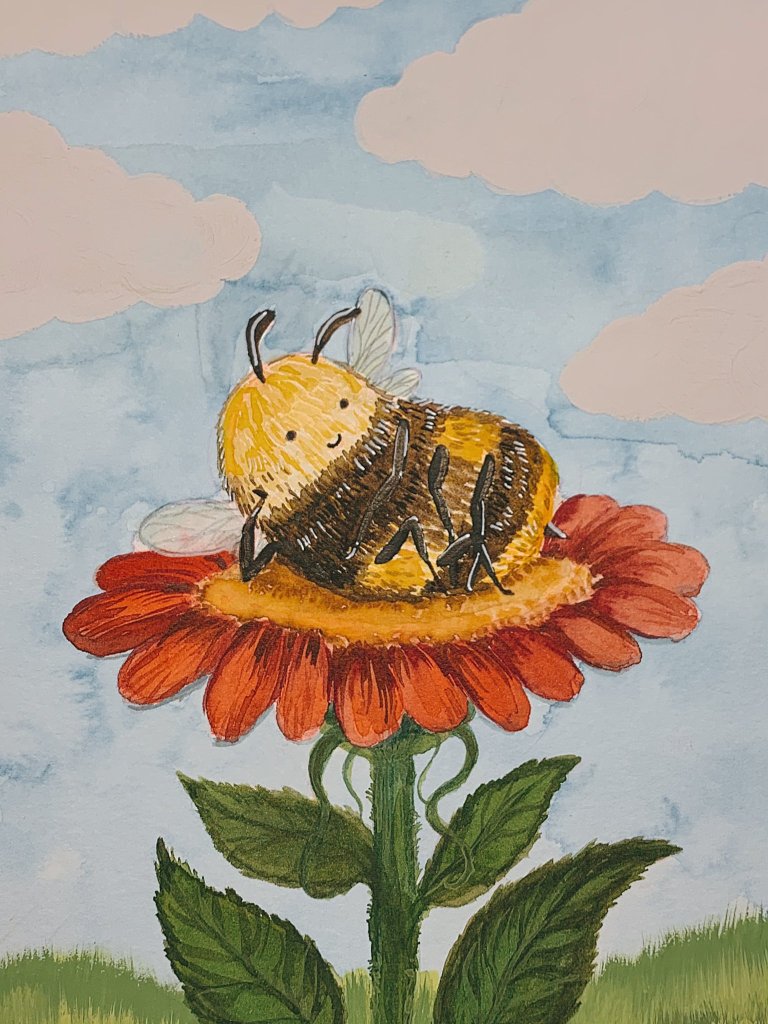
E Pii, e Paa tiny bees swarming

E Pii, pō pō ia you are life’s tenderness

Hoki mai kake mai come, return

Hoki mai anō ki ahau rest in my arms

Ko au karanga nei you are me, I am you

E Pii, e Paa, e Pii pō pō e our richness is

Hoki mai rā each other

~Haare Williams

Head and Heart Reset Yoga

All round sweetie Adrienne Mishler and her dog Blue make you come home to your own body.

Book Recommendation: Standing At the Edge: Finding Freedom Where Fear and Courage Meet by Joan Halifax

This is one of the most prescient and important spiritual books ever written. My review coming up on the 14th of January
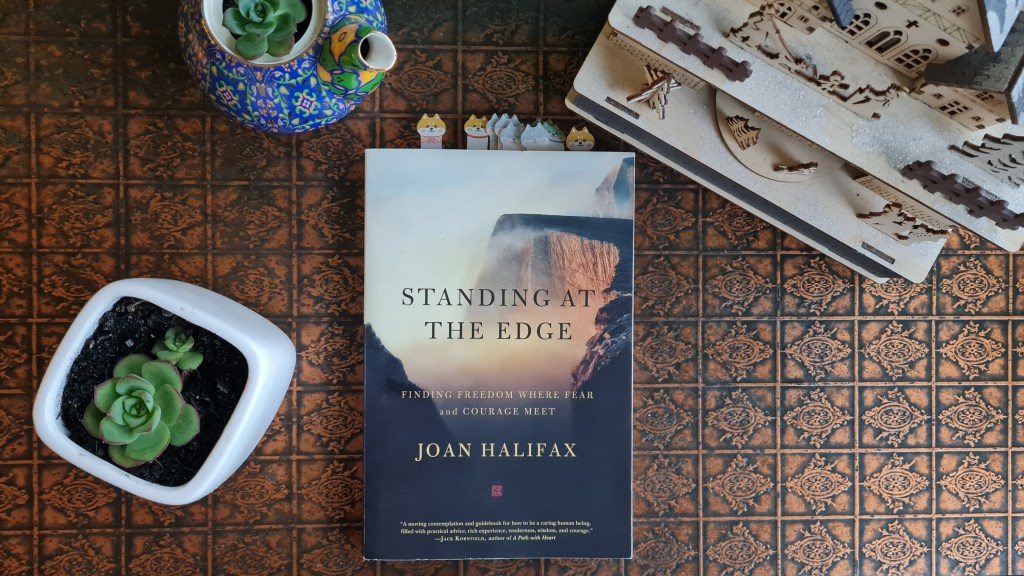
Book Review: Standing At the Edge: Finding Freedom Where Fear and Courage Meet by Joan Halifax

A Pep Talk from the Cryptonaturalist

An ingenious, moving and funny pep talk from a mysterious man who sounds like a cowboy and pursues mythical beings through America.

Let’s be honest, the pandemic unleashed an absolute shit storm for some families, so if yours is affected, I hope this list of things give you some comfort. Let me know if it helped, and also if you have your go-to things to look at when you feel down.

Travel: Poland’s Creepy Chapel of Skulls

*I visited Poland in 2016 and saw the Chapel of Skulls, this story is from this time.

For a completely off the beaten path look at the more macabre and dark past of Poland, then you should visit the Chapel of Skulls located just outside of the popular spa town of Kudowa Zdroj in Lower Silesia, Poland.

Chapel of Skulls in Czermna, Poland. Kaplica Czaszek w Czermnej. interior

The Chapel of Skulls: a symbol of life, death and war

The chapel was built in 1776 by the Czech local parish priest Wacław Tomaszek. It was inspired by Tomaszek’s pilgrimage to Rome where he saw a similar graveyard. Over a period of about 18 years, himself along with J. Schmidt and grave digger J. Langer salvaged and cleaned the bones of people who died during the Thirty Years’ War (1618–1648), three Silesian Wars (1740–1763), as well as of people who died because of cholera epidemics, plague, syphilis and hunger.

Around three thousand skulls line every surface of the Baroque chapel along with another 21,000 skulls in the basement. If you visit the chapel of skulls then you can listen to a nun give a presentation about it. Popular for school trips with children and teens in Poland, the chapel allows about 30 people into the tiny space at once for the 20 minute presentation. Although the audio history of the chapel is only available in Polish, Czech and German and not in English. At the doors of the baroque chapel, a Latin inscription reads ‘Arise from the dead’.

Out of the group, I was the first person into the chapel. I found it far too confronting to see all of these dead things around me. I got creeped out immediately and left very quickly. My more practical boyfriend enjoyed the presentation and found it interesting.

Outside view of the Chapel of Skulls

Something about this place creeped me out and I am not even sure why. It was irrational, as these people were obviously long dead. As someone who doesn’t like horror movies or gore, it follows that it would be this way. But still it was an unsettling experience!

Comforting thought: You shouldn’t want it all

You shouldn’t want it all by Piet Hein

You shouldn’t want it all

You are only one part

You own a world in the world

You need to make it whole

Choose just one path,

and be as one with it.

Other paths must wait.

We always come back.

Don’t hide from troubles.

Confront them here and now.

Finiteness is the very thing,

That makes it all worthwhile.

This is the Now you must be,

do and submit to.

That is finiteness,

We never come back.

Bio

Piet Hein (1905- 1996) was a Danish mathematician, designer, inventor, poet, author and polymath. He wrote short poems known as grooks and often wrote under the Old Norse pseudonym of Kumbel meaning tombstone.

“To bestow form on your life is, literally, to practise the existential art of living, which is only possible if we are willing to miss out on other things. If your life takes a certain form., it follows logically that it cannot take a myriad of others – you miss out on them.” ~ Svend Brinkmann, The Joy of Missing Out

Book Review: One Year Wiser by Mike Medaglia

Imagine if you will, a delightful and timeless book of wisdom that fits into the palm of the hand or your handbag. A hardback that looks at first inconspicuous and unimportant. And yet on opening this book you will unlock a treasury of wisdom that’s beautifully illustrated on high quality paper. One Year Wiser by Mike Medaglia is that book.

I discovered it in a bookshop in Auckland and was immediately stunned by how amazing it was. One Year Wiser features timeless wisdom by a diverse range of people from throughout history, that has been lovingly illustrated and matched to the 365 individual days of the year.

Mike Megadalia has selected wisdom from philosophers and leaders both modern and ancient. You will hear quotes by Anais Nin, Seneca, Ralph Waldo Emerson, Marcus Aurelius, the Dalai Lama and ancient Chinese and Japanese philosophers (to name a few).

It’s a compendium for life and all of its rocky, unpredictable and disheartening occurrences. This is a homing beacon and a reference book to scan through when you’ve had one of those days and you just want to cry. It’s a book to flick through when you feel untethered from happiness and floating in a sea of confusion. If you ever need a beacon of light on your journey, One Year Wiser is it.

This slideshow requires JavaScript.

These quotes and beautiful illustrations are all so universal, so uplifting and profound that even the most cynical members of my family couldn’t fail to be moved by them.

I have gifted this book to several people in my life who are (for whatever reason) yearning to find that hallowed place of quiet, solace and peace in their lives. However most of us don’t need to be going through something to enjoy a philosophical shot in the arm.

What I find really remarkable with this book, is the lack of popularity or publicity around it. Despite its remarkable high quality and philosophical weight, there are no London Review of Books or Guardian reviews out there. Shockingly, it seems that I’m one of the only bloggers out to have profiled this book and attempted to draw attention to it. All the more reason why it’s vital to get the message out there about it.

If you want an easy Christmas or Birthday gift for anyone who’s deep and reflective in nature – this is the perfect gift.

In the past I’ve bought One Year Wiser for friends and family on Book Depository, they offer free delivery worldwide and their books are significantly cheaper than buying in the shop. It’s NZD $22 instead of the hefty $40 at Union Books.

About Mike Medaglia 

One Year Wiser by Mike Medaglia http://mikemedaglia.com/
One Year Wiser by Mike Medaglia
http://mikemedaglia.com/


One Year Wiser is the creation of artist, illustrator who illustrated the underground One Year Wiser series that was published by SelfMadeHero. The series includes a book of daily illustrated mediations, a colouring book and a newly released gratitude journal. Along with that, Mike draws comics and writes for The Huffington Post on topics like mindfulness, gratitude, Zen and modern life.

He has also worked as an art editor in the past producing a range of comics and graphic novels about topics like chronic pain, dementia, Aspergers Syndrome, PTSD and anxiety and writes a regular comic called The Mindful Life for Elephant Journal, you can read all the posts here.

[BTW this isn’t a paid advert despite the raving, overly enthusiastic nature of this piece. I am just genuinely in love with this book and wanted to share it in the hope others will discover it]. 


Buy it here

Book reviews


Comforting Thought: In adversity, we show our true colours

“If you want to get an idea of a friend’s temperament, ethics, and personal elegance, you need to look at him under the tests of severe circumstances, not under the regular rosy glow of daily life.”
― Nassim Nicholas Taleb, The Black Swan: The Impact of the Highly Improbable

Olivia Laing, The Lonely City: Adventures in the Art of Being Alone

Ancient Word of the Day: Vellichor

Noun: Vellichor from the Latin Vell (paper) and ichor (essence).

An ethereal perfume that is extruded from the earth and infuses old book stores with mystery, wistfulness and nostalgia.

Books are worlds unto themselves that reveal tiny and huge universes all co-existing side-by-side. The aroma of books is the smell of the passage of time.

Old books smell of dust and the literary smoke of history, of writer-soul and the ink of eternity. ~Terri Guillemets, “Treasures in dark corners,” 2004

Maria Laach Benedictine Abbey in Rhineland-Palatinate, Germany. Open since 1156 AD.
Maria Laach Benedictine Abbey in Rhineland-Palatinate, Germany. Abbey open since 1156 AD.

He found himself in a room not unlike the shop. All books again, packed tight on shelves or laying in piles on every surface. It was a cozy room, for all that; it smelled of warm, rich words and very deep thoughts. ~Jenny Nimmo, Midnight for Charlie Bone, 2002

Trinity College Library in Dublin has over 7,000,000 volumes of manuscripts and opened in 1592 AD.

The aroma of an old book is familiar to every user of a traditional library. A combination of grassy notes with a tang of acids and a hint of vanilla over an underlying mustiness, this unmistakable smell is as much a part of the book as its contents.

~Matija Strlič. Chemist at University College London. “The smell of old books analysed by scientists,The Telegraph, 2009

Due to the different materials used to make books throughout history, there is no one characteristic odour of old books. Professional perfumers has evaluated seventy aromas emanating from books. They chaacterise the smells are being dusty, musty, mouldy, paper-like or dry.

The pleasant aromatics from the paper come from ground wood from different parts of the world and different eras. Pleasing notes such as sweetly fragrant vanillin, aromatic anisol and benzaldehyde fruity almond-like odours are often experienced. On the other hand, terpene compounds, deriving from rosin, which is used to make paper more impermeable to inks, contribute to the camphorous, oily and woody smell of books. A mushroom odour is caused by some other, intensely fragrant aliphatic alcohols.

~ Jana, Head of Laboratory for Cultural Heritage at the University Library of Slovenia. The Naked Scientists

Ancient Word of the Day: Vellichor

There are two perfumes to a book: a book is new, it smells great; a book is old, it smells even better. It smells like ancient Egypt. So a book has got to smell. You have to hold it in your hands and pray to it. You put it in your pocket and you walk with it. And it stays with you forever. But the computer doesn’t do that for you. I’m sorry.

~Ray Bradbury, 2010
There are two perfumes to a book: a book is new, it smells great; a book is old, it smells even better. It smells like ancient Egypt. ~ Ray Bradbury

Although Vellichor sounds old, this word was invented relatively recently by The Dictionary of Obscure Sorrows.

I hope you revel in some old book smells in the not too distant future…

Ancient Word of the Day: Vellichor

Ancient Word of the Day: Dam

Dam: To Tame or domesticate from Proto-Indo-European

Other words that originate from Dam are:

Domesticate: Hunter gatherer tribes needed to be able to trust dogs to watch out for bears, wolves and other carnivores. They had to be safe to keep around children and become domesticated.

Tame: The first wolves were domesticated and made tame around 14,000 years ago.

Wild woman quote: show your soul

Docile: to be made dumb and obedient like livestock

Domable: A 16th century word in English meaning ‘to tame’

Dom: meaning home in Polish.

Polish: Gość w dom, Bóg w dom

Dominion: A chief or head of a tribe oversees a vast tract of land known as her/his dominion.

Dame/Madam: A lady in charge of a house.

Dominus: The Latin word for a lord or overseer of a home.

References

An Etymological Dictionary of the English Language By Walter W. Skeat (1910)

A Concise Dictionary of Middle English From A.D. 1150 To 1580 by A. L. Mayhew and Walter W. Skeat (1888)

Ancient Word of the Day: Thule

Thule or Tile is a legendary island in the North Europe, which was first written about by Ancient Greek Explorer Pytheas of Massalia during his travels between 330-20 BC. Later, a Roman citizen named Strabo wrote about Thule in his treatise named Geographica c. 30 AD.

Thule – is the great unknown. The land of fire and ice where the sun never sets. About six days north of Britain.

Children of wild Thule, we

From the deep caves of the sea,

As lark springs from the lea

Hither come, to share your glee.

‘Song for the Mermaids and Mermen’ Sir Walter Scott (1771 – 1832)

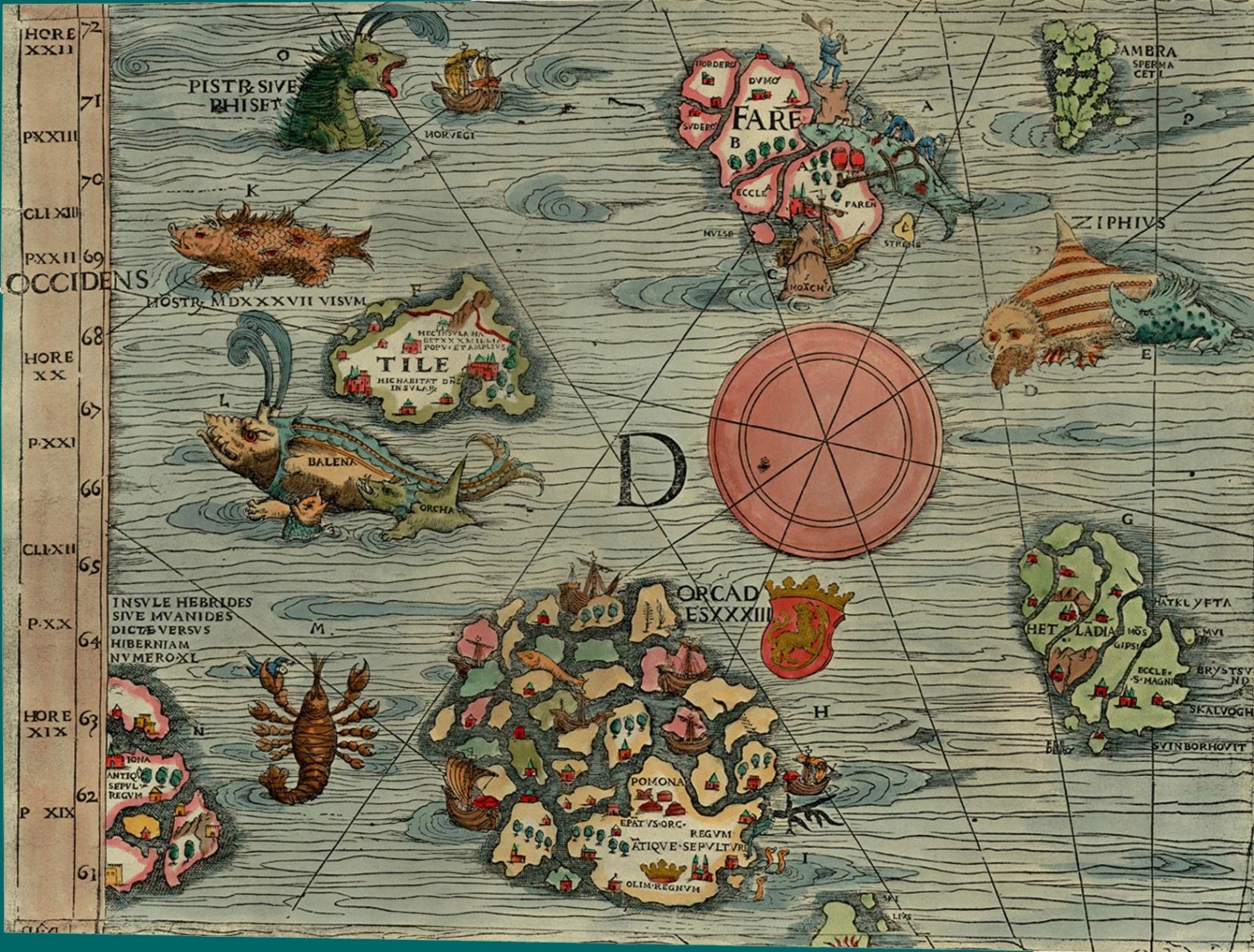
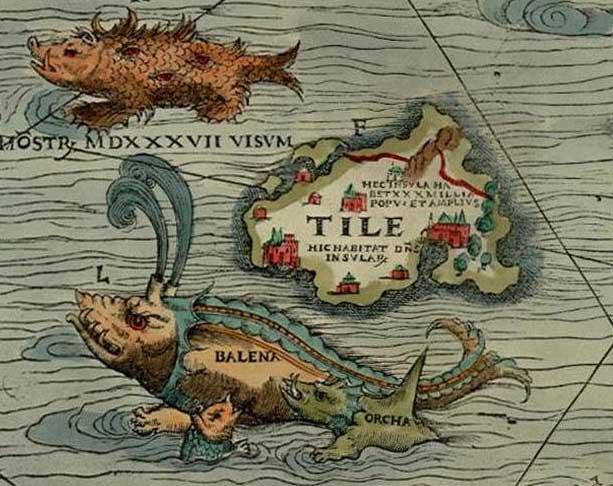
Thule as Tile on the Carta Marina of 1539 by Olaus Magnus, where it is shown located to the northwest of the Orkney islands, with a “monster, seen in 1537”, a whale (“balena”), and an orca nearby.

“The people (of Thule) live on millet and other herbs, and on fruits and roots; and where there are grain and honey, the people get their beverage, also, from them. after first gathering in the ears thither; for the threshing floors become useless because of this lack of sunshine and because of the rains”.

Strabo, Geographica (c. AD 30)

In the Middle Ages, philosophers and thinkers often conflated the mythical isle of Thule with other remote, cold and misty isles close to the Arctic Circle, such as the Shetland Islands, Orkney Faroe Islands, Iceland, Jutland, Scandinavia or Greenland.

The ancient and ‘lost’ isle of Thule shouldn’t be confused with the immediate ancestors of modern Greenlanders, who are known as the Thule Inuit culture of the 17th to 19th Century.

Dreamland by Edgar Alan Poe

By a route obscure and lonely,
Haunted by ill angels only,
Where an Eidolon, named Night,
On a black throne reigns upright.
I have reached these lands but newly
From an ultimate dim Thule –
From a wild weird clime, that lieth, sublime,
Out of Space – out of Time.

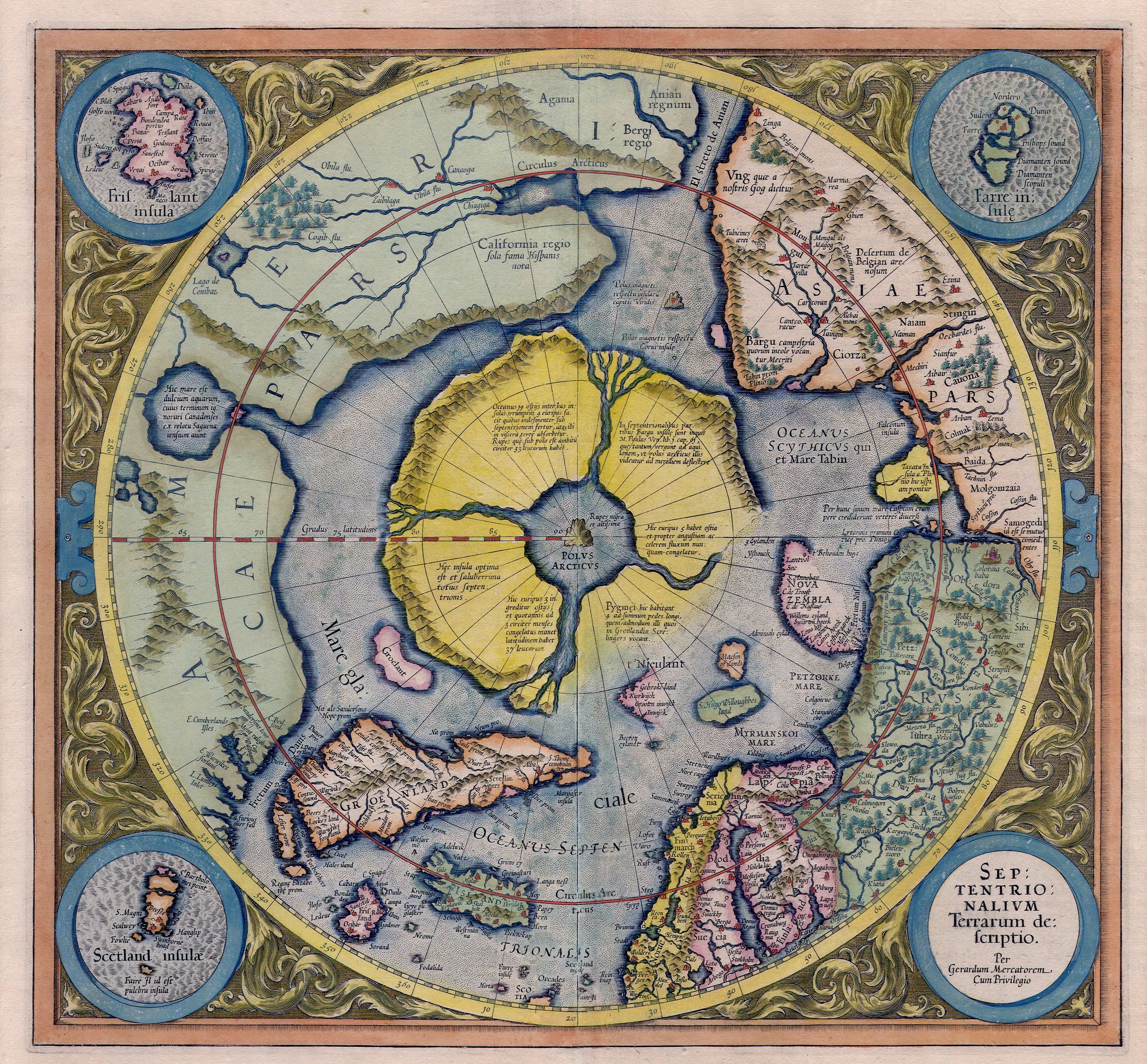
Septentrionalium Terrarum

Mercator: Septentrionalium Terrarum descriptio. A map of the North Pole.
Septentrionalium Terrarum Map of the Arctic by Gerardus Mercator. First print 1595, this edition 1623.

Ultima Thule (Thyle ultima) is an island of the Ocean in the northwestern region, beyond Britannia, taking its name from the sun, because there the sun makes its summer solstice, and there is no daylight beyond (ultra) this. Hence its sea is sluggish and frozen.

Isidore of Seville, Etymologies c. 7th Century AD
Here be the Viking Hoard: The Mystery of the Lewis Chessmen http://wp.me/p41CQf-ItW
Walrus hunting in the Middle Ages

Thule, the period of cosmography,
Doth vaunt of Hecla, whose sulphureous fire
Doth melt the frozen clime and thaw the sky;
Trinacrian Etna‘s flames ascend not higher

~ A madrigal by Thomas Weelkes, entitled Thule (1600)

The Voyage of St Brendan

Navigatio Sancti Brendani Abbatis (Voyage of Saint Brendan the Abbot) c. AD 900. According to the legend, Saint Brendan performed a mass on the back of a whale.

St. Brendan of Ardfert circa 484-578, was an Irish monk who set sail with sixty men through the northern Atlantic’s sluggish and icy oceans towards the elusive and mysterious islands of Hy Brasil and Thule. According to the story, they sailed for five years and saw many wonders, even conducting a mass on the back of a whale (see above) and eventually reaching a beautiful island where they met a holy man. Brendan believed this to be his “Promised Land of the Saints.”

Read about another mythical island of Hy Brasil

Ancient Word of the Day: Uiscebeatha

Uisgebeatha: n Irish Gaelic uisce “water”, and bethu “life” or Water of Life. Another variation is the Scots Gaelic Uisge beatha. Pronounced Ish-ka ba-ha.

This was a Gaelic name given by Irish and Scottish monks in the early Middle Ages to describe distilled alcohol. It’s a translation of the Latin aqua vitae ‘water of life‘.

When this word first appeared in English in the 1500’s, it still retained its Gaelic origins and was spelt usquebaugh.

Uisgebeatha/Uiscebeatha was later corrupted and anglicised to become whiskey.

How to pronounce Uiscebeatha

Does whiskey (aqua vitae/uiscebeatha) originate from Ireland or Scotland?

It is recorded throughout the medieval period as aqua vitae. It seems there is a record that dates Irish Whiskey as being older than Scotch Whiskey, but only only a few decades.

“Richard Magrannell Chieftain of Moyntyreolas died at Christmas by taking a surfeit of aqua vitae. Mine author sayeth that it was not aqua vitae to him but aqua mortis.” ~ Annals of Clonmacnoise Ireland 1405 AD.

“To Friar John Cor, by order of the King, to make aqua vitae, VII bolls of malt” ~ The Scottish Exchequer Rollls, 1495 AD.

The king referenced here was King James IV of Scotland. And ‘eight bolts of malt’ refers to 48 bushels or around 400 gallons of whiskey!

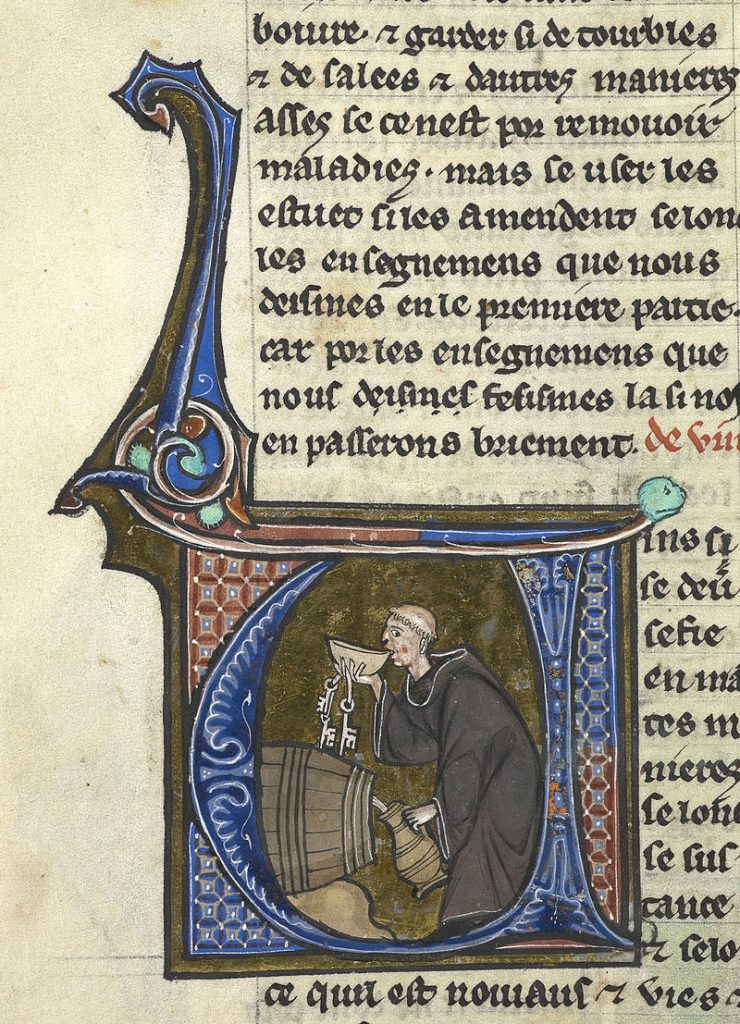
An abbey cellarer testing his wine. Illumination from a copy of Li livres dou santé by Aldobrandino of Siena. British Library manuscript Sloane 2435, f. 44v.

References

Uiscebeatha: Wikipedia

The Cabinet of Linguistic Curiosities : A Yearbook of Forgotten Words by Paul Anthony Jones

A History of Pious Drinking

It’s true whiskey originated from Ireland

An abbey cellarer testing his wine. Illumination from a copy of Li livres dou santé by Aldobrandino of Siena. British Library manuscript Sloane 2435, f. 44v.

10 Interesting Things I Found on the Internet #35


Hello my lovely friends and welcome to another bounty of beatific delights and shimmering wonders taken from the bottom of the internet ocean and brought to the surface for you to enjoy. Let me know what you think of them below…


The bewitching bejewelled Lindau Gospels

Named after the Abbey of Lindau on Lake Constance (Germany), where it was once housed, the Lindau Gospels ranks as one of the great masterpieces of book-binding and was constructed and put together at different times. The back cover dates from Salzburg 8th Century A.D, the front cover was made in eastern France 100 years later and it was written in and illuminated in a monastrery in St Gall. Switzerland. Read more


Writing and art synesthesia

Is this what it means to smell or feel colours?

Washington-based painter Tyree Callahan modified a 1937 Underwood Standard typewriter, replacing the letters and keys with color pads and hued labels to create a functional “painting” device called the Chromatic Typewriter.

Writing and art synesthesia
Writing and art synesthesia. Via Reddit

How to write a VICE article

This is possibly a little crass, a little cheeky and even a little gross but I still think it’s funny, perhaps because of all of the above reasons, by the Australian comedian Adrian Alaberg. WordPress won’t let me embed it, so here is the link


A beautiful iridescent hummingbird

Nature’s beauty can’t be matched by anything made with a human hand…

A beautiful iridescent hummingbird
Found on Reddit

Found on Reddit


Magazine: Because You’re Frightened

A catchy post-punk song that I had on my playlist from years ago and just rediscovered, don’t you just love those times!


When mother nature takes LSD

When mother earth takes LSD
When mother earth takes LSD. Via Reddit

Via Reddit


The immersive world-building of Studio Ghibli

How Studio Ghibli draws you into a hypnotic sense of realism and yet dreamy otherworldly mastery. If you have never watched a Ghibli film, I envy you, because you have many worlds to explore.


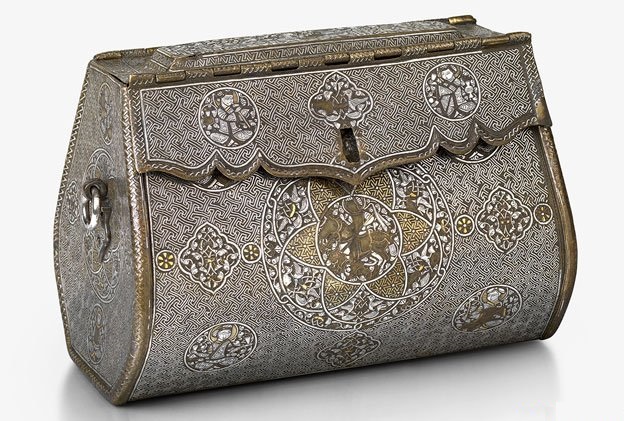
A woman’s purse from the 14th century in Iraq

Beautiful things deserve to be admired forever.

A woman's purse from the 14th century in Iraq
A woman’s purse from the 14th century in Iraq

Via Twitter


Quando, Quando, Quando

This is an oldie but a goodie. The older gent has dementia and the together with his son they sing Quando, Quando, Quando on the way to the supermarket. You may have heard this one it went viral years ago, but it still makes me smile.


You’re already beautiful now by Titsay

This has to be the most wholesome and nourishing Twitter account out there. I have been courting her for an interview, but she is being a bit coy about it, I think she is really busy with her art, so that’s great!

Via Twitter


Make Things by the Cryptonaturalist

The Cryptonaturalist always has amazing, short-form poetry about the connectedness of nature, humans and animals.

This ‘give me space’ dog vest

I love the shy and slightly tense looks on the dogs face. Why is it unacceptable for humans to want quiet, silence and space? I am just wondering. What if I just don’t want to be social or friendly or make conversation? Inside my head is a far more interesting place to be for me, I actually like it there mostly, it’s nice. Conversely I find the outside world to be pretty overwhelming, harsh and just too much, so yeah Via Twitter


A delicious looking mushroom melt burger by Will Yeung

Baroque hair printing is now a thing…

Via Twitter

I hope you liked these picks, let me know below what you think…