It is the time when crimson stars
Weary of heaven’s cold delight,
And take, like petals from a rose,
Their soft and hesitating flight
Upon the cool wings of the air
Across the purple night.
It is the time when silver sails
Go drifting down the violet sea,
And every poppy’s crimson mouth
Kisses to sleep a lovesick bee;
The fireweed waves her rosy plumes
On pasture, hill and lea.
It is the time to dream—and feel
The lanquid rocking of a boat,
The pushing ripple round the keel
Where cool, deep-hearted lilies float,
And hear thro’ wild syringas steal
Some songster’s drowsy note.
It is the time, at eve, to lie
And in a hammock faintly sway,
To watch the golds and crimsons die
Across the blue stretch of the bay;
To hear the sweet dusk tiptoe by
In the footsteps of the day.
The sky puts on the darkening blue coat
held for it by a row of ancient trees;
you watch: and the lands grow distant in your sight,
one journeying to heaven, one that falls;
and leave you, not at home in either one,
not quite so still and dark as the darkened houses,
not calling to eternity with the passion of what becomes
a star each night, and rises;
and leave you (inexpressibly to unravel)
your life, with its immensity and fear,
so that, now bounded, now immeasurable,
it is alternately stone in you and star.
In this travel memoir by novelist Geoff Dyer I read this book waiting to be immersed into the world of the travel. Although sadly I found the result rather disappointing to be honest. He is a great writer don’t get me wrong – I loved his novel Paris, Trance in the past. This was a fictional novel of loose collective of directionless youth all shagging and dropping e in Paris in the 90’s.
Although this memoir, Yoga for People Who Can’t Be Bothered To Do It is a collection of vignettes of his travel journeys in Rome, New Orleans, Angkor Wat. It reads to me as pretty banal and boring. It has a sort of pointless ‘Waiting for Godot’ type of vibe to it, as Dyer traipses around the place looking at things.
Dyer has said though that this is the whole point. That travel is often not stimulating or enlightening. Instead it’s banal and filled with the tedium of going around in circles.
I found this notion depressing though, which probably says a lot more about me rather than Dyer. For me travel should be framed in this bigger existential idea of awe and universal discovery of new truths and new beginnings of the self.
Of course travel, just like life, can’t be everything all the time. As a (once upon a time) directionless youth moving aimlessly through Europe having meaningless and for the most part unsatisfying encounters, I have say that this kind of random dionysian existence was familiar territory for me, but still made for a depressing read. Because whatever one’s personal circumstances, if you turn travel into the banal and boring experience, then what hope do we have at all for excitement and adventure in our lives?
In all I would say pass on this one. Especially if you are wanting some genuinely juicy and satisfying armchair travel. Instead I got rather turned off the idea of travel after reading this.
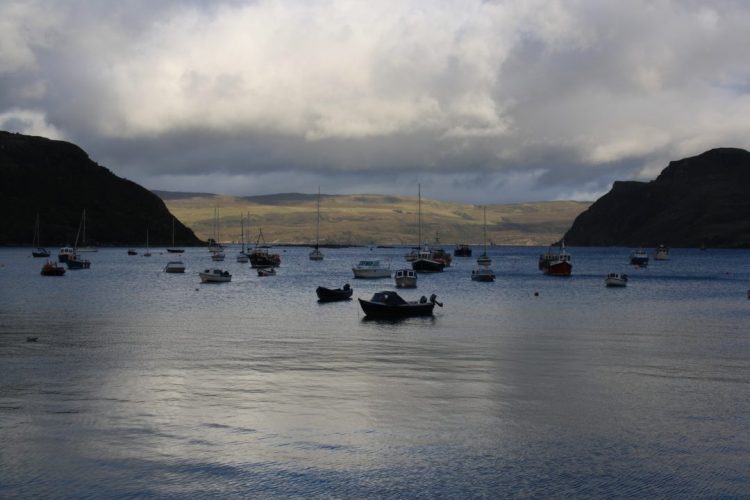
A popular anarchist squat, bar and music venue in Berlin 2010. Copyright Content Catnip 2010 https://wp.me/p41CQf-KHm
Odilon Redon’s art is the kind of mystical haze of colour and composition that you would find in the corner of your consciousness as you emerge from sleep. I love his art because of this reason, it hints at hidden worlds of emotion and depth that are located deep within us all.
Odilon Redon (1840-1916) was a French symbolist painter. His work can be linked to the poetry of Baudelaire and Edgar Allan Poe, and the music of Claude Debussy in terms of symbolism.
His work evokes all of the bizarre fantasies and half realised ideas from the subconscious that lurk behind our daily lives. He wanted to evoke this sense of mystery and his work definitely achieves this.
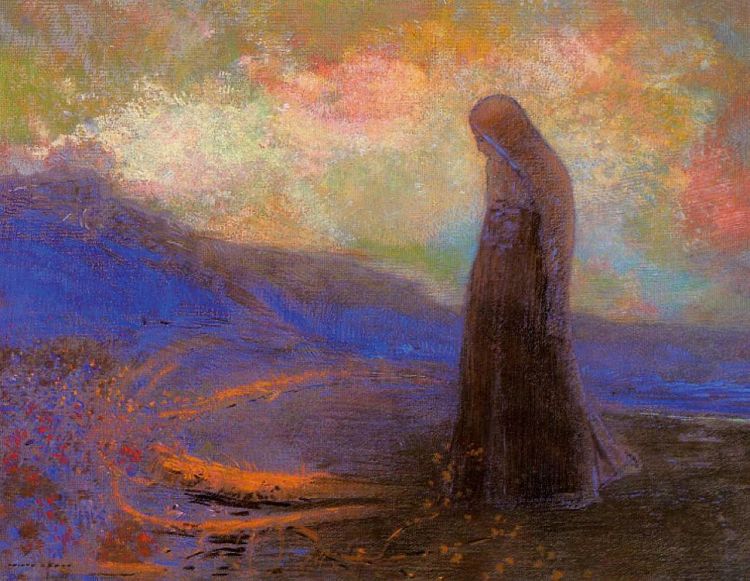
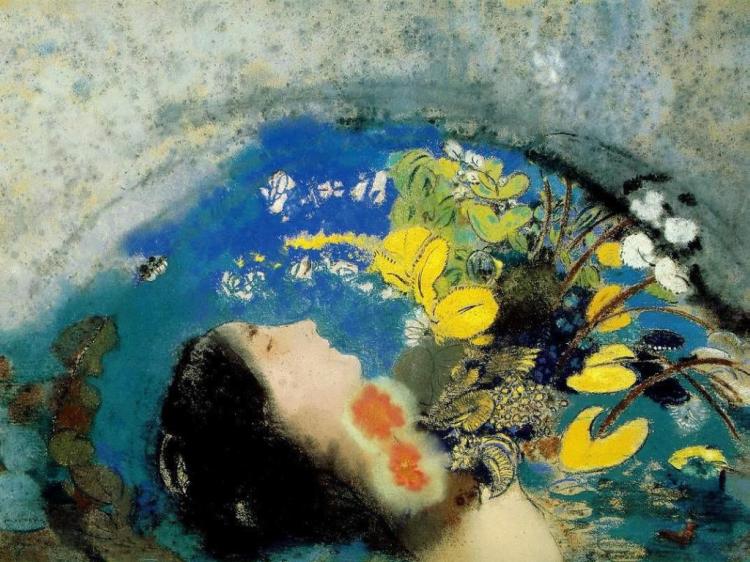
Reflexion by Odilon RedonInto the Light by Odilon Redon
“I have placed there a little door opening on to the mysterious. I have made stories”. Odilon Redon
In a note of 1887, Redon lists three sources from which art can be created – tradition, the legacy of art, containing ‘the entire thinking and moral life of humanity’, reality or nature, ‘outside of which our own ambition to create remains in a state of dream, of abstraction’, and personal invention, ‘the original intuition that combines and summarises everything, seeking support in the past and in the present in order to give to the contemporary world a new organisation’.
He was born in Bordeaux in 1840 and then moved to Paris in 1870. He had a solitary childhood and expressed the view that society wanted to control natural phenomena, and in the process suppressed its dreams.
A Muse on Pegasus by Odilon Redon
Redon produced dream-like and bizarre images of monsters and figures. His monsters refused to be categorised as their beautiful or grotesque, human or non-human but rather somewhere in between. Just like Poe’s psychopaths, Redon’s creatures, both attractive and repellent came to suggest a new and disturbing way of viewing the self and the unfamiliar aspects of the psyche.
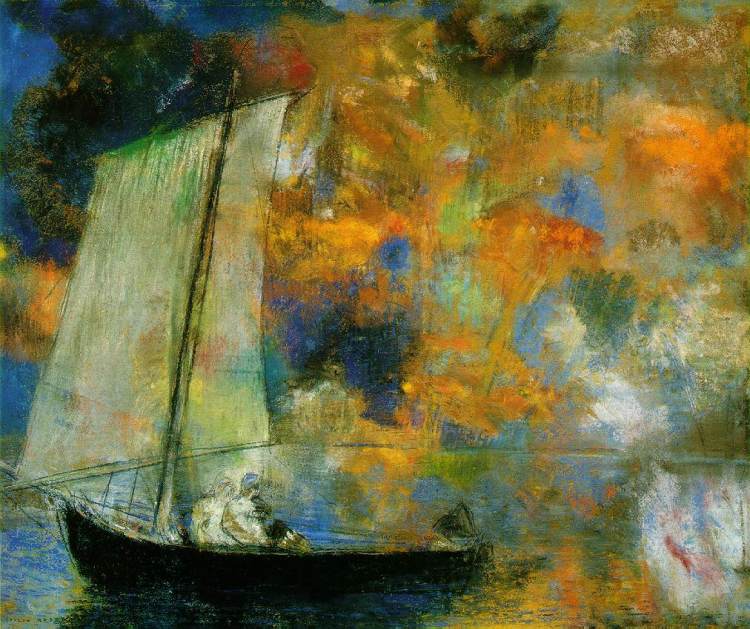
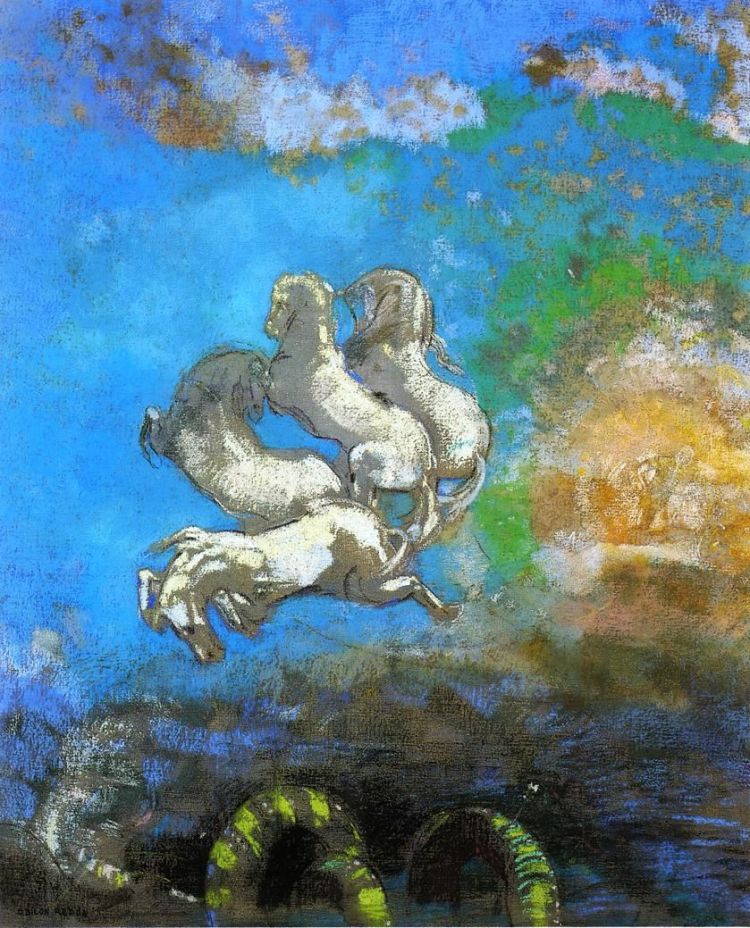
He spent most of his career drawing in charcoal, abandoning this for his better known vivid pastels at 60 years old. He created radiant flower scenes and mythological tributes. The Chariot of Apollo was one of his favourite themes. He worked tirelessly to conjure up natural beauty and dreamy subconscious memories.
Flower Clouds by Odilon Redon
“Painting depends on a gift of delicious sensuality, which can with a little of the most simple liquid substance reconstitute or amplify life, leave its imprint on a surface, from which will emerge a human presence, the supreme irradiation of the spirit”.
Odilon Redon, 1903.
‘
Apollo’s Chariot by Odilon Redon
During his career he created 30 etchings and 170 lithographs. His most well known are the Homage to Goya (1885), The Temptation of St Anthony (1896) and The Apocalypse of Saint John (1889).
He is one of the most fascinating and enduringly timeless artists of the 19th Century.
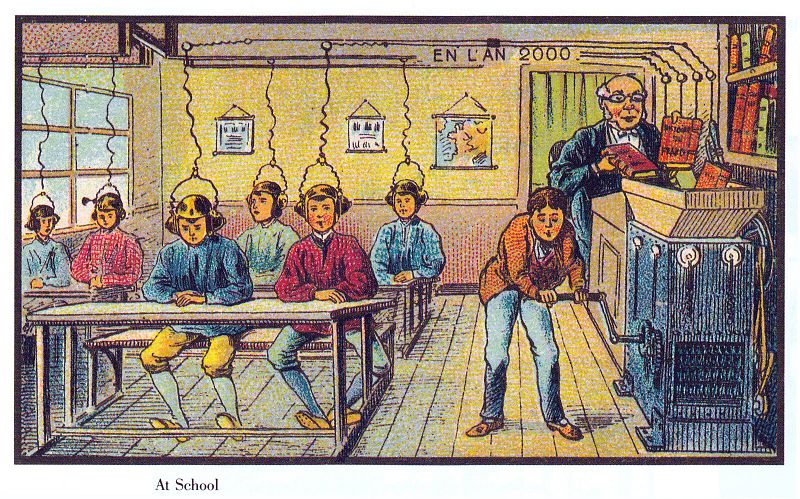
In 1986, when famed science fiction author Isaac Asimov chanced upon a delightful series of postcards dating from 1899, 1900, 1901 and 1910 France, he couldn’t believe his luck!
The postcards depicted scenes from a barely imagined future, then a distant figment of imagination. Of the 21st Century, imagined by French artists in the midst of the steam-powered industrial age.
The predictions on the postcards fell a long way from the mark, which is not surprising. The postcards were stuck in the milieu of the industrial age of mechanical cogs, telephones, steam powered engines, flight and a fascination for underwater adventures aided by early and primitive brass scuba gear of the era.
The postcards, of which 87 are now discovered were originally created by various artists to celebrate the 1900 World Exhibition in Paris, They are a whimsical look at the future that might have been, from the lost world of 19th Century Paris.
There is a curious and delightful steampunk edge to these postcards which jump out at you, it’s a vivid larger-than-life depiction of fantasy, the very stuff of sci-fi novels.
At the turn of the 20th Century, due to financial difficulties by the postcard distributor Jean-Marc Côté, these remarkable cards never actually saw the light of day and remained in a dusty stack somewhere.
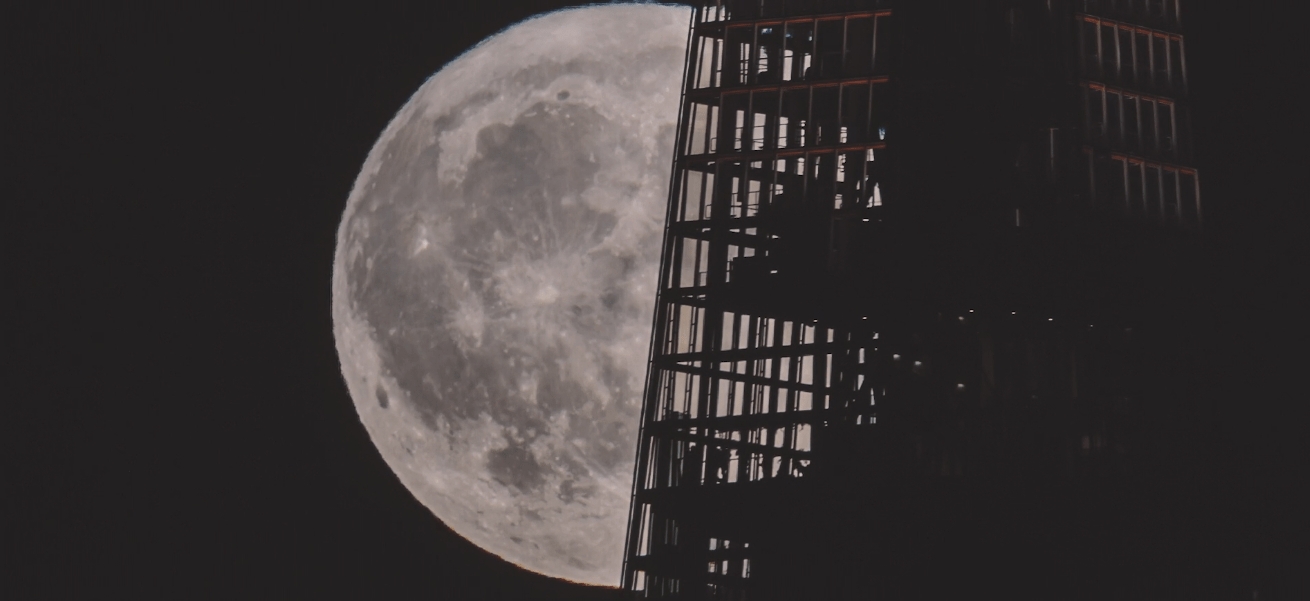
In this stunning short film called Sun Moon London by filmmaker Luke Miller, we witness otherworldly visions of the interplay of the moon, sun and bustling central London.
Luke captured the harvest moon on the 5th of October 2017, when the moon was at its zenith of autumnal equinox. Along with footage of the 1st of January 2018 Supermoon, a once a year phenomenon when the full moon is at its closest point to the earth
The resulting film captures an eerie London teleported into a different reality. A film-set complete with a post-apocalyptic cast of celestial bodies. People and their built environments become spooky and unknowable. This short film invites us to remember how small and insignificant we are in the grand scale of the universe.
In this mind-bending short film, US designer John Edmark, a lecturer in mechanical engineering at Stanford University, uses 3D printing, the mathematics of the golden ratio and photography tricks to create moving symmetry – a bloom.
[The] animation effect is achieved by progressive rotations of the golden ratio, phi (ϕ). This is the same golden ratio applied in nature, seen in pinecones and sunflowers.
Edmark also uses a camera on an incredibly short shutter speed to mimic a stroke effect that you would find on a zoetrope.
The speed of the shutter occurs in concert with the bloom as it turns 137.5º (the angular version of phi).
Each bloom’s particular form and behavior is determined by a unique parametric seed called a phi-nome (/fī nōm/)
This reminds me of Kunstformen der Natur or Artforms in Nature by German naturalist and biologist Ernst Haeckel. In this classic book originally published in 1899, you can find all kinds of lithographs and watercolours of organisms.
The main over-riding principle that guided Haeckel was that each of these organisms displayed complexity and intricate symmetry. He loved to capture ammonites, boxfishes, jellyfish and micro-organisms for this reason, arranging them for maximum visual and aesthetic impact. I have written about Haeckel’s gorgeous book of treasures before in an article called Exquisite Marine Invertebrates of the 19th Century.
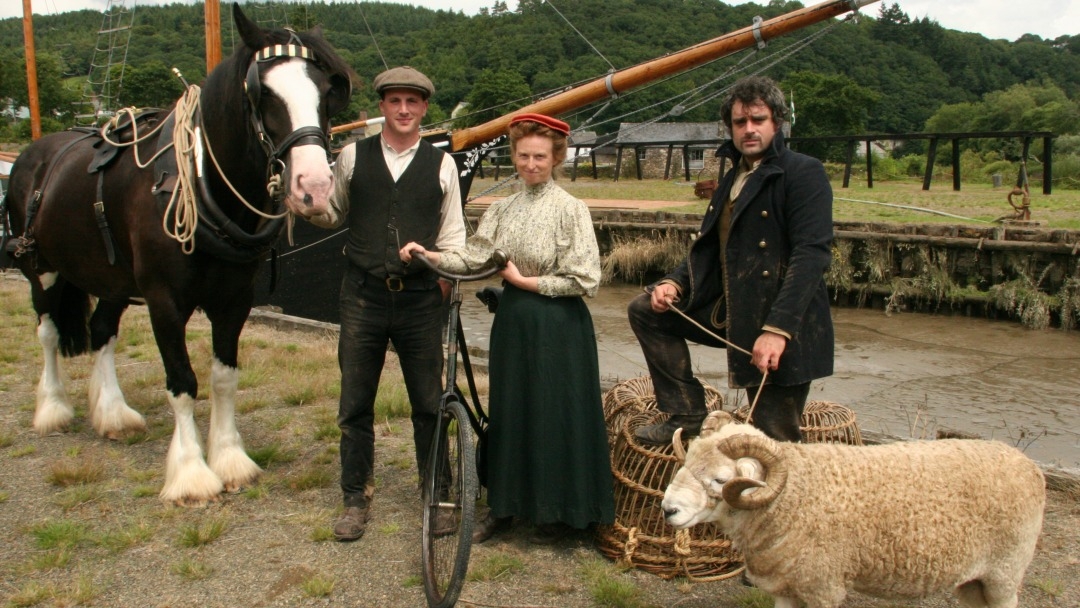
In this series by the BBC, a group of historians and archaeologists recreate the running of a farm during the Edwardian era. This is a fascinating series that was originally aired in 2011 and now resides on countless Youtube channels – for better or worse with regards to copyright. Still, these issues aside this is a wonderful series and worthy of your time – it’s incredibly addictive for anyone who loves history and particularly British history.
The farming team are made up of historian Ruth Goodman and archaeologists Alex Langlands and Peter Ginn who are given the mammoth task of running and managing an Edwardian farm for 12 months located on Morwellham Quay, an historic port town in Devon.
Located on a beautiful river and with all of its original buildings, life on an Edwardian Farm has everyone dressed in period clothes – the result is rather scenic and delightful and sets the imagination into gear for how it would have been to live in those times.
Each of the 12 episodes corresponds with a month in the calendar year. The rural life in those days consisted of making the most of the bounty of nature and living off the land and animals and subject to the unpredictable vagaries of nature. The Edwardian era also ushered in the new industrial farming practices which sadly began to usurp the use of beautiful farm horses.
Each episode is delightful. January sees Alex and Peter go down a copper mine. They farm the first daffodils in March. In May, a steamboat full of tourists arrives. In October they begin a market garden selling strawberries and they celebrate a spooky Feast of All Souls aka Samhuinn/Samhain.
If you enjoy British history, or you enjoy novels set in this time, then you will enjoy this series. Well worth a watch and all 12 episodes are available on YouTube.
Jen Muir is an illustrator currently residing in Scotland where she crafts intricate, sublime and whimsical watercolours and pencil drawings.
Although she’s always loved making art, Jen begun working as an artist when she took a year off University to do a visual communications course.
“I usually use watercolour and graphite for making things, but lately I’ve been experimenting with oil pencils and pastels. I typically make illustrative work for children and scientific illustrations,” she says.
Jen has a strong affinity with animals. She is well known for her fantastical paintings of animals both real and imagined in strangely beautiful contexts.
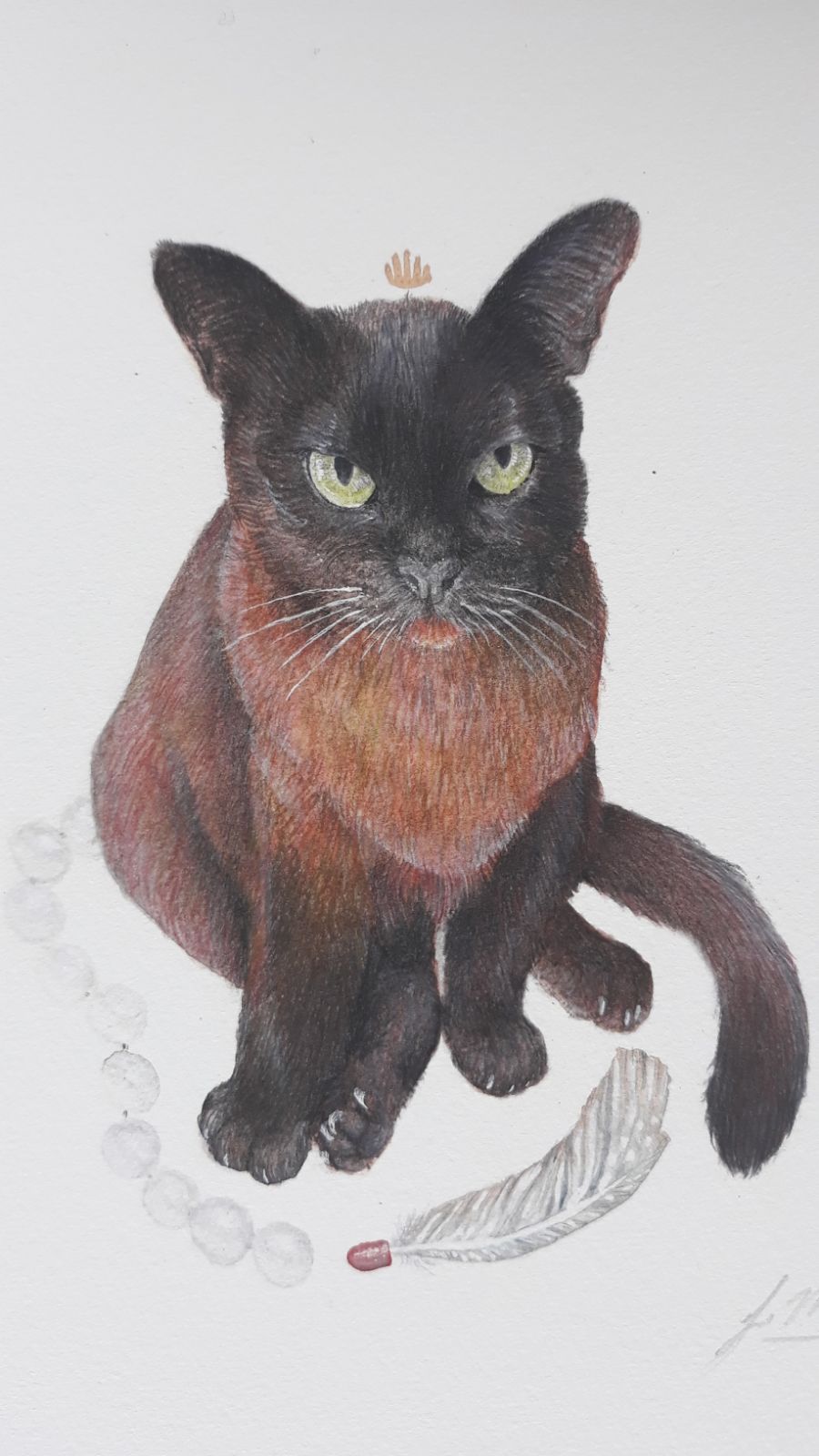
These paintings resonated deeply with me. I saw that Jen also does pet portraits so I got in touch with her for a pet portrait of my favourite furry friend – a cheeky and mischievous Burmese cat named Pearl.
Pearl by Jen Muir
Pearl – the original photo
Pearl currently resides with my mum, but I still fancy that I am her favourite human, even though we live on a different continent. I commissioned Jen to do a watercolour of Pearl, so that I could stare up at her all the time in my lounge room.
Over the years, Jen has developed her freelance business as an artist. She took a course on starting up a small business with the Princes Trust and found this useful to learn the boring but necessary skills of kicking off a freelance enterprise.
Howler Monkey by Jen Muir
As well as being a creative, Jen is a roving adventurer at heart.
“In the future I would like to combine my art with more animal conservation interests, possibly through illustrating species guides and educational work,” says Jen.
Soon she is off to Brazil for a month for conservation research, and she plans on making some beautiful art there.
Thank you Jen for your beautiful painting of Pearl. Good luck in Brazil!
Do you have a pet that you absolutely adore? Perhaps one that has sadly now left this world? I recommend getting Jen to immortalise your pet with one of her wonderful true-to-life paintings.













 Content Catnip
You must be logged in to post a comment.