
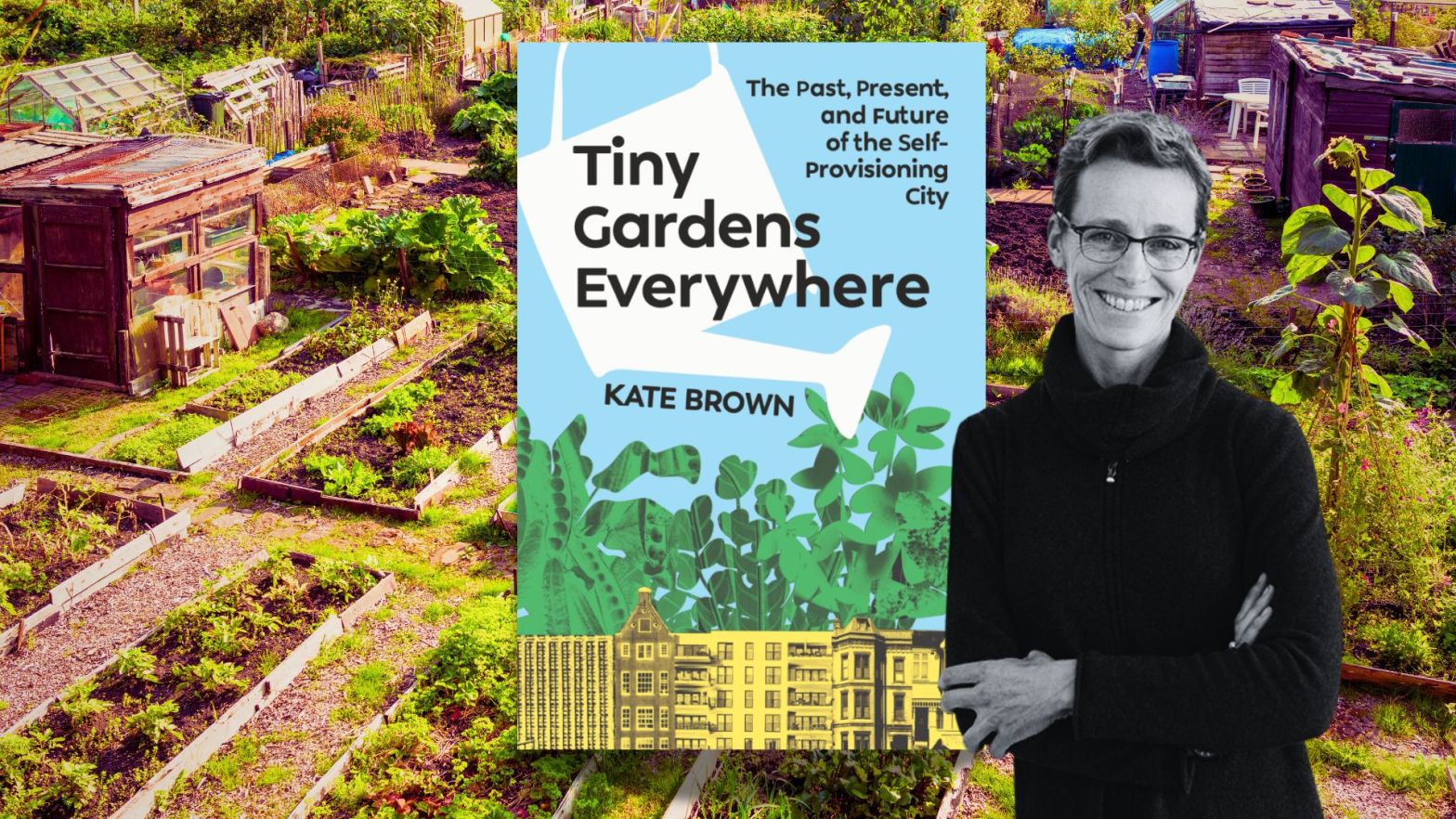
This is an enormously important book about the history of gardening not as a placid recreational activity for the wealthy but as a practical form of survival, food security and resistance by working class people all over the world. Never has a book been more important as right now with the commodification of land and homes.
Rating: 🌟🌟🌟🌟🌟
Genre: Non-fiction, Gardening, History, Socialism, Worker’s Rights, Human Rights, Food security.
Publisher: W. W. Norton & Company
Review in one word: Cornucopian
Tiny Gardens Everywhere: The Past, Present, and Future of the Self-Provisioning City is a little-known and criminally underrated history of urban gardening as a form of political and community resistance. Written by MIT historian Dr. Kate Brown it blends personal memoir, oral history and archival research into a hugely compelling narrative.
This is the first time I’ve read an overtly political book about gardening and to be honest it was instantly interesting to me. Previously I’ve read Orwell’s Roses by Rebecca Solnit, which I also reviewed on this blog. George Orwell was a political commentator and writer who was a strong advocate for worker’s rights and the importance of Bread and Roses. That is the concept of eight hours of work, eight hours of rest and eight hours to do what you will.
Brown delves deeply into the history of communal farming in different parts of the world. Firstly she focuses on feudal England and how the privatisation of land by the gentry in the 18th century dramatically reduced English peasant’s potential to farm their own land.
This move coincided with the growth of the Industrial Revolution. Instead of allowing peasant farmers to work their own land in the country, giving them tangible independence and autonomy, these people were forced into penury and reliance on wealthy industrial overseers. Industrialists demanded that they work long hours for very little pay, often putting their lives at risk.
Of course, the purpose of allotments was not reparation. The elite had no intention of returning commons to commoners. The goal was merely to keep laborers from starving and rioting, while lowering taxes (the poor rate) to support the jobless workers. The philosopher John Stuart Mill cynically quipped that allotments were a strategy to have people “grow their own poor rates.” To ensure that people would still work when needed, landowners carved fields into tiny gardens “insufficient for a full subsistence.
And more was lost than land. While commoners had elected their own leaders and managed communal territory collectively, landlords ruled allotments. To get a plot, field wardens took into account family history, criminal record, employment, church attendance, and the number of children. No one considered “saucy” or “lazy” got a plot. Nor did men who joined labor unions. Men received allotments; only rarely did women get them. Women, who had long cultivated kitchen gardens, were edged out as male heads of households came to dominate the family growing space.”
But with simple shovels allotments flourished. By 1873, one in every three male agricultural workers in England had an allotment. Urban workers also acquired them. In 1880, the National Agricultural Labourers’ Union included allotment gardens in their platform, along with the right to vote and collective bargaining. Unions embraced allotments because they changed the equation in labor disputes. When miners or factory workers went on strike, families could fall back on garden provisions to tide them over. Workers’ gardens cultivated organizational skills and new political tools so that urban and rural protestors could engage in open politics and trade unionism.
In 1887, an allotment candidate won a seat in Parliament, and later that year Parliament passed another allotment act that gradually established gardens on public land, which meant lower rents and more permanence than allotments on private land. From 1860 to after World War I, more applicants desired allotments than could get them. The number of allotments grew in twentieth-century England to reach a half million plots.
Tiny gardens, as meager as they were, built alternative political dominions. The spade cultivated care. Care extended outward from plants and soil to more inclusive politics. One definition of freedom is being able to re-create oneself through a connection to others. After the commons were wiped away, allotment gardens restored in some measure the ability for working-class people to make their own worlds.
Excerpt from Tiny Gardens Everywhere by Kate Brown
Barackia in Berlin
The second example in the book is of Barackia in 1870’s Berlin. Barackia was an autonomous and self-sufficient town that once stood near Kottbusser Tor in the Berlin suburb of Kreuzberg. Then it was a backwater of Berlin and on the outskirts. Today, Kreuzberg is a vibrant suburb in the heart of the city. For a while there, at least when I was living there over a decade ago, Kreuzberg was enjoying a renaissance of counterculture of sorts. The suburb stood for the same anarchic and socialist values as in Barackia had before.
“ Berlin shantytown dwellers rented municipal lots until an investor willing to pay more for the land came along. They had short-term leases and no rights. Their huts and gardens served as placeholders for future development. Although Barackia residents were happy to be liberated from landlords and tenements, they did not have permanence, independence, or the right to exclude others. Barackia residents had already lost their homes and village commons.”
“Instead of property-backed, rugged individualism, Barackia residents relied on each other. Households lived together in small colonies of 150 to 300 people. They managed by consent the governance of an informal community that handled small industry, enterprise, and the construction of infrastructure. Colonists built their streets, fountains, and public spaces. They solved the problems of shelter, waste, hygiene, and food security with no public funds, no planning or bureaucracy, no elite leadership or intervention. ”
“Like a jar of pickles, daily life ferments into culture. Culture on the most basic level brings together disparate ideas, practices, and living beings to brew into something novel, satisfying, and sometimes miraculous. Barackia’s musicians, storytellers, and informal news gatherers nurtured a working people’s civilization, which took shape as they sat before their huts in the evening, the murmur of voices and accordion music tracing the outlines of the community.”
Excerpt from Tiny Gardens Everywhere by Kate Brown
In the 1870’s Barackia consisted of lean-tos and a miscellany of self-built homes and gardens. Disenfranchised working class families and migrants who couldn’t afford expensive city rents established the village along with highly productive and fertile fruit and vegetable gardens. These gardens allowed the people to circumvent the expensive food in the city centre. They remained completely outside of the jurisdiction of the Prussian state. Barackia became so successful middle-class people started emulating their farming methods. The Prussian state cracked down on them with catastrophic results. They violently destroyed the houses and cleared out the settlement on the weak pretext that the houses didn’t have architectural plans. From this point the workers were forced back into the oppressive and low page wage for labour system.
The third example cited by Brown is African American resistance gardening in the middle of last century in Washington D.C.
During the Great Migration, millions of Black Southerners moved to northern and mid-Atlantic cities to escape Jim Crow laws and seek industrial jobs. When they arrived, they brought with them deep, generations-old agricultural knowledge rooted in rural Southern traditions.
Black residents of DC transformed empty and derelict urban lots into highly productive food gardens. They established complex food cooperatives, shared seeds, and created sophisticated composting systems that ensured future food security for black neighbourhoods.
Yet, much like in Berlin, this self-sufficiency was viewed as a threat by the municipal government. Local officials, operating under the guise of “urban renewal” and city beautification, began to target these gardens.
Brown argues that these urban renewal projects and gentrification are actually mechanisms of social control that are driven by endless capitalist growth.
Resisting endless growth in favour of growth for all
Brown pushes back against the idea that urban gardens cannot produce enough food to sustain populations, noting that during World War II, victory gardens supplied the majority of food for the population.
The book ends on a positive and empowering note. Brown asserts that a better world is possible. That gardening as a form of resistance is an enduring form of protest that is anything but passive! She argues that the right to garden and grow one’s own food for one’s community is part and parcel of rejecting the most toxic forms of extreme capitalism. Gardening is a major step towards building a reciprocal and interconnected community and society.
This is an enormously important book about the history of gardening not as a placid recreational activity for the wealthy but as a practical form of survival and resistance by working class people all over the world. There’s so much in here that I struggled to condense this down, I was worried I missed out on things. This book is not to be missed if you are about human rights, worker’s rights and what freedom and autonomy really means. These questions are still pertinent even now as house and land prices skyrocket throughout the world due to investor speculation – read: GREED. Books like this are an antidote to this kind of greed and show how you can carve out a green space for yourself and those you love.