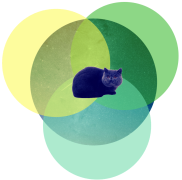

The mind replays what the heart wants to heal

Iconoclast and Rebel Peaches opens up her mind on Amoeba’s channel
One of the most singular and outre artists in the world Peaches visits the Amoeba shop and picks out her fav albums and films. This was interesting because she has some pretty wild choices including a strange film with Kate Blanchett in it that I’ll need to check out. Also I’ve never heard of Eartha Kitt but I will be looking into that further.
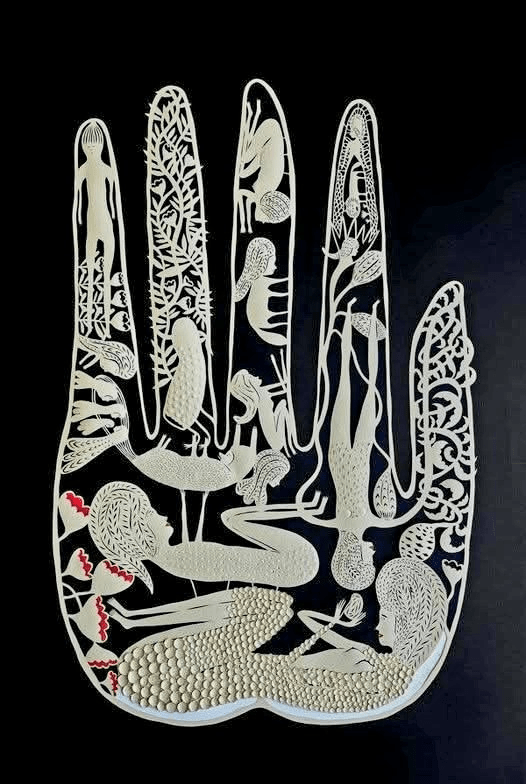
Intricate papercut art by Elsa Mora
Paper-cut artwork by multimedia artist Elsa Mora, who was born and raised in Cuba before moving to the US in 2001. Via Alabandine on BlueSky
Junghofstraße Trance Classics | OMEN Frankfurt Tribute Mix
Take a trip back to the ecstatic heart of 90’s trance.
Title
Animal agents who can shape their own lives and the course of history
Plato’s attempt 2,500 years ago to define the human as ‘a featherless biped’ had to be swiftly qualified –‘with broad flat nails’ – when Diogenes presented him with a plucked chicken. Many subsequent attempts at human self-definition have faced similar problems in relation to exceptionality. Yet lately, scholars have begun to conclude that while the difference between humans and other animals is great, it is one of degree, not kind. Steadily, the notion that humans were uniquely created in the image of the divine is dropping out of the Western world view, as it becomes clear that characteristics once thought to be unique to our species – tool use, language, culture – are found to occur among other species. Even so, one aspect of humanity has seemed indisputably ours alone: our capacity for self-conscious agency; that is, our ability not just to act on and influence the world, but to do so deliberately and reflectively.
Self-aware animal protagonists have always existed within the human world. Usually, however, they’ve been imaginary, and mostly they’ve appeared in the pages of children’s stories. Characters such as the talking animals in The Chronicles of Narnia (1950-56) by C S Lewis, for example, were relatively simple. For all their animal appearance, their thoughts, actions and emotions were largely indistinguishable from those of humans. Other stories have exploited differences in human and animal experience to teach moral or ethical lessons, by precept or example. In some cases, this involved close exploration of the inner lives of animal protagonists – the gradual civilisation of the wolf-dog in Jack London’s White Fang (1906), for example, or the mature suffering of the horse in Anna Sewell’s Black Beauty (1877). But more often than not, the author’s aim was to use the animal to explore the human, and humane.
T H White’s Merlyn transformed the wart (the young King Arthur) into (variously) a hawk, an ant and a badger so that the regent in The Once and Future King (1952) could learn more about the governance of human nature; the altruistic friendships in Charlotte’s Web (1952) by E B White gradually shaded into the conscious acceptance of individual mortality. Animals have also been deployed allegorically, to explore relationships between people (often depending on animals to say things that humans found hard to hear). Such childhood stories frequently acquire resonance as their readers grow. For example, when read in adulthood, Kenneth Grahame’s The Wind in the Willows (1908) provides just as devastating a critique of the shift from an agricultural to an industrial society as George Orwell’s Animal Farm (1945) does of the transition from capitalism to socialism.
Of course, animal allegories and stories featuring animal narrators are not confined to children’s literature. Books such as Felidae (1993) by Akif Pirinçci, The Plague Dogs (1977) by Richard Adams or Only the Animals (2014) by Ceridwen Dovey use nonhuman protagonists to explore aspects of human inhumanity to animals, while Carmen Dog (1988) by Carol Emshwiller and Pig Tales (1997) by Marie Darrieussecq specifically explore inhumanity to women. Yet within these accounts writers can also make intriguing efforts to explore what it might be like to view the world from the animal’s perspective, as in Pig Tales where the protagonist shifts from pig to person, and back again. The detective sheep of Three Bags Full (2005) by Leonie Swann retain an ovine logic throughout (just as the narrator of Felidae remains feline). The Many Selves of Katherine North (2016) by Emma Green examines the consciousness of a ‘phenomenaut’, someone who can project herself into the mind of a lab-grown animal body, unravelling the devastating and addictive impact of animal senses on human awareness.
In The Inheritors (1955), William Golding embarked on a sustained novelistic attempt to imagine a nonhuman consciousness among Neanderthals. Golding shows us a world where ego is integrated at the community, rather than individual, level. Understanding is based on collective experience, intense proximity and abiding empathy, while knowledge, concept and communication are kinaesthetic rather than cerebrally based. Golding’s Neanderthals are not self-conscious in the human sense – since they are not ‘human’. They are, however, active subjects and agents making their own histories and influencing those of others. Reading that novel is a breathtaking and disturbing exercise in trying to understand, rather than analyse, awareness.
The Inheritors presaged a new way of thinking that would spread among animal behaviourists, evolutionary scientists and eventually historians in the latter part of the 20th century. It turns on there being a difference between agency and consciousness – and between agency and subjectivity, or agency and individuality. Humans have the capacity to act as agents, because they are considered to know what they are doing and why they are doing it. But even though nonhumans possess individuality and consciousness, too, the absence of self-consciousness among them has generally been taken to preclude agency. However, as scholars and artists adopt less anthropocentric approaches to understanding how histories (and futures) are made, in the manner that Golding did in 1955, such thinking is now being challenged. Put another way, do literary efforts to create an embodied but nonhuman consciousness have any purchase in reality?
Frankie’s cultural observations: Gen Z
Hedge Hearth and Witch resists with beautiful AI-free art
I love that she called out how shitty AI is for artists but even more so how it stifles creativity and originality for everyone. She goes into detail about how art is a form of witchy resistance for her. Now full transparency I have posted AI art on this blog in the past but I now realise how soulless it is.
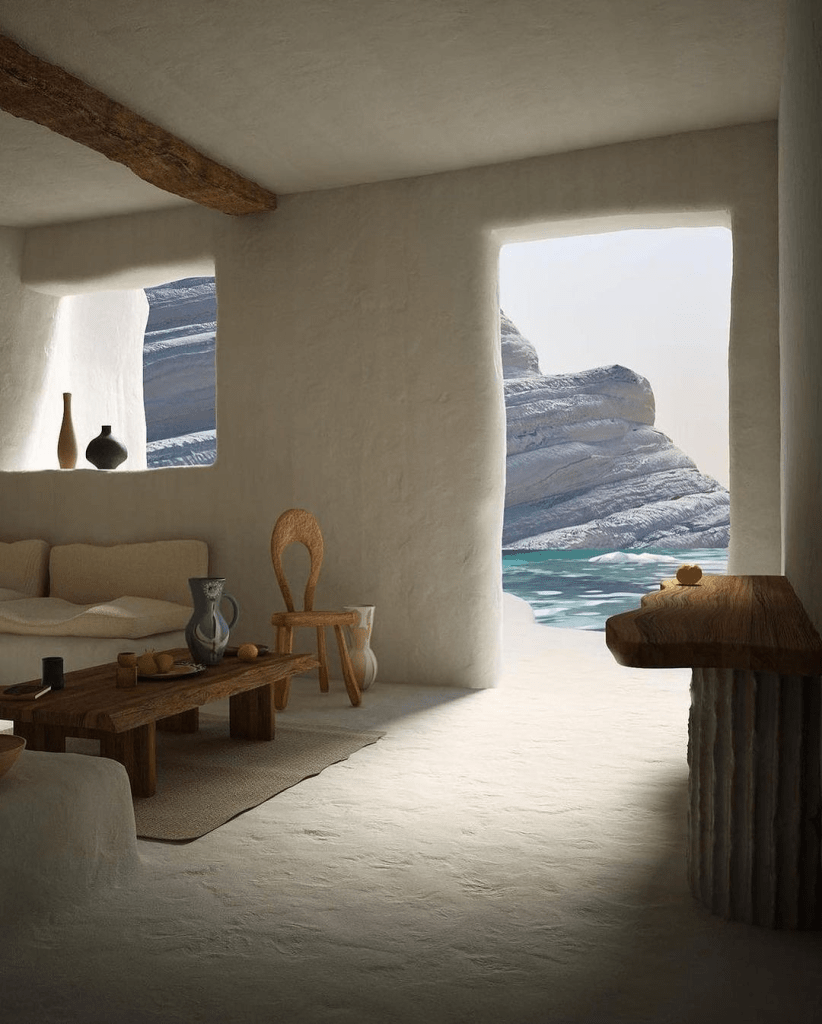
Villa Saraceni, a digital rendering by designer Charlotte Taylor and 3D artist Riccardo Fornoni



Polynesian Origins: DNA, Migrations and History
I am fascinated about the history of my own ancestors in Polynesia and so this was so on point for me!
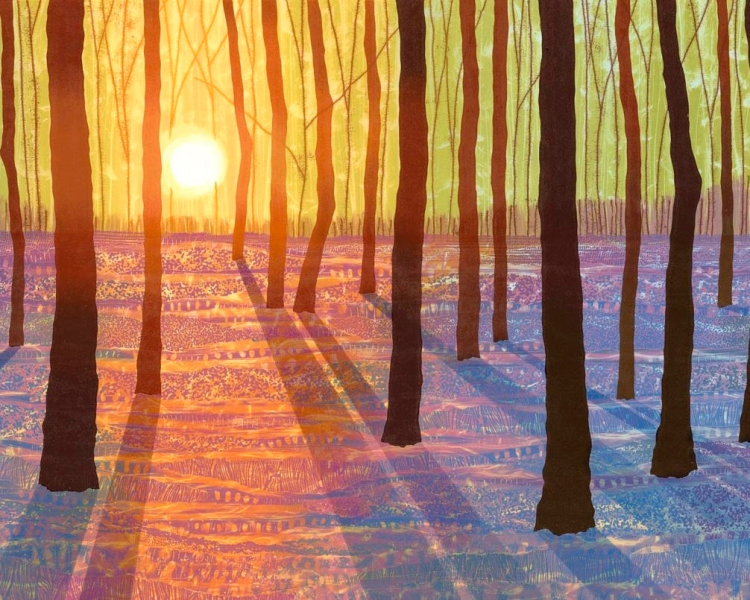
Art by Rebecca Vincent
Rebecca Vincent is a printmaker and artist from Northumberland, UK whose expressive, colourful landscapes bring nature, light, and joy into any space. Finding solace in the the English countryside, she manifests fields, hills, trees, flowers, and coastlines into richly layered compositions filled with movement and depth. Her intricate two-plate etchings and painterly monotypes reveal a mastery of technique and a deep connection to the natural world. Rebecca has exhibited widely across the UK and built a loyal following of collectors worldwide. She brings the soul of nature from the outdoors in, read more.
Did you enjoy this collection? let me know what you think of it below. Thank you for reading my dear friends!
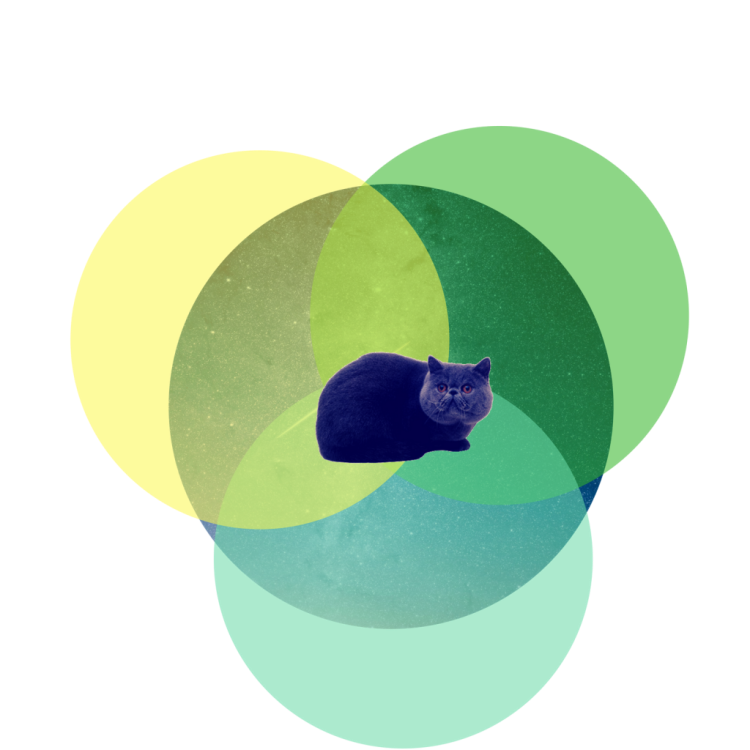


That head and heart image is powerful! And the GenZ video is hilarious.
LikeLiked by 1 person
Thanks so much! So glad you enjoyed these and they made you smile 😉
LikeLiked by 1 person