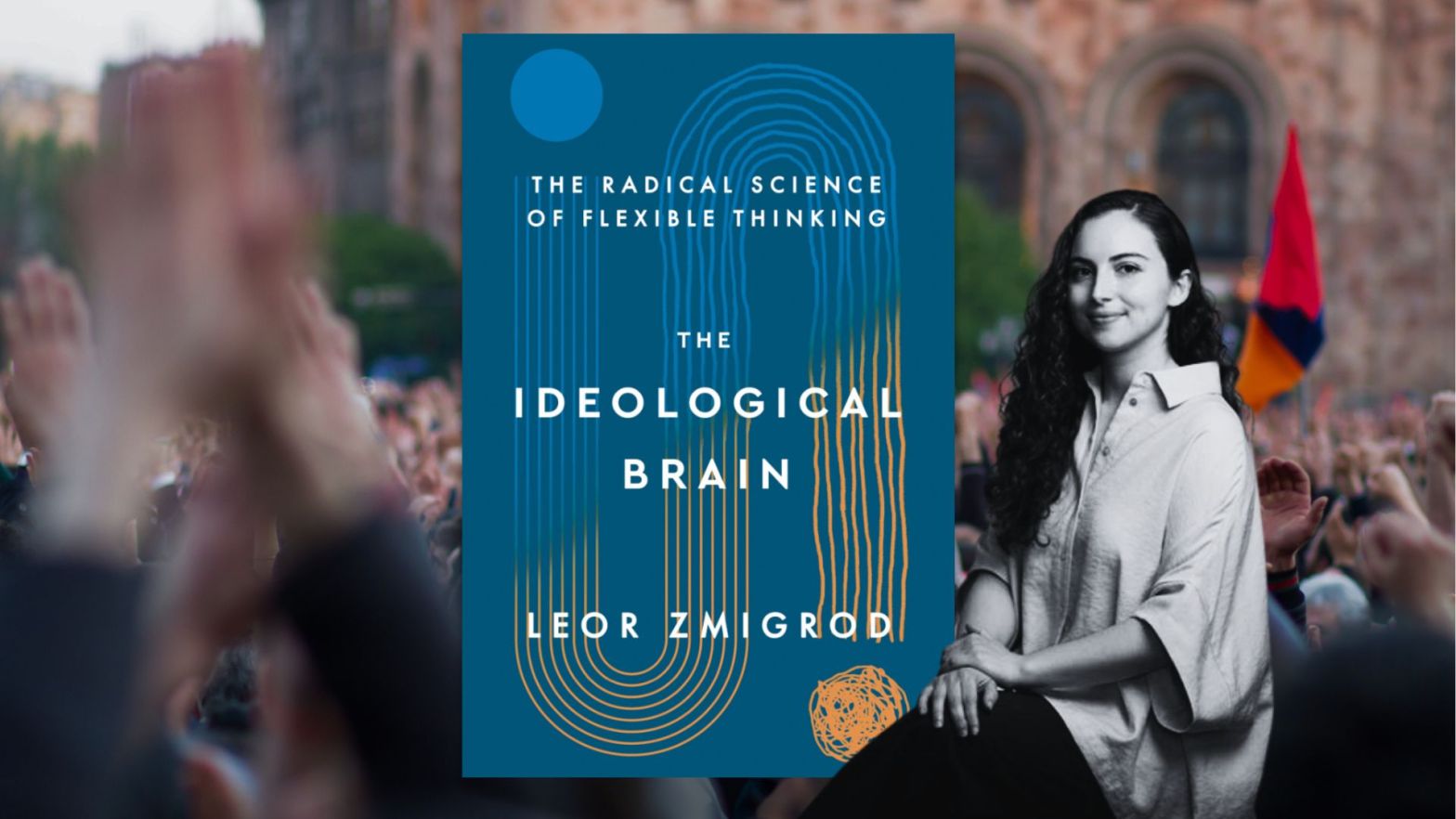
A very timely and interesting book about the interplay between ideology and rigid thinking and how our psychology and neurobiology influence our personal politics. You may discover why your brain is wired to be conservative or progressive.
Rating: 🌟🌟🌟
Genre: Non-Fiction,
Publisher: Henry Holt and Company
Review in one word: Ideological
“All day long, all through the night,
all affairs—yours, ours, theirs—
are political affairs.
Whether you like it or not,
your genes have a political past,
your skin, a political cast,
your eyes, a political slant.
Whatever you say reverberates,
whatever you don’t say speaks for itself.
So either way you’re talking politics.
—WISŁAWA SZYMBORSKA, “CHILDREN OF OUR AGE”
The Ideological Brain is challenging in all of the right ways. It draws on neuroscience, psychology and political theory goes deep into the connection between our political beliefs and the biology of our brains.
This connection might seem tenuous to some, but there is evidence out there to support that there is a relationship between our biology and environment that predisposes some people to have rigid thinking and others to be more flexible in their thinking.
With modern scientific techniques we are now able to ask how deeply into the architecture of the human brain ideological systems can penetrate—how far into the mind and body indoctrination really goes. We have discovered that the brain schooled by ideology is a brain worth exploring.
Excerpt from The Ideological Brain by Leor Zmigrod
Long story short, people who lean towards conservative political ideas are rigid thinkers with limited and inflexible capability to see outside of the paradigms of their own beliefs about the world.
Conversely, people who are more curious, creative and imaginative – who display traits of flexible thinking are able imagine the lives of others and thus tend to be more progressive in their political views.
There is a lot of research condensed down into this book from diverse disciplines like social science, epidemiology, philosophy, religion, neuroscience and neurobiology, psychology. If you enjoy this kind of interdisciplinary approach you will find this book fascinating.
However, I did get the impression that the author shoehorned the findings of various research papers in there, to confirm her own views about an ideological basis for neurobiology.
There was a tacit message that being a creative and flexible thinker i.e. progressive-leaning is more highly evolved and more aspirational than being an inflexible (read stubborn) conservative-leaning person.
At this point of the book it stopped being objective and started taking on a political flavour all of its own. Because surely, being conservative has some benefit as well given that so many people swing this way. I am saying this as a very left-leaning progressive. However, I could see that the book’s argument was about pitching one against the other and finding political conservativism as being inferior.
Not only does this kind of binary thinking contribute to more divisive and us versus them thinking that got the world into this mess, but it really doesn’t add anything to the overall conversation that is going to be fruitful and lead to greater understanding across the political divide.
For this reason I found this book to be fatalistic and the research to be a bit pointless in trying to drive change across party lines. Seeing as I work in small ‘p’ political campaigning with unions and other community groups, I was expected more actionable insights from this book that I could take and use to drive change and work with people rather than alienate them. If you’re looking for a book like that, this isn’t it.
The people with the most flexible minds are the people who acknowledge that the intellectual realm can be separated from the personal realm. They do not viscerally hate their interlocuters—they may hate their opinions but they do not project that hatred onto the persons voicing them. In contrast, the most cognitively rigid individuals, those who struggle to change when rules change, tend to hold the most dogmatic attitudes. They hate disagreement and are unwilling to shift their beliefs when credible counterevidence is presented. Cognitive rigidity translates into ideological rigidity.
Excerpt from The Ideological Brain by Leor Zmigrod
There is a lot of political theory in here that is really interesting, I particularly thought this observation about children living in a totalitarian regime was spot on. People rarely talk about childhood in terms of this kind of power dynamic.
Yet, perhaps in the most important ways, children are the constant subjects of a totalitarian-like structure. The existential condition of being a child is akin to being in a hierarchical ideological system with constant surveillance and the need to appease all-knowing leaders.
Resources are concentrated in the hands of a few powerful authority figures. For a child, life is governed by opaque rules and rituals whose meaning and purpose are often unclear and unexplained.
The family is a site of fundamental inequality, defined by an inescapable asymmetry in dependence. Power, in the family, is unevenly distributed. Every decision, every plea, is dictated by the fact that the child cannot survive alone.
The caregiver gives, and the gift of care is not free. In return, there is payment and debt. Children, after all, are “among the most powerless and casually brutalized creatures in the world,” observes the literary critic Merve Emre. Children by their very nature are powerless and live in conditions akin to a totalitarian regime.
Excerpt from The Ideological Brain by Leor Zmigrod
Another quote about how human beings seek solidarity with other similar people in groups was interesting. Although again there’s a lot of talking and theorising in this book, but not a lot of tangible insights or solutions for meaningful change.
“Solidarity is contagious. Our social brain longs to feel part of a story, part of a group. When minds communicate, they transcend the confines of skulls and skins. No one is alone. Everybody can be understood. Everything is shared.
The human brain’s communicative abilities culminate in the motivation to feel attended to. To feel at home. To feel belonging. To feel that our lives have significance, that we matter.
For the brain, we must matter, our subjectivity must count; otherwise the model of the world we have created—in which we act, predict, explain, and anticipate, correct our expectations and communicate frustrations, tell stories and build identities, tolerate complex and at times awkward social lives—all this predictive and communicative labor will be in vain. We must matter for all the psychological burdens to have value and meaning. A brain’s life must be worth living.
The brain seeks comprehension and recognition—compensation for the energy it requires to decode and participate in social life. The brain examines and wishes to be (gently, kindly) examined in return. After all, as Socrates supposedly said, the unexamined life is not worth living. And the blunter French-Algerian philosopher Albert Camus famously claimed that there is but one truly serious philosophical problem, and that is suicide.
So, in order not to die, not to kill or be killed or kill ourselves, the brain’s attention to the world must be accompanied by the feeling that the world is paying attention to it too. We must feel that we understand the workings of the world—we need a reliable representation of our reality—and we must feel understood by others—we need communication. Existence teaches us that our actions are followed by rippling reactions. We learn to expect”
Excerpt from The Ideological Brain by Leor Zmigrod
Overall this book was really intense and not the lightest read. It requires fortitude to get through because of the density of its contents that traverse a very large spectrum of ideas. If you get through it you will be rewarded with learning a lot about people, political history, power and ideology, but not so many concrete real world solutions. Also the author’s prejudices against rigid and conservative ways of thinking are very clear, which is ironic in a book about ideology and ideological thinking.


“Also the author’s prejudices against rigid and conservative ways of thinking are very clear, which is ironic in a book about ideology and ideological thinking. ” You really hit the nail on the head here, Athena. It seems to be the flashpoint of today’s coverage of political views. I always thought myself a left-leaning progressive, but with an academic hinterland of prehistory and anthropology, I can also see very good, life embracing reasons why people cling to conservative viewpoints. I’m coming to despise the right-left codification of all current actions/views. This kind of thinking is not only divisive, but deliberately obstructive, serving not humanity, but self-interested power groups.
Many thanks for your very thoughtful reading and review of this book.
LikeLiked by 1 person
Hi Tish thank you so much for reading my review. You really got to the heart of this book and the heart of what’s so broken about our world I think, and also what could fix it, if only people could get over their differences and be able to see past these ideological labels of left and right. You are so right that this polarised thinking is driven by big business interests, lobbyists who want to keep people pointing the finger at each other rather than at those who control the media, or the corporate interests that drive our world. It’s such a massive topic, if only the media covered it more clearly so that people could see past the ideological differences and could see that they have more in common with each other despite political differences, but have less in common with billionaires. But I realise ironically that this response of mine is ideological in nature too, and we are all a product of our beliefs. I too really love prehistory and anthropology as well, thanks for reading and take care.
LikeLiked by 1 person
Txx
LikeLike