
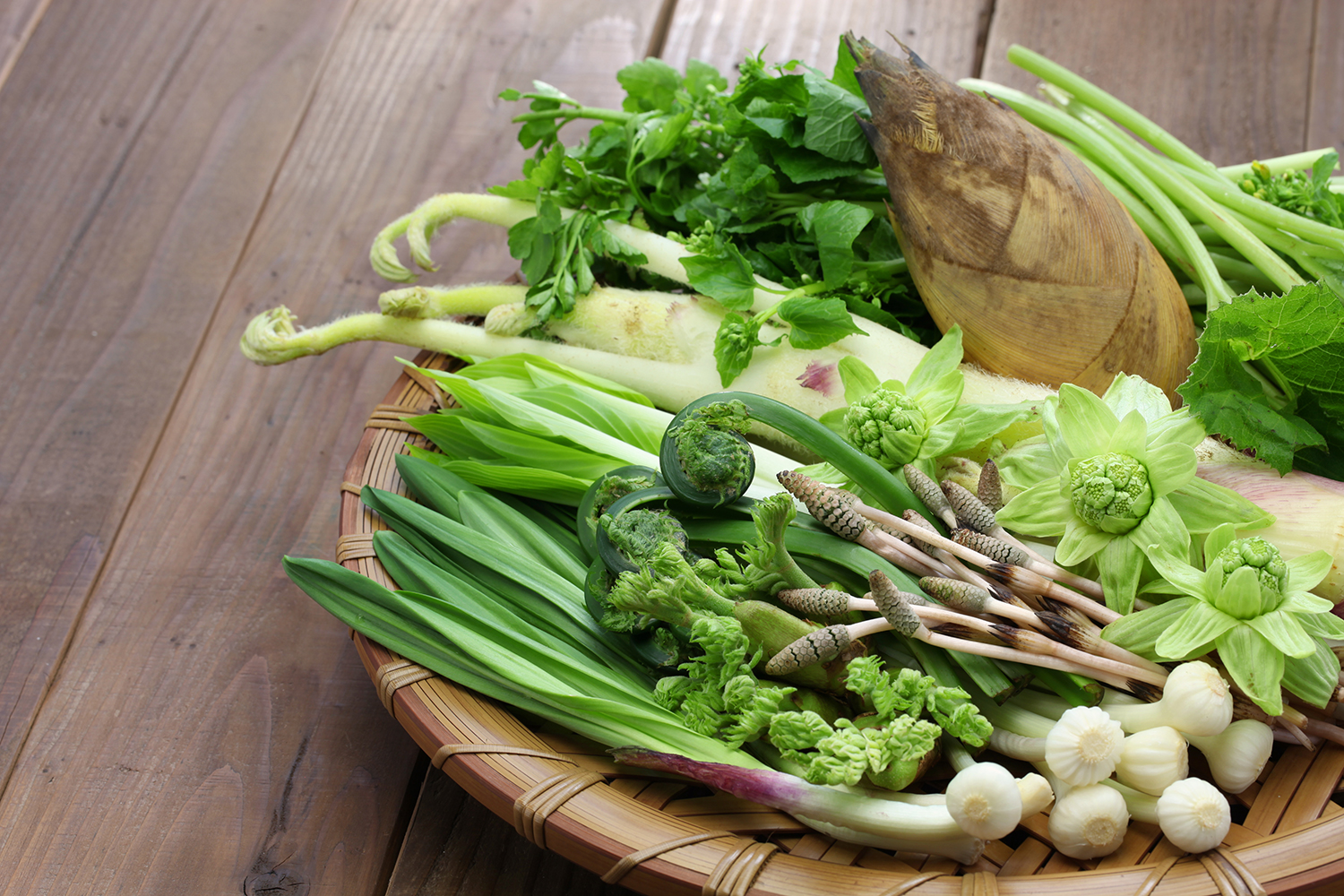
Sansai. n. ‘mountain vegetables’ from Japanese.
Sansai grow wild in marshlands, and grasslands, or in the forest. Japanese people have been gathering wild food to cook with since ancient times. In fact, wild plants or Sansai have helped Japanese when food has been scarce because of drought or some other natural disaster.
When food was in short supply after the Second World War, city-dwellers scoured the hills for tasty Sansai such as Warabi (bracken), Tara-no-me (angelica) and Kogomi (a type of fern).
Renkon: Lotus Root
Japanese Sansai like renkon or lotus root is found in many traditional Japanese dishes. Bamboo shoots are also another familiar wild food. In June, many people go on Sansai expeditions and can be very secretive about where their favourite wild foods grow. Japanese angelica buds are known as the King of Sansai’.

Yabu Kanzō: a day lily found in early spring. You can cook this in a soup or make tempura with it.
Fuki (Butterbur): is a bitter but versatile plant that looks a bit like rhubarb and has soft fat stems. You can cook it with miso and rice.
Mitsuba: A Sansai found in springtime with a similar flavour to parsley and used in soups and salads.
Zenmai (Japanese Royal Fern): is high in potassium and vitamins A and C. It is usually fried and served as a side dish with wild sesame.
Warabi: a fern that grows in the forest, you can eat the stems and make starch from the roots. There is a delicious chewy summer pudding called warabimochi.
Azami: a popular sansai in summer. This can be eaten with miso soup or pickled as a preserve.
[Pictured: Aralia elata, the Japanese angelica tree, Wikipedia]
Extracted from Shinrin-Yoku: The Art and Science of Forest Bathing by Dr Qing Li
Book Review: Shinrin-Yoku: The Art and Science of Forest Bathing by Dr Qing Li
[Pictured: Ryoan-Ji zen garden in Arashiyama, Kyoto. Content Catnip 2018]
 Content Catnip
I was macrobiotic for a whole year.
LikeLiked by 1 person
Really!? How was it did it improve your health?
LikeLiked by 1 person
It was amazing. I used to bound out of bed in the morning. Lost all excess weight.
But the diet really isolated me because I wasn’t able to eat normal food. G
LikeLiked by 1 person
It sounds amazing well done on doing that…it takes a lot of discipline. I share a lot of healthy food here but it’s more about motivating myself to do better. I admit I have a weakness for fried food, although there is a lot to be said for tasty healthy food too. My fav cuisine is middle eastern and Indian a lot of naturally vegan and incredibly tasty foods there without skimping on flavour, what is your dav cuisine? 😅
LikeLiked by 1 person
Fav cusine
LikeLike
Why weren’t you able to eat normal food?
LikeLiked by 1 person
Because I was macrobiotic
LikeLiked by 1 person
Those veggies look absolutely delicious! Too bad it’s hard to find them outside of Japan. I’d love to try them. The mochi dish also sounds great! I love daifuku and mochi!
LikeLiked by 1 person
Thank you Fedora for the comment 🙏 😊 I wish you could try them and I hope you will one day. You are right they are not found in other countries (I don’t think?) I had the pleasure of having some mountain veg in the town of Kagurazaka a few years ago and had the veg in a hot pot and they were so sweet and such strange strong flavours this kick started my obsession with these vegetables I hope to one day go back there to have them again. Daifuku and mochi
…yum yum! 😋
LikeLiked by 1 person
At least one can find mochi and daifuku easily everywhere. Lots of Asian stores in every country as far as I know.
LikeLiked by 1 person
Yes that’s true 👍
LikeLiked by 1 person