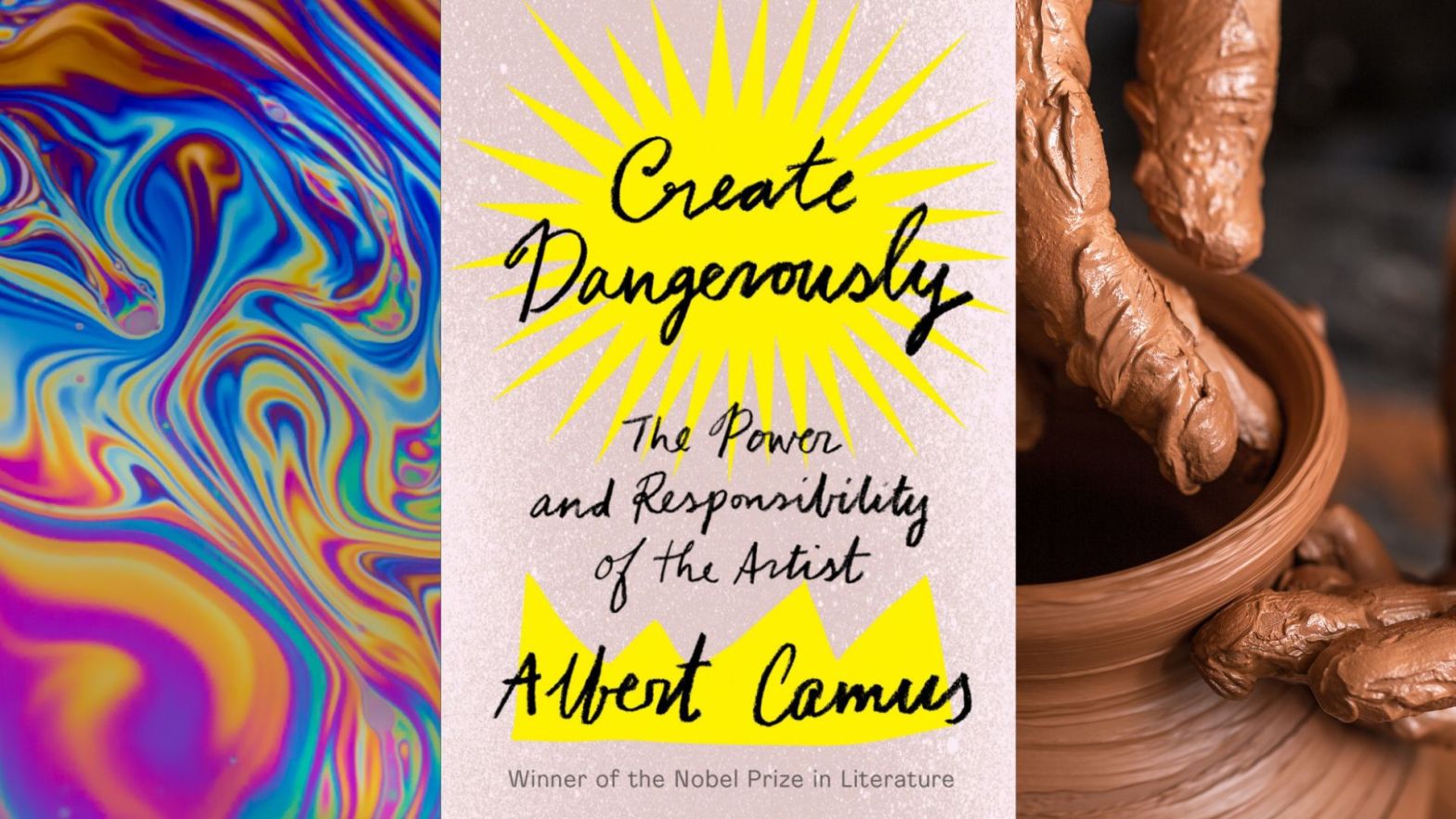
An electrifying and timeless book of ideas about how artists can resist and overcome the forces of fascism written by one of the greats of the 20th Century who created a massive body of work and actively resisted Nazism.
Rating: 🌟🌟🌟🌟🌟
Genre: Essays, Non-Fiction, Politics, Art
Publisher: Vintage
Review in one word: Electrifying
I read L’Etranger by Camus when I was at Uni and remember enjoying it but finding it deeply bleak and sad. Up until now, that’s all I knew about Camus. So this deep-dive into his philosophical heart and soul was a complete revelation.
“Create Dangerously” is a short book of essays written in the 1950s. Yet its snappy insights feel immediately applicable to the current state of our world in 2025 and beyond. Camus touches on weighty topics like the role and responsibility of the artist, resisting fascism through artistic expression and rebellion, human freedom, love, beauty and despair.
Camus wrote “Create Dangerously” following WWII at a time when artists (and the whole world) was recovering from the worst of fascist extremism and death. In our time of ever-greater constrictions on women’s rights, gay rights and the creation of an ‘alternative truth’, pervasive online misinformation and ridiculous conspiracy theories, this book is just as relevant now as it was back then.
Albert Camus (1913–1960) was a French-Algerian philosopher, author, and journalist and his insightful works of fiction and non-fiction are widely regarded as one of the most influential of the 20th century. His ideas were often affiliated or connected to the ideas of Sartre and the Existentialist movement.
Overarching theme of this book (from what I can gather) is that the responsibility of all artists is to rebel and resist against fascism. That all great works of art and beauty cannot be corrupted by hatred and fascism. It is notable that during WWII Camus founded and worked for an underground newspaper called Combat which documented the resistance movement in France.
He explicitly rejects nihilism and instead calls for active participation from artists and creatives of all kinds towards the pursuit of justice and solidarity. He does not advocate for a withdrawal from the world and living some hermetic ascetic existence in order to make art. Instead he says people should revel and enjoy the material existence of the world and its earthly pleasures. Also that we are obligated to actively participate and engage with the world, in order to create beauty and art to counterbalance the forces of evil and fascism in the world.
I loved this short book of essays so much and I’ve excerpted several key ideas and quotes from “Create Dangerously” for you to enjoy in the coming months. I hope you will seek out this book and enjoy it. Buy it online
“Consumer society can be defined as a society in which objects disappear and are replaced by symbols. When the ruling class no longer measures its wealth in acres of land or gold bars, but rather by how many digits ideally correspond to a certain number of financial transactions, then that society immediately links itself to a certain kind of trickery at the very heart of its experience and its world. A society based on symbols is, in its essence, an artificial society in which the physical truth of humankind becomes a hoax.”
Create Dangerously: The Power and Responsibility of the Artist, Albert Camus
“Brutality is never temporary. It does not respect the boundaries set for it, and so it is natural that brutality will spread, first corrupting art, then life. Then, out of the misfortunes and bloodshed of humankind, we see born insignificant literature, frivolous newspapers, photographed portraits, and youth-club plays in which hatred replaces religion. Art then ends up in forced optimism, which is precisely the worst of indulgences, and the most pathetic of lies.”
Create Dangerously: The Power and Responsibility of the Artist, Albert Camus
“Artists are the perpetual defenders of living creatures, precisely because those creatures are alive. They truly advocate to love whoever is close by right now, and not those far in the future, which is what debases contemporary humanism, turning it into a catechism of the courthouse. Quite the reverse: a great work of art ends up baffling all the judges. At the same time, through such great works, artists give homage to the finest example of humankind and bow down to the worst criminals. As Oscar Wilde wrote from prison: “There is not a single man among these unfortunate people locked up with me in this miserable place who does not have a symbolic relationship with the secret of life. Yes, and that secret of life coincides with the secret of art.”
‘Create Dangerously: The Power and Responsibility of the Artist’ by Albert Camus.
“If art does not control itself, it descends into madness and is enslaved by its own illusions. The most liberated form of art, and the most rebellious, will thus be the most enduring; it will glorify the greatest effort. If a society and its artists do not accept this long, liberating task, if they yield to the comforts of entertainment or conformity, to the diversions of art for art’s sake or the moralizing of realistic art, its artists will remain entrenched in nihilism and sterility. Saying this means that a rebirth in art today depends on our courage and our desire to see clearly.”
‘Create Dangerously: The Power and Responsibility of the Artist’ by Albert Camus.
 Content Catnip
“Create Dangerously” is such a wonderful title – fabulous review – I’ll have to try to make time to read it! Thanks for the tip, Linda xx
LikeLiked by 1 person