
Two hours of cute nudibranches and chill out tunes
Giant cuttlefish! They are in danger and scientists are going to save them with … bubbles!

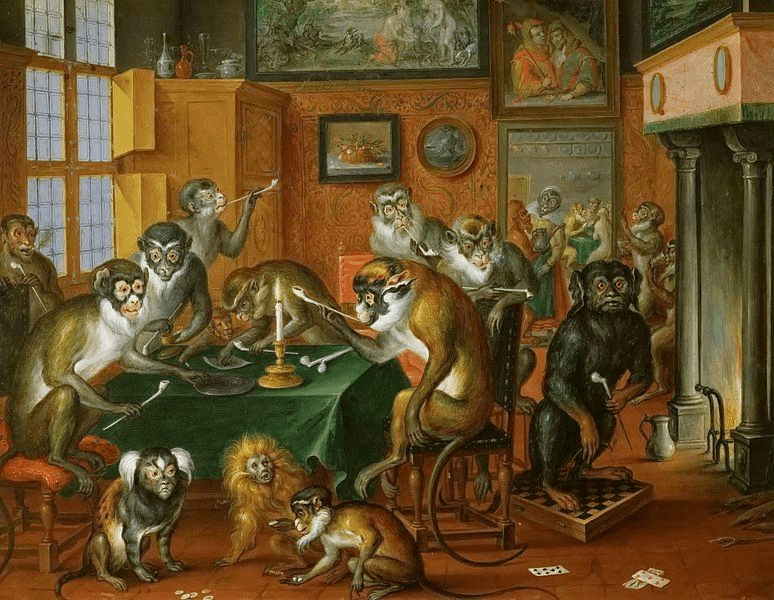
Tobacco Club by Abraham Teniers (mid-17th century)
Singerie — from the French for “Monkey Trick” — is a genre of art in which monkeys are depicted mimicking human behaviour. Via Public Domain Review
SPF 50+ claims verus reality in sunscreens
16 out of 20 sunscreens fail to meet their lofty claims of being 50+ SPF. Sunscreens are an essential if you live in Australia or New Zealand as the UV here is diabolical and skin cancer is very common, even for people with olive skin. See full infographic. The study was conducted by the Therapeutic Goods Ad

The Metaphysical Foundations of Buddhism
Owen Flanagan explores how Buddhism reconciles meaning and science — without a creator, a soul, or supernatural scaffolding.

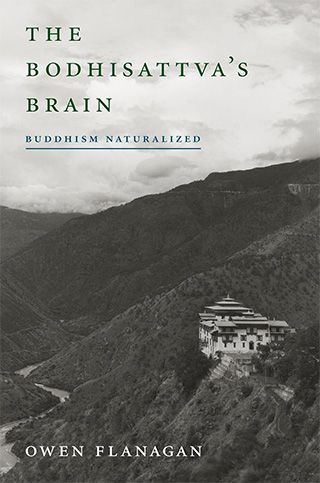
By: Owen Flanagan via MIT Press Reader
In “The Bodhisattva’s Brain: Buddhism Naturalized,” philosopher Owen Flanagan explores whether a major spiritual tradition can be reconciled with a thoroughly scientific worldview. Rejecting supernaturalism, Flanagan presents a version of Buddhism that remains both ethically serious and existentially rich, while remaining fully compatible with contemporary science and philosophy. In the excerpt that follows, he examines how Buddhism diverges sharply from theistic traditions by denying the existence of a creator God and a permanent self. Drawing on metaphysical concepts like dependent origination and anatman (no-self), he argues that these doctrines not only make internal sense within Buddhist thought but also resonate with modern scientific understandings of consciousness and the cosmos.
Buddhism originated in 500 BCE when Siddhartha Gautama, or simply Buddha, gave his inaugural address at Deer Park, near the outskirts of Benares, India (now called Varanasi). Depending on how one understands the orthodox Vedic or Indic spiritual tradition of that time, Buddhism was either a complete break with that tradition or a development of it.1 Buddhism rejects the caste system on ethical grounds. More interesting to those who think of religion as requiring belief in divinity, Buddhism rejects both the idea of a creator God and an immutable, indestructible soul (atman), on logical and empirical grounds.
That said, traditional Buddhism is chock full of ghosts, spirits, devils, deities, heaven and hell realms, and rebirths according to karmic laws that govern the universe. Even if contemporary secular Westerners see Buddhism as compatible with Enlightenment philosophy, many Asian Buddhists, especially the Tibetan variety, do not.
Buddhism rejects the reigning Vedic conception of Brahman as the prime mover,2 and it also rejects the idea that each individual houses an unchanging self or soul. Beyond this, many familiar Indian ideas are retained and developed in Buddhism — although, in certain quarters, and only recently, with hesitancy. This legacy includes the deep importance of the appearance-reality distinction, the idea of reward for virtuous action (karma), the idea that suffering (dukkha) defines the human predicament (samsara) and that liberation is possible (nirvana) through enlightenment (panna; Sanskrit: prajna, bodhi) and virtue (sila, karuna), as well as the ideas of reincarnation or rebirth.
Let me stick with the two metaphysical beliefs that Buddhism rejects: a creator God and a permanent self or soul. First, Buddhism sees right through the familiar problems with cosmological and design arguments for the existence of God. Such arguments beg the question of the origin of the creator or designer. To say that the prime mover always was or is self-creating and self-sustaining is to accept the infinite regress of causes (this one a causa sui) that such arguments are designed to make evaporate, which they reject as a possibility. If God always is and shall be, then God itself is infinitely regressive.
When the Dalai Lama listens to the story of the Big Bang occurring 14 billion years ago, he says fine “but not, of course, the first Big Bang.” This response is hardly a rejection of our theory of the Big Bang. The Dalai Lama sees the Big Bang theory as itself inadequate because it is not deeply causal enough. Some scientists themselves are now wondering if a better story doesn’t involve less of a singular, original bang than an origin for this universe that involves an open wormhole from another parallel universe, with these other universes or their ancestors — possibly comrades in a vast, even infinite, multiverse — being beginningless.
Buddhism sees right through the familiar problems with cosmological and design arguments for the existence of God.
Cosmologists will sometimes say one can’t ask what there was before the singularity banged or how the singularity got there. What they mean is that “time,” as physics understands it, begins (or becomes a useful concept) with the Big Bang. But this hardly makes the sense behind the question go away. Thus other cosmologists will admit the legitimacy of the question and say they have no clue as to how to answer it. Buddhism is comfortable with an infinite regress of natural causes. Indeed, the idea fits well with the metaphysical idea of dependent origination, according to which everything that happens depends on other things happening.3
The rejection of the Vedic (Indic) doctrine of atman, the idea that humans are possessors of an immutable, indestructible self or soul, comes from two lines of thought. First, there is the idea of dependent origination that I have just mentioned. Everything is in flux and all change is explained by prior change. The principle is universal and thus applies to mind. Next bring in experience or phenomenology: One will see that what one calls “the self” is like many other natural things, partaking of certain relations of continuity and connectedness. My conscious being is much more streamlike than it is like Mount Everest (which is also part of the flux, just less visibly so). Conventional speech allows us to reidentify each person by her name as if she is exactly the same over time.
But in fact identity is not an all-or-nothing thing. Personhood is one kind of unfolding. The Himalayas are a very slow unfolding (one answer to how long it takes to reach final enlightenment is as long as it would take for a mountain range 84,000 times larger that the Himalayas to erode if touched once a day with a soft cloth!); humans are a faster unfolding than the ordinary Himalayas; drosophila unfold much more quickly. Each kind of thing in the cosmos is an unfolding in the cosmos, the eternal Mother of all unfoldings, and has a temporal span during which it can be said to be what it is — a mountain range, a person, a fruit fly — and after which it ceases to have enough integrity to be said to be the same thing, itself. At such a transition point, we say the thing, event, or process is gone, over, dead, that it has passed, passed on, or passed away.
This is the doctrine of anatman, no-self. Nothing is permanent, even things that seem so, aren’t. If properly understood the view is not nihilistic. One of my students once asked in a very disturbed manner, “If I am not myself who the fuck am I?” I am happy to report that further therapy about the meaning of the doctrine of anatman calmed him. Indeed, in the West a very similar view is widely held from Locke to the present. And it fits nicely with contemporary mind science. Furthermore, the doctrine of anatman suits Buddhist ideas that persons can in fact transform themselves, become enlightened, and so on. If one’s nature is, as it were, immutably fixed, it is hard to see how self-transformation is possible.
Twisting Tradition: Medieval Cats, Dead Dad Pots and the Ceramics of Vicky Lindo & Bill Brookes
Zeta Reticula – EP 2
A real electropunk banger that still hits just as hard now as it did back in the early 00’s, from Dave Clarke’s World Service, a classic of Techno and Electro.
The RAIN resilience method by Tara Brach phD
“In her book Radical Compassion, mindfulness educator Tara Brach, PhD, describes a practice called RAIN, which can help you manage difficult emotions and avoid being hijacked by them.”
.“R: Recognize what is happening. Bring to mind a difficulty you’re experiencing. Looking inward, ask yourself: What’s my inner experience? What’s here right now? What’s calling for my attention? Let yourself recognize whatever is present, whether it’s fear, anger, sadness, or any other feeling.
A: Allow the experience. Next, see if you can allow the feelings to be present just as they are. This can feel difficult, and you may worry that you’ll be overwhelmed by the feelings. Your mind may begin judging, fixing, problem-solving. Your task, though, is to simply let what’s here be here. Remind yourself that you are safe, and that you can handle whatever arises. Remind yourself that all feelings pass.
I: Investigate with interest and care. Now explore what’s going on in your body as you consider this difficulty. With a sense of curiosity, check in with yourself, as kindly and gently as you can. Scan yourself slowly from head to toe, and note if there are areas of tightness or tension, warmth or ease. See if you can greet whatever you find with compassion.
N: Nurture with self-compassion. Finally, bring nurturance to your entire experience. Imagine a loving presence who’s telling you, “It’s okay. You’ll be all right. I’m here for you.” This may be yourself, a beloved person, or a spiritual entity. It could be a scene from nature or simply a sense of light and ease. Take a few slow deep breaths, taking in this sense of comfort and care.
Having done this exercise, notice any shifts in your physical state. Notice whether you feel calmer. Let yourself sit still for another minute or two and rest, taking in this state rather than quickly jumping back into your day. You may feel like you’ve had a very gentle rain wash over you.”
‘The epitome of amazingness’: how electroclash brought glamour, filth and fun back to 00’s music
Witty, foul-mouthed, camp and punky, it was the 00s answer to slick superclubs and the rock patriarchy. As its rough, raw sound returns, the scene’s eyeliner-ed heroes, from Peaches to Jonny Slut, relive its excesses.
Adult. – Hand To Phone (Cordless Mix)
Jonny Melton knew that his club night Nag Nag Nag had reached some kind of tipping point when he peered out of the DJ booth and spotted Cilla Black on the dancefloor. “I think that’s the only time I got really excited,” he laughs. “I was playing the Tobi Neumann remix of Khia’s My Neck, My Back, too – ‘my neck, my back, lick my pussy and my crack’ – and there was Cilla, grooving on down. You know, it’s not Bobby Gillespie or Gwen Stefani, it’s fucking Cilla Black. I’ve got no idea how she ended up there, but I’ve heard since that she was apparently a bit of a party animal.”
Dave Clarke – World Service Side 2, Electro (1999)
It seems fair to say that a visit from Our Cilla was not what Melton expected when he started Nag Nag Nag in London in 2002. A former member of 80s goth band Specimen who DJed under the name Jonny Slut, he’d been inspired by a fresh wave of electronic music synchronously appearing in different locations around the world. Germany had feminist collective Chicks on Speed and DJ Hell with his groundbreaking label International DeeJay Gigolos. France produced Miss Kittin and The Hacker, Vitalic and Electrosexual. Britain spawned icy electro-pop quartet Ladytron and noisy, sex-obsessed trio Add N To (X). Canada spawned Tiga and Merrill Nisker, who abandoned the alt-rock sound of her debut album Fancypants Hoodlum and, with the aid of a Roland MC-505 “groovebox”, reinvented herself as Peaches. New York had performance art inspired duo Fischerspooner and a collection of artists centred around DJ and producer Larry Tee, who gave the sound a name: electroclash.
The lyrics tended to be witty, occasionally foul-mouthed and very camp. The sound had house music, techno, 80s synth-pop and electro in its DNA, but boasted a rough-hewn, punky edge, the latter partly down to attitude and partly down to the era’s technological advances. “It isn’t like today, where you can take an idea to a playable version in five hours on a laptop,” says Larry Tee, “but you could record something releasable in your bedroom, you could get a Juno 106 [synthesizer] and alter the sounds and fry and burn them. I’m convinced the best electroclash tracks happened because people made mistakes, the levels were too loud or there was something wrong.”

It was audibly a reaction to something. In Britain, it felt a world apart from the increasingly slick dance scene of superclubs and superstar DJs. In New York, Larry Tee suggests it was a shift away from “trance and tribal house”. For Peaches, who had recorded her 2000 album The Teaches of Peaches in her bedroom, “lying in bed, smoking weed, masturbating and making beats”, it was music made by “marginalised, queer people … who were fed up with a system that was telling us ‘rock music has to be by four beautiful boys down the line from the Rolling Stones, electronic music has to be completely serious like you’re doing brain surgery while turning buttons’. Where was the punk? And for me, I can’t think of another time in music history where women were so at the forefront – Chicks on Speed, Miss Kittin, Tracy + the Plastics. It’s always like, ‘This dude did this’, you know?”
Whatever it was an answer to – superclubs or rock’s traditional patriarchy – electroclash seemed to find an audience quickly. It wasn’t the only music Melton and his fellow DJs played at Nag Nag Nag – as underlined by a new 5CD box set, When the 2000s Clashed, they were equally wont to drop old punk singles, early industrial music or the Neptunes’ exploratory R&B – but electroclash was the club’s sonic backbone, and the night was an immediate success. Boosted by approving reviews first in the gay press, then the style magazines, its initial clientele – “a few old goths and some art students in their mum’s old curtains,” according to Melton – were soon joined by a succession of celebrities: Kate Moss, Alexander McQueen, Pet Shop Boys, Boy George, Björk. Perhaps inevitably, it attracted comparisons to celebrated New Romantic hangout the Blitz. “But there was no door policy, no guest list,” demurs Melton. “I didn’t want any of that exclusivity shit. It wasn’t posey at all, there was more a feeling of abandon. It was very hedonistic.”
“It was the epitome of amazingness, this incredible melting pot of every kind of character,” says Concetta Kirschner, better known as rapper Princess Superstar, who turned up at Nag Nag Nag while promoting her 2002 UK hit Bad Babysitter. The club had an immediate impact on her sound. “It gave me a shot of freedom. I felt like there were a lot of tightly defined rules in hip-hop. But after Nag Nag Nag, I felt I could experiment, be whatever I wanted, rap over dance music or crazy new rhythms.”

The newly electroclash-adjacent Princess Superstar had a Top 3 hit with Perfect (Exceeder), a collaboration with Dutch producer Mason, but it was the exception that proved the rule. For all the excitement and press coverage it generated, electroclash noticeably failed to produce a major crossover star, although it wasn’t for want of trying in some quarters. The Ministry of Sound’s record label famously spent vast sums signing New York duo Fischerspooner, but their debut album #1 failed to catch light. “Electroclash didn’t work in hygienic conditions,” offers Mark Wood, a DJ and Nag regular behind the new box set. “It worked in clubs that were dark, hot, grubby, full of smoke, all sorts of things going on.”
Peaches, meanwhile, went out on tour as a support to hard rock artists, including Marilyn Manson and Queens of the Stone Age: their audiences, she says, were “horrified”. “I think a lot of [electroclash artists] were offered these more traditional tours and thought ‘I can’t handle it’. On the Marilyn Manson tour I was spat on every night, but I rapidly developed some prank skills and some great one-liners.”
But in Britain at least, electroclash entered the mainstream regardless, audibly impacting on the way existing pop stars sounded. Sugababes rebooted their career with Freak Like Me, a Richard X-produced reimagining of the old Adina Howard hit backed by the music from Tubeway Army’s Are Friends Electric? Another Richard X mashup, Being Nobody, which melded Rufus and Chaka Khan’s Ain’t Nobody with the Human League’s Being Boiled, was a Top 3 hit for Popstars runners-up Liberty X. You could hear echoes of electroclash in Goldfrapp’s platinum-selling 2003 album Black Cherry, Rachel Stevens’ 2004 hit Some Girls and Madonna’s 2005 album Confessions on a Dance Floor. Even Fischerspooner ended up on Top of the Pops, in the company of Kylie Minogue, performing their remix of Come Into My World.
It was girls, gays and theys – and the music industry didn’t invest in those categories
In America, however, the movement provoked a backlash. “It was unfairly beaten up after three or four years,” says Larry Tee. “Electroclash was girls, gays and theys, the music industry didn’t really invest in those three categories, and I think they were as anxious to kill it as they were disco. I think the reason they wanted to burn electroclash so fast is that it didn’t really include that soccer bro culture, which EDM did.”
Nag Nag Nag eventually closed its doors in 2008 – the club that hosted it, Ghetto, was demolished to make way for the Crossrail development. It seemed symbolic of the end of something bigger than electroclash. “It was Soho’s last stand as a grubby nightclub place – that’s all literally gone, everything moved east,” says Wood. “It was around the same time that smartphones arrived, which changed everything too. All that happened around the same time electroclash was being put to bed. Nothing lasts for ever if it’s worth having in pop music.”
But recently, Jonny Melton noticed something odd. He was being sent new dance tracks that self-described as electroclash, while club nights, including London’s Shackled By Lust and Bloghouse, also use the term to describe what’s on offer. “That would never have happened before,” he laughs. “At the time electroclash was like goth – no one who was in a goth a band would ever admit to being a goth band.”
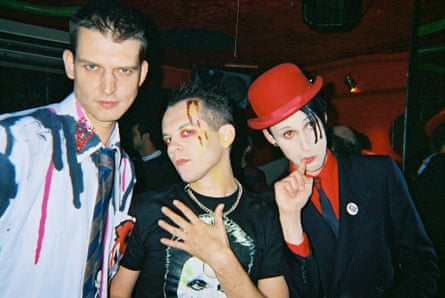
Meanwhile, in 2023, Peaches embarked on a tour performing her debut album: it was both rapturously received and attracted an audience noticeably big on twentysomethings too young to remember its release. Princess Superstar, whose “career sort of died” in the 2010s, has watched with baffled delight as her electroclash-era hits unexpectedly enjoyed a new lease of life. First, Perfect (Exceeder) belatedly went gold in the US after it was used on the soundtrack of the 2023 movie Saltburn. Then, last year, her 2008 collaboration with Larry Tee, Licky, unexpectedly went viral on TikTok. “I think they thought it was by Britney Spears,” she says. “So I put a video up like, ‘Hey dudes’ and it all went crazy.”
She’s currently making new music, some of it in collaboration with Frost Children, a US duo among a wave of younger artists who bear the influence of electroclash: you can hear its strains in Snow Strippers, Confidence Man and the Dare. Larry Tee, who’s currently planning an electroclash documentary, suggests there’s an influence in the music of both Lady Gaga and Charli xcx’s Brat.
The music on When the 2000s Clashed still sounds remarkably fresh. Perhaps that fact that most of it remained underground, never dominating the singles chart or the radio playlists helped; so too does the fact that it’s informed by a lot of ideas that were subsequently mainstreamed: it was gender fluid before anyone talked about gender fluidity, sex-positive before anyone used that term either. “I think the younger generation get it,” nods Larry Tee, “because it was like the resistance: we’ve had enough of homophobia, enough of misogyny. For a moment, the door was open.”
When the 2000s Clashed: Machine Music for a New Millennium is out on 17 October on Demon/Edsel
Crispy Korean Pancakes by Nagi
Looks easy enough…might give them a go
Masterpiece of Craftsmanship: Traditional Cloisonné Enamel Kettle | Intangible Cultural Heritage
Did you enjoy this collection? let me know what you think of it below. Thank you for reading my dear friends!
 Content Catnip
Not surprised about sunscreen.
I’m a Dave Clark fan. I have all his catalog.
LikeLiked by 1 person
Yeah the sunscreen thing really made me angry when I read about it, how many people got skin cancer because of their negligence? I hope they will regulate and test it better in the future. I think it’s so cool you enjoy a lot of the same music as me. How did you find Dave Clarke and discover his music? Were you into techno and going to parties?
LikeLiked by 1 person
Yes. In the 90s I went regularly.
LikeLiked by 1 person
A lovely round up of what’s out there online. You never know what’s out there. The sunscreen one is an interesting topic for discussion, and it makes you think of the ethics behind science and marketing. It makes you wonder what’s true or not all that true when it comes to seeing such claims anymore. Testing benchmarks are also another thing altogether – and there will always be different kinds of benchmarks when it comes to testing.
I like how you contrasted this post with more philosophical notes. Radical Compassion sounds like an interesting read. Emotions can get the better of us sometimes and it’s helpful to lean into being non-reaction and instead explore what’s going on. ‘Allow the experience’ sounds very helpful too where you accept your feelings as opposed judging them, and staying grounded.
Thanks for sharing Nagi’s Korean pancakes. I’ve followed Nagi’s recipes here and there. Always very delicious and not that hard to make. Hope you are doing well, Athena 🙂
LikeLiked by 1 person
It’s always so nice to hear from you dear Mabel thanks for stopping by. Sorry for the delay in replying to you, it has been a busy week. Very true your observations about the marketing of sunscreens in Australia, I’m really glad the consumer watchdog will look at them more closely. The other day I got three bottles from Priceline of the winner of the tests, Cancer Council Kids 50+, which actually measures up to spf 50+ which is great news, I recommend this…I guess because its for kids they cant muck around so much with the chemicals.
LikeLiked by 1 person
Thanks so much for reading the long read about radical compassion too I really liked your insights on this especially ‘allow the experience’ this is such good advice isn’t it! I try and put this into practice and I have to admit, doing it makes me much calmer, when I remember to just stop and do nothing. I’m so glad you like Nagi, I’m a huge fan of her recipes and her as a person, she has a very vibrant and warm energy also she has a cheeky dog. I wrote her and email recently. In it basically I said she doesn’t need to have a male chef side-kick to make her look good (recently she has been showcasing one of her staff members who is a French pastry chef) I said..that she’s already amazing as a great cook who makes great and easy to make food and doesn’t need to change or impress anyone. I hope she took this the right way though…she has a light and a charisma I admire. Sometimes we women think we need to be more to be “legitimate” but it’s not true, we are already awesome
LikeLike
I think the more we make something a habit, the more we can see growth. Like you I follow Nagi and see her featuring her team including the French pastry chef! Nagi is an amazing cook and personality as is, and has built her light and worth over the years by being authentic. I like to think she elevates others, and her team elevates her too and brings another dimension to what she stands for 😊💕
LikeLiked by 1 person
loving the monkey party painting – not so much love for the years of applying expensive SPF products that weren’t working… grrr… (have a great week!) Linda xx
LikeLiked by 2 people
Hi Linda thank you so much for stopping by and having a read! Yes I agree aren’t those monkeys delightful…I always find the chaotic, silly and loud energy of monkeys very enjoyable to watch so maybe they are my spirit animal hehe what about you? Yes the sunscreen situation is annoying…they tell us to apply it but dont test or regulate it properly which is disgraceful, I hope now that you know you’ll find a good one from that list take care
LikeLiked by 1 person
I think the most upsetting thing about the suncream was that it made me realize how much we just assume that other people are looking after our best interests, to realize that they are after money not safety made me feel betrayed and very sad (but not entirely surprised – which in itself was sadder still). Sending lots of healthy sun-shiney vibes your way! L 🌞
LikeLiked by 1 person