

Wholesome Meme: Appreciate Where You Are Now

Rare Historical Photo: African American maid, does the food for the family who employs her, 1950s. kodachrome shot
It wasn’t so long ago was it? It explains a lot about why the racists are in power there now, the people in this image and their children are still alive. This is the nostalgic idyll that the racists in America desire, a return to this segregated, two tiered society. A mythical idyll of white supremacy is also what the Nazis longed for, we all know what happened after that. Via Reddit

Archaeologists compared the size of 50,000 ancient houses to learn about history of inequality, they found that it’s not inevitable
We’re living in a period where the gap between rich and poor is dramatic, and it’s continuing to widen. But inequality is nothing new. In a new study published in the journal PNAS, researchers compared house size distributions from more than 1,000 sites around the world, covering the last 10,000 years. They found that while inequality is widespread throughout human history, it’s not inevitable, nor is it expressed to the same degree at every place and time.
“This paper is part of a larger study in which over 50,000 houses have been analyzed to use differentials in house sizes as a metric for wealth inequality over time, on six continents,” says Gary Feinman, the MacArthur Curator of Mesoamerican, Central American, and East Asian Anthropology at the Field Museum in Chicago, and the paper’s lead author. “This is an unprecedented data set in archaeology, and it allows us to empirically and systematically look at patterns of inequality over time.”
The paper Feinman led delves into a comparison of the extent of inequality at different localities (mostly archaeological) to figure out how things changed over time. “While there is not one unilinear sequence of change in wealth inequality over time, there are interpretable patterns and trends that cross-cut time and space. What we see is not just noise or chaos,” says Feinman.
The variation that the researchers found challenges long-held views across history and the social sciences that we can use ancient Greece and Rome, or the medieval history of Europe as generalized representations of humanity’s past. “There are a lot of things that have been presumed for centuries — for example, that inequality rises inevitably,” says Feinman. “The traditional thinking expects that once you get larger societies with formal leaders, or once you have farming, inequality is going to go way up. These ideas have been held for hundreds of years, and what we find is that it’s more complicated than that — high degrees of inequality are not inevitable in large societies. There are factors that may make it easier to happen or increase to high degrees, but these factors can be leveled off or modified by different human decisions and institutions.”
“Variability in the sizes of houses may not be the full extent of wealth differences, but it’s a consistent indicator of the degree of economic inequality that can be applied across time and space,” says Feinman. “I know from my own archaeological fieldwork in the Valley of Oaxaca, Mexico, that almost always, the larger the house, the more elaborate the house, with special features and thicker walls.”
To quantify and compare economic inequality in different places, at different points in history, the researchers used the variable distributions of house sizes at more than 1000 settlements to calculate a Gini coefficient for each site conducted statistical analyses in which they examined the relationship between the amount of inequality in a society and the political complexity of that society. The Gini coefficient is a commonly employed metric to assess inequality that ranges between 0 (complete equality) and 1 (maximal inequality).The coefficients for each locality were then compared across time and space to examine trends in inequality and assess how it varied in relation to population, political organization, and other potential causal factors.
The investigators then looked at these trends in the Gini values in the context of the size of the sites that were compared and how complex the hierarchical structure of governance was. They found that even while populations have risen over the years, inequality hasn’t always increased in a uniform way.
“The measure of inequality we found in these sites is quite variable, which suggests that there’s not one homogenized pattern,” says Feinman. In other words, contrary to traditional scholarly thinking, there’s no one-size-fits-all explanation for why societies become economically unequal.
“Human choice and governance and cooperation have played a role in damping down inequality at certain times and places, and that is what accounts for this variability in time and space,” says Feinman. “And if inequality isn’t inevitable when human aggregations get larger and governmental structures get more hierarchical, then there is a suite of implications for how we view the present and how we look at the past. Although history has shown us that elements of technology and population growth can raise the potential for inequality at certain times and places, that potential is not always realized, as people have implemented leveling mechanisms and systems of governance that mute that potential. The often-expressed views that certain economic, demographic, or technological conditions or factors make great wealth disparities inevitable simply are not borne out by our global past.”
Celebrating a 1940s lifestyle to help get through the lean times
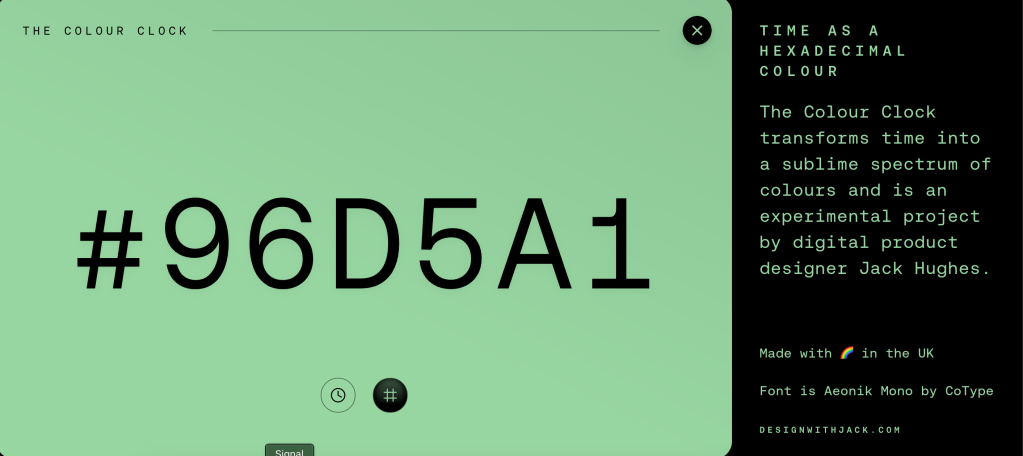
The Colour Clock: Time as a Hexidecimal Colour by Jack Hughes
The Colour Clock is an experimental project by London-based digital designer Jack Hughes that transforms time into a visual experience by representing each second of the day as a unique hexadecimal color. By mapping the current time—hours, minutes, and seconds—to corresponding RGB color values, the clock creates a dynamic spectrum that shifts subtly every moment. This innovative fusion of timekeeping and color theory offers a mesmerizing way to perceive the passage of time, as the background color transitions through over 16 million hues daily.
Where did cringy corporate jargon come from?
These words and phrases are all so common-place that it’s difficult to not use them. I sometimes find them cringey and sometimes I find them enjoyable to use. Their history and where they all came from is fascinating!
Take a trip back to the ye olde internet of the early 90s
Old’aVista is a search engine indexing early personal websites plus Yahoo directory listings from 1996 to 2003. Via Mastodon.

★ 4K 🇨🇭 St-Triphon – Lausanne – Basel cab ride [10.2021] Führerstandsmitfahrt Swiss train
Lovely armchair travel from one part of Switzerland to another
The ska group Madness were very popular in Japanese Honda adverts in the 70s
Honda Civics were super reliable I have to say, never stopped moving no matter how old they got…
Cosy ASMR cottage core
I love this cosy channel and it’s wonderful vibes of simple homely joy!
16 Whimsical and Kitsch Fruit Bus Stops in Nagasaki Japan
Whimsical, nostalgic and bursting with charm, Nagasaki’s fruit-shaped bus stops are a slice of pure fairy-tale kitsch. Dreamed up after the 1990 Travel Expo and inspired by Cinderella’s pumpkin carriage, these roadside delights were designed to make travellers smile. Found along Route 207 between Konagai and Isahaya, 16 playful shelters shaped like giant strawberries, melons, oranges, tomatoes and watermelons invite you to slow down and soak up Japan’s rural agrarian magic. A charming detour for the offbeat explorer and the Instagram-happy wanderer alike—because who wouldn’t want to wait for the bus inside a tomato? Via TimeOut



Did you enjoy this collection? let me know what you think of it below. Thank you for reading my dear friends!


The fruit bus stops are delightful! As was the 90s internet… what a trip!!
LikeLiked by 1 person
Such cute bus stops! Also that video about the woman living like it’s the 1940’s has been in my Youtube feed forever, but I’ve never watched it. Perhaps this is a sign that I should?
LikeLiked by 3 people