This week, #alien enigmas in ancient #Japan, Tiny Yu’s monstrous #fish #sculptures, tips to avoid bad decisions, #chickpea and potato stew recipe, #Rothko explained for those who don’t get it and much more! #ContentCatnip #InterestingThings
The Myths and Lore of the Milky Way
To look up at the sky and see a road for the gods, a great river, or the final resting place of your ancestors is deeply human. Via MIT Press Reader
By: Or Graur
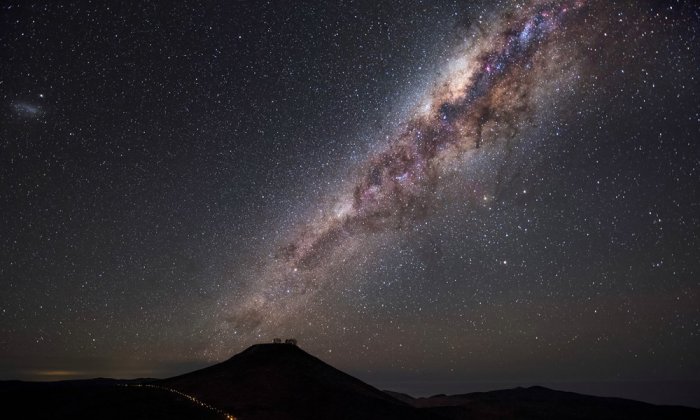
Before our cities lit the night and banished the stars, a gauzy band of faint light and shadows vividly cleaved the night sky. Our name for this band, “Milky Way,” originates in Greek mythology. Heracles, it is told, was born to Zeus following one of his many infidelities. To grant him protection and superhuman powers, Hermes snuck Heracles up to Olympus and placed him at Hera’s breast as she slept. But when Zeus’s wife woke up and realized what had happened, she flung the baby from her breast and some of her milk spilled out across the heavens. Hence the Greek term kuklos galaxías (κύκλος γαλαξίας), or “milky circle.”
The Greeks also saw in the Milky Way a road traveled by either the Sun or the gods. The Romans, who were heavily influenced by Greek culture, also thought of the Galaxy as a road traveled by the gods and called it Via Lactea — “milky way.” Roman writers also adopted the Greek word galaxías, which then made its way through medieval Latin into English.
The ancient Greeks and Romans were not the only peoples to see the Galaxy as a road. Of the different names for the Galaxy in Arabic, for example, the most common one is “The Straw Way” (درب التبانة—Darb al-Tabānah), after the sheafs of straw dropped by farmers on their way back from the fields. Spread by trade, religion, and conquest, this name is now found in many languages throughout Central Asia and northern Africa.
Neighboring countries often share similar names for the Galaxy. In Spain and Portugal, for example, the Milky Way is known as “The Road to Santiago” (Camino de Santiago), as it guided Christian pilgrims on their way to Santiago de Compostela. Meanwhile, in Finland, Estonia, and several Baltic states, birds migrating south for the winter seem to follow the arc of the Galaxy, which is called the “Birds’ Path” (e.g., Linnunrata in Finnish or Paukščių Takas in Lithuanian).
In many cultures, the Milky Way is more than just a road — it is a conduit between this world and the next. This conception of our Galaxy is found among many of the peoples of North America, from the Lakota “Spirit Road” (Wanáǧi Thacháŋku) to the Cheyenne “Hanging Road” (ekutsihimmiyo).
The ancient Egyptians may have held a similar belief. Nut, the sky goddess who swallowed the Sun at dusk and gave birth to it once more at dawn, also served as a ladder for the spirits of the pharaohs to climb up to the sky. Her arched, often star-studded body adorns sarcophagi and tomb walls, and is thought to be a depiction of the Milky Way.
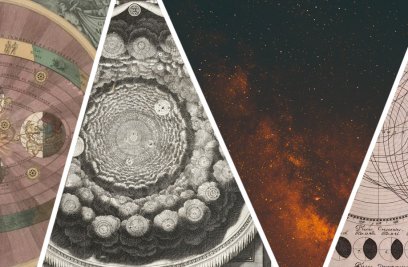
Roads are not the only motifs found among the many names of the Milky Way. Rivers were the lifeblood of many cultures, so it is not surprising to find that those cultures viewed the Galaxy as a celestial river. The great rivers of India, China, and South America, for example, all have celestial counterparts.
In India, the Milky Way is known as the “Heavenly Ganges” (आकाशगंगा—ākāśagaṅgā) and stretches across the belly of a cosmic dolphin. In China, the Silver River (銀河—yínhé) separates the Cowherd (牛郎—Niúláng) from his wife, the Weaver Girl (織女—Zhīnǚ). The star-crossed lovers, symbolized in the night sky by the stars Vega and Altair, can only meet once a year, on the seventh day of the seventh lunar month, when a flock of magpies temporarily forms a bridge across the heavenly river.
The star-crossed lovers can only meet once a year, on the seventh day of the seventh lunar month, when a flock of magpies temporarily forms a bridge across the heavenly river.
Andean peoples of South America, including the Quechua and Aymara, believe that all terrestrial rivers flow into the celestial river, Mayu, which then replenishes them. The Mapuche, who live in Chile and Argentina, also think of it as a river of stories (Repeu apeu).
From rivers we turn to animals, which figure in many myths and creation stories. A Hawai’ian tale recounts how the demigod Ka-ulu flung the Chief of Sharks into the sky, where his shattered body formed the Milky Way. Variations of this story are found throughout the island nations of Oceania. To the Māori, all the way on the other side of the Pacific Ocean, it is Māui who placed the shark, Te Māngōroa, in the sky.
The Andean people of South America see “dark constellations” in the shadowy parts of the Milky Way: a snake, a toad, a tinamou bird, and a llama suckling her baby. On the other side of the world, the most famous dark constellation is the celestial emu, the counterpart of Australia’s large, flightless bird.

These are but a handful of the many names given to the Galaxy by peoples throughout the ages and around the world. The many names and origin stories of the Milky Way are beautiful in and of themselves but also for the deeper truth they reveal about humanity. Separated by oceans, centuries, and cultural barriers, people have time and again reached for the same images. To look up at the sky and see a road for the gods, a great river, or the final resting place of your ancestors is not Chinese or Australian, Arab or Greek, African or Mayan; it is simply, deeply human.
Or Graur is Associate Professor of Astrophysics at the University of Portsmouth’s Institute of Cosmology and Gravitation, as well as Research Associate at the American Museum of Natural History. He is the author of “Supernova” and “Galaxies,” from which this article is excerpted.
The medieval period was a trippy time
As the sun rose on April 14, 1561, over the German city of Nuremberg, the residents saw what they described as some kind of aerial battle take place in its glare — complete with the erratic dance of orbs, crosses, cylinders, and the appearance of a large and mysterious black arrow-shaped object — all followed by a crash-landing somewhere beyond the city limits. Later that month, local artist Hans Glaser produced a broadsheet (pictured above) offering a woodcut engraving of the scene, and a detailed description of what was witnessed. Via Mastodon
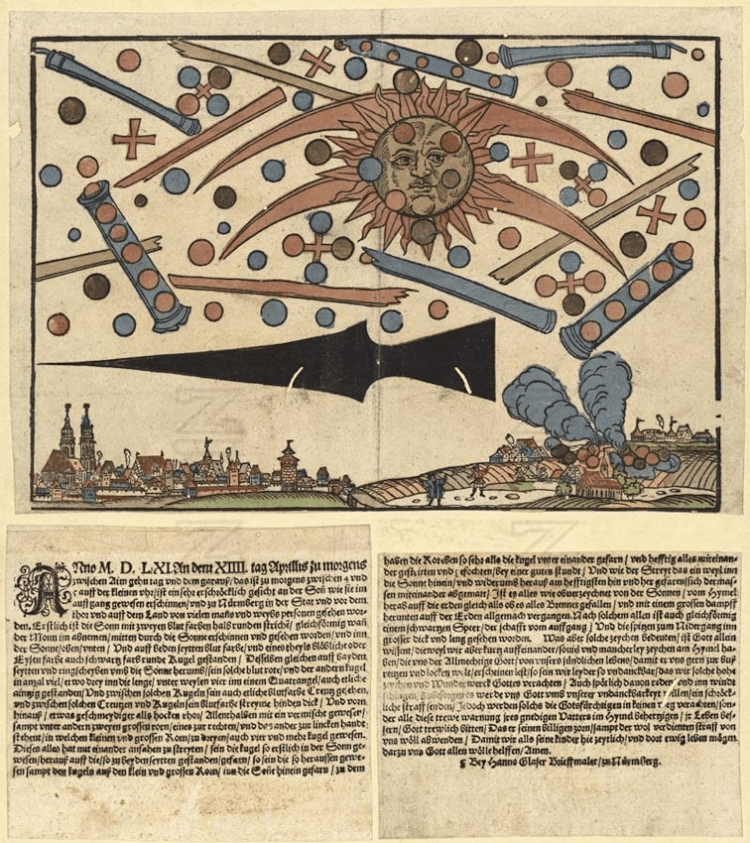
The text reads:
In the morning of April 14, 1561, at daybreak, between 4 and 5 a.m., a dreadful apparition occurred on the sun, and then this was seen in Nuremberg in the city, before the gates and in the country – by many men and women. At first there appeared in the middle of the sun two blood-red semi-circular arcs, just like the moon in its last quarter. And in the sun, above and below and on both sides, the color was blood, there stood a round ball of partly dull, partly black ferrous color. Likewise there stood on both sides and as a torus about the sun such blood-red ones and other balls in large number, about three in a line and four in a square, also some alone. In between these globes there were visible a few blood-red crosses, between which there were blood-red strips, becoming thicker to the rear and in the front malleable like the rods of reed-grass, which were intermingled, among them two big rods, one on the right, the other to the left, and within the small and big rods there were three, also four and more globes. These all started to fight among themselves, so that the globes, which were first in the sun, flew out to the ones standing on both sides, thereafter, the globes standing outside the sun, in the small and large rods, flew into the sun.
A young elephant scampers into view when he hears his name ‘Shavo’
Via Nature is Fucking Lit on Reddit
Infographic: 12 Powerful Psychological Tips to Avoid Bad Decisions
Everyone has made bad decisions before. I can recognise a few of these traps that I’ve fallen into in the past when making decisions that I’ve later regretted. Really amazing advice here! Via Reddit Cool Guides.

Gustave Caillebotte – Man on a Balcony, Boulevard Haussmann (1880)
![Gustave Caillebotte - Man on a Balcony, Boulevard Haussmann (1880) [1748x2293]](https://contentcatnip.com/wp-content/uploads/2024/07/image-1.png)
Reclaim your light
A beautiful passage of encouragement and like a warm cup of tea around the heart by Susana Cabaço. This is a brilliant blog on WordPress to follow!
Divine light shines in you and for you always, even though, out of free will and personal conditioning, you may block it. While complaining of the darkness, make sure you are not the one hiding from the light. Don’t keep yourself away from what’s always there for you. Find it inside and let it shine through you all around.
Mark Rothko’s art explained
This is an incredible channel – Great Art Explained. Every single long-form documentary is exhilarating and exciting and gives you real insight into the deeper meaning of well-known masterpieces. The story of Mark Rothko is bittersweet and sad, however even after viewing this incredible documentary, I am still confused about the appeal of his art and why/how large blocks of colour can be considered meaningful by themselves. Can anyone explain Rothko to me? I’m turning my brain inside-out to understand.
Silent Poems: A different type of typing
This is a fun take on the notion of “just typing”, something we’ve played with in our own Keyboard Yoga project. With Silent Poems, you type, and interconnected glyphs appear. They’re squiggly and abstract and animated. You get to fill one screen, and that’s it. Read more and try it here

Utsuro-Bune: Japan’s 1803 Alien Enigma
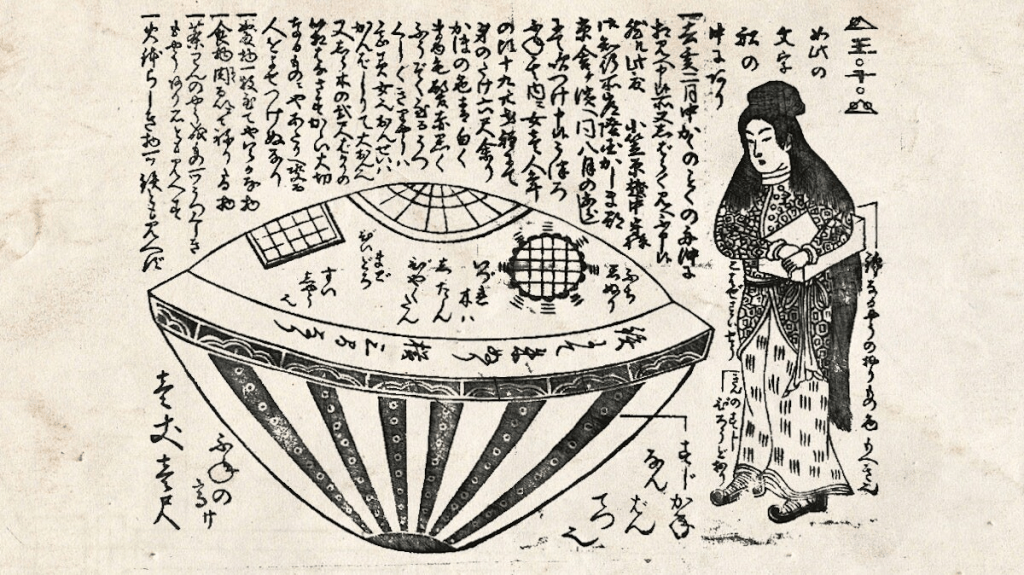
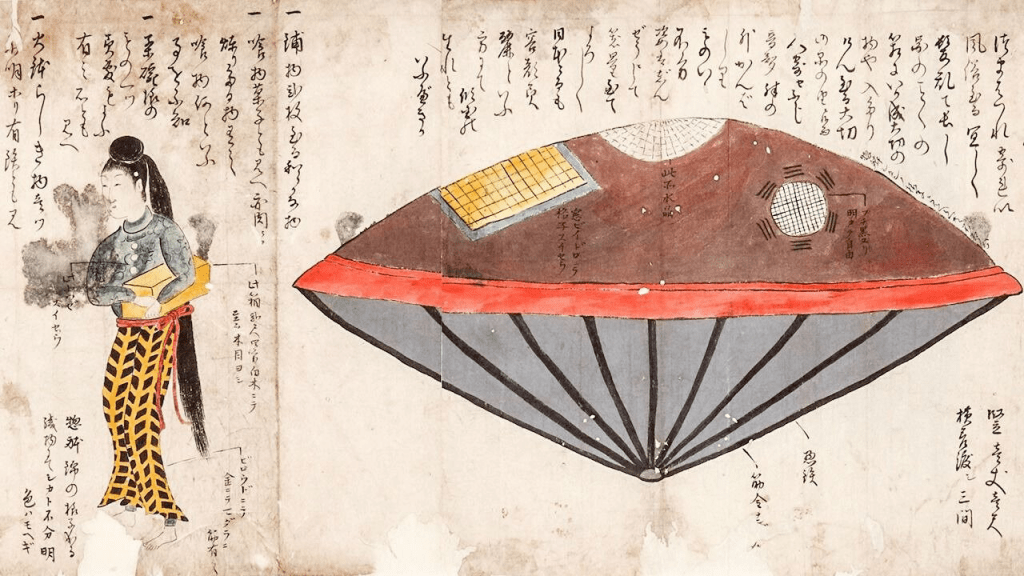
In the early months of 1803, a strange vessel washed ashore on the Japanese coast, resembling a cauldron or pod. Fishermen, thinking it familiar, rowed out to tow it in. But this was no ordinary ship; its bottom was forged from heavy metal, and the top was lacquered rosewood with latticed glass. Villagers, peering through opaque windows, saw something writhing inside. Suddenly, a panel opened, revealing a nearly human figure.
This utsuro-bune, or hollow ship, features in twelve Edo period texts. The most notable is Bakin Takizawa’s Toen shōsetsu (1825). In one tale, a five-meter vessel is found on a Hitachi beach, carrying an adolescent beauty with red and white-streaked hair, possibly fur. Dressed in a unique garment admired by local women, she clutched a wooden box and refused to let go. Her kind seemed to drink water and eat mince and cake, but she spoke no Japanese. Read more on Public Domain Review.


Indian Chickpea and Sweet Potato Stew
Another easy one-pot dream to just set and forget about and then enjoy. Via Rainbow Plant Life.
A hearty, filling meal that’s 100% wholesome, this Indian Chickpea Sweet Potato Stew is the best of healthy comfort food. It’s vegan, gluten-free, and made with whole foods like sweet potatoes, chickpeas, warming Indian spices, and greens, but it feels like a cozy hug in a bowl!
Prep Time:25minutes mins
Cook Time:55minutes mins
Total Time:1hour hr 20minutes mins
Cuisine:Indian-Inspired
DietVegan
Serving size:4
Ingredients
- ▢2 teaspoons black mustard seeds*
- ▢1 1 ⁄2 teaspoons whole cumin seeds
- ▢2 tablespoons coconut oil
- ▢2 medium yellow onions finely diced
- ▢6 garlic cloves minced
- ▢1 1 ⁄2-inch piece fresh ginger grated or minced
- ▢3 bay leaves
Ground spices
- ▢1 tablespoon garam masala
- ▢2 teaspoons ground coriander
- ▢1 teaspoon ground turmeric
- ▢½ teaspoon Indian red chili powder or 1⁄4 teaspoon cayenne pepper**
- ▢A generous amount of freshly cracked black pepper
- ▢2 (15-ounce) cans of chickpeas, drained and rinsed (equivalent to 3 1/2 cups cooked chickpeas)
- ▢2 cups water or vegetable broth
- ▢3 cups peeled and finely diced sweet potatoes****
- ▢1 (14.5-ounce) can crushed tomatoes, or half of 1 (28-ounce) can crushed tomatoes
- ▢1 1/2 teaspoons kosher salt
- ▢4 ounces Swiss chard****, finely sliced into ribbons
- ▢1 1/2 tablespoons fresh lemon juice
- ▢1 cup fresh cilantro, roughly chopped
- ▢1/2 cup fresh mint*****, finely chopped
Garnishes (optional but recommended)
- ▢Thinly sliced red onions
- ▢Coconut yogurt
For serving
- ▢White rice or brown rice
- ▢Indian flatbread or pita bread
Instructions
- Heat a large, deep nonstick frying pan or a Dutch oven over medium heat. Once hot, add the black mustard seeds and cumin seeds. Stir occasionally and toss the seeds around for 1-2 minutes, or until they start to jump in the pan and smell very aromatic but not burning.
- Add the coconut oil and once it’s melted, add the diced onions. Cook, stirring occasionally, until the onions are softened and start to turn golden, 5 to 7 minutes.
- Add the garlic and ginger and cook for 1-2 minutes until very aromatic, stirring frequently to prevent burning and sticking.
- Add the bay leaves and ground spices, and then add the chickpeas and stir them around to coat around in the spices. Allow them to cook for 5-6 minutes, turning only once after a few minutes, to allow them to get a bit browned and crispy.
- Pour in the water, stirring around to scrape up any browned bits on the bottom of the pot. Pour in the crushed tomatoes, diced sweet potatoes, crushed tomatoes, and salt. Stir well and bring to a boil. Reduce the heat to medium-low and simmer, stirring occasionally, for 30 minutes, or until the sweet potatoes are tender and the stew has thickened.
- Add the chard (or kale) and cover the pan. Cook for 5 more minutes until wilted. Remove bay leaves.
- Stir in cilantro and lemon juice. Serve with fresh mint, sliced red onion, and coconut yogurt.
Notes
* If you can’t find black mustard seeds, feel free to substitute brown mustard seeds – they’re a bit less spicy.
** Omit for a mild version.
*** This is equivalent to 3 medium or 2 large sweet potatoes. Make sure to finely dice the sweet potatoes – otherwise, they won’t fully cook through in the stew (or you’ll need to cook the stew longer). To see what size I dice them, be sure to watch the video starting around the 05:00 mark.
**** You can use other greens, such as kale or spinach. Spinach will cook very quickly and won’t need as much time.
***** The fresh mint adds a really nice cooling complement to the spiciness of the stew.

By The Shore’ The Making of a Fish Monster by Tina Yu
I think Tina Yu is one of the most talented sculpters on Youtube. I love the peaceful background music and the attention to detail and exquisite sheens and shimmers she puts on different parts of her sculpture, she shows enormous talent and imagination. I hope you enjoy this and especially the end result!
The Distance by Totally Enormous Extinct Dinosaurs
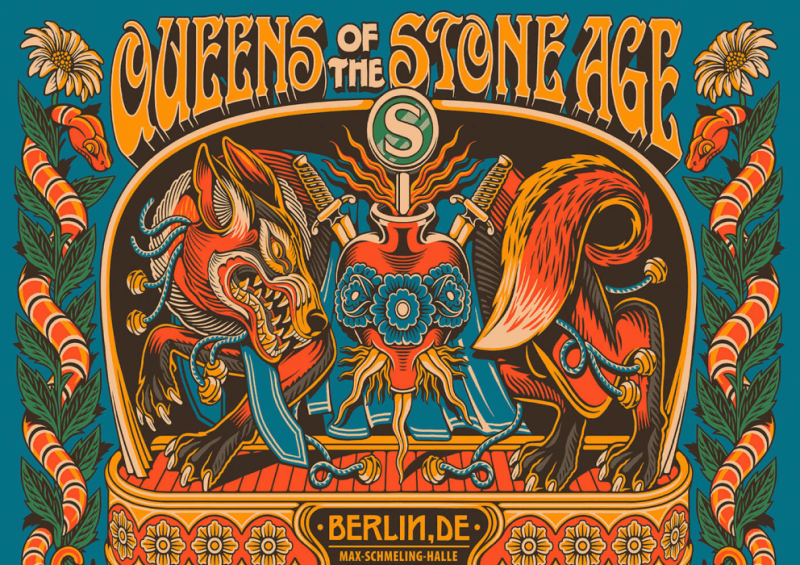
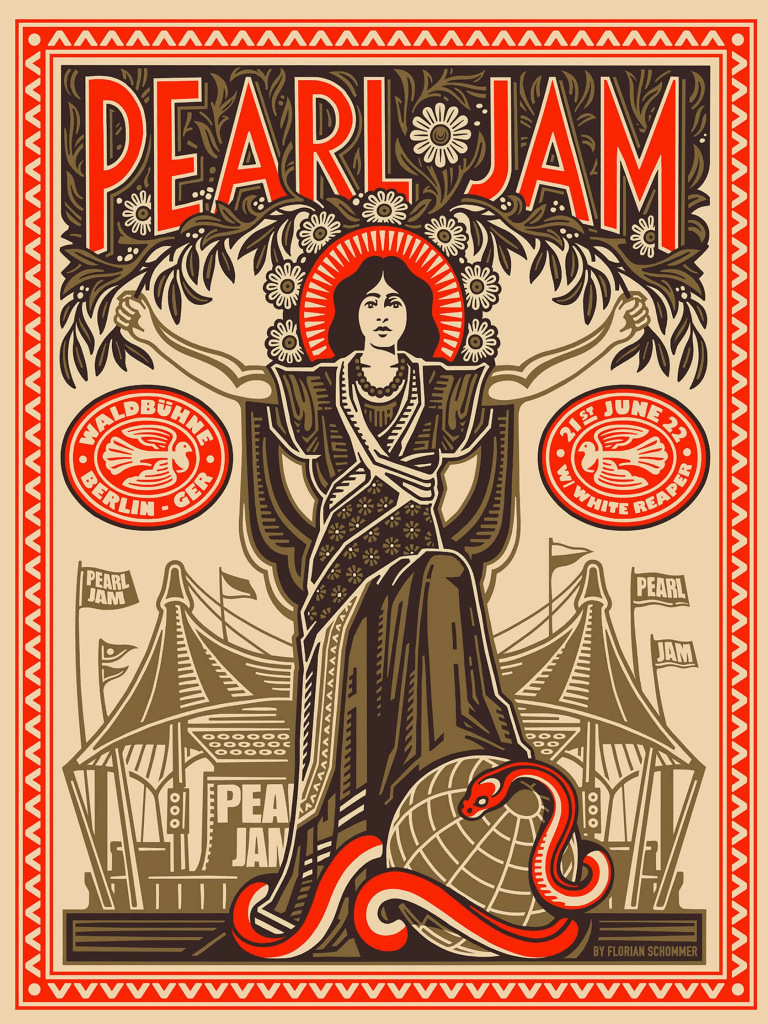
Psychedelic Punk Vibes: Florian Schommer
Florian Schommer, a Berlin-based art director and designer, infuses his work with psychedelic punk and rock vibes. His creative journey began in the punk and skater scenes, designing artwork for his band in the early 2000s. Today, his portfolio reflects this edgy aesthetic, featuring vibrant, bold designs and illustrations. Schommer’s diverse projects span personal works and collaborations with brands, all showcasing his unique, rebellious style. Explore more of Florian’s electrifying art via Inspiration Grid.



Did you enjoy this collection? let me know what you think of it below. Thank you for reading my dear friends!


Thank you, my friend, for mentioning my blog and for your kind words. Honored to be here! The young elephant Shavo just melted my heart. With appreciation and gratitude, sending light and blessings 🙏✨🌻💖🌈
LikeLiked by 1 person
So cute with that elephant! Thanks for sharing ❤️
LikeLike
Rothko rules
LikeLiked by 2 people
Yes! I think your explaining of Rothko helped me to see him and his art in a new light – as pure emotion. I am coming closer to understanding it now, it’s both simple and infinitely complex at the same time 🙂
LikeLiked by 1 person