An emotionally and physically eviscerating exploration of what it means to be a human and what it means to be an animal. And the morbid and savage extent that humans will go to dehumanise the living beings they eat.
Rating: 🌟🌟🌟🌟🌟
Genre: Horror, animal rights, human rights, speculative fiction
Publisher: Scribner
Review in one word: Provocative
* Contains no plot spoilers.
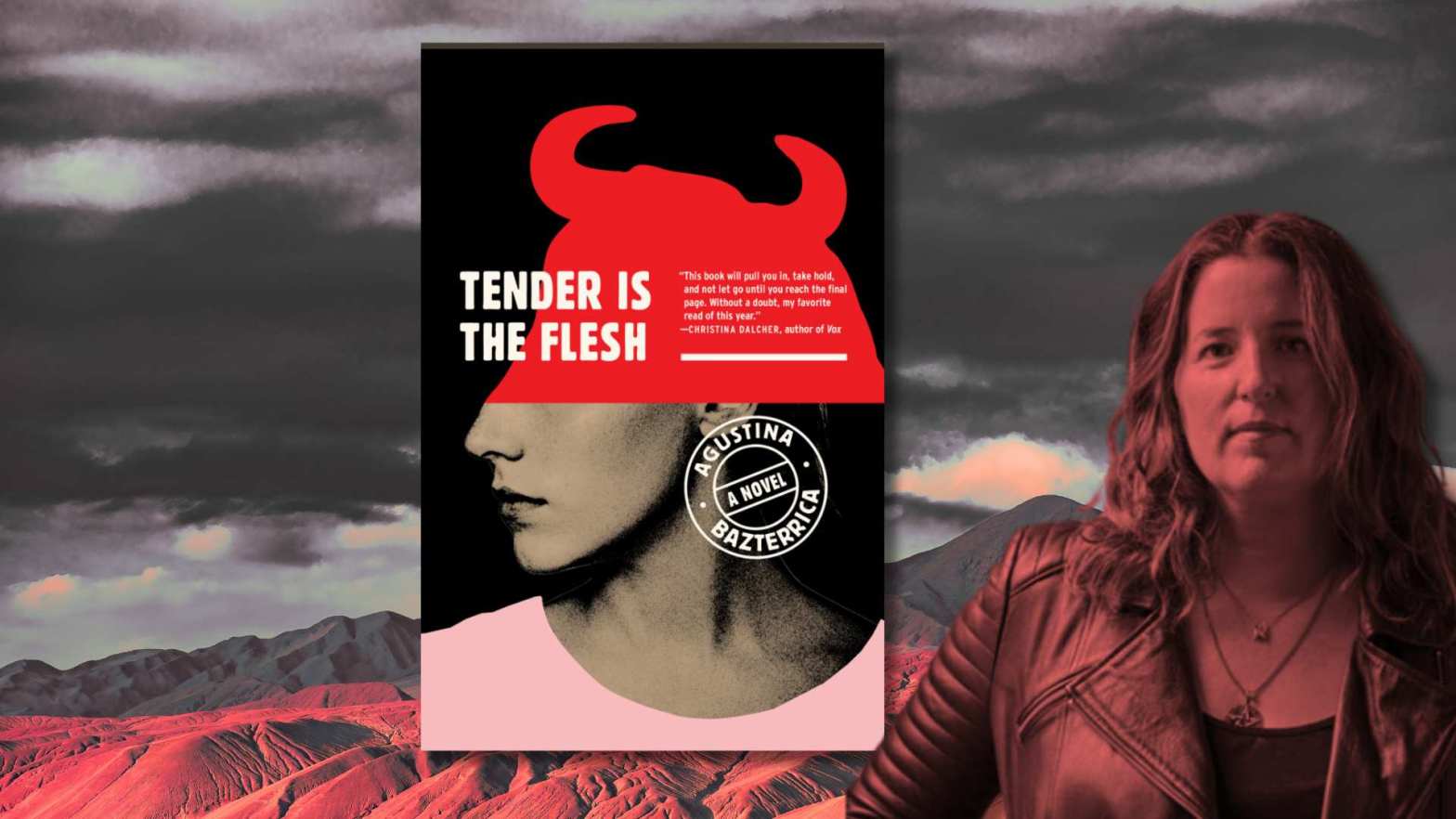
Tender is the Flesh is dark fictional work of enormous savagery, beauty and genius. This is one of the best books I’ve ever read in my life and I’m not even a fan of horror. Normally I shy away from gory, horror-filled and post apocalyptic books because I don’t like any kind of gratuitous violence. This book was hugely different because there’s a powerful philosophical meaning to the violence.
From the moment of reading the first sentences I was utterly captivated. In a world not too different from our own, a virus wipes out all animals on the planet. This means in order for human life to continue, a protein must be found that contains all of the amino acids humans need. The world is overpopulated and so this protein becomes other human beings – cannibalism is rebranded as ‘special meat’.
Instead of just “meat,” now there’s “special tenderloin,” “special cutlets,” “special kidneys.” He doesn’t call it special meat. He uses technical words to refer to what is a human but will never be a person, to what is always a product. To the number of head to be processed, to the lot waiting in the unloading yard, to the slaughter line that must run in a constant and orderly manner, to the excrement that needs to be sold for manure, to the offal sector.
No one can call them humans because that would mean giving them an identity. They call them product, or meat, or food. Except for him; he would prefer not to have to call them by any name.”
Tender is the Flesh
Protagonist Marcos works at the local slaughterhouse AKA processing plant, where they slaughter humans, although these creatures are intentionally dehumanised – not given a name, have their vocal chords cut out at birth so that they can’t scream, are branded and corralled into small pens where they are artificially inseminated, sold into labs for unspeakably cruel experiments and treated like – well…like how people treat animals every day!
This was where the book became infinitely interesting for me and powerful. By supplanting animals we use for meat – cows, pigs, sheep and chickens for human beings, for the first time people who are desensitised to what happens to animals are shockingly able to see, the immense cruelty, slavery and pain that animals have to endure before they are killed, simply because we want to eat, wear or use them.
“There’s a sharp, penetrating smell to the resting cage sector. He thinks it’s the smell of fear. They climb a set of stairs to a suspended balcony from where it’s possible to observe the shipment. He asks them not to talk loudly because the head need to be kept calm. Sudden sounds disturb them, and when they’re edgy they’re more difficult to handle. The cages are below them. The head are still agitated after the journey, despite the fact that unloading took place in the early hours of the morning. They move about in a frightened way.
He explains that when the head arrive, they’re given a spray wash and then examined. They need to fast, he adds, and are given a liquid diet to reduce intestinal content and lower the risk of contamination when they’re handled after slaughter. He tries to count the number of times he’s repeated this sentence in his life.”
Tender is the Flesh
In this scene in a butcher specialising in ‘special meat’ there’s a softening of the language and a rebranding that goes on, exactly like how a deli or butcher would refer to animal meat:
“First it was the packaged hands that Spanel placed off to the side where they were hidden among the milanesas à la provençale, the cuts of tri-tip, and the kidneys. The label read “Special Meat,” but on another part of the package, Spanel clarified that it was “Upper Extremity,” strategically avoiding the word hand. Then she added packaged feet, which were displayed on a bed of lettuce with the label “Lower Extremity,” and later on, a platter with tongues, penises, noses, testicles, and a sign that said “Spanel’s Delicacies.”
Tender is the Flesh
This is a masterwork of subversive fiction and as a person who has wrestled with eating meat for all of my life and being plant-based, this is how I chose to see the book’s meaning.
It’s about the immense brutality of people against other people, and people against other animals. It’s about power and status and how those with lower status (humans or animals) are subjected to untold and unimaginable cruelty for sport, food, experimentation, fashion and everything else.
“Urlet is sitting against the tall back of an armchair made of dark wood. Behind him hang half a dozen human heads. His hunting trophies. He always clarifies, to whomever will listen, that over the years these were the toughest head to hunt, those that posed “monstrous and invigorating challenges.” Next to the heads hang framed photographs. They’re antique photographs of black people being hunted in Africa before the Transition. The largest and sharpest image shows a white hunter down on his knees holding a rifle, and behind him, on stakes, the heads of four black men. The hunter is smiling.”
Tender is the Flesh
The language used in the ‘processing centre’ is deliberately softened and dehumanised in much the same way as a person working in a slaughterhouse learns to use different words to describe what they are really doing, brutally murdering conscious living beings over and over again.
This book is a warning and an allegory about how we treat animals but also how, if given the chance, we will treat other human beings. I don’t believe it’s a coincidence that in this book the processing plant’s directors were either German or Japanese – this alludes to the brutal ‘processing’ of people in camps that occurred during WWII. There is a lot of dark collective emotional baggage that is aired in this book! It is explosive and yet so very necessary!
Originally written in Spanish by Argentinian writer Agustina Bazterrica, one of the only things I know about Argentina aside from Tango is that they love and export A LOT of meat. This book really gets to the heart of their meaty culture.
How living, thinking and feeling human beings and living, thinking and feeling animals are reduced to “resources” that can be used to one’s advantage for profit or comfort.
Marcos the book’s narrator has a life that’s crumbling to pieces with his dad disappearing due to dementia and a wife who has recently left him due to them both losing a child.
Everything seems to be going to pieces for Marcos until he gets a live female specimen of Pure Grade Meat who he ties up in his garage. Little by little he begins to treat her like a human being and it seems that through this connection he might yet salvage some of his compassion and humanity.
If this book sounds like it’s too much for you, I actually felt the same way and for a long time held onto it, looking at it like some kind of dark talisman.
By eventually reading it, I was rewarded with some of the most mind-blowing fiction I’ve ever read. I heartily recommend this one. Yes it’s not for the fainthearted but it will forever change how you view humans and animals and the casual, socially acceptable ways that we deny consciousness and basic rights to other living beings – human and animal…and after all aren’t we all really just animals?