
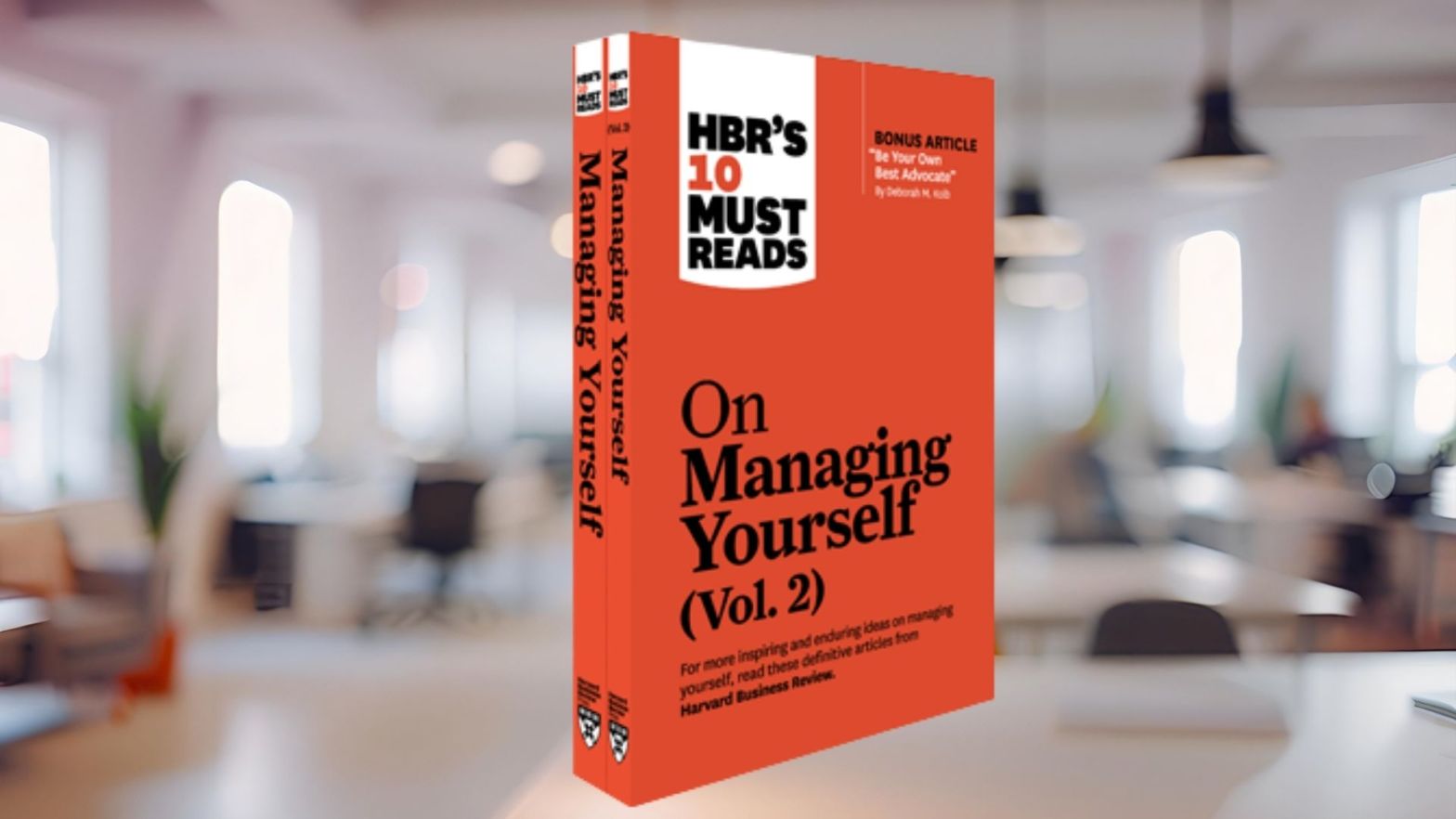
Distilling insights from decades worth of essays for Harvard Business Review. This collection shows you how to bounce back from setbacks, how to be resilient. Aside from some cringey moments it’s worth a read.
Rating: 🌟🌟
Genre: Non-Fiction, Business, Self-Help, Psychology, Career Growth
Publisher: Harvard Business Review
Review in one word: Helpful.
This curated collection from the Harvard Business Review distils decades of thought leadership insight into one toolkit for personal and career growth. There is a bit of corporate mumbo-jumbo in here. However alongside of it, there are some genuinely helpful and insightful gems that could help you to do well in your current or next job.
In the format of a series of short essays, themes include how to bounce back from setbacks and failures, how to manage your energy (not just your time), how to develop emotional resilience, and lead from your values.
If this sounds like the typical shallow fodder of LinkedIn posts, it’s not. These essays are from leaders who learned the hard way and are presenting in (mostly) no-nonsense, and deeply practical language.
Nevertheless, whenever there’s a business essay it can quickly escalate into cringe when the author delves too much into comparing organisations to people. As though the two are interchangeable. In other words an essay on resilience or creativity in people is compared directly to an example of a resilient organisation or a creative organisation. The idea that corporations and people are the same is preposterous.
One is a flesh and blood human with emotions, drives, memories and thoughts aside from profit making. A person who will die some day. And the other is a for-profit organisation that is more concerned with profit than people and is willing to expel, obliterate and forget any human people as and whenever its required. It is driven by relentless growth and the goal of immortality. As a corporate entity it is willing to do just about anything (legal, illegal, ethical or unethical) to achieve the ideal of long-term viability.
Perhaps that sounds cynical and perhaps it is. I am deeply cringed though by the comparison of corporations with people, as occurred frequently in this book.
Nevertheless, despite the corporate-cringe, there are sparkling gems of insights in this book. If you are ambitious and upwardly mobile (or merely looking to stay employed during this tumultuous time in history) then you will gain something from reading this.
Some of the more interesting insights I have highlighted are below.
Do Not Try and Change Yourself. Work on Improving Your Strengths
“The conclusion bears repeating: Do not try to change yourself—you are unlikely to succeed. But work hard to improve the way you perform. And try not to take on work you cannot perform or will only perform poorly.”
There’s No Point Being the Richest Person in the Cemetery
“A person’s strengths and the way that person performs rarely conflict; the two are complementary. But there is sometimes a conflict between a person’s values and his or her strengths. What one does well—even very well and successfully—may not fit with one’s value system. In that case, the work may not appear to be worth devoting one’s life to (or even a substantial portion thereof).
If I may, allow me to interject a personal note. Many years ago, I too had to decide between my values and what I was doing successfully. I was doing very well as a young investment banker in London in the mid-1930s, and the work clearly fit my strengths. Yet I did not see myself making a contribution as an asset manager. People, I realized, were what I valued, and I saw no point in being the richest man in the cemetery. I had no money and no other job prospects. Despite the continuing Depression, I quit—and it was the right thing to do. Values, in other words, are and should be the ultimate test.”
Other People are Just as Individual As You Are
“The first is to accept the fact that other people are as much individuals as you yourself are. They perversely insist on behaving like human beings. This means that they too have their strengths; they too have their ways of getting things done; they too have their values. To be effective, therefore, you have to know the strengths, the performance modes, and the values of your coworkers. That sounds obvious, but few people pay attention to it. The same holds true for all your coworkers. Each works his or her way, not your way. And each is entitled to work in his or her way. What matters is whether they perform and what their values are. As for how they perform—each is likely to do it differently. The first secret of effectiveness is to understand the people you work with and depend on so that you can make use of their strengths, their ways of working, and their values. Working relationships are as much based on the people as they are on the work.”
Resilience: It Has Nothing Do with Having Rose-Coloured Glasses
“Today, theories abound about what makes resilience. Looking at Holocaust victims, Maurice Vanderpol, a former president of the Boston Psychoanalytic Society and Institute, found that many of the healthy survivors of concentration camps had what he calls a “plastic shield.” The shield was comprised of several factors, including a sense of humor. Often the humor was black, but nonetheless it provided a critical sense of perspective. Other core characteristics that helped included the ability to form attachments to others and the possession of an inner psychological space that protected the survivors from the intrusions of abusive others. Research about other groups uncovered different qualities associated with resilience. ”
“Resilient people, they posit, possess three characteristics: a staunch acceptance of reality; a deep belief, often buttressed by strongly held values, that life is meaningful; and an uncanny ability to improvise. You can bounce back from hardship with just one or two of these qualities, but you will only be truly resilient with all three.”